
Opinion
Sri Lankan Tamil refugees in India remain suspended in limbo – A time to return


The recent arrests of returning refugees under the United Nations High Commissioner for Refugees (UNHCR) voluntary repatriation by state agencies in Sri Lanka on the ground that they fled the island in boats without a valid travel document has drawn the attention of the public to the plight and future of Sri Lankan (Tamil) Refugees the world over but especially those living in camps in the neighbouring state of Tamil Nadu in India. UNHCR has also stopped their assistance to voluntary return as a response to this action by state authorities. Minister Bimal Ratnayake in response to questions in parliament from Tamil MPs has stated that these arrests are not government policy and has welcomed the Tamil refugees returning to their homeland.
Though this statement is welcomed by the refugees and returnees alike, words must be followed up by deeds and should be followed up by concrete action to facilitate return and reintegration. It must be recognised that this population with its skills and knowledge gained from being educated and working productively in Tamil Nadu the state with India’s highest GDP, can contribute to Sri Lanka economic development when provided basic durable solutions to facilitate their return.
Displacement
The July / August 1983 riots / pogrom targeting the Tamil speaking citizens of the Country marked the beginning of the refugee outflow from Sri Lanka to neighbouring India and also to the rest of the word including the West. Most affluent and English educated Tamils moved to Australia, Canada, the USA and European countries including the UK, while the less affluent including government servants, farmers, fishers and trades people fled across the narrow Palk Straits in boats to India. 1983 also marked the escalation of a non-violent struggle for the rights of the Tamil speaking people into the civil war between the Tamil militants and the Lankan armed forces. As the war progressed further waves of refugees fled to India.
In periods of relative peace some refugees returned to Sri Lanka, while some migrated to the west and Australia. At its height there were around 330 refugee camps in Tamil Nadu housing around 1.3, lakh refugees in the camps and another estimated 1 lakh living outside the camps. Today there are still over 100 camps and approximately 55,000 refugees living in the camps, and another estimated 30,000 living outside the camps. In 2009 the war ended with the defeat of the main militant organization the LTTE. It is now 16 years since the war ended and most of these Refugees are still living in camps and their status is undetermined. The recent arrests of refugee returnees in Sri Lanka has heightened the concerns of the Refugees as to their future in their homeland.
A Refugee
A refugee is defined in the 1951 Refugee Convention and its 1967 Protocol as “a person who owing to a well-founded fear of being persecuted for reasons of race, religion, nationality, membership of a particular social group or political opinion is outside the country of his nationality and is unable or owing to such fear is unwilling to avail himself of the protection of that country, or who not having a nationality and being outside the country of his habitual residence as a result of such events is unable or owing to such fear unwilling to return to it.” The Convention envisages a case by case determination of the refugee status. India, Sri Lanka and other South Asian countries are not parties to the Refugee Convention. Hence the large refugee inflows have been allowed to remain in the country on humanitarian grounds and not on the basis of a judicial determination of whether the persons so fleeing come within the definition set out in the Convention. Hence while we refer to these persons as refugees they are not refugees “de facto” and not “de jure” as they fulfill the requirements set out in the Conventions definition.
In the case of de jure refugees they have certain rights in the host country, which are set out in the Convention. They have the right to work the right to education and importantly the right to apply for citizenship of the host country after a certain number of years stay in that country. The principle of non-refoulement, is also incorporated in the Convention. As it is a principle of customary international law it applies even to those countries which are not party to the Convention. It protects refugees from forcible deportation to a country where their life is in danger. We must recognize that many states including Sri Lanka and India have in practice acted with the humanitarian imperative and provided refuge to persons fleeing for their safety.
Legal Status
There is a misconception that just as Sri Lankan Tamils who sought refuge in western countries which are parties to the Refugee Convention have had their cases judicially determined and are in most cases now citizens of or have a permanent status in those countries, those in India have citizenship or legal status. In reality, most refugees in India still live in camps and have no legal status. Legally speaking, they continue to be under the Foreigners Act, foreigners who have entered the country illegally without documents i.e. Visa and passport. This position has been somewhat mitigated by the recent, Immigration and Foreigners (Exemption) order notified by the Union Ministry of Home Affairs. It exempts a set of people from the requirement of a valid passport or other valid travel document and valid Visa to enter, stay and exit the Country. It covers nationals of Nepal, Bhutan, Tibetan refugees, six religious minorities from Afghanistan, Pakistan and Bangladesh and Sri Lankan Tamil refugees who have entered India before January 9th 2015 and have registered themselves. The order protects the Sri Lankan refugees from forcible repatriation to Sri Lanka.
However, while this order protects this category from forcible repatriation it must be pointed out that they are still classified as illegal migrants. Furthermore, most Sri Lankan refugees are not eligible to apply for Citizenship. They are not eligible for Long Term Visas LTV and hence cannot apply under the Citizenship Act for Indian citizenship by registration or by naturalization by long residence. Sri Lanka is also not included in the countries i.e. Muslim majority countries namely Pakistan, Afghanistan and Bangladesh from which minority religious groups namely Hindus, Sikhs, Jains, Buddhists, Christians and Parsees, can apply for Citizenship under the Citizenship Amendment Act of 2019.
Care by the people and government
In contrast whatever the legal position might be, the people of Tamil Nadu and the Governments of Tamil Nadu and India were sympathetic and welcoming. There were also social benefits provided to the refugees in the camps. The Government provides each family shelter, a dole for their living, food rations were provided. Each family receives 20kgs of rice free and is provided with a ration card to buy their rations such as Sugar, Dhal and Oil from the public distributions system at cheaper prices and have access to free, state healthcare.
Furthermore, refugee children are eligible to study up to class 12 free and receive the benefits which the Indian children receive including free text books uniforms, noon meals, bus passes and even laptops and bicycles. Higher education is also available for those who meet the university requirements and earlier state governments even gave special quotas for refugee students in medical colleges now withdrawn. More recently Tamil Nadu Chief Minister Stalin has been building and renovating the housing in the camps.
Education
As a result of the liberal education policy of the state government, the refugee community has produced around 4,000 graduates including a few medical and several engineering and other professional graduates. This is a remarkable feat for a refugee community in any part of the world and much of the credit goes to the OfERR, an Organization run for and by refugees themselves in India since 1984. This organization through its advocacy with the state and central governments was able to get these advantages for refugee students while also running other programs such as preschools, tuition classes and student councils in the camps along with other charitable institutions thus fostering educational values within the refugee community.
While a few of these graduates have gone on to foreign countries many have returned to Sri Lanka with these qualifications and are involved in gainful employment some even in high positions. While they are not allowed to work in the public sector in India as they are not citizens many have got jobs in the private sector and others are self-employed benefitting and contributing to the Tamil Nadu economy and even contributing income tax. The Sri Lankan Tamils have always valued education and this is one of the reasons they would rather remain in India than return as opportunities for higher education are far less in Sri Lanka.
Caught in Limbo
Sri Lankan Tamils are thus caught in a bind although some of them have been in India for almost half a century from 1983, and have children and grandchildren born in the camps they are still legally speaking illegal migrants who have been allowed to stay in India on humanitarian grounds and who will not be punished for same because of an order made by the Home Ministry. This however could be changed in the future. This is why they can be said to be in Limbo, i.e. a place in Christian theology where Souls who are not eligible for Heaven or Hell are kept waiting indefinitely.
Demand for Indian Citizenship
Due to their long stay in India where many have made their lives and livelihoods and know no other, a growing number of refugees have begun to demand citizenship in India. Both the ruling DMK government and opposition AIADMK party have periodically supported this and demanded citizenship or permanent status for Refugees from the Indian central government. While a few individuals whose parents were entitled to Indian citizenship for different reasons including; they being people of more recent Indian origin or those who were slated for repatriation to India under the Sirmavo Shasthri pact have been successful, this has not materialized for all. An amendment to the law made in the time of former Minister of Finance P. Chidambaram in 1987 during the Congress era of central governance made the conditions for granting citizenship more stringent. Moreover, the grant of citizenship remains a matter of discretion of the central government and the present amendments do not indicate any changes in the position of the Sri Lankan refugees.
Voluntary Return
The Sri Lankan Tamils refugees also have an alternative path which is that of Voluntary Repatriation or Return to their home country Sri Lanka. The 1951 Convention does not explicitly provide a right of Return for refugees but it does recognize the principle of voluntary repatriation as a preferred durable solution.
The Convention encourages return to their country of origin under voluntary safe and dignified conditions. The Right to Return is however a Human Right recognized in the Universal Declaration of Human Rights. During the long drawn out civil war in the country there have been intermittent periods of relative peace during which there has been an increase in voluntary repatriation. For example between 1987—1989 some 25,000 refugees were repatriated and in 1992 – 1995 an estimated 54,000 were repatriated to Sri Lanka. Then in 1995 – 2002 around 23,000 voluntarily returned. With the end of the war also people started going back, but some have also since returned.
Obstacle course
Though the refugees may have fled in fear arriving in Tamil Nadu with little, they are now established economically and to an extent socially with lives and livelihoods be it, within the confines of a ‘Sri Lankan Tamil Settlement’ as chief minister Stalin has renamed the camps with new housing. Though consecutive governments in Sri Lanka have made statements welcoming return, the process remains an obstacle course for most with ever changing requirements, regulations and systems before and after return which those who have suffered the process confide as having driven them to despair and raising the question of the state’s (not just successive governments) commitment to the return of Tamil Refugees.
Then there are the economic challenges such as finding suitable jobs for educated and skilled young people especially in the aftermath of Covid and the economic collapse under the Gotabaya regime.
A number of young graduates who had enthusiastically returned during the Yahapalanaya regime and had secured graduate appointments lost them as the Gotabaya regime failed to distinguish refugees graduates cancelling their
appointments from state employment categorizing them among foreign graduates. Currently, there is no government program to provide support by way of housing or livelihoods for returning refugees most of all they are made to feel unwelcome of which an example is the state’s unwillingness to exempt refugees born in India who have past the age 21 to obtain their citizenship certificate from paying a fine of LKR 25,000/- a case of adding insult to injury. The certificate is essential for citizens born outside Sri Lanka to process documentation.
Durable Solutions
In this regard the OfERR organization along with others campaigning for the wellbeing of refugees and returnees in both countries reiterate that the government of India and Sri Lanka must ensure durable solutions to facilitate return. In order to strengthen the trust and confidence of the returnees, guidelines and circulars should be issued to the relevant authorities to ensure dignity of the returning refugees, and provide them due protection of the law instead of arresting them, also facilitate a speedy process for refugees to obtain birth and citizenship certificates among other documents practically required for obtaining travel documents and passports. Set up a process for receiving applications for obtaining National Identity Cards before return, design a suitable program to make use the educational and professional skills acquired by the refugees to enhance their own livelihood and contribute meaningfully to the development of the country; establish a mechanism for speedily obtaining equivalence for educational certificates and professional skills and make arrangements to ferry back their possessions, especially items useful to restart livelihoods the fruit of their labour in India. Formulate guidelines for return of lands, allotment of shelter and livelihood assistance and provide exemption so that returning refugee graduates are not barred access to state employment as foreign graduates. This would be particularly attractive to qualified, job seeking refugee youth. Finally include returning refugees in the welfare programs such as Asvasuma and provide dry food rations for a period in the aftermath of their return.
The right of return, reconciliation and reintegration
President AKD and his government won the hearts and votes of the Tamil speaking peoples of the northern, eastern and other parts of Sri Lanka by advocating a policy of equality and fair play for all ethnic groups and communities in Sri Lanka. The right of return is a basic human right recognized in the Universal Declaration of Human Rights. The fledgling state of Israel gave a right of return to all Jewish people scattered in the far corners of the earth but sadly continues to alienate and violate the rights of the Palestinian people, the consequences of this can be seen in the conflict which continues even today. It is both an example and a lesson for Sri Lanka to welcome back all those who fled or were forced to flee due to a bitter civil war in a spirit of brotherhood and reconciliation. The time is ripe for him to translate words into deeds welcoming home the long exiled Sri Lankans and ensuring they finally find a place once again in the land they still call home.
* LL.B. Cey; LL.M Cantab; Ph.D Col; Attorney–at-Law.
by Dr Nirmala
Chandrahasan


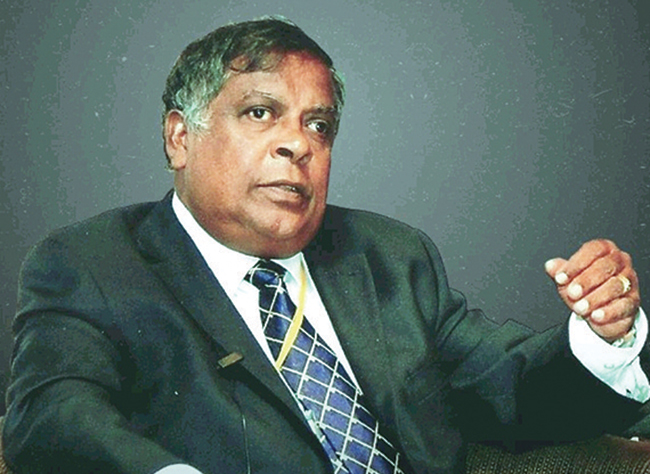
Mr. Tuli Cooray, former Deputy Director General of the Board of Investment of Sri Lanka (BOI) and former Secretary General of the Joint Apparel Association Forum (JAAF), passed away three months ago, leaving a distinguished legacy of public service and dedication to national economic development.
An alumnus of the University of Colombo, Mr. Cooray graduated with a Special Degree in Economics. He began his career as a Planning Officer at the Ministry of Plan Implementation and later served as an Assistant Director in the Ministry of Finance (Planning Division).
He subsequently joined the Greater Colombo Economic Commission (GCEC), where he rose from Manager to Senior Manager and later Director. During this period, he also served at the Treasury as an Assistant Director. With the transformation of the GCEC into the BOI, he was appointed Executive Director of the Investment Department and later elevated to the position of Deputy Director General.
In recognition of his vast experience and expertise, he was appointed Director General of the Budget Implementation and Policy Coordination Division at the Ministry of Finance and Planning. Following his retirement from government service, he continued to contribute to the national economy through his work with JAAF.
Mr. Cooray was widely respected as a seasoned professional with exceptional expertise in attracting foreign direct investment (FDI) and facilitating investor relations. His commitment, leadership, and humane qualities earned him the admiration and affection of colleagues across institutions.
He was also one of the pioneers of the BOI Past Officers’ Association, and his passing is deeply felt by its members. His demise has created a void that is difficult to fill, particularly within the BOI, where his contributions remain invaluable.
Mr. Cooray will be remembered not only for his professional excellence but also for his integrity, humility, and the lasting impact he made on those who had the privilege of working with him.
The BOI Past Officers’ Association
jagathcds@gmail.com
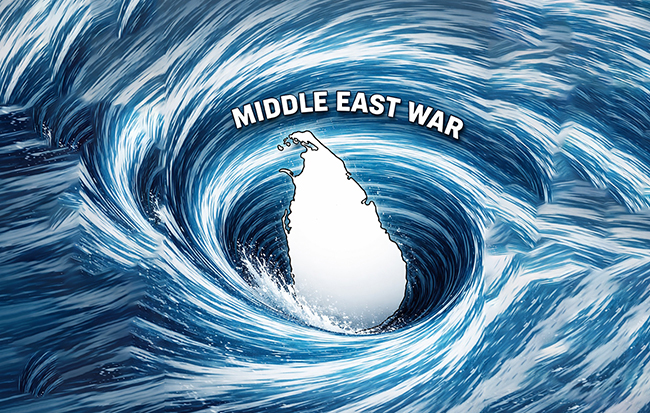
“As a small and open country, Singapore will always be vulnerable to what happens around us. As Lee Kuan Yew used to say: “when elephants fight, the grass suffers, but when elephants make love, the grass also suffers“. Therefore, we must be aware of what is happening around us, and prepare ourselves for changes and surprises.” – Prime Minister Lee Hsien Loong, during the debate on the President’s Address in Singapore Parliament on 16 May, 2018, commenting on the uncertain external environment during the first Trump Administration.
“When elephants fight, it is the grass that suffers”
is a well-known African proverb commonly used in geopolitics to describe smaller nations caught in the crossfire of conflicts between major powers. At the 1981 Commonwealth conference, when Tanzanian President Julius Nyerere quoted this Swahili proverb, the Prime Minister Lee Kuan Yew famously retorted, “When elephants make love, the grass suffers, too”. In other words, not only when big powers (such as the US, Russia, EU, China or India) clash, the surrounding “grass” (smaller nations) get “trampled” or suffer collateral damage but even when big powers collaborate or enter into friendly agreements, small nations can still be disadvantaged through unintended consequences of those deals. Since then, Singaporean leaders have often quoted this proverb to highlight the broader reality for smaller states, during great power rivalry and from their alliances. They did this to underline the need to prepare Singapore for challenges stemming from the uncertain external environment and to maintain high resilience against global crises.
Like Singapore, as a small and open country, Sri Lanka too is always vulnerable to what happens around us. Hence, we must be alert to what is happening around us, and be ready not only to face challenges but to explore opportunities.
When Elephants Fight
To begin with, President Trump’s “Operation Epic Fury”.
Did we prepare adequately for changes and surprises that could arise from the deteriorating situation in the Gulf region? For example, the impact the conflict has on the safety and welfare of Sri Lankans living in West Asia or on our petroleum and LNG imports. The situation in the Gulf remains fluid with potential for further escalation, with the possibility of a long-term conflict.
The region, which is the GCC, Iraq, Iran, Israel, Jordan, Syria and Azerbaijan (I believe exports to Azerbaijan are through Iran), accounts for slightly over $1 billion of our exports. The region is one of the most important markets for tea (US$546 million out of US$1,408 million in 2024. According to some estimates, this could even be higher). As we export mostly low-grown teas to these countries, the impact of the conflict on low-grown tea producers, who are mainly smallholders, would be extremely strong. Then there are other sectors like fruits and vegetables where the impact would be immediate, unless of course exporters manage to divert these perishable products to other markets. If the conflict continues for a few more weeks or months, managing these challenges will be a difficult task for the nation, not simply for the government. It is also necessary to remember the Russia – Ukraine war, now on to its fifth year, and its impact on Sri Lanka’s economy.
Mother of all bad timing
What is more unfortunate is that the Gulf conflict is occurring on top of an already intensifying global trade war. One observer called it the “mother of all bad timing”. The combination is deadly.
Early last year, when President Trump announced his intention to weaponise tariffs and use them as bargaining tools for his geopolitical goals, most observers anticipated that he would mainly use tariffs to limit imports from the countries with which the United States had large trade deficits: China, Mexico, Vietnam, the European Union, Japan and Canada. The main elephants, who export to the United States. But when reciprocal tariffs were declared on 2nd April, some of the highest reciprocal tariffs were on Saint Pierre and Miquelon (50%), a French territory off Canada with a population of 6000 people, and Lesotho (50%), one of the poorest countries in Southern Africa. Sri Lanka was hit with a 44% reciprocal tariff. In dollar terms, Sri Lanka’s goods trade deficit with the United States was very small (US$ 2.9 billion in 2025) when compared to those of China (US$ 295 billion in 2024) or Vietnam (US$ 123 billion in 2024).
Though the adverse impact of US additional ad valorem duty has substantially reduced due to the recent US Supreme Court decision on reciprocal tariffs, the turbulence in the US market would continue for the foreseeable future. The United States of America is the largest market for Sri Lanka and accounts for nearly 25% of our exports. Yet, Sri Lanka’s exports to the United States had remained almost stagnant (around the US $ 3 billion range) during the last ten years, due to the dilution of the competitive advantage of some of our main export products in that market. The continued instability in our largest market, where Sri Lanka is not very competitive, doesn’t bode well for Sri Lanka’s economy.
When Elephants Make Love
In rapidly shifting geopolitical environments, countries use proactive anticipatory diplomacy to minimise the adverse implications from possible disruptions and conflicts. Recently concluded Free Trade Agreement (FTA) negotiations between India and the EU (January 2026) and India and the UK (May 2025) are very good examples for such proactive diplomacy. These negotiations were formally launched in June 2007 and were on the back burner for many years. These were expedited as strategic responses to growing U.S. protectionism. Implementation of these agreements would commence during this year.
When negotiations for a free trade agreement between India and the European Union (which included the United Kingdom) were formally launched, anticipating far-reaching consequences of such an agreement on other developing countries, the Commonwealth Secretariat requested the University of Sussex to undertake a study on a possible implication of such an agreement on other low-income developing countries. The authors of that study had considered the impact of an EU–India Free Trade Agreement on the trade of excluded countries and had underlined, “The SAARC countries are, by a long way, the most vulnerable to negative impacts from the FTA. Their exports are more similar to India’s…. Bangladesh is most exposed in the EU market, followed by Pakistan and Sri Lanka.”
So, now these agreements are finalised; what will be the implications of these FTAs between India and the UK and the EU on Sri Lanka? According to available information, the FTA will be a game-changer for the Indian apparel exporters, as it would provide a nearly ten per cent tariff advantage to them. That would level the playing field for India, vis-à-vis their regional competitors. As a result, apparel exports from India to the UK and the EU are projected to increase significantly by 2030. As the sizes of the EU’s and the UK’s apparel markets are not going to expand proportionately, these growths need to come from the market shares of other main exporters like Sri Lanka.
So, “also, when elephants make love, the grass suffers.”
Impact on Sri Lanka
As a small, export dependent country with limited product and market diversification, Sri Lanka will always be vulnerable to what happens in our main markets. Therefore, we must be aware of what is happening in those markets, and prepare ourselves to face the challenges proactively. Today, amid intense geopolitical conflicts, tensions and tariff shifts, countries adopt high agility and strategic planning. If we look at what our neighbours have been doing in London, Brussels and Tokyo, we can learn some lessons on how to navigate through these turbulences.
(The writer is a retired public servant and can be reached at senadhiragomi@gmail.com)
by Gomi Senadhira
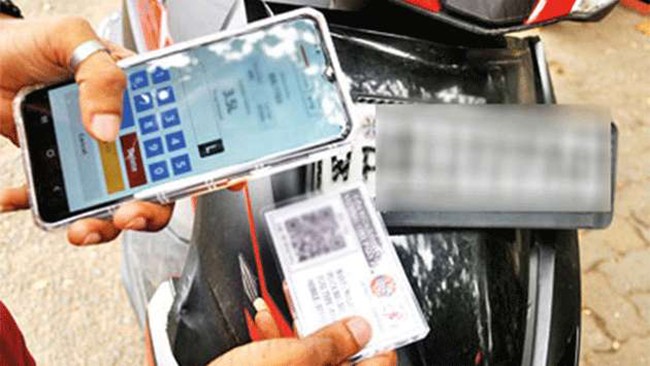
The introduction of the QR code–based fuel quota system can be seen as a timely and necessary measure, implemented as part of broader austerity efforts to manage limited fuel resources. In the face of ongoing global fuel instability and economic challenges, such a system is aimed at ensuring equitable distribution and preventing excessive consumption. While it is undeniable that this policy may disrupt the daily routines of certain segments of the population, it is important for citizens to recognize the larger national interest at stake and cooperate with these temporary measures until stability returns to the global fuel market.
At the same time, this initiative presents an important opportunity for the Government to address long-standing gaps in regulatory enforcement. In particular, the implementation of the QR code system could have been strategically linked to the issuance of valid revenue licenses for vehicles. Restricting QR code access only to vehicles that are properly registered and have paid their revenue dues would have helped strengthen compliance and improve state revenue collection.
Available data from the relevant authorities indicate that a significant number of vehicles—especially three-wheelers and motorcycles—continue to operate without valid revenue licences. This represents a substantial loss of income to the State and highlights a weakness in enforcement mechanisms. By integrating the fuel quota system with revenue license verification, the government could have effectively encouraged vehicle owners to regularise their documentation while simultaneously improving fiscal discipline.
In summary, while the QR code fuel system is a commendable step toward managing scarce resources, aligning it with existing regulatory requirements would have amplified its benefits. Such an approach would not only support fuel conservation but also enhance government revenue and promote greater accountability among vehicle owners.
Sariputhra
Colombo 05

Electricity tariffs to be increased from 1st April

A QR code system to be introduced for agricultural lands and other sectors requiring fuel

Rickelton, Rohit, Shardul break Mumbai’s first-game jinx

Oil tops $116 a barrel as Iran accuses US of preparing invasion

Iranian attack damages Kuwait power and desalination plant, kills worker

Warm weather conditions prevailing over the island are expected to continue

‘Dates have the highest sugar content to fight Coronavirus’

Sunday Island 27 December – Headlines

#SundayIsland 17th December – Headlines

Sunday Island – 28th March

Sunday Island Headlines – 21 March

Sunday Island – 21st February – Headlines
-

 News6 days ago
Senior citizens above 70 years to receive March allowances on Thursday (26)
-

 Features3 days ago
A World Order in Crisis: War, Power, and Resistance
-

 News4 days ago
Energy Minister indicted on corruption charges ahead of no-faith motion against him
-

 News5 days ago
US dodges question on AKD’s claim SL denied permission for military aircraft to land
-

 Business5 days ago
Dialog Unveils Dialog Play Mini with Netflix and Apple TV
-

 News6 days ago
CEB Engineers warn public to be prepared for power cuts after New Year
-

 Sports4 days ago
SLC to hold EGM in April
-
 Business7 days ago
Postponement of Sri Lanka Investment Forum 2026