
Latest News
Sri Lanka crumble after Khawaja and Inglis set up mammoth Australia total

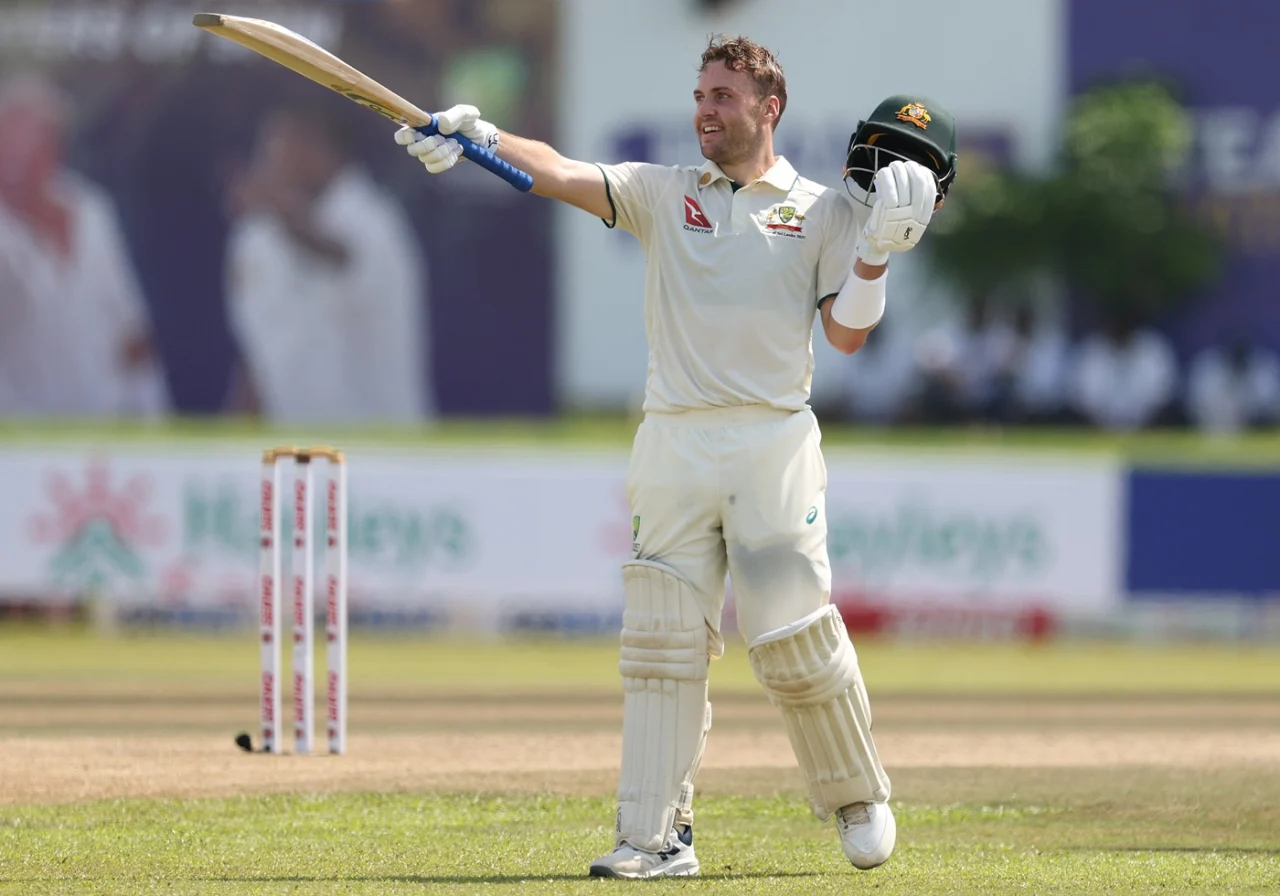
Usman Khawaja’s maiden Test double century and a rapid ton from debutant Josh Inglis decimated a flagging Sri Lanka before Australia’s attack breathed life into a slow Galle surface late on day two.
After stand-in captain Steven Smith declared Australia’s innings on 654 for 6 midway through the final session, Sri Lanka’s top order fell apart and they lost three wickets inside the opening 10 overs. Sri Lanka reached 44 for 3 when rain ended the day’s play prematurely with Australia enjoying a firm grip on the first Test.
Exhausted after spending 154 overs in the field, openers Oshada Fernando and Dimuth Karunaratne were dismissed within the first five overs.
With Mitchell Starc selected as Australia’s only frontline quick, there was intrigue over who would share the new ball with him. Left-arm spinner Matthew Kuhnemann, playing in his first Test match in almost two years, was an inspired choice and claimed Fernando lbw for 7 in his first over.
Bowling from around the wicket, Kuhnemann trapped him on the flap of his front pad as Fernando reviewed in vain. Kuhnemann was mightily pleased when the decision was upheld having made a speedy recovery from a thumb injury sustained in a BBL match on January 16.
Sri Lanka slid further when Karunaratne edged a short-of-a-length delivery from Starc to gully, where substitute fielder Nathan McSweeney completed a catch on the juggle having desperately turned around and dived after the ball bobbled over his head.
Having had little to do in the recent series against India, offspinner Nathan Lyon completed Australia’s near perfect day with the wicket of Angelo Mathews, who was brilliantly caught by a diving Travis Head at short leg.
Australia have completely capitalised on winning a favourable toss and batting first on a slow surface amid stifling humidity as they amassed their highest ever total against Sri Lanka.
Khawaja finished with 232 off 352 balls and fell early in the second session dominated by Inglis, who became the first Australian debutant to score a Test century since Adam Voges – his Western Australia coach – in 2015.
England-born Inglis reached his century off just 90 balls and he jumped high before punching the air with his proud parents visibly emotional in the terraces. He joined Michael Clarke and Shaun Marsh as Australian century-makers on Test debut in Asia.
Inglis showcased his proficiency against spin with decisive footwork either by skipping down the track or rocking back deep into the crease. His aggressiveness and maturity, having captained Australia in ODI and T20I cricket recently, reinforced why the selectors were keen to shoehorn him in the side.
Inglis, the Western Australia wicketkeeper playing as a specialist batter, celebrated his milestone with incumbent keeper Alex Carey at the crease before he fell on 102 having faced 94 balls.
Khawaja had earlier notched his highest Test score, overtaking his 195 not out against South Africa at the SCG in 2023 when rain forced an Australia declaration.
Khawaja and Smith were the fulcrum of Australia’s massive first innings, combining for a 266-run partnership. Smith was the only wicket to fall in the morning session after being trapped lbw for 141 by legspinner Jeffrey Vandersay, Sri Lanka’s most threatening bowler.
Smith added 37 runs to his overnight tally after a momentous opening day where he became the fourth Australian to reach 10,000 Test runs en route to a 35th century.
The 38-year-old Khawaja celebrated his first Test double century just before lunch as he kneeled down and bowed to the turf as the fans, many of whom are Australians, applauded with gusto.
He had earlier overtaken Justin Langer’s 166 in Colombo in 2004 as the highest score by an Australian in Sri Lanka. Having struggled against spin earlier in his career in South Asia, Khawaja has become only the second Australian after Allan Border to make Test centuries in India, Pakistan and Sri Lanka.
Khawaja has wound back the clock after an 18-month Test-century drought, having most recently against India struggled at the hands of tormentor Jasprit Bumrah.
Sri Lanka utilised just their four frontline bowlers with sole quick Asith Fernando bowling just 15 overs. Left-arm spinner Prabath Jayasuriya was effectively blunted with 3 for 193 off 60 overs in a far cry from when he claimed 12 wickets against Australia on the same ground in 2022.
Sri Lanka’s attack were unable to counter Australia’s aggressive approach and stem the flow of runs. Their tardy performance in the field on the opening day, where they missed several opportunities to dismiss Khawaja and Smith, proved costly.
Australia resumed on 330 for 2 with play starting 15 minutes early after rain ended day one prematurely. After resorting to a defensive leg-stump tactic late on day one, Jayasuriya attacked the stumps and aimed to skid the second new ball on.
But after four overs, Smith had enough and showed his first signs of aggression by skipping down the wicket as the partnership passed 200 runs.
Khawaja unfurled the reverse sweep to good effect on day one, but was lucky on his first attempt in the morning’s play when he only just cleared Peiris over short third for a boundary.
A third straight wicketless session loomed for Sri Lanka until Vandersay deceived Smith with a delivery that straightened down the line and hit him on the back pad. Vandersay’s enthusiastic appeal was initially turned down, but the decision was overturned on review in a massive relief for Sri Lanka.
After waiting almost 100 overs, Inglis finally entered the crease as he chewed gum furiously awaiting his first delivery in Test cricket. He started in fine fashion with a boundary after whipping Vandersay through mid-on and was at ease against spin.
He showcased his confidence by skipping down the track and launching several blows down the ground to race to 44 at a run a ball pace by tea.
Fernando was handed the ball after the interval for the first time in the day’s play and tried to provide a spark for his flagging team. But his short delivery was treated with disdain by Inglis, brought up on the WACA’s fast and bouncy surface.
Inglis reached his half-century off 51 balls to become the third Australian debutant in as many Tests to reach that landmark, following in the footsteps of Beau Webster and Sam Konstas.
Shortly after the pair reached their 100-run partnership, Inglis was given out lbw on 58 off Nishan Peiris after being struck on the back leg having missed a reverse sweep. But he reviewed immediately and the decision was overturned with a nick on the bottom of the bat detected.
Inglis remained unflustered and continued attacking, but Khawaja’s indefatigable knock finally ended when Jayasuriya enticed an edge to wicketkeeper Kusal Mendis.
Inglis reached his ton with a push through the off-side before providing a simple catch to cover as Jayasuriya’s toil was again rewarded.
Australia ground Sri Lanka into the ground before Smith finally declared and batting suddenly became extremely difficult for the beleaguered home team.
Brief scores:
Sri Lanka 44 for 3 (Kamindu Mendis 13*, Dinesh Chandimal 9*; Mitchell Starc 1-10, Mathew Khuneman 1-26, Nathan Lyon 1-7) trail Australia 654 for 6 dec in 154 overs (Usman Khawaja 232, Steven Smith 141, Josh Inglis 102, Travis Head 57; Jeffrey Vandersay 3-182, Prabath Jayasuriya 3-193) by 610 runs
[Cricinfo]


Despite driving his jeepney through some of Metro Manila’s busiest neighbourhoods on a daily basis, Arturo Modelo, 52, only takes home about a third of the 600 Philippine pesos ($10) he would normally earn, as thecost of fuel has soared in the Philippines and his profits have diminished as a result.
“I can’t even afford my kid’s lunch money,” he told Al Jazeera.
Leaning on his jeepney, Modelo explained how he joined two days of transport strikes in Manila on Thursday and Friday because he wanted “a deaf government to listen”.
Besides, he added, “you can’t really make a living on the road these days.”
The iconic jeepney, which emerged at the end of World War II when Filipinos repurposed old United States military jeeps to use as minibuses, is the cheapest and most common form of commuter transport in the Philippines.
Last week, jeepney owners staged a strike, which was followed by bigger demonstrations this week, as workers – from bus, taxi and minibus drivers to motorcycle taxi riders – representing nearly a dozen national transport groups joined the stoppage to protest rising fuel costs amid what they see as government inaction.
Thousands marched to the Presidential Palace on Friday, demanding price controls on petrol and diesel, scrapping fuel taxes, and tighter government regulation of the fuel industry.
The workers, who came together on Thursday and Friday under the No to Oil Price Hike Coalition, believe the government was too slow to act and had, for weeks, ignored their demands for price controls.
The No to Oil Price Hike Coalition also called out what it said was “American aggression” against Iran for the economic woes being felt in the Philippines.
“Filipinos didn’t start this war, don’t want any part of it, but are suffering because of it,” said Jerome Adonis, chairperson of the national workers’ group Kilusang Mayo Uno (May First Movement), who joined the strike.
“It’s like the United States also dropped a bomb on us,” Adonis said.
President Ferdinand Marcos Jr declared a state of national energy emergency on Tuesday night, a first as the US-Israel war on Iran entered its fourth week.
The emergency decleration will remain in force for one year, and allows the government to more rapidly procure fuel and petroleum products and to take action against the hoarding, profiteering and manipulation of petroleum product supplies.
Marcos said he ordered the “implementation of the fuel and energy allocation plan and other energy conservation measures” as a means to tackle the price surge and promised the country would have “a flow of oil”.
The Philippines has been hit harder than its neighbours by price shocks since the US and Israel attacked Iran last month. It has among the highest diesel and petrol prices in Southeast Asia, slightly behind Singapore – a country with higher wages and a far higher standard of living – as the global oil shortage bites.

Singapore diesel, according to various reports, was about $2.7 per litre this week, while diesel in the Philippines went up to $2.3 per litre. Petrol was about $2.35 per litre in Singapore, while in the Philippines it was nearly $2 per litre. In contrast, Malaysia, Vietnam and Thailand have recorded prices at about half of that at the fuel pumps.
As transport costs rise, students and workers in some cities in the country have been given free access to bus rides, and the government has started to provide a 5,000 peso ($83) subsidy to motorcycle taxi drivers and other public transport workers.
But for many, strike action is the only platform to express their concerns.
Transport union leaders said thousands had joined picket lines at 85 commuter terminals across the capital and major cities, while very few jeepneys could be seen on typically congested streets during the strike on Friday.
Authorities, however, said the two days of industrial action failed to paralyse Metro Manila, criticising the strike’s organisers and participants for inconveniencing commuters.
Asked on Friday if the government was considering directly subsidising fuel costs, similar to some countries in Southeast Asia, presidential spokesperson Claire Castro said the administration would study such a proposal.
Castro said the government had already doled out 2.5 billion pesos ($414m) in fuel subsidies this week to nearly 300,000 transport workers. However, advocacy groups say some 2 million people are likely working in the sector.
But transport workers also reported extremely long queues or missing out on the 5,000-peso payment due to their work details being absent from official government databases.
Jeepney driver Modelo, who spoke to Al Jazeera, said nobody from the transport terminal where he worked in Manila had received any government assistance.
Mody Floranda, national president of the transport workers group Piston, which initiated some of the strike action, said President Marcos Jr was favouring oil companies over Filipinos.
“Right now, Marcos can release an executive order for a price cap. He says it’s an emergency but acts like it isn’t,” said Floranda.
Presidential spokesperson Castro told reporters that the government’s swiftest action was “talking to manufacturing companies and other stakeholders not to increase the prices of goods”.
In a radio interview, Department of Energy (DOE) chief Sharon Garin said the agency aimed to please all stakeholders and that price caps imposed on fuel firms required the “right formula” to avoid harming businesses.
Experts attribute the high prices in the Philippines to the country’s dependence on oil imports and a deregulated market, plus excise taxes and a high value-added tax (VAT) of 12 percent.
Industrial economics Professor Krista Yu at De La Salle University in Manila said the dire situation was also due to the country’s “very limited domestic production and refining capacity”.
Yu said the government should prioritise securing “physical supply and reducing exposure to external shocks”.
According to the Energy Department, about 98 percent of the domestic crude oil supply is imported in the Philippines.

Emmanuel Leyco, chief economist at Credit Rating and Investors Services Philippines and the Center for People Empowerment in Governance (CenPEG), said that while the president is concerned about supply, “the public is already feeling the pain caused by unreasonable runaway prices.”
Leyco blamed the Oil Industry Deregulation Law of 1998 for the current situation, as it leaves fuel price adjustments in the hands of industry players.
“It is the main culprit. Even slight price adjustments cause serious problems because half the population is poor,” Leyco told Al Jazeera.
Faced with the likelihood of more strikes and growing public dissatisfaction, Marcos Jr separately signed a law on Wednesday allowing him to temporarily suspend excise taxes on fuel when crude oil exceeds a certain price per barrel for a month.
“Why not include the VAT and remove it with the excise taxes permanently?” asked opposition Kabataan Partylist lawmaker Renee Co.
“Both forms of taxation are regressive because they place the weight of commodity expenses on the people,” Co told Al Jazeera.
Co, along with other opposition lawmakers in Congress, had previously filed a bill to cancel both taxes, and on Wednesday filed a separate bill for state regulation of the oil industry.
Co was also among 50 members of Congress who passed a resolution calling for the “immediate cessation of hostilities in Iran, particularly an end to the military aggression instigated by the United States of America and Israel, in order to prevent further loss of life and humanitarian suffering”.
[Aljazeera]
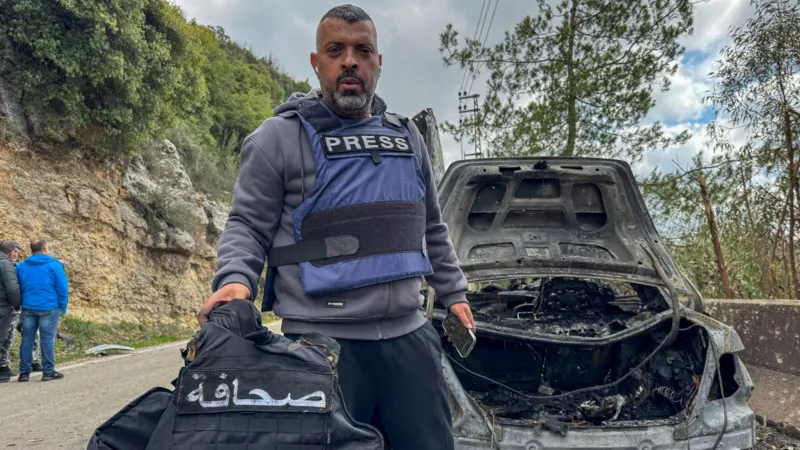
Three Lebanese journalists were killed in a targeted Israeli strike in southern Lebanon on Saturday, their employers have said.
Ali Shoeib, a reporter for the Hezbollah-affiliated Al Manar TV, was killed in the town of Jezzine alongside reporter Fatima Ftouni and her brother, cameraman Mohamed Ftouni, both from the channel Al Mayadeen, according to the stations.
The strike reportedly hit the journalists’ car just before noon local time (10:00 GMT).
The Israel Defense Forces (IDF) confirmed it had killed Shoeib, describing him as a “terrorist” from Iranian-backed Hezbollah’s elite Radwan Force who had “operated for years under the guise of a journalist”.
It said he had worked to “expose the locations of IDF soldiers operating in southern Lebanon and along the border”, including during the current fighting, and had used his position “to disseminate Hezbollah propaganda materials”.
The IDF provided no evidence to support its claim that Shoeib had a military role. It did not comment on the deaths of Fatima or Mohamed Ftouni.
Hezbollah denounced the strike as the “deliberate criminal targeting of journalists”.
(BBC)
Latest News
Heat Index likely to increase up to ‘Caution level’ at some places in the Western, Sabaragamuwa, Southern, Eastern, North-western, Northern and North-central provinces and in Monaragala district
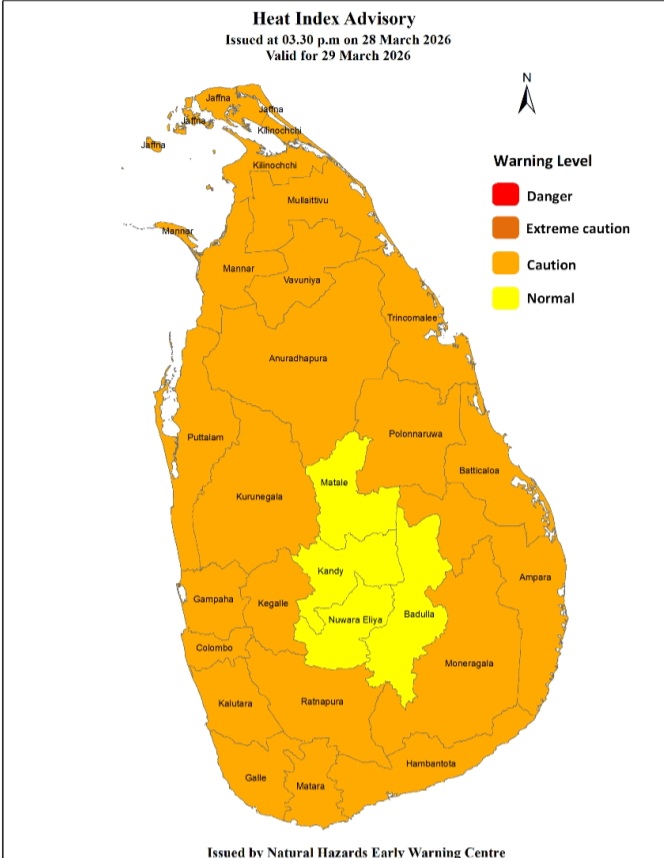
Warm Weather Advisory
Issued by the Natural Hazards Early Warning Centre of the Department of Meteorology
Issued at 3.30 p.m. on 28 March 2026, valid for 29March 2026.
Heat index, the temperature felt on the human body is likely to increase up to ‘Caution level’ at some places in the Western, Sabaragamuwa, Southern, Eastern, North-western, Northern and North-central provinces and in Monaragala district.
The Heat Index Forecast is calculated by using relative humidity and maximum temperature and this is the condition that is felt on your body. This is not the forecast of maximum temperature. It is generated by the Department of Meteorology for the next day period and prepared by using global numerical weather prediction model data.

Effect of the heat index on human body is mentioned in the above table and it is prepared on the advice of the Ministry of Health and Indigenous Medical Services.
ACTION REQUIRED
Job sites: Stay hydrated and takes breaks in the shade as often as possible.
Indoors: Check up on the elderly and the sick.
Vehicles: Never leave children unattended.
Outdoors: Limit strenuous outdoor activities, find shade and stay hydrated.
Dress: Wear lightweight and white or light-colored clothing.
Note:
In addition, please refer to advisories issued by the Disaster Preparedness & Response Division, Ministry of Health in this regard as well. For further clarifications please contact 011-7446491.

Philippine transport strikers say Marcos Jr failing to control oil prices

One ant for $220: the new frontier of wildlife trafficking

Three Lebanese journalists killed in Israeli strike, say broadcasters

Showers will occur at a few places in the Sabaragamuwa province and in Colombo, Kaluthara, Galle, and Matara districts after 2.00 pm

War-linked power crunch pushes Lanka to four-day week

Lanka to swelter through April and May, Met Dept warns

‘Dates have the highest sugar content to fight Coronavirus’

Sunday Island 27 December – Headlines

#SundayIsland 17th December – Headlines

Sunday Island – 28th March

Sunday Island Headlines – 21 March

Sunday Island – 21st February – Headlines
-

 News4 days ago
Senior citizens above 70 years to receive March allowances on Thursday (26)
-

 Features1 day ago
A World Order in Crisis: War, Power, and Resistance
-

 Features6 days ago
Trincomalee oil tank farm: An engineering marvel
-

 News2 days ago
Energy Minister indicted on corruption charges ahead of no-faith motion against him
-

 News3 days ago
US dodges question on AKD’s claim SL denied permission for military aircraft to land
-

 Features6 days ago
The scientist who was finally heard
-

 Business3 days ago
Dialog Unveils Dialog Play Mini with Netflix and Apple TV
-

 Sports2 days ago
SLC to hold EGM in April