
Sports
Sri Lanka after 41 years of Test cricket


by Rex Clementine
This week we celebrated 41 years of Test cricket having played our inaugural Test match in 1982 on the 17th of February. Over the years we have gone onto earn the admiration and respect of rest of the cricketing world for the sheer brilliance, creativity and innovativeness with which we have played the game. The Sri Lankan brand of cricket has challenged the way the game has been played and has added excitement and entertainment over the last 41 years.
Mind you it took India 20 years to win their first Test match. The Kiwis needed 26 years while we won our first Test in a mere three years in 1985. In between, they dazzled at Lord’s in 1984 in their first visit to the Home of Cricket and nearly made India eat humble pie in the Madras Test of 1982 in what was the teams inaugural meeting with Duleep Mendis making twin hundreds.
Over the last 41 years, Sri Lanka have made their presence felt in the game. The highest wicket taker in Test cricket is a Sri Lankan with Muttiah Muralitharan’s 800 scalps pretty hard to beat.
The world record for the highest total in Test cricket also belongs to Sri Lanka with Arjuna Ranatunga’s men posting 952 for six declared in 1997. That was a Test match where Indian captain Sachin Tendulkar conceded that he hadn’t seen Bradman but he had seen Jayasuriya.
The opener posted 340 in that innings and hence Sri Lanka had a triple centurion in Test cricket before India, South Africa or New Zealand had one.
South Africa who started playing Test cricket in 1889 only had a triple centurion in Tests 123 years later when Hashim Amla got there in 2012. India, who started playing Test cricket in 1932 only had a triple centurion in Tests 72 years later in 2004 when Virender Sehwag reached the milestone while New Zealand who entered the Test arena in 1930 ended the jinx 84 years later in 2014 thanks to Brendon McCullum.
Well, it took Sri Lanka only 15 years to have a triple centurion in Test cricket. The game of Test cricket has been played for nearly 150 years now and the two highest partnerships in the game belong to Sri Lankans. Kumar Sangakkara and Mahela Jayawardene added 624 runs for the third wicket against South Africa in 2006 while Jayasuriya and Roshan Mahanama added 576 runs for the second wicket in 1997 against India.
Consistency has been the hallmark of Sri Lankan cricket. There have been rough patches but those have been not extended ones. Although the team has done well overseas winning in England, Pakistan, New Zealand and West Indies, their record in India and Australia have been found wanting as they have not won a Test match so far in those countries.
Beyond the playing field, Sri Lankans have made an impact in the game as well with former captain Kumar Sangakkara going onto become the first non British President of the MCC.
Ranjan Madugalle has been an ICC Match Referee since 1991 and in 2002 was appointed Chief Match Referee. In 2018, Sri Lanka became the first Asian nation to pass laws in parliament making corruption in cricket a crime. The game’s reputation had suffered a blow after several individuals were entangled in sting operations to expose corruption in cricket. Any person who attempts to corrupt cricket now faces a jail term.






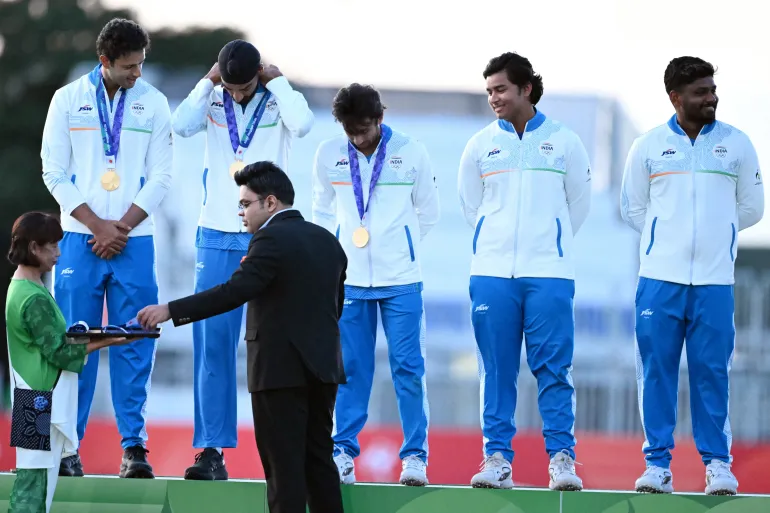
India beat their fierce rivals Pakistan by 19 runs to win Asian Games cricket gold after a pulsating final in front of a small but raucous crowd in Nagoya, Japan.
World T20 champions India posted 211-6 in their 20 overs on Saturday, with Abhishek Sharma scoring 61 and Tilak Varma 51 not out, before Hasan Nawaz’s valiant 96 saw Pakistan come up just short at 192-6.
It was India’s seventh straight win over Pakistan in T20s and the fifth consecutive men’s game between the two bitter rivals where players didn’t shake hands — both before and after the game.
The neighbouring countries only meet in international tournaments and on neutral ground because of political tensions, and the captains refused the normal handshakes before the match.
The medal ceremony was also substantially delayed before ICC chairman Jay Shah appeared first to present the medals, as twice announced by the official Asian Games broadcast.
Only the Indian players were presented with medals, however, by Shah, who is the son of India’s Interior Minister Amit Shah and a former BCCI secretary.
Pakistan and bronze medallists Sri Lanka were presented with their medals by Asian Games officials.
As before the contest, no handshakes took place at the end of the match or during the medal ceremony.
No reason has been given for the delay or the apparent change to the medal ceremony plans. Al Jazeera has asked the Asian Games for comment.
The clash on a converted baseball field in Japan was new ground for even these bitter enemies and their hundreds of millions of fans who were watching back home on TV.
(Aljazeera)
by Rex Clementine
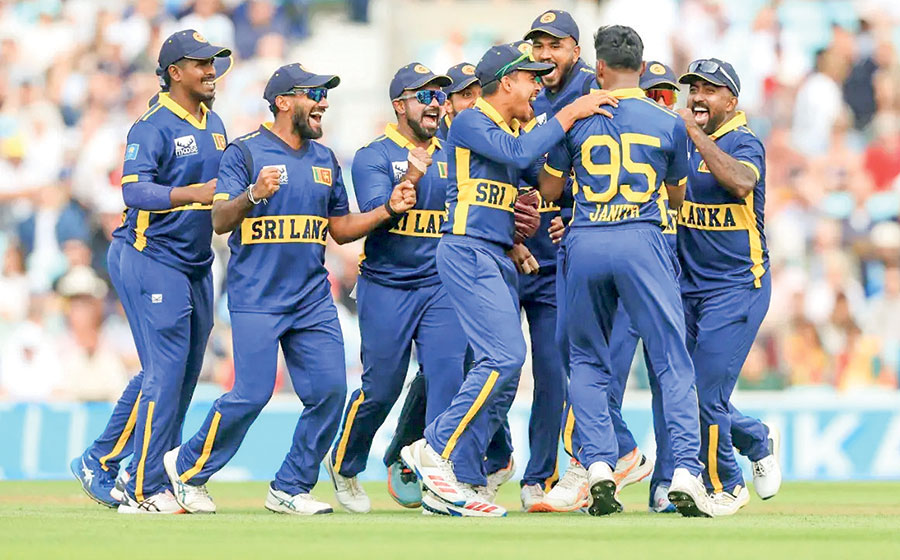
The national cricket team is bracing for a major shake up, with several new faces set to be drafted into the national set up as officials begin plotting a course towards next year’s World Cup.
The national team has endured a wretched two months across all three formats and several prominent players are now in the firing line ahead of the tour of Pakistan, one of the longest assignments undertaken by a Sri Lankan side in recent memory.
The Pakistan tour will stretch across 46 days, with Sri Lanka playing three T20Is, a tri-nation ODI series involving England, followed by two Test matches.
Two former captains, in particular, are under the pump.
Former white ball skipper Wanindu Hasaranga has been left out of the T20I squad and is unlikely to be considered for the ODIs either, with concerns over his attitude understood to have ruffled feathers within the hierarchy.
Hasaranga was sent home midway through the recent tour of England after an unusual sequence of events. It is understood that the leg-spinner had gone to watch a football match and on his return, complained of back pain that ruled him out of the opening ODI. SLC subsequently decided to send him home. Although the injury was considered only a minor niggle, the selectors now appear ready to draw a line in the sand by overlooking him for the Pakistan games.
Test captain Dhananjaya de Silva is also on shaky ground. He is expected to lose the captaincy and could even struggle to retain his place in the playing XI. Kusal Mendis, who leads Sri Lanka in limited-overs cricket, is expected to take over the Test reins on an interim basis.
The Cricket Transformation Committee is also looking at clipping the wings of players who spend considerable time on the franchise circuit. One proposal would restrict a player to two overseas franchise tournaments, while players could also be required to leave their franchise commitments and report to Colombo at least a week before Sri Lanka embark on an international assignment.
The arrival of several players in England directly from franchise commitments in the Caribbean is understood to have gone down badly in some quarters.
With the old guard under scrutiny, opportunity is knocking for several youngsters who have put their hands up in domestic cricket. A number of them are expected to be blooded during the Pakistan tour as Sri Lanka begin building towards next year’s World Cup.
The winds of change are not confined to the dressing room either.
Moves are also under way to overhaul the administration of Sri Lanka Cricket. The Cricket Transformation Committee is understood to be unimpressed with the returns delivered by some of the board’s highest paid executives but has little room to manoeuvre until their contracts expire. The absence of exit clauses in some of those agreements has proved a costly administrative blunder.
Meanwhile, the proposed new constitution for SLC is gathering momentum, with its architects hoping to transform the governing body into a more professional organisation in keeping with some of the leading cricket boards around the world.
Similar reforms were proposed in 2015 when Sidath Wettimuny headed an interim administration with the backing of then Sports Minister Navin Dissanayake. A new constitution was drafted by respected legal scholar Prasanna Jayawardena, but the government of the day showed little appetite to push the reforms through and eventually handed the reins back to elected officials.
Had those reforms been implemented in 2015, SLC might have emerged as a far more robust institution. Instead, elected administrations continued to call the shots, too often with little long term vision or pragmatism.
Public criticism over the manner in which SLC has been administered has mounted over the years, leaving the government with something approaching Hobson’s choice. It eventually decided to take the bull by the horns despite the risk of suspension by the global governing body in Dubai.
In a shrewd move, the government brought respected former players Sidath Wettimuny, Roshan Mahanama and Kumar Sangakkara into the committee overseeing cricket affairs during the transition, lending considerable credibility to the reform process.
The new constitution is expected to be in place by the end of the year, although legal challenges appear inevitable.
As The Sunday Island has previously reported, several leading lawyers were beneficiaries of the previous SLC administration’s willingness to spend record sums on legal fees. With another battle looming, it would hardly raise eyebrows if some of the same legal eagles were soon singing for their supper again.
by Reemus Fernando
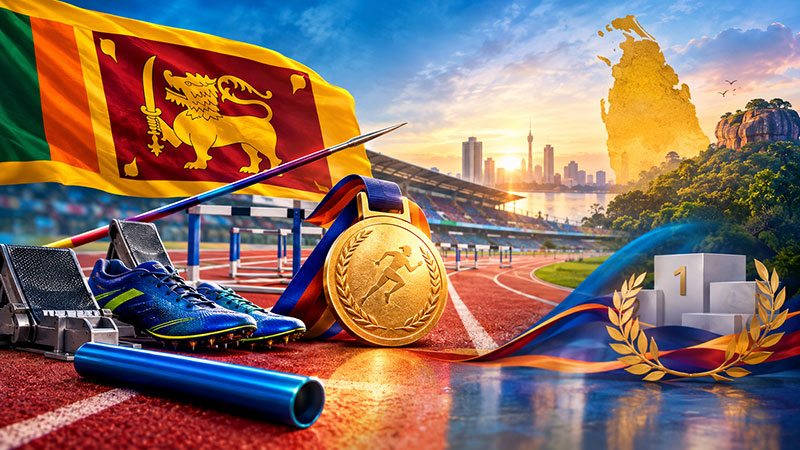
Sri Lanka’s track and field team may have failed to match the medal haul of the previous edition at the Asian Games, but athletes from the 24-member squad finished among the top eight in at least seven events, a feat few countries managed. Those performances did not receive the recognition they deserved, as the spotlight fell on Rumesh Tharanga’s historic javelin gold.
At the 2023 edition in China, Sri Lanka won one gold, one silver and two bronze medals. This time, the team won only one gold.
Thanks to Tharanga’s victory, Sri Lanka finished 13th in the medal table. China dominated with 39 medals, including 17 golds. Hosts Japan were second with 32 medals (10 golds), followed by Bahrain (9), Thailand (3) and Uzbekistan (3) in third, fourth and fifth places respectively, each winning more than one gold.
Neighbours India, sixth with one gold, nine silvers and 14 bronzes, were the only other South Asian country besides Sri Lanka to win a track and field medal at this edition.
Every Sri Lankan athlete who competed in Japan has a remarkable story. Persevering in a sport that offers so few rewards is itself worth celebrating.
Take Dilhani Lekamge, who won silver in 2023. As highlighted in these columns last week, her perseverance deserves recognition. Some of her teammates were toddlers, or not yet born, when Lekamge took up javelin as a schoolgirl. At 39, she placed fifth with a throw of 59.27m, a distance that would have earned at least a bronze at three of the past six editions. Sumedha Ranasinghe, the country’s first Olympic thrower, could not produce his best, yet still finished sixth with a throw of 78.08m.
Tharanga explained on his return that Sri Lanka’s hurdlers felt the barriers coming at them closer than usual on the faster track, which left them short of their personal bests. Even so, Ayomal Akalanka finished fifth in the 400m hurdles final in 49.37s, the second-fastest time by a Sri Lankan in history. Akalanka has produced personal bests at crucial overseas meets since his youth and junior years, and his coach Anura Bandara, no stranger to coaching Asian Games medallists, had hoped for something special in Japan. “There was a slight problem with his hamstring over the ninth hurdle in the heats. If not for that injury, he would have done better and secured a good lane in the final,” Bandara told The Sunday Island on their return.
As the brightest hurdles prospect to emerge from the junior structure, Akalanka has many years ahead of him and should be earmarked for sustained investment.
The women’s 4x400m relay team included two members of the bronze-winning quartet from the last edition, Nadeesha Ramanayake and Lakshima Mendis. Ramanayake and Tharushi Karunaratne, who won a historic 800m gold in 2023, were in superb form then, and their contributions were key to the relay podium finish. Tharushi was absent this time, as her performances had begun to fade after she moved to the USA for training and studies. Ramanayake and Mendis were joined by Araliya Sathsarani and Jithma Wijeythunga, and the team placed seventh in the final (3:34.90), the third-fastest time in the country’s history.
Veteran sprinter Kalinga Kumarage reached the final and clocked 46.31 seconds.
The men’s 4x100m relay team (seventh in the final) and triple jumper Madushani Herath (eighth) were the other top-eight finishers.

Debris found from plane that went missing off US coast

Construction of Jet A-1 Aviation fuel pipeline and new oil tank complex at Muthurajawela begins under President’s patronage

Landslide Early Warnings issued to the Districts of Kandy, Kegalle, Matale and Ratnapura

No handshakes and a delayed ceremony as India beat Pakistan at Asian Games

Showers or thundershowers will occur in most parts of the island after 1.00 p.m

Lanka enters new phase of prosecutions as hurdles clear

‘Dates have the highest sugar content to fight Coronavirus’

Sunday Island 27 December – Headlines

#SundayIsland 17th December – Headlines

Sunday Island – 28th March

Sunday Island Headlines – 21 March

Sunday Island – 21st February – Headlines
-

 News7 days ago
Police remove Thileepan statue in Jaffna
-

 Features7 days ago
The 22nd Amendment, constitutional recovery and illiberal slippage
-

 Features7 days ago
Of foreigners as CEOs of Lankan ventures
-

 Latest News5 days ago
Gold winner Tharanga gets brand-new Honda Vezel from SLAAJ
-

 News7 days ago
Sajith rejects Jt. Opp. protest sabotage claim; SJB TU chief demands remedial action
-

 Features5 days ago
Why Sri Lanka needs an Inclusive Civic Nationalism – urgently
-

 News4 days ago
US-assisted ‘Ice’ detection: NPC to examine IGP’s move to transfer drug-busting team
-

 Features6 days ago
Thailand’s biggest new global star …