
Latest News
South Africa go top as New Zealand slump to third straight defeat


One of the advantages of a long-drawn league phase is that teams have an opportunity to make up for indifferent starts. But New Zealand are finding out the converse can be true as well. A third straight loss amid a series of injuries in the camp threatens to throw their World Cup campaign off the rails.
If the loss to Australia in Dharamsala was heartbreaking, this one to South Africa in Pune was outright demoralising. The bowlers were sent on a leather hunt as Quinton de Kock and Rassie van der Dussen plundered centuries, and David Miller added more salt to the wounds with a blistering 30-ball 53 not out as South Africa posted 357 for 4; the last 10 overs alone brought them 119 runs.
In reply, New Zealand’s top order unraveled against South Africa’s quality pace attack under lights. Marco Jasen’s extra bounce accounted for Devon Conway and Rachin Ravindra, Will Young was out nicking behind off Gerald Coetzee, and Kagiso Rabada had Tom Latham chipping one to cover.
Daryl Mitchell kept hope flickering, oozing class and confidence as he played a couple of gorgeous on-drives, but his dismissal while looking to hit out against Keshav Maharaj in the 19th over opened the floodgates. The game became staggeringly one-sided as New Zealand petered to 167 all out, with only Glenn Phillips offering any resistance to make 60.
The defeat, and the quantum of it, was massive from a tournament’s standpoint, with New Zealand now slipping back to potentially enter a logjam for fourth place, which Pakistan, Afghanistan and Sri Lanka are all eyeing. Few would have expected New Zealand to cave in the manner they did, even after South Africa had set them 358.
New Zealand’s capitulation was a sharp contrast to how things panned out for South Africa after they were put into bat.
Temba Bavuma was the early aggressor, crunching two cover drives off Matt Henry in the fourth over to kick the innings into gear. De Kock was largely subdued and fidgety early on, and even copped a blow to the shoulder from a Trent Boult bouncer in the ninth over. At that point, South Africa’s innings had barely gotten out of second gear. Having roughed up de Kock, Boult had sent Bavuma back with a sucker ball, a full one that had him nicking low to Mitchell at slip.
It could have been wickets in back-to-back overs for New Zealand had Phillips latched on to a screamer at backward point off Tim Southee. That we’re even talking about it being a chance was down to his brilliance – anticipating de Kock’s cut and taking two steps to his right before flinging himself full-stretch to go one-handed. De Kock was on 12 off 24 at that point.
At the other end, van der Dussen helped himself to a pull to begin proceedings as Southee, coming in for the first game of his fourth World Cup, seemed erratic and down on pace to begin with. For much of the first 100 runs in their 200-run stand, de Kock and van der Dussen were steady and calculating, playing themselves into a position from which they could tee off in the back 15. It’s a plan that worked to the T for them, and perhaps much more easily than they may have anticipated because New Zealand had a massive hole to fill midway through.
Henry pulled his hamstring halfway through his sixth over, the 27th of the innings, to leave Ravindra, James Neesham and Phillips to bowl 14.3 overs between them. De Kock and van der Dussen accelerated knowing fully well that New Zealand needed to back-load their part-timers.
The first sign of de Kock breaking the shackles came in the 16th over when he got stuck into Southee. He followed an imperious pull in front of square for four by walloping a six over the bowler’s head. De Kock had another slice of luck soon after when he chipped Phillips into the leg side, with the ball falling between three fielders. De Kock soon brought up his half-century off 62 deliveries and van der Dussen followed suit, getting there off 61.
New Zealand’s cup of woe was far from over. Neesham, one of the part-timers called on to make up overs, suffered a blow of his own when he was struck flush on the thumb by a de Kock straight drive. On 95, de Kock should have been run out off the same delivery when he was sent back even as the ball deflected to Mitchell Santner at cover. The batter had given up hope when Santner fired a throw at the bowler’s end, but it missed the stumps. De Kock soon brought up his hundred – his fourth of this World Cup, which left him one behind Rohit Sharma’s record of five in a single edition – by getting inside the line and helping a pull deep beyond the fine leg fence for six. He reached the century off 103 balls, and seemed to be revving up for a big finish.
At the other end, the industrious van der Dussen brought out cute reverse paddles and sweeps to throw New Zealand’s spinners off gear. The second-wicket pair had added 200 at better than a run-a-ball when de Kock picked out point to give Southee a wicket in the 40th over. It’s at this point that South Africa pulled out a surprise move, pushing Miller up the order, seemingly to keep the left-right combination going, and he tore into the bowling at the death to get to his half-century in 29 balls. Neesham went for 69 off his 5.3 overs, and conceded 18 in the 50th.
While New Zealand walked off knowing they had a big chase, there was a sense that the game was still in the balance given how well they had batted in big chases against England and Australia. But their hopes were dashed by a South African attack that made you wonder if this was the same surface New Zealand had bowled on.
After the top order was blown away, Phillips delayed the inevitable, getting in some batting time amid a lower-order collapse. By the end, New Zealand were so desperate to minimise the damage to their net run rate that an injured Henry hobbled out to bat and gave Phillips company for 5.1 overs, in the process adding 34 for the final wicket. However, even that didn’t quite diminish the magnitude of the defeat, which, all told, was a proper pasting.
Brief Scores:
South Africa 357/4 in 50 overs (Rassie van der Dussen 133, Quinton de Kock 114, Temba Bauvma 24, David Miller 53; Tim Southee 2-77) beat New Zealand 167 in 35.3 overs (Will Young 33, Daryl Mitchell 24, Glenn Phillips 60; Marco Jansen 3-31, Gerald Coetzee 2-41, Keshav Maharaj 4-46)by 190 runs









Latest News
Heat Index is likely to increase up to ‘Caution level’ at some places in the Western, Sabaragamuwa, Southern and North-western provinces and in Anuradhapura, Mannar and Vavuniya districts.
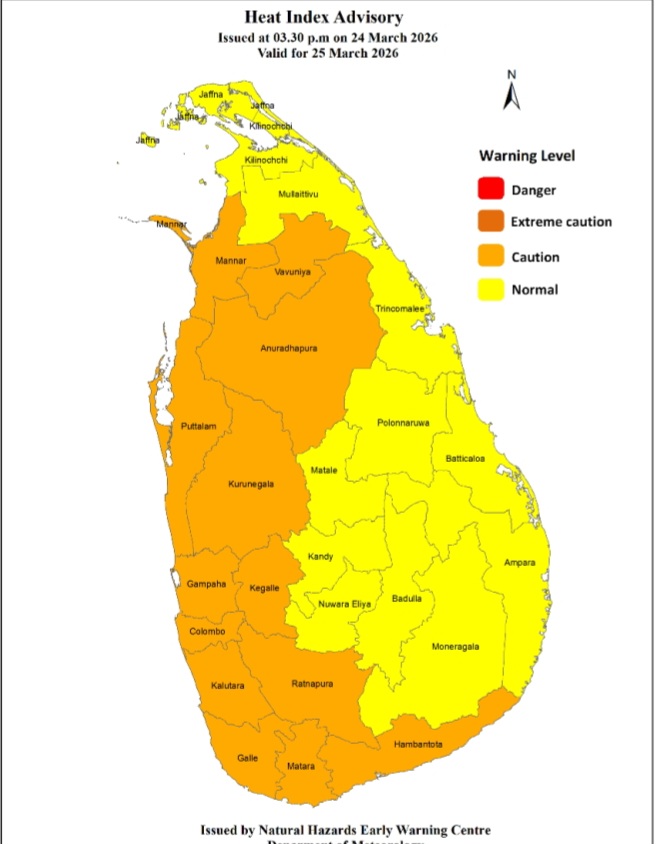
Warm Weather Advisory
Issued by the Natural Hazards Early Warning Centre of the Department of Meteorology
at 3.30 p.m. on 24 March 2026, valid for 25 March 2026.
The Heat index, the temperature felt on human body is likely to increase up to ‘Caution level’ at some places in the Western, Sabaragamuwa, Southern and North-western provinces and in
Anuradhapura, Mannar and Vavuniya districts.
The Heat Index Forecast is calculated by using relative humidity and maximum temperature and this is the condition that is felt on your body. This is not the forecast of maximum temperature. It is generated by the Department of Meteorology for the next day period and prepared by using global numerical weather prediction model data.
Effect of the heat index on human body is mentioned in the above table and it is prepared on the advice of the Ministry of Health and Indigenous Medical Services.
ACTION REQUIRED
Job sites: Stay hydrated and takes breaks in the shade as often as possible.
Indoors: Check up on the elderly and the sick.
Vehicles: Never leave children unattended.
Outdoors: Limit strenuous outdoor activities, find shade and stay hydrated.
Dress: Wear lightweight and white or light-colored clothing.
Note:
In addition, please refer to advisories issued by the Disaster Preparedness & Response Division, Ministry of Health in this regard as well. For further clarifications please contact 011-7446491.

Considering the resolution furnished by the Minister of Health and Mass Media, the Cabinet of Ministers has decided to appoint R.A.P. K. Jayaratne, the most senior officer of the Printing Service, currently serving as Deputy Government Printer in the Department of Government Printing and holding a Class I, Grade II position in the Printing Service, to perform the duties of the post of Government Printer with effect from 02.04.2026.

The computer system at the Department of Registration of Persons has been rectified and the services are back to normal.

Siyapatha Finance debenture issue oversubscribed

Media action group questions NPP’s response to arrests under PTA

Trade Finance Association of Bankers holds 29th Annual General Meeting

Riffai Karriapper promoted as Dean

Cement prices up

NOLIMIT unveils new fashion destination in Kiribathgoda, strengthening retail presence across Sri Lanka

‘Dates have the highest sugar content to fight Coronavirus’

Sunday Island 27 December – Headlines

#SundayIsland 17th December – Headlines

Sunday Island – 28th March

Sunday Island Headlines – 21 March

Sunday Island – 21st February – Headlines
-

 News7 days ago
CIABOC questions Ex-President GR on house for CJ’s maid
-

 Features2 days ago
Trincomalee oil tank farm: An engineering marvel
-

 News6 days ago
Bailey Bridge inaugurated at Chilaw
-

 News5 days ago
CIABOC tells court Kapila gave Rs 60 mn to MR and Rs. 20 mn to Priyankara
-

 News6 days ago
Pay hike demand: CEB workers climb down from 40 % to 15–20%
-

 Editorial7 days ago
Couple QR-based quota with odd-even rationing
-

 Features5 days ago
Science and diplomacy in a changing world
-

 News4 days ago
Colombo, Oslo steps up efforts to strengthen bilateral cooperation in key environmental priority areas