
News
SLPP cannot survive by suppressing truth and printing money, says Kabir

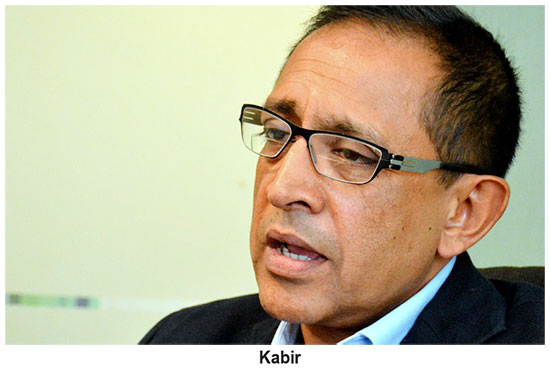
‘Govt deprived Treasury of wherewithal to tackle crisis’
By Shamindra Ferdinando
Samagi Jana Balavegaya lawmaker Kabir Hashim alleges that the Finance Ministry report for 2020 is meant to deceive both the Parliament and the public. The former UNPer insists the cash-strapped SLPP government cannot overcome the rapidly developing financial crisis by suppressing the truth or printing money.
The Finance Ministry was making a desperate bid to hide the actual situation by painting a wrong picture, says Kegalle District lawmaker, Senior Vice President of the SJB Hashim.
In a brief interview with The Island, over the last weekend MP Hashim explained how mismanagement of the national economy had caused irreparable damage and losses at a time the country was struggling to cope up with the rampaging Covid-19 pandemic.
Referring to parliamentary proceedings on June 23, 2021, Hashim said that he had an opportunity to take up the erroneous Finance Ministry, 2020 annual report in the presence of Premier Mahinda Rajapaksa who is also the Finance Minister. The MP alleged that the Finance Ministry, in addition to issuing wrong figures deliberately left out critically important data in a bid to deceive the public.
Responding to another query, Hashim pointed out how the 2020 Finance Ministry annual report estimated the national debt at Rs 14.8 trillion though figures released by the National Audit Office and Auditor General raised questions in respect of the overall accounting process. According to MP Hashim, as much as Rs 170 bn in loans had been left out of 2020 Finance Ministry report. Alleging malpractices in the accounting process, the SJB official alleged that Treasury bonds worth Rs 290 bn hadn’t been properly taken into account as at Dec 31, 2020. Asked whether he took responsibility for the claims he made, MP Hashim said that he was repeating what he told Parliament. “Of course, my statement made in Parliament on June 23 didn’t receive the desired media coverage.”
Lawmaker Hashim questioned why the Finance Ministry conveniently refrained from mentioning Japan seeking compensation to the tune of Rs. 5,896 bn from cash strapped Sri Lanka for the cancellation of the Japan International Cooperation Agency (JICA)-funded Colombo Light Rail Transit (LRT) project. The top SJB spokesperson said that the government owed an explanation over the cancellation of the LRT project finalised during the previous administration.
Underscoring the need for financial and political stability, the former UNP Chairman described the government as a patient warded in an Intensive Care Unit (ICU) with multiple organ failure though it sometimes talked big, in an obvious bid to deceive those struggling to make ends meet. The national economy suffered debilitating setbacks due to the SLPP’s ruinous fiscal policies, the MP said, alleging the incumbent government caused a catastrophe at the beginning by depriving the Treasury of much needed revenue. MP Hashim emphasized that the Treasury suffered a loss of colossal amount of money due to unprecedented tax cuts soon after the change of government. The losses suffered due to exemption of VAT alone was quite big, the SJB MP said, lambasting the government for delivering a deadly blow to the national economy. According to the SJB MP, the Treasury lost a staggering Rs 600 bn due to tax cuts and of that amount approximately half as a result of VAT exceptions.
The then Joint Opposition/ SLPP quiet shamelessly attacked the previous government efforts to streamline the tax collection process, the MP said. Specific measures to enhance tax revenue were depicted as fleecing of the public by those who played politics with the national economy. “Now they are in charge. Obviously, they lacked at least basic vision to sustain the national economy,” MP Hashim said, alleging the SLPP’s foolish strategies resulted in downgrading of Sri Lanka’s status.
The MP challenged Trade Minister Bandula Gunawardena to compare the prices of dhal, sugar, sprats, salmon, rice and milk powder at the time the 2015 change of government and the time of the 2019 presidential election. Contrary to the SLPP boasts, the incumbent government caused itself serious damage by depriving the Treasury the wherewithal to meet the crisis, the former Minister said.
Alleging Scottish economist John Law (1671-1729) had ruined France in the 1700s due to his shortsighted strategies, MP Hashim claimed that the SLPP was following a policy very much similar to that utterly destructive strategy. Unrestrained printing of money was part of that foolish strategy, the former Minister said, alleging that by April 2020 the SLPP printed money amounting to Rs 165 bn. MP Hashim said that the ugly truth was having had preached throughout the 2015-2019 period how to manage the economy the big talkers ruined the economy.
Lawmaker Hashim flayed the government over the unprecedented sugar tax scam, runaway rice prices against the backdrop of Agriculture Minister Mahindananda Aluthgamage’s ridiculous claim of record paddy yield last year. Subsequently, the government announced plans to import 100,000 metric tonnes of rice, MP Hashim said, urging the government to address real issues without further delay.
Finance Minister Mahinda Rajapaksa, who was also the State Minister of Money and Capital Market and State Enterprise Reforms and State Minister of Samurdhi, Household Economy, Micro Finance, Self-Employment and Business Development owed a clear explanation, he said.
Those who boasted of having the world’s best intelligence service couldn’t locate hoarded paddy/rice in spite of growing criticism of continuing shortages, the MP said. How could they ‘catch’ those who had been involved with the 2019 Easter Sunday bomber Zahran Hashim or fugitive CBSL Governor Arjuna Mahendran if rice millers couldn’t be tackled.
MP Hashim demanded the SLPP to give up political power if it couldn’t do what it promised.
Commenting on the SLPP being split over fuel price hikes, the SJB top gun said that the government should explain what it did with funds amounting to USD 1.3 bn (Rs 253 bn) saved due to much lower crude oil prices in the world market in 2020. MP Hashim asked what happened to Rs 48 bn paid by the CEB to the CPC in 2020. The SJB also demanded an explanation as regards Rs 50 bn in the much- touted oil price stabilization fund established by the SLPP administration. The former Minister emphasized as the CBSL and COPE confirmed the setting up of the stabilization fund, the government should explain what had really happened, the former UNP Chairman said.
Declaring that in Murban terms the price of barrel of crude oil remained at USD 60, MP Hashim demanded an explanation from the government why prices of diesel, petrol and kerosene sharply increased. MP Hashim explained how in terms of forward booking purchases were made on prices in the market two months before.
The former Minister said that Fisheries Minister Douglas Devananda recently claimed that the government planned to increase the price of a litre of kerosene by Rs 35 though he managed to thwart the move. According to a Fisheries Ministry statement carried on page 1 on June 30 edition of The Island Minister Devananda managed to restrict the increase of the price of a litre of kerosene to Rs 7.
MP Hashim said that EPDP leader Devananda’s colleagues had challenged his claim.
Responding to queries as regards the state of the economy in the wake of the Covid-19 eruption, lawmaker Hashim said that the SLPP leadership was blind to the difficulties experienced by the middle class and those who survived on daily wages.
Pointing out that Treasury Secretary S.R. Attygalle, in response to a query posed by SJB lawmaker Dr. Harsha de Silva based on Energy Minister Udaya Gammanpila’s take on the financial crisis, at a meeting of a parliamentary watchdog committee, MP Hashim said that the country was now in bind.
The former Minister said that the people weren’t interested about the internal conflicts within the ruling party. The government should be ashamed of itself for the ridiculous battle between a section of the SLPP and Energy Minister Gammanpila and the ‘boru’ show over Basil Rajapaksa’s return on the National List.
“The SLPP administration is in tatters,” the former Minister said declaring the people recognized the SJB’s role as the main Opposition. The government was in such a desperate situation it propagated the lie that the SJB would disintegrate with the return of UNP leader Ranil Wickremesinghe to Parliament.
MP Hashim asked whether various declarations made by members of the SLPP parliamentary group, backing Basil Rajapaksa’s return, reflected the failure on the part of the government less than a year after last parliamentary polls. The bottom line is that the near two-thirds majority enjoyed by the SLPP in Parliament didn’t reflect in its handling of the developing situations, the former Minister said.

Latest News
Sun directly overhead Pomparippu, Anuradhapura, Mihinthale, Galenbindunuwewa, Agbopura and Serunuwara about 12:11 noon today (11)


On the apparent northward relative motion of the sun, it is going to be directly over the latitudes of Sri Lanka from 05th to 15th of April in this year.
The nearest areas of Sri Lanka over which the sun is overhead today (11th) are Pomparippu, Anuradhapura, Mihinthale, Galenbindunuwewa, Agbopura and Serunuwara about 12:11 noon.

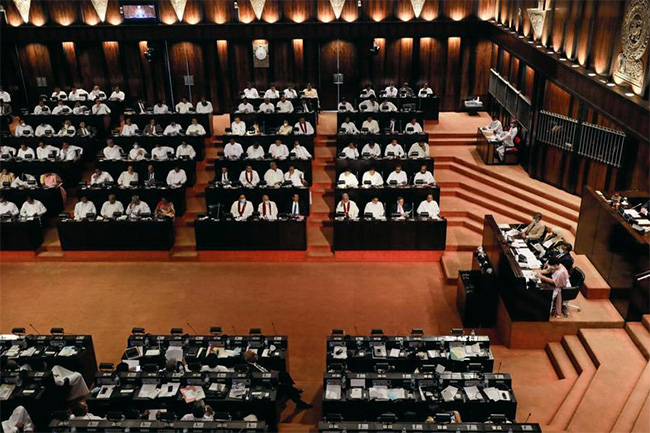
A no-confidence motion brought by the Opposition against Energy Minister Kumara Jayakody was defeated in Parliament yesterday by a majority of 104 votes.At the end of the debate, 49 members voted in favour of the motion, while 153 voted against it.
The motion, submitted to the Speaker on 19 March, was signed by Opposition Leader Sajith Premadasa, SJB MPs, and other Opposition members.
It accused Minister Jayakody of failing to ensure the procurement of adequate and quality coal for the Lakvijaya Coal Power Plant in Norochcholai, alleging that such negligence amounted to a breach of ministerial responsibility over a critical national energy asset.
The motion also cited ongoing legal proceedings against the Minister, noting that he has been indicted by the Commission to Investigate Allegations of Bribery or Corruption and produced before the Colombo High Court under Section 70 of the Bribery Act, in connection with alleged acts of corruption during his tenure as Procurement Manager of the Ceylon Fertiliser Company Limited.
The motion read: Vote of No Confidence against Kumara Jayakody, Minister of Energy,— Whereas the Provision in Section 6 of the Part III of the Code of Conduct for Members of Parliament which states that: “The Members shall on all occasions act in accordance with the public trust entrusted with them and shall always behave with probity and integrity, including the use by them of any public resources.” has been violated; And whereas the following rules of conduct set out in Section 9 of the Part V of the Code of Conduct for Members of Parliament have prima facie been breached, namely:- “(a) to be conscience; (c) to act so as to merit the trust and respect of the people; (e) to hold themselves accountable for the conduct and duties for which they are responsible;” And whereas it is observed that the Minister has failed, in his capacity as a Minister of the Cabinet of Ministers, to discharge the fundamental duties incumbent upon him in accordance with Article 28 of the Constitution;
And whereas it is established that the Minister of Energy has failed to discharge his primary duty of ensuring the procurement of adequate and good quality coal for the Norochcholai Lakvijaya Coal Power Plant;
And whereas such gross negligence in overseeing a critical national energy asset constitutes a fundamental breach of ministerial responsibility;
And whereas the Minister of Energy has failed to carry out the subjects and functions vested in him by the Notification of Gazette Extraordinary No. 2412/08 of 25th November 2024 of the Democratic Socialist Republic of Sri Lanka, including taking necessary steps to reduce the losses at the institutional management level and technical damages that occur to the electricity generation and distribution system and reduction of costs for generating electricity and removal of uncertainties during generation;
And whereas the Commission to Investigate Allegations of Bribery or Corruption has filed formal indictments before the Colombo High Court against the incumbent Minister of Energy under Section 70 of the Bribery Act (Chapter 26) for the offence of “corruption” in connection with acts of corruption allegedly committed while he was serving as the Procurement Manager of the Lanka Fertilizer Company;
And whereas, in light of the foregoing, the Minister of Energy has irretrievably forfeited the confidence of Parliament and the people of Sri Lanka by causing losses to public finances, endangering national energy security, corruptly mishandling the procurement process, being subjected to active judicial proceedings for the offence of “corruption”, and betraying the Government’s own “anti-corruption mandate”, and his continued tenure as the Minister of Energy is contrary to the public interest, the rule of law, and the principles of good governance;
That this Parliament resolves that it has no confidence in the competence of Kumara Jayakody, Minister of Energy to function as a Minister of the Cabinet of Ministers any longer.”
by Saman Indrajith

Chinese Ambassador to Sri Lanka Qi Zhenhong yesterday assured that China would not allow a fuel crisis to arise in Sri Lanka, under any circumstances, reaffirming Beijing’s continued support to the country.
The Ambassador made these remarks addressing the media after attending a dry ration distribution programme for 350 low-income families at Sri Chandananda Buddhist College, at Asgiriya, in Kandy.
Highlighting the longstanding ties between the two countries, Ambassador Qi said China has consistently stood by Sri Lanka and remains ready to extend assistance whenever required.
Amid concerns over global energy disruptions, stemming from the ongoing Middle East conflict, he noted that several countries are already facing difficulties, but stressed that China is prepared to support Sri Lanka at any time.
He said that any potential fuel shortage in Sri Lanka could be managed with the involvement of China’s Sinopec.
Reiterating Beijing’s commitment to Sri Lanka’s economic recovery and development, the Envoy also expressed hope that the current ceasefire in the Middle East would hold, while assuring that China stands ready to respond to any future developments and assist Sri Lanka as needed.
By SK Samaranayake

Sooryavanshi blitz, Jurel 81* help Rajasthan Royals take down Royal Challengers Bengaluru with ease

Sun directly overhead Pomparippu, Anuradhapura, Mihinthale, Galenbindunuwewa, Agbopura and Serunuwara about 12:11 noon today (11)

Showers expected in the Western, Sabaragamuwa, North-western , Southern and Uva provinces and in Anuradhapura, Mannar, Kandy and Nuwara-Eliya districts after 2.00 p.m.

Opposition NCM against Energy Minister defeated

Chinese Ambassador assures Lanka China will not allow a fuel crisis to develop here

Minister Jayatissa blames administrations since 2010 for not following proper procedures when procuring coal

‘Dates have the highest sugar content to fight Coronavirus’

Sunday Island 27 December – Headlines

#SundayIsland 17th December – Headlines

Sunday Island – 28th March

Sunday Island Headlines – 21 March

Sunday Island – 21st February – Headlines
-

 Features7 days ago
Ranjith Siyambalapitiya turns custodian of a rare living collection
-

 News7 days ago
Global ‘Walk for Peace’ to be held in Lanka
-

 News5 days ago
Lankan-origin actress Subashini found dead in India
-

 News3 days ago
AG: Coal procurement full of irregularities
-

 Business2 days ago
Israeli attack on Lebanon triggers local stock market volatility
-

 Features7 days ago
Beyond the Blue Skies: A Tribute to Captain Elmo Jayawardena
-

 Features7 days ago
Aspects of Ceylon/Sri Lanka Foreign Relations – 1948 to 1976
-

 Business3 days ago
Hayleys Mobility introduces Premium OMODA C9 PHEV