
Sports
Pucovski announces retirement from cricket due to concussion


Will Pucovski has announced his retirement from cricket due to concussion saying it was a “humongous disappointment that is hard to deal with”.
Pucovski, 27, played one Test in 2021 against India and had been touted as a long-term mainstay at the top of the order in the Australia Test team having dominated first-class cricket for Victoria from a young age.
But Pucovski’s career has been cut short due to his long-term concussion issues. He had not played since March 2024 when he suffered a severe concussion after he was hit by Tasmania’s Riley Meredith in a Sheffield Shield game.
An independent medical panel was convened to assess Pucovski’s future last year after the number of concussions that he had in his sporting career were estimated in the mid-teens dating back to his first head knock while playing Australian rules football as a teenager.
That panel recommended Pucovski retire from the game although he took some time to make a decision while there has also been an ongoing negotiation on his contract, insurance and potential lost earnings.
Pucovski went on SEN radio in Melbourne on Tuesday to announce he would not play cricket again.
“I wish I was coming in maybe under better circumstances,” Pucovski said. “I’m not going to be playing cricket again. It’s been a really difficult year to put it as simply as possible.
“I’d need a few hours, I think, to take you through the whole journey…but the simple message is I won’t be playing cricket at any level again.”
Pucovski said the decision was particularly hard given he felt he was back on track in the 2023-24 season, having played the most first-class games in a season that he ever had and having made a century in his second last match against New South Wales.
“After that century in Sydney, I thought from a personal point of view things were starting to click for me,” he said. “I put a mountain of effort into getting things right off the field to be good on the field.
“It had always been my dream to play for Australia, I found myself in that position in 2021. My ambition didn’t stop there. I wanted to be that guy that was a leader of the batting unit. I wanted to play 100 Tests.
“Unfortunately, one Test is where it ends.”
Pucovski detailed the difficulties he had last year following the latest concussion. He revealed the symptoms lasted longer than he had ever experienced before and it made for the toughest year of his life to-date.
“In the couple of months post that [last concussion] I struggled to get anything done, walking around the house was a struggle,” he said. “My fiancée was annoyed because I didn’t contribute to chores. I was sleeping a lot.
“From there it’s been a tough year, a lot of the symptoms didn’t go away which has led me to this decision. The first few months were horrendous, but things didn’t leave me.
“I’ve only just turned 27, the space of concussion is very young. Speaking to a lot of specialists, this is a difficult space to deal with.
“The technology isn’t quite there to understand what is what. When you have symptoms for over a year and I’ve had others for numerous years, it can be quite difficult to see how can I get out to play professional sport again when I’m struggling to live my life how I want to.”
Despite the recommendation of the medical panel for Pucovski to retire last year he did not want to make anything official until he had exhausted all possible scenarios that might give him a chance to play again.
“In my head, I didn’t want to make an official call until I was symptom-free,” Pucovski said. “When you’re struggling it’s hard to make a huge decision. The medical panel recommended I retire and that was really difficult to come to terms with. I felt like I was coming over the hill with a few things.
“Technically you can’t make anyone retire from anything…it got made clear to me it was a strong recommendation but the final decision ultimately was up to me.
“Since then I have spent a ridiculous amount of time trying to find answers, trying to understand what the brain injury is that I have and why have I had all these problems.
“There probably wasn’t a moment that I thought ‘This is the day’ but things haven’t changed. I wanted to hold on to the dream as long as I could but the flip side to that is you want to feel better and live your life normally.
“I just don’t want to risk doing any more damage to my brain than I’ve already done.”
Pucovski revealed that the retirement is not the end of his journey with the symptoms. He is still battling issues that will remain in his life for years to come.
“It’s complicated,” Pucovski said. “There’s the mental health symptoms which is one part of it. Then there’s the fatigue, which is quite bad, I get regular headaches.
“I really struggle with things on my left side. If I have things happening in my left I feel sick and dizzy. I struggle with motion sickness.
“At 27, I have so much ahead of me and I have so many things I want to achieve in my life. I wanted to play another 15 years and that gets taken away which is bad enough. At least I know I won’t get hit in the head again, but when the symptoms are ongoing, it’s frightening.
“I know what I was like before these concussions and I know what I am now. My family and friends have noticed a difference in me and that’s scary for me and for them.”
Pucovski said he will remain involved in the game. He has already committed to taking the head coach role with his Victoria Premier club Melbourne for season 2025-26. He has previously done some television commentary and may return to that at some point.
Overall in first-class cricket, Pucovski scored 2350 runs at 45.19 with seven centuries, three of which were doubles.
[Cricinfo]



by Reemus Fernando
Zahira College Maradana booked a place in the quarter-finals of the Under 19 Division II Tier ‘A’ Limited Overs Cricket Tournament with an eight-wicket win over Sri Devananda College, Ambalangoda, at Maradana on Sunday.
The home side bowled Devananda out for 99 in 34.2 overs, then reached 102 for two in 25.2 overs. It was Zahira’s fourth consecutive victory in the tournament and their third with bonus points.
Devananda struggled against a disciplined Zahira attack from the start. Nishith Thejawa (22) and Kisandu De Silva (20) were the only batsmen to pass 20, as Mohomed Maswooth (3/12), Lithum Ransika (3/20) and Mohommed Aqeel (2/23) took wickets at regular intervals. Maswooth was particularly economical, conceding just 12 runs in nine overs.
Zahira’s chase was anchored by opener Ijaz Ahmed, who made an unbeaten 33 off 83 balls with three boundaries. Himsara Heshan added a valuable 41 off 59 deliveries, including four fours and two sixes, and Maswooth finished the job with an unbeaten 10 off 11 balls, including two fours.
Led by Thabith Rizficar, the team has now beaten Piliyandala Central (by four wickets), Holy Cross College, Kalutara (by six runs, after being bowled out for 74), Sri Sumangala College, Hikkaduwa (by 164 runs) and Sri Devananda in succession. They have sealed a knockout berth with one match to spare and will face Sri Rahula, Matara, in their next game.
A former Division I side, Zahira struggled over the past few seasons. This year, however, after the school administration invested in the services of reputed coach Dinesh Weerasinghe, the results are there to be seen, with the Under 19 team remaining unbeaten on the way to a quarter-final spot.
Weerasinghe’s name has long been associated with teams that have reached the top national stage whether it was in schools structure or in the club tournaments. He began coaching in 1988 at Ananda College, Kottawa, and Lumbini, D.S. Senanayake and Thurstan are among the schools that have won major national titles under his guidance.
With a knockout berth secured within months of his arrival, few would doubt the team’s ability to earn promotion to the top division now. The next challenge is to repeat this success in the upcoming two-day tournament, where they will aim to reach the final.
by Rex Clementine
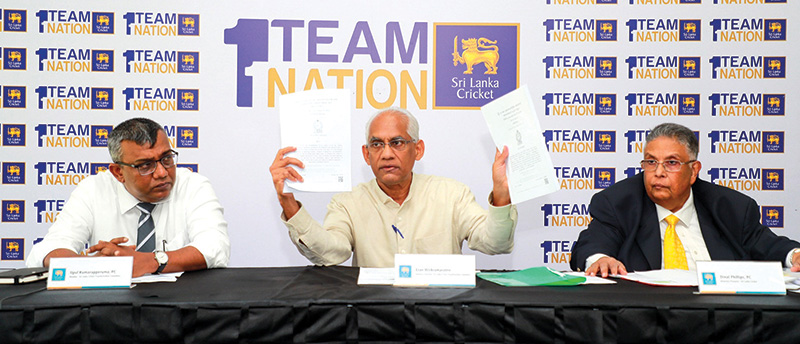
The proposed new constitution for Sri Lanka Cricket is now in the public domain and has understandably become the talking point among stakeholders of the great game. There is considerable excitement that the new constitution could usher in an era of professionalism and accountability in cricket administration. Inevitably, there are also parties with vested interests painting a grim picture. Their warnings need to be taken with a generous pinch of salt.
One of the most significant proposed changes is that cricket officials will function essentially as a Board of Directors, responsible for policy and strategic decisions, while the day to day running of SLC will be entrusted to a qualified Chief Executive Officer and other professionals chosen through a rigorous screening process.
For years, SLC’s chief executives have come from cricketing backgrounds. There is nothing inherently wrong with that, but the proposed structure allows the net to be cast much wider. It opens the door for an accomplished corporate professional to run the organisation, helping SLC keep pace with the increasingly sophisticated manner in which cricket boards around the world operate.
The appointed directors, too, will largely come from corporate backgrounds, with a renowned former cricketer also among them. More importantly, the proposed structure creates the possibility of someone of the calibre of Roshan Mahanama or Kumar Sangakkara becoming Chairman of the Cricket Board, a scenario virtually unimaginable under the present electoral system.
Will a new board or a revamped electoral process transform the fortunes of the national team overnight? Certainly not. Constitutions do not score hundreds or take five wicket hauls. What good governance can do, however, is create the platform from which a stronger Sri Lankan team can emerge.
One of Sri Lankan cricket’s biggest self inflicted wounds came about a decade ago when SLC expanded the First Class competition to as many as 25 teams. Quantity overwhelmed quality and the competition became hopelessly diluted.
The current administration has now trimmed the First Class competition to ten teams and upgraded matches from three days to four. Such sweeping reform would have been extremely difficult under an administration dependent on club votes. Asking elected officials to reduce the number of voting clubs is rather like asking turkeys to vote for Christmas.
That has been the fundamental weakness of the system.
Administrators elected to office have traditionally followed one cardinal rule: keep happy the member clubs, provinces and district associations that vote them into power. In doing so, they have often been reluctant to take the bull by the horns and make difficult decisions in the wider interests of Sri Lankan cricket.
Merit, too, has not always been the only consideration when positions have been handed out. A recent independent assessment found that several coaches employed at district and provincial levels were simply not up to the required standard. When favouritism creeps into professional appointments, cricket inevitably pays the price.
The new constitution should probably have arrived a decade ago. Sadly, successive governments since 2016 lacked the political will to confront the deep rooted problems afflicting cricket administration.
Both the SLFP and UNP have proud links with the game, with party stalwarts ranging from J.R. Jayewardene to Lakshman Jayakody having served cricket with distinction. Yet when reform was desperately required, successive governments turned a blind eye and sided with the elected office bearers running the show.
Dayasiri Jayasekara, Faizer Mustapha, Harin Fernando and Namal Rajapaksa all served as Sports Ministers during this period. Yet, despite the national team’s fortunes steadily deteriorating, meaningful structural reform remained elusive. Some ministers even strengthened the hand of elected officials by extending Shammi Silva’s term limit or permitting Extraordinary General Meetings and Special General Meetings that consolidated his authority.
The public, meanwhile, grew increasingly frustrated with the direction in which the game was heading. Of those former Sports Ministers, Dayasiri narrowly survived to secure a seat in the present Parliament, while the others were rejected at the polls. Namal Rajapaksa subsequently returned to Parliament through the National List.
Credit, therefore, must go to the NPP government for displaying the political will to tackle an issue successive administrations preferred to kick down the road.
The proposed reforms appear to have struck a responsive chord with a large section of cricket loving Sri Lankans. There will be debate, opposition and inevitably legal scrutiny. That is healthy. Once the Supreme Court has made its observations and Parliament has had its say, Sri Lankan cricket will hopefully have a governance structure fit for purpose.
No constitution can guarantee runs, wickets or trophies. But it can ensure that the people making decisions are accountable, qualified and free from the obligation of keeping a voting bloc sweet.
Sri Lankan cricket has waited far too long for that change.
Better late than never.
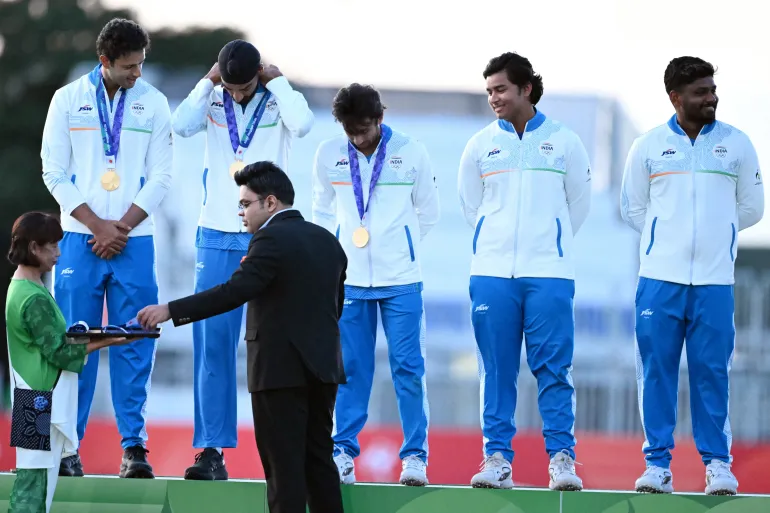
India beat their fierce rivals Pakistan by 19 runs to win Asian Games cricket gold after a pulsating final in front of a small but raucous crowd in Nagoya, Japan.
World T20 champions India posted 211-6 in their 20 overs on Saturday, with Abhishek Sharma scoring 61 and Tilak Varma 51 not out, before Hasan Nawaz’s valiant 96 saw Pakistan come up just short at 192-6.
It was India’s seventh straight win over Pakistan in T20s and the fifth consecutive men’s game between the two bitter rivals where players didn’t shake hands — both before and after the game.
The neighbouring countries only meet in international tournaments and on neutral ground because of political tensions, and the captains refused the normal handshakes before the match.
The medal ceremony was also substantially delayed before ICC chairman Jay Shah appeared first to present the medals, as twice announced by the official Asian Games broadcast.
Only the Indian players were presented with medals, however, by Shah, who is the son of India’s Interior Minister Amit Shah and a former BCCI secretary.
Pakistan and bronze medallists Sri Lanka were presented with their medals by Asian Games officials.
As before the contest, no handshakes took place at the end of the match or during the medal ceremony.
No reason has been given for the delay or the apparent change to the medal ceremony plans. Al Jazeera has asked the Asian Games for comment.
The clash on a converted baseball field in Japan was new ground for even these bitter enemies and their hundreds of millions of fans who were watching back home on TV.
(Aljazeera)

Showers or thundershowers will occur at several places in the most part of the island after 1.00 p.m

Geneva takes up Sallay’s case and govt. ignores opportunity to answer accusations

Section of wartime KKS High Security Zone vacated to facilitate economic development in the area

Lawyer lodges complaint against Govt. Printer, Media Ministry Secy.

Sri Lankan troops in joint anti-terrorist exercise in Russia

Nine Indian poachers brought to KKS with their boat

‘Dates have the highest sugar content to fight Coronavirus’

Sunday Island 27 December – Headlines

#SundayIsland 17th December – Headlines

Sunday Island – 28th March

Sunday Island Headlines – 21 March

Sunday Island – 21st February – Headlines
-

 Latest News6 days ago
Gold winner Tharanga gets brand-new Honda Vezel from SLAAJ
-

 Features6 days ago
Why Sri Lanka needs an Inclusive Civic Nationalism – urgently
-

 News5 days ago
US-assisted ‘Ice’ detection: NPC to examine IGP’s move to transfer drug-busting team
-

 Features7 days ago
Thailand’s biggest new global star …
-
 News7 days ago
First cases taken up by SC after enactment of 22A dismissed
-

 News6 days ago
Civil society activist accuses govt. of favouring Ven. Gnanasara
-

 Editorial4 days ago
Colombo Port drug bust: The plot thickens
-

 Editorial7 days ago
Aftershocks of 22A