
News
SLPP ally questions order to pay back wages of Dr. Shafi


By Shamindra Ferdinando
The National Freedom Front (NFF) says the ongoing investigations into Dr. Shafi Shahabdeen’s alleged involvement in Easter Sunday attackers and nonconseual sterilisation of women in Kurunegala had been seriously weakened by the government’s controversial decision to pay him back wages.
The Constituent party of the ruling Sri Lanka Podujana Peramuna (SLPP) yesterday (20) called a special media conference at its Pitakotte party office to explain how the government had undermined multiple investigations, including one handled by the CID much to the dismay of the Easter Sunday victims and those sterilised against their wishes.
State Minister Jayantha Samaraweera flayed the Public Service Commission and the Health Ministry over the payment of back wages and reinstatement of Dr. Shahabdeen. However, Health Minister Keheliya Rambukwella’s Office in a statement issued on Dec 17, at the onset of the controversy, stressed that Dr. Shahabdeen hadn’t been reinstated though the Director, Kurunegala Hospital was instructed to pay his back wages.
Lawmaker Samaraweera, who represents the six-member NFF parliamentary group, said that they were quite surprised the way attempts were being made to undermine the investigations taking place at a snail’s pace. The Kalutara District MP alleged that under the current dispensation, too, investigations were being handled in a shoddy manner. According to him, the then Health Secretary Wasantha Perera following an investigation conducted by the Director, Kurunegala Hospital had sent Dr. Shahabdeen on compulsory leave, instead of initiating a proper inquiry under the PSC. MP Samaraweera claimed that Dr. Shahabdeen had been sent on compulsory leave with a view to saving him and that had happened now.
Dr. Shahabdeen was granted bail in July 2019.
State Minister Samaraweera sought an explanation from law enforcement authorities regarding Dr. Shahabdeen’s alleged involvement with Easter Sunday terror attacks mastermind Zahran Hashim. The lawmaker claimed that Dr. Shahabdeen had been investigated for giving access to an associate of Zahran Hashim Rs 440 mn. The alleged connection came to light following an arrest made after the 2019 Easter Sunday blasts, the State Minister said.
Lawmaker Samaraweera said that the CID recorded statements from 601 Kurunegala women whereas 8,000 were believed to have been sterilized over a period of time.
Responding to allegations, the Health Ministry said that the Health Services Committee of the PSC on June 11, 2019 approved that Dr. Shahabdeen be sent on compulsory leave. This was in line with recommendations made by a six-member expert committee that inquired into sterilization of Sinhala women during Dr. Shahabdeen’s tenure at the Kurunegala hospital, the health ministry spokesperson said.
The expert committee, in an interim report dated January 20, 2020 that had been submitted to the PSC recommended he be placed further on compulsory leave to enable the continuation of the investigations, the ministry spokesperson said.
In spite of Dr. Shahabdeen being granted bail and repeated requests to relevant authorities to reinstate him the Health Services Committee of the PSC on Oct 12, 2020 recommended that he be continued to be placed on compulsory leave, the spokesperson said, adding that on Oct 27, 2020, Dr. Shahabdeen requested the PSC and the Health Secretary again that he be reinstated and paid back wages, the ministry official said.
Subsequent to that intervention, the Director of the Kurunegala Hospital had been directed to pay Dr. Shahabdeen’s back wages and also sought an explanation as to why the payment was not made earlier in terms of the relevant sections of the Establishment Code. Accordingly, the Health Ministry has issued necessary instructions for the payment of back wages though Dr. Shahabdeen hadn’t been reinstated.
State Minister Samaraweera attacked the decision on the part of the health ministry to call for an explanation from Director Kurunegala Hospital in that regard. The former JVPer accused the government of illegally influencing in Dr. Shahabeen’s case at a time the administration was under fire from the Catholic Church over the ham-fisted handling of the Easter Sunday case.





Bus fares have been increased by 12.19% with effect from midnight today [23rd March 2026].
The minimum fare will be increased from Rs 27 to Rs 30 while the maximum fare of Rs2159/- will be increased to 2422/-
Latest News
Public will not be served as Computer system failure at Department of Registration of Persons

The Acting Commissioner General of Registration of Persons has announced that due to an unexpected failure of the computer system of the Department of Registration of Persons, all services, including the one day service will not be held on Tuesday (24th March) at the Head Office and all Provincial offices.

Latest News
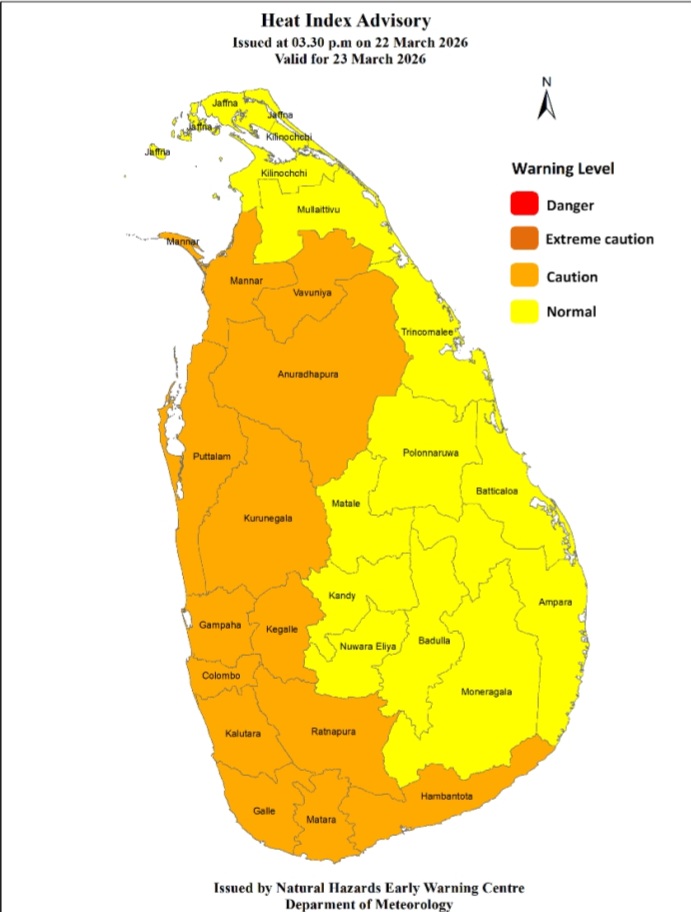
Heat Index at Caution Level in the Western, Sabaragamuwa, Southern and North-western provinces and in Anuradhapura, Mannar and Vavuniya districts
Warm Weather Advisory
Issued by the Natural Hazards Early Warning Centre of the Department of Meteorology
at 3.30 p.m. on 22 March 2026, valid for 23 March 2026.
The Heat index, the temperature felt on human body is likely to increase up to ‘Caution level’ at some places in the Western, Sabaragamuwa, Southern and North-western provinces and in
Anuradhapura, Mannar and Vavuniya districts.
The Heat Index Forecast is calculated by using relative humidity and maximum temperature and this is the condition that is felt on your body. This is not the forecast of maximum temperature. It is generated by the Department of Meteorology for the next day period and prepared by using global numerical weather prediction model data.
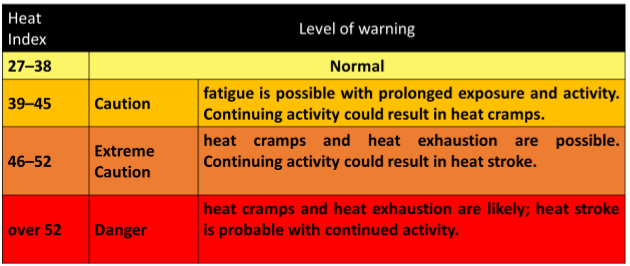
Effect of the heat index on human body is mentioned in the above table and it is prepared on the advice of the Ministry of Health and Indigenous Medical Services.
ACTION REQUIRED
Job sites: Stay hydrated and takes breaks in the shade as often as possible.
Indoors: Check up on the elderly and the sick.
Vehicles: Never leave children unattended.
Outdoors: Limit strenuous outdoor activities, find shade and stay hydrated.
Dress: Wear lightweight and white or light-colored clothing.
Note:
In addition, please refer to advisories issued by the Disaster Preparedness & Response Division, Ministry of Health in this regard as well. For further clarifications please contact 011-7446491.

Two killed when Air Canada jet hits fire truck at NYC’s LaGuardia Airport

Bus fares increased by 12.19% from midnight today [23]
Public will not be served as Computer system failure at Department of Registration of Persons

Trump says he is postponing strikes on Iran power plants after ‘productive’ talks on ending war

Asia stocks slide as US and Iran threaten to escalate war

Heat Index at Caution Level in the Western, Sabaragamuwa, Southern and North-western provinces and in Anuradhapura, Mannar and Vavuniya districts

‘Dates have the highest sugar content to fight Coronavirus’

Sunday Island 27 December – Headlines

#SundayIsland 17th December – Headlines

Sunday Island – 28th March

Sunday Island Headlines – 21 March

Sunday Island – 21st February – Headlines
-

 News6 days ago
CIABOC questions Ex-President GR on house for CJ’s maid
-

 News7 days ago
Sri Lankan marine scientist Asha de Vos honoured at UNGA opening
-

 News7 days ago
Australian HC debunks misleading travel risk claims for Sri Lanka
-

 News5 days ago
Bailey Bridge inaugurated at Chilaw
-
 Latest News7 days ago
Wednesdays declared a government holiday with effect from 18th March
-

 News5 days ago
Pay hike demand: CEB workers climb down from 40 % to 15–20%
-

 News4 days ago
CIABOC tells court Kapila gave Rs 60 mn to MR and Rs. 20 mn to Priyankara
-

 Editorial6 days ago
Couple QR-based quota with odd-even rationing