News
SL joins American Georgia State University’s global Cosmic Ray Muon Detector network
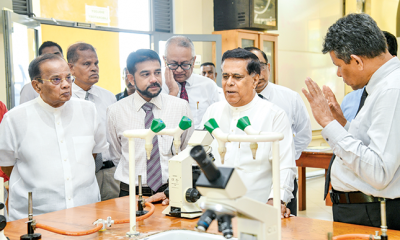
Sri Lanka became the very first country (outside the USA) to deploy Georgia State University’s (GSU) Cosmic Ray Muon Detector. Sri Lanka now becomes GSU’s first international member as a part of its ongoing deployment plan for a global muon detector network and hosts a detector each at two strategic locations – Badulla, hosted at the University of Uva Wellassa campus, and Colombo, hosted at the University of Colombo campus, according to a press release issued by Prof. Unil Perera of GSU.
These two detectors have started logging data since end of March, and the data is being shared between the campuses and communicated to a central repository, managed by the GSU team in Atlanta, Georgia. The data from the detectors consists of raw muon counts (flux) sampled at one-minute intervals, which will be comprehended with meteorological data from open data sources and meteorology department collaborations. These datasets, along with the datasets generated by the entire network of muon detectors that have been deployed and those that will be deployed in near and far future, will be made available for free access to promote climate and other inter-disciplinary research across the globe.
Cosmic rays are high energy particles moving through space at nearly the speed of light and are one of the few direct samples of matter from outside our solar system. Most cosmic rays are protons (i.e., ionized hydrogen nuclei) with galactic origins. Other cosmic ray particles include gamma rays, electrons, neutrinos, and heavier elements. Protons could be deflected by magnetic fields making it hard to determine their origin.
Discovered in 1912, many things about cosmic rays remain a mystery more than a century later. Cosmic ray radiation has been blamed for causing electronics problems in satellites and other machinery. Earth’s magnetic field and atmosphere shield the planet from 99.9 percent of the radiation from space. However, for people outside the protection of Earth’s magnetic field, space radiation becomes a serious hazard. A previous Mars rover mission during its 253-day cruise revealed that the radiation dose received by an astronaut on even the shortest Earth-Mars round trip is equivalent to receiving a whole-body CT scan every five or six days.
This cosmic ray detector network deployment in Sri Lanka was spearheaded by GSU and led by computer scientist and engineer Dr. Ashwin Ashok (Associate Professor, Computer Scientist), nuclear/particle physicist Dr. Xiaochun He (Regents’ Professor, Physics and Astronomy), and device and biomedical physicist A. G. Unil Perera (Regents’ Professor, Physics and Astronomy). The team visited Sri Lanka to set up two cosmic ray muon detectors at the Faculty of Applied Sciences, Uva Wellassa University (UWU) in Badulla, and the Department of Physics at the Faculty of Science at the University of Colombo (UOC). Professor Jagath Pitawala and Dr. Rasanga Samaraweera (a former GSU graduate) will lead the project at UWU. Prof. Upul Sonnadara, Dr. Kithsiri Jayananda, and Mr. Deshitha Wickramarathna will be the lead team working at UOC on the project. The cost of the detectors, associated electronics and travel costs were borne by GSU, with an agreed official memorandum of understanding (MoU) and a material transfer agreement (MTA). The participants (including the researchers) will have access to the worldwide data and will be equal partners of the network of scientists studying the effects of the variation of muon flux with exogenous parameters such as elevation, time of the year and ambient temperature and pressure.
At present GSU has five cosmic ray detectors installed in the USA, three in Atlanta at the GSU main campus, another at Mount Wilson, California (GSU Chara Array cite) and at the Hard Labor Creek Park Observatory, (another GSU observatory in Rutledge, GA). In addition to the two detectors in Sri Lanka, the next stage of international installations is planned for a subset of countries in Asia and Europe. The main goal of the project at the near-term is to install more detectors at collaborating institutions worldwide and to study the variations of cosmic ray muon flux which are associated with the regional weather patterns and with the changes in space weather. The long-term goal is to install detector(s) in every country in the world and to use the network for several interdisciplinary studies which include space and terrestrial weather monitoring, public health (related to cosmic ray radiation), and other practical applications based on cosmic ray particle studies.
GSU is a “research one-R1” public University in the USA (recognized as one of the most research-intensive institutions by the Carnegie Classifications with at least 20 research or scholarship-based doctoral degrees and spend at least $5 million on research each year) and the nation’s second most innovative university in the US (US News and World Report) with more than 250 different majors and 35 different PhD programmes, has a fruitful connection with Sri Lanka. GSU has graduated more than 30 Sri Lankan students with Physics doctorates in addition to several doctorates in Computer Science, Biology, Chemistry, etc. Several of those GSU doctorates, particularly from Physics, are working as productive faculty members at several Sri Lankan universities and other reputed research laboratories around the globe.
Professor Unil Perera, a UOC alumni, who was also the graduate Director of Physics at GSU from 1995-2012, had established several joint programmes GSU, IIT Chennai and IFS, Hanthana and with UOC. GSU proudly and cordially welcomes this research collaboration and hopes to pursue these ties for a long term and further the cordial USA-Sri Lanka relationship.

News
Navy seizes an Indian fishing boat poaching in northern waters
During an operation conducted in the dark hours of 27 Dec 25, the Sri Lanka Navy seized an Indian fishing boat and apprehended 03 Indian fishermen while they were poaching in Sri Lankan waters, south of the Delft Island in Jaffna.
The seized boat and Indian fishermen (03) were brought to the Kreinagar Jetty and were handed over to the Fisheries Inspector of Jaffna for onward legal proceedings.
News
Delay in govt. response to UK sanctions on ex-military chiefs, and others causes concern
Admiral of the Fleet Wasantha Karannagoda said that he is still waiting for the government’s response to the UK sanctions imposed on three ex-military officers, including him, and a former member of the LTTE.
The former Navy Chief said so in response to The Island query whether he was aware of the position taken by a three-member ministerial committee, consisting of Foreign Minister Vijitha Herath, Justice and National Integration Minister Harshana Nanayakkara and Deputy Defence Minister Maj. Gen (retd) Aruna Jayasekera.
The government named the committee in the wake of the UK declaration of travel bans and asset freezes in respect of Karannagoda, General Shavendra Silva, General Jagath Jayasuriya and Vinayagamoorthy Muralitharan, also known as Karuna. Maj. Gen. Jayasekera said that they inquired into the issue at hand.
Karannnagoda said that he would like to know the government’s recommendations if the ministerial committee briefed the Cabinet as per a decision taken by the Cabinet of Ministers. Karannagoda said that the issue should have been taken at the highest level as various interested parties continue to humiliate the war-winning military by targeting selected individuals.
Other sources, familiar with the issues at hand, told The Island that the government was yet to announce its stand.
Sources pointed out that the Opposition has been silent on what they called a matter of utmost national importance.
Cabinet spokesman Dr. Nalinda Jayathissa is on record as having described the UK move as a unilateral move and that committee was formed to examine the developments and recommend appropriate measures to the Cabinet.
Foreign Minister Herath told The Island the government was not successful in getting the British to withdraw sanctions. Describing the UK decision as unilateral, the Miniser said that the government conveyed its concerns but the UK didn’t change its stand.
The Island raised the issue with Minister Herath and Admiral Karannagoda in the wake of British MP of Sri Lankan origin, Uma Kumaran requesting the UK Foreign Secretary Yvette Cooper to expand on the government’s sanctions imposed on the four above-mentioned persons.
During a Foreign Affairs Committee meeting on 16 December, the MP for Stratford and Bow highlighted the lack of accountability and political will from the current Sri Lankan government to address war crimes and mass atrocities committed in Sri Lanka.
Sources said that David Lammy, who served as Secretary of State for Foreign, Commonwealth and Development Affairs at the time of the declaration of sanctions, had no qualms in declaring that the action taken against four Sri Lankans was in line with a commitment he made during the election campaign to ensure those responsible wouldn’t be allowed impunity. The UK government statement quoted Lammy as having said that this decision ensured that those responsible for past human rights violations and abuses were held accountable.
By Shamindra Ferdinando
News
Sri Lanka outlines seven key vectors of international cooperation at Moscow forum
Sri Lankan Ambassador to the Russian Federation, Shobini Gunasekera recently presented a conceptual framework of seven key vectors that defined contemporary international relations and facilitated dialogue among States. She made the presentation at XI Moscow International Financial and Economic Forum held under the theme “Building Bridges: Partnership without Borders”.
In her address, the Ambassador emphasised that these vectors represent the channels through which ideas circulate, trade expands, and peace is strengthened, serving as guiding principles for cooperation amid global uncertainties. The seven key vectors highlighted were economic ties as a foundation for long-term stability; political choice and diplomacy through dialogue and multilateral engagement; security cooperation to address cross-border threats; cultural linkages through education, tourism, and professional exchanges; technological advancement, particularly in digital systems and artificial intelligence; environmental stewardship through collective action on renewable energy and climate change; and humanitarian obligations, including disaster relief and development cooperation.
Drawing on Sri Lanka’s experience, the Ambassador illustrated the practical application of these principles by highlighting the country’s strategic location in the Indian Ocean, its role as a trade and logistics hub, and its active engagement in regional groupings such as BIMSTEC and the Indian Ocean Rim Association, where the Russian Federation serves as a Dialogue Partner.
The potential for enhanced Sri Lanka–Russia bilateral cooperation was underscored, particularly through complementarities between Russia’s technological and energy expertise and Sri Lanka’s logistical capabilities and maritime infrastructure. She noted that such synergies could support joint initiatives in trade, innovation, tourism, and logistics, while cultural and scientific exchanges would further strengthen mutual understanding between the two countries.
Concluding her remarks, the Ambassador stated that sustained progress requires dialogue, mutual respect, and forward-looking partnerships capable of shaping a shared and stable future.
-
News7 days agoMembers of Lankan Community in Washington D.C. donates to ‘Rebuilding Sri Lanka’ Flood Relief Fund
-
News5 days agoBritish MP calls on Foreign Secretary to expand sanction package against ‘Sri Lankan war criminals’
-
Features7 days agoGeneral education reforms: What about language and ethnicity?
-
News7 days agoSuspension of Indian drug part of cover-up by NMRA: Academy of Health Professionals
-
Sports5 days agoChief selector’s remarks disappointing says Mickey Arthur
-
News4 days agoStreet vendors banned from Kandy City
-
Editorial7 days agoA very sad day for the rule of law
-
News7 days agoUS Ambassador to Sri Lanka among 29 career diplomats recalled