
Business
Singer’s legendry sewing industry and Academies developing skills and entrepreneurship in Sri Lanka

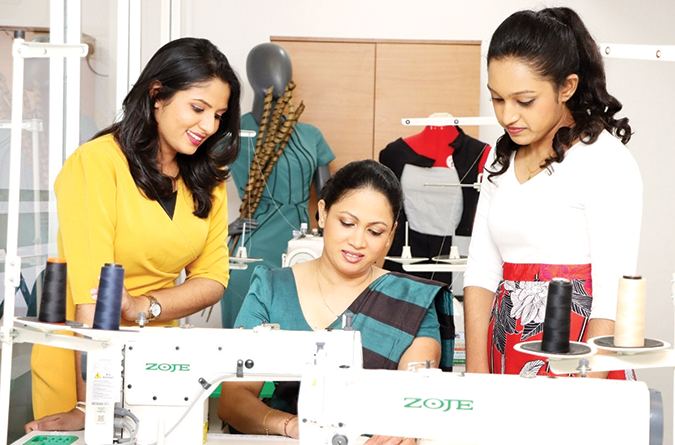
A name synonymous with Singer (Sri Lanka), Singer sewing machine has over the years become an indispensable product at local households, helping thousands of women and men to make a living through a sewing business. For over six decades, Singer has been manufacturing its trademark sewing machines in Sri Lanka. Singer brand has claimed many firsts in sewing machine innovations including the world’s first zig-zag machine and the first electronic sewing machine.
Singer Industries, a subsidiary of Singer (Sri Lanka) manufactures traditional, portable and digital sewing machines at a fully-fledged facility, where it provides direct employment for over 100 factory workers and accommodates around 150 service agents. The traditional sewing machines are of two variants such as the straight stich and the zig-zag sewing machine, while the portable and digital sewing machines cater to the modern customers. Singer Industries is mandated with assembly of sewing machines and manufacturing of cabinets and stands for sewing machines.
The sewing machine stands and cabinets are 100% locally manufactured with the help of local suppliers who also depend from sewing machine manufacturing. Singer Industries also consists of a strong R&D section for sewing machine innovations. All the sewing machines produced by Singer Industries are distributed by its parent company, Singer (Sri Lanka) through their 431 distribution touch points. Currently, Singer sustains its dominance as the market leader for domestic sewing machine industry with a market share of 85%. Among the facilities, Singer Industries provides to its customers, it has deployed special service technicians at island wide service centres for technical assistance and support related to sewing machines. Its YouTube channel has access to over 130 technical assistance videos to further support its valued customers.
The name ‘’Singer’’ is closely associated with sewing. One of its major contributions to the local sewing industry is the Singer Fashion Academy. For more than 60 years, the Academy has helped thousands of individuals to develop sewing skills and become entrepreneurs. The Fashion Academy conducts sewing courses and diplomas while a degree pathway is to be implemented soon to further support students. The Academy is also the first and only institute in the country to receive course validation status from the Chartered Society of Designers (CSD) in the UK.
As of today, the academy consists of 54 branches Island wide and offers 22 sewing courses, 2 diplomas and another 10 courses as part of its Diwi Saviya program for low-income families. Annually, over 5000 – 6000 students get enrolled in Singer Fashion Academy’s courses. In addition to the physical classes, the academy conducts online courses and also provides a recorded version of lessons to further facilitate students. During the last decade, over 60,000 students have successfully completed the Fashion Academy’s courses and some of these students have already started their own sewing businesses. The Fashion Academy has helped in developing the passion of sewing among Sri Lankans and as a result, sewing has become a hobby among many.
Sewing can be considered one of the most feasible self-employment opportunities with its potential to generate a good income. A business of one’s own is a luxury at present due to current economic crisis. Many individuals who started their sewing businesses from scratch have developed their businesses to highly profitable ones. Singer Fashion Academy has all the resources ready to help develop sewing skills and is committed to develop a skilled workforce for the betterment of the country.
(Company news release)


Salesforce, the world’s leading AI-powered CRM platform, is set to expand its presence in Sri Lanka with the launch of the Salesforce Startup Program by the end of January 2026, signalling growing confidence in the country’s technology-led growth potential.
The move comes as Sri Lanka consolidates its position as the second-largest startup ecosystem in South Asia after India, with software, data and artificial intelligence-driven ventures accounting for nearly 60 per cent of the national startup base.
Industry observers say this concentration places Sri Lanka at a decisive stage where global exposure and enterprise access could unlock the next phase of scale.
Under the programme, Sri Lankan startups will gain access to Salesforce’s global ecosystem, including AI-powered platforms, business and technical mentorship, joint go-to-market opportunities and connections to enterprise customers, enabling founders to build globally competitive solutions from Sri Lanka.
“Sri Lanka has developed a strong base of technical talent and entrepreneurial ambition that is increasingly visible regionally and globally,” said Arundhati Bhattacharya, President and CEO of Salesforce South Asia.
“Through the Salesforce Startup Program, we aim to help startups move beyond early momentum to global relevance while delivering long-term economic impact,” he added.
He also said the initiative builds on the success of its Startup Program in India and Singapore, which today supports over 435 startups, including more than 230 AI-first companies. Several participants have expanded across Asia and beyond by building products natively on the Salesforce platform.
Responding to queries, he said Sri Lanka is also emerging as an important enterprise market for Salesforce, with major corporates such as John Keells Holdings and Cinnamon Hotels adopting the platform to modernise customer engagement, sales, marketing and loyalty management operations.
In parallel, Salesforce is strengthening the country’s digital talent pipeline through its Trailhead learning ecosystem, with plans to skill nearly 1,000 learners over the next year via local workforce development partners and community-led cohorts.
Chamil Madusanka, Head of Salesforce Practice and Salesforce Architect, said the programme arrives at a critical juncture for Sri Lanka’s startup ecosystem.
“Sri Lankan founders are increasingly building AI, data and enterprise software solutions with global relevance,” Madusanka told The Island Financial Review.
“What many startups need is structured access to enterprise customers, global mentorship and market exposure. This initiative creates that bridge, enabling local companies to scale faster while remaining rooted in Sri Lanka.”
He said the Startup Program is designed to act as a connective platform, bringing together startups, enterprises, technology partners, universities and developer communities to accelerate collaboration and innovation.
By Ifham Nizam ✍️

CSE activities were extremely bullish yesterday following Central Bank Governor Dr Nandalal Weerasinghe’s announcement that Sri Lanka’s foreign reserves had risen to US $ 6.8 billion in December 2025, up US$ 791 million from November 2025.
The Governor provided the estimated economic growth while announcing the Central Bank’s policy agenda for this year.
In December Sri Lanka received budget support loans from the Asian Development Bank and the International Monetary Fund.
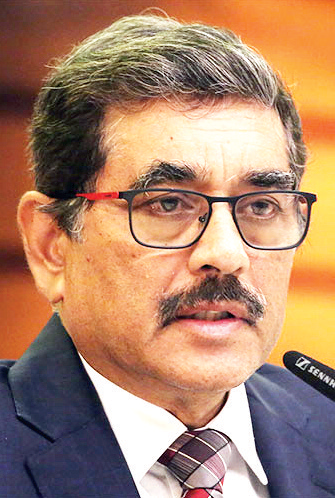
Dr Nandalal Weerasinghe
Amid these developments both CSE indices moved upwards. The All Share Price Index went up by 226.81 points, while the S and P SL20 rose by 100.01 points. Turnover stood at Rs 12.3 billion with 12 crossings.
Top seven crossings that mainly contributed to the turnover were: Lee Hedges 18.2 million shares crossed to the tune of Rs 3.9 billion; its shares traded at Rs 416, Commercial Bank 2.1 million shares crossed for Rs 467.6 million; its shares traded at Rs 215, Ceylon Hotels 429,000 shares crossed for Rs 128.7 million; its shares traded at Rs 300, LB Finance 650,000 shares crossed for Rs 105 million; its shares sold at Rs 152.50, Ceylinco Holdings 31000 shares crossed for Rs 104.5 million; its shares traded at Rs 3400, Melstacorp 200,000 shares crossed tfor Rs 35.7 million; its shares sold at Rs 178.50 and Three Acres Farm 400,000 shares crossed to the tune of Rs 29.6 million; its shares fetched Rs 740.
In the retail market top seven companies that mainly contributed to the turnover were; Wealth Trust Securities Rs 1.17 billion (55.8 million shares traded), Commercial Bank Rs 509 million (2.4 million shares traded), HNB Rs 370 million (870,000 shares traded), ACL Cables Rs 303 million (three million shares traded), Prime Lands Residencies Rs 283 million (7.9 million shares traded), Lanka Realty Rs 227.5 million (4.7 million shares traded) and HNB Rs 218 million (332,000 shares traded). During the day 223.7 million share volumes changed hands in 55116 transactions.
Yesterday, investor interest in Wealth Trust and banking stocks led to higher activity levels, brokers said. Further, the real estate sector also performed well. Lanka Realty Investments PLC acquired 51 percent of the total number of shares in issue of Lee Hedges, CSE sources said. 13,057,595 ordinary voting shares were bought at Rs 216 each.
Yesterday the rupee opened at Rs 310.12/18 to the US dollar in the spot market, weaker from Rs 310.05/15 the previous day, dealers said, while bond yields opened marginally high.
By Hiran H Senewiratne ✍️

The Gamani Corea Foundation (GCF) is pleased to announce the launch of the monograph Development: Not By Economics Alone by Dr. Nimal Sanderatne, Emeritus Chairperson of the Foundation. The foreword to the publication has been written by Dr. Godfrey Gunatilleke, one of Sri Lanka’s most eminent development economists. The launch ceremony will be held on Friday, 9th January 2026, at 4.00 p.m. at the Horton Lodge.
In this monograph, Dr. Sanderatne argues that development cannot be understood through economic indicators alone. He emphasizes that the quality of human capital depends not only on knowledge and skills acquired through formal education, but also on deeper, non-formal processes embedded in a society’s culture and value systems. These influence human behaviour, shaping work ethics, attitudes to work and leisure, capacity for teamwork, preferences between short- and long-term goals, and patterns of saving and consumption.
Dr. Sanderatne is a distinguished economist and academic, holding degrees from the Universities of London, Saskatchewan, and Wisconsin, and was conferred the Doctor of Science (Honoris Causa) by the University of Peradeniya in 2004.

Landslide RED warnings issued to the Divisional Secretaries Divisions of Ududumbara, Nildadndahinna and Walapane

Harmanpreet, Mandhana return to DY Patil, on opposite sides this time

Huge anti-government protests in Tehran and other Iranian cities, videos show

Clinical Pakistan look to keep momentum going and wrap up series

Astronaut’s ‘serious medical condition’ forces Nasa to end space station mission early

Six whales die after mass stranding on remote New Zealand beach

‘Dates have the highest sugar content to fight Coronavirus’

Sunday Island 27 December – Headlines

#SundayIsland 17th December – Headlines

Sunday Island – 28th March

Sunday Island Headlines – 21 March

Sunday Island – 21st February – Headlines
-

 News3 days ago
Interception of SL fishing craft by Seychelles: Trawler owners demand international investigation
-
 News3 days ago
Broad support emerges for Faiszer’s sweeping proposals on long- delayed divorce and personal law reforms
-

 News4 days ago
Private airline crew member nabbed with contraband gold
-

 News2 days ago
Prez seeks Harsha’s help to address CC’s concerns over appointment of AG
-

 Opinion7 hours ago
The minstrel monk and Rafiki, the old mandrill in The Lion King – II
-

 Latest News1 day ago
Warning for deep depression over South-east Bay of Bengal Sea area
-

 News2 days ago
Govt. exploring possibility of converting EPF benefits into private sector pensions
-

 Features3 days ago
Educational reforms under the NPP government