
Business
Shortage of medicines likely to exacerbate from Paracetamol to life-saving drugs: SLCPI

by Sanath Nanayakkare
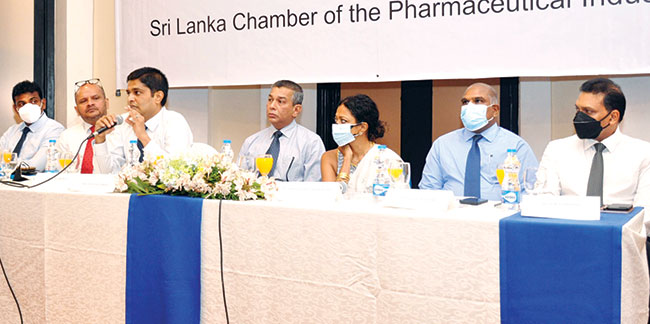
The current shortage of Paracetamol and Panadol in the market could aggravate to a situation where life-saving drugs would not be available to patients in a few months, Sri Lanka Chamber of the Pharmaceutical Industry (SLCPI) warned yesterday.
“This could happen if the US dollar shortage is not properly addressed and a realistic pricing formula for imported medicines is not introduced forthwith by the authorities,” they said.
“At present, the shortage of medicines is about 5%. One might say it is small or unimportant as to be not worth considering. But in 4-6 weeks from now it could increase to about 25%,” they warned.
SLCPI made these comments at a press briefing held at Taj Samudra Colombo.
“We have a fear. We want to update the general public of Sri Lanka on the current situation with regard to medicine imports because what is on the horizons is not good. Delays at the National Medicines Regulatory Authority (NMRA), the unrealistic price mechanism and the dollar crisis are biting our industry. The dollar crisis is common to every industry, but we also have a serious problem as medicine importers. Until last month, we didn’t have a major crisis. But this month and in the last two weeks, the banks have been advised to prioritise allocation of dollars for fuel purchases and it appears that medicine imports have received de-prioritisation on the list of essential imports. If this trend continues, we will have a serious problem in even importing life-saving drugs. At the moment, it is under control. We have to inform the general public of the evolving situation,” Azam Jaward, Vice President, SLCPI said.
“The last price increase on drugs was allowed in August 2021 when the USD was trading at Rs. 194. Now the dollar has incresed to Rs. 203 which is the ‘published rate’ by the Central Bank of Sri Lanka, but unfortunately there is no mechanism to address the current disparity in the exchange rate. We need asustainable pricing mechanism which addresses the exchange rate, freight rate, current global prices, inflation, cost of fuel etc,” they said.
“Our industry is quite energy-driven. Some drugs need to be stored in temperatures between 2- 8 Celsius. Some need -20 Celsius. If we don’t have electricity, we face big issues. We have to run generators and multiple storage facilities. At present, we are managing it. But all of this depends on the availability of fuel. To run a generator for 7-8 hours a day, we need 2,000 litres of diesel per day,” they said.
“The NMRA charges dollars from us to register a product. They adjust it monthly based on the change of the exchange rate. The government has a fee- charging mechanism based on the US dollar. Then why don’t they do the same for drugs that are imported for sale? These are two conflicting policies,” they argued.
“We don’t need a price increase. Just amend the prices relative to the value of the dollar. For this we need an intervention by the Central Bank. If we can obtain a monthly allocation of USD 25-30 million per month, we believe that we can supply essential drugs to the general public without any disruption,” they said.
“We have had discussions with the authorities on these matters and we have submitted these facts for them to consider, but we have not yet achieved any results other than discussions.There is undue delay at the NMRA in granting the re-registration of products which have been available in the market for a considerable period, and new product registrations. With regulatory fees increasing by an average of 11-fold, the service of the regulator is below expectation,” they said.
Some excerpts of the SLCPI press statement are reproduced below.
“Over 85% of pharmaceutical products are imported, and these imports are paid for by US dollars. The current US dollar shortage in the country has increased the difficulty of importing essential medicines. In addition to this, companies have been unable to pay their dues. As a result, suppliers are no longer interested in supplying to Sri Lanka.”
“The situation is further worsened as banks find it difficult to honour the Letters of Credit (LCs) that are opened to import drugs. Banks delay opening the LCs until there are sufficient dollars. This has resulted in shipments being scheduled according to the availability of dollars and not according to the needs of the patients.”
acceptable pricing mechanism as well as immediately ironing out NMRA red tape for registrations are prerequisites for resolving this crisis.”
SLCPI serves as the representative of over 60 members who account for more than 80% of the private pharmaceutical industry, spanning manufacturers, importers, distributors and retailers. These stakeholders supply Sri Lankan patients with 1,200 molecules from 435 manufacturers from across the world.
SLCPI told The Island that banks ask them to purchase dollars from exporters to finance their medicine imports, but when they reach exporters to buy their dollars, they ask Rs. 245 per US dollar which is the price in the gray market. “So, how can we buy dollars from them and import and sell at controlled prices?” they said.




Sri Lanka enters the new year confronting a familiar but deepening economic strain, with falling foreign reserves, a weakening rupee, rising public debt and mounting disaster-related losses posing what analysts describe as a decisive test of fiscal discipline and policy coherence.
Sri Lanka Human Rights Centre Executive Director and former Provincial Governor Ranjith Keerthi Tennakoon has warned that the country urgently requires a coordinated economic response to prevent further deterioration, particularly as the cost of post-disaster reconstruction threatens to exert fresh pressure on already strained public finances.
“While the government has succeeded in revenue augmentation through heavy taxation and repeated increases in electricity and gas tariffs, its performance in maintaining fiscal discipline remains weak,” Tennakoon said in an economic indicators statement issued on January 5.
According to figures cited by Tennakoon, Sri Lanka’s domestic debt stood at Rs. 17,595.05 billion when President Anura Kumara Dissanayake assumed office. By the end of September 2025, that figure had climbed to Rs. 18,701.46 billion, reflecting an increase of Rs. 1,106.41 billion within a year.
External debt has also trended upward. From Rs. 10,429.04 billion at the end of 2024, foreign debt rose to Rs. 10,974.34 billion by September 2025. As a result, Sri Lanka’s total public debt stock now stands at Rs. 29,675.81 billion, underscoring the scale of the country’s fiscal exposure.
“This trajectory raises serious concerns about long-term debt sustainability,” Tennakoon warned, noting that debt servicing costs will intensify further if currency depreciation continues.
Foreign reserves under pressure
The steady decline in foreign reserves remains one of the most critical challenges facing the economy. Gross official reserves fell from USD 6,531 million in March 2025 to USD 6,033 million by the end of November, a contraction of nearly USD 500 million.
Tennakoon cautioned that upcoming reconstruction needs following widespread floods and landslides will necessitate substantial imports of construction materials, machinery and industrial inputs, inevitably drawing down scarce foreign exchange reserves.
Although Sri Lanka managed to maintain a current account surplus in 2024, the balance slipped back into deficit during September and October 2025, before returning to surplus in November. While a surplus is not required at all times, Tennakoon said the November turnaround offered a “cautious but positive signal” regarding the economy’s direction.
The rupee’s depreciation continues to amplify macroeconomic risks. The exchange rate has weakened from Rs. 293.25 per US dollar last year to around Rs. 309.45, increasing the rupee cost of foreign debt servicing while driving up import and production costs.
More troubling, Tennakoon noted, is the widening gap between commercial bank exchange rates and the informal undiyal (black market) rate, reflecting growing uncertainty and eroding confidence.
“This was precisely how the 2021–2022 economic crisis began — with a widening divergence between official and informal exchange rates,” he warned.
The economic fallout from recent floods and landslides adds another layer of urgency. Tennakoon criticised the government for failing, thus far, to prepare a comprehensive estimate of financial losses and reconstruction costs.
Preliminary assessments by the World Bank estimate disaster-related losses at USD 4 billion, while the International Labour Organization (ILO) places the figure as high as USD 16 billion, equivalent to 16 percent of GDP.
“Massive tax resources will be required for relief payments, while reconstruction will demand substantial foreign exchange for imports,” Tennakoon said, stressing that the government must urgently prepare credible financial assessments to mobilise both domestic and international support.
He also warned that delays in providing adequate relief have already become a serious concern for displaced communities struggling to rebuild their lives.
By Ifham Nizam
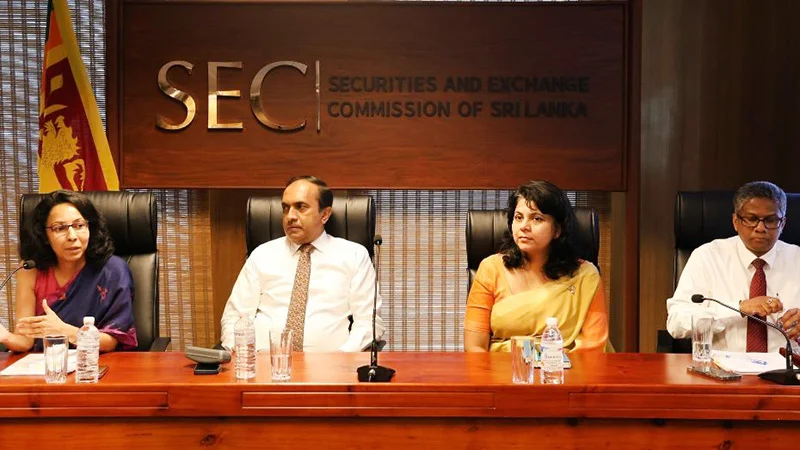
The Securities and Exchange Commission of Sri Lanka (SEC) in collaboration with the Colombo Stock Exchange (CSE) conducted an awareness session for Corporate Finance Advisors focusing on enhancing regulatory compliance and streamlining the listing process.
The forum brought together Corporate Finance Advisors and senior officials from the SEC and CSE to enhance the listing process by addressing regulatory expectations, identifying prevalent shortcomings in applications, and establishing best practices to strengthen investor confidence and market integrity.
Addressing the participants, Senior Prof. D.B.P.H. Dissabandara, Chairman, SEC highlighted the vital role Corporate Finance Advisors play in building market confidence beyond their traditional functions in facilitating listings, mergers, and acquisitions.
“Your screening process, your due diligence supports market confidence directly in addition to your key major roles,” the Chairman stated. “As a regulator, our main job is to look at investor confidence plus investor protection. And indirectly your job facilitates that as well.”
The Chairman emphasized that the overall reputation of the Sri Lankan capital market depends on the professional judgment and performance of Corporate Finance Advisors, as investors make decisions based on their assessments and recommendations.
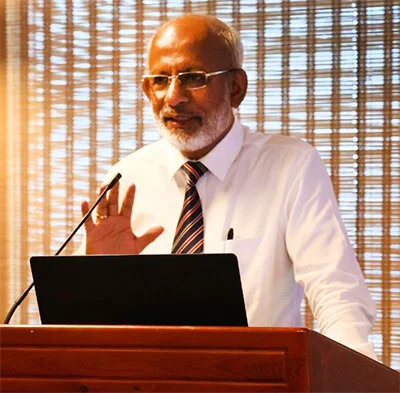
Senior Prof. D.B.P.H. Dissabandara
Reinforcing this message, Mr. Rajeeva Bandaranaike, Chief Executive Officer, CSE emphasized the importance of collaboration in improving market efficiency. “The objective is to completely revamp and improve the overall listing experience for companies and issuers,” he stated. “This is a journey that we need to go together with the community. We cannot do this alone.”
He also noted the complexity of public listings compared to bank financing, explaining that heightened scrutiny is necessary when dealing with public money. “At the end of the day, if the prospectus is not clean and accurate, we’re going to face problems. We don’t want companies going into the watchlist after one or two months of listing.”
Building on this framework, Ms. Kanishka Munasinghe, Vice President, Listing, CSE highlighted critical gaps in recent listing applications, particularly regarding litigation disclosure and legal due diligence. The CSE has expanded its disclosure requirements to cover not just financial impact but also operational continuity and licensing implications.
Business
nVentures leads US $200K seed round into Flash Health to scale cashless outpatient care in Sri Lanka

Flash Health, a Sri Lankan healthtech startup building cashless, on-demand outpatient care, has raised a US $200,000 seed round led by nVentures, with participation from angel investors across Sri Lanka, Singapore, and the United States.
The funding comes as Flash Health expands its footprint across insurers, large employers, and healthcare providers, positioning itself as one of the country’s most widely adopted digital outpatient platforms addressing everyday healthcare needs.
At the core of Flash Health’s offering is Cashless OPD, which allows employees and policyholders to access doctor consultations, medicines, diagnostics, and telemedicine services without paying out of pocket, removing upfront payments and simplifying access to address a long-standing friction point in everyday healthcare across emerging markets. The platform’s approach has also received global recognition, with Cashless OPD winning at the World Summit Awards, an UN-backed platform recognising startups advancing the Sustainable Development Goals, selected from over 900 applications across 143 countries. Commenting on the investment, Chalinda Abeykoon, Managing Partner at nVentures, said, “We first met Arshad and the Flash Health team in late 2023 and were immediately struck by their ethos, attention to detail, and culture of excellence. As we worked with the team to fine-tune their product roadmap and execution, we saw a team that listens, iterates, and delivers. Flash Health is now operating at real scale, which made this a clear investment decision for us.”
Flash Health’s growth has been driven by partnerships with leading insurance providers, including AIA, HNB Assurance, Janashakthi Insurance, and Union Assurance, enabling policyholders to access services such as medicine delivery, home lab testing, telemedicine consultations, and wellness incentives through integrated digital workflows.

Shadab, Mirza, Abrar set up Pakistan’s easy win in first T20I

Shadab, Dhananjaya back as Pakistan chase in first T20I

Russia sends navy to guard oil tanker being pursued by US forces

Landslide Early Warnings issued to the Districts of Badulla, Kandy, Matale, Monaragala and Nuwara Eliya

Indian gang rape survivor back home after a week in hospital

Brilliant Bethell hundred pushes SCG Test to fifth day but Australia on target for 4-1

‘Dates have the highest sugar content to fight Coronavirus’

Sunday Island 27 December – Headlines

#SundayIsland 17th December – Headlines

Sunday Island – 28th March

Sunday Island Headlines – 21 March

Sunday Island – 21st February – Headlines
-
 News2 days ago
Broad support emerges for Faiszer’s sweeping proposals on long- delayed divorce and personal law reforms
-

 News2 days ago
Interception of SL fishing craft by Seychelles: Trawler owners demand international investigation
-

 News3 days ago
Private airline crew member nabbed with contraband gold
-

 News5 days ago
Health Minister sends letter of demand for one billion rupees in damages
-

 News21 hours ago
Govt. exploring possibility of converting EPF benefits into private sector pensions
-

 News21 hours ago
Prez seeks Harsha’s help to address CC’s concerns over appointment of AG
-

 Opinion7 days ago
Remembering Douglas Devananda on New Year’s Day 2026
-

 Features2 days ago
Educational reforms under the NPP government