
News
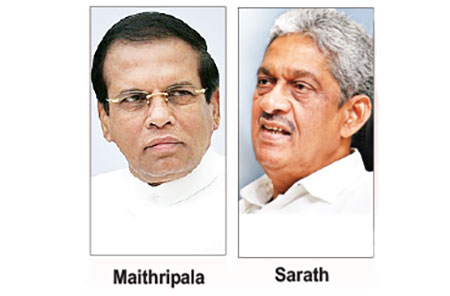
Sarath Fonseka disputes Sirisena’s monkey claim

By Saman Indrjaith
Former President Maithripala Sirisena yesterday told Parliament that the monkey population in the country had increased to become a serious problem.
Participating in the debate on the Government’s Policy Statement, the former President said that farmers were confronted with a serious issue where their crops were destroyed by animals.
He said that when he was the Agriculture Minister there were around one million monkeys in Sri Lanka. “However, today the number has increased to over two million monkeys,” Sirisena said adding that the increased monkey population had become a threat as they destroy the crops cultivated by the people.
“These animals are not harmed here because ours is a Buddhist country. In addition, there are animal rights groups who will oppose such an act,” he said.
Sirisena said that Sri Lanka was the only country where animals were given protection as opposed to food grown for human consumption.
He said that coconut cultivations were the most affected by the monkeys. “Suppose a single monkey destroys the harvest of a single tree to pluck one coconut, we would have to forego the harvest of around 1.5 million trees. This would result in a shortage of coconuts,” he said.
SJB Gampaha District MP Field Marshal Sarath Fonseka however said that Sirisena was wrong in his estimates. “It is wrong to assume that monkeys have nothing else to do but to engage in a campaign to destroy coconut trees. According to him, monkeys ate only coconuts and keep on plucking coconuts. That is far from the truth. Monkeys destroy other crops too. It is sad that he sees that as an issue of high importance. There are many other burning issues in this country,” Field Marshal Fonseka said.

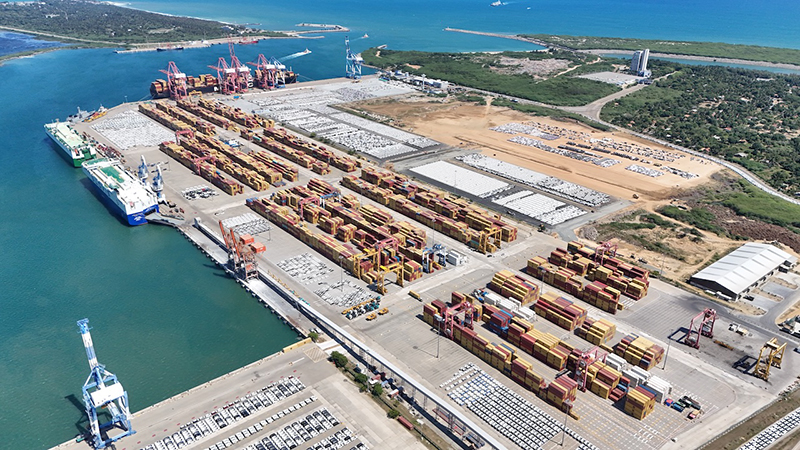
The ongoing West Asia war, triggered by joint Israel-US attack on Iran on 28 Februar, has benefited the China-run Hambantota International Port (HIP).With Iran imposing restrictions on the Strait of Hormuz shipping, in retaliation for unprovoked attack, thereby choking vital shipping routes, particularly for crude oil and refined oil products, HIP situated, along the East-West shipping corridor, has received the anticipated attention.
Soon after the sinking of an unarmed Iranian frigate, just outside Sri Lanka’s territorial waters, in India’s backyard, Indian External Affairs Minister Subrahmanyam Jaishankar categorised HIP as a foreign military base, along with Diego Garcia, Bahrain and Djibouti, where both the US and China maintained major bases.
HIP, in a press release issued on Sunday (05), declared that the Port has significantly expanded its operational capacity, in response to a sharp surge in global shipping volumes, resulting from the West Asia conflict.
The company asserted that the developing situation reinforced its position as a key alternative hub along the East–West shipping corridor.
The port has doubled its Roll-on/Roll-off (RoRo) yard capacity and increased its container yard capacity by 30%, as shipping lines divert operations away from disrupted routes in search of stable and efficient alternatives.
HIP is situated just 10 nautical miles from the main East–West shipping route, allowing vessels to divert with minimal deviation while maintaining schedule integrity.
The Chinese government-owned China Merchant Port Holdings (CMPort) under controversial circumstances acquired controlling interests of the Hambantota port in 2017 during the Yahapalanaya administration. Although the Sri Lankan government repeatedly said that Sri Lanka was paid USD 1.12 bn according to the HIP website CMPort invested $974 mn in the HIP and held 85 percent of the shares.
The 2017 agreement granted CMPort a 99-year lease to develop, manage and operate the Port area. The Supreme Court dismissed a fundamental rights petition filed by lawmaker Vasudeva Nanayakkara pointing out that the original agreements pertaining to the Hambantota port had been signed in 2012 and 2013 during Mahinda Rajapaksa’s tenure as the president when he was a member of the Rajapaksa Cabinet.
The HIP press release quoted CEO of HIP Wilson Qu as having said: “What we are witnessing today is a structural shift in global shipping patterns. At HIP, we have focused on building the capacity and operational agility to respond to such changes. Our ability to scale quickly, combined with our location, allows us to support global shipping lines when reliability becomes critical. Looking ahead, we will continue to invest in infrastructure and capabilities to strengthen Hambantota’s role as a key logistics and transshipment hub in the region.”
The rise in both vehicle transshipment and container volumes has driven yard utilization levels to the highest in HIP’s history, highlighting the scale of ongoing supply chain disruptions and the port’s growing strategic importance in global trade.
To accommodate increased throughput, HIP has rapidly expanded yard space across both cargo segments, enabling it to handle higher volumes while maintaining operational efficiency and minimizing congestion. Expanding capacity within a short time frame in a live port environment presents considerable operational and technical challenges and requires significant investment. However, through close coordination across management, engineering and operational teams, HIP was able to deliver these enhancements in step with rising demand.
The HIP statement added: “The expansion reflects Hambantota International Port’s continued development as a resilient logistics platform in the Indian Ocean, as geopolitical developments reshape established maritime routes and increase demand for alternative hubs. As infrastructure scales in tandem with demand, HIP is increasingly positioned to capture a larger share of regional transshipment volumes while supporting the continuity of global supply chains.”
Amidst the continuing uncertainty caused by war and growing threat to international shipping the Hambantota International Port Group (HIPG) the owning group of HIP recently finalised an agreement to invest USD 108 mn to procure new container handling equipment- six quay cranes, 16 rubber-tyred gantry cranes (RTGs) and 40 trailers, under the initial phase of the port’s Phase II container terminal development.
By Shamindra Ferdinando

A three-day “study visit” by the subject Minister to the Norochcholai coal power plant has triggered concern among power sector insiders, after he appointed his own batch-mate—reportedly a coal yard manager—as the acting head of the facility during a critical operational period.
Informed officials told The Island that the decision had raised serious questions about judgment and priorities at a time when the plant’s performance is crucial to maintaining national grid stability.
“This is not a routine period. The plant is under significant operational pressure, and any disruption could have island-wide consequences,”
one senior official said on condition of anonymity. “Yet the acting head is someone who has not directly managed plant operations.”
The Lakvijaya Power Plant at Norochcholai, the country’s largest coal-fired power station, has historically faced technical and maintenance challenges. Industry experts stress that leadership during sensitive periods—especially when demand is high—requires deep operational experience.
“Appointing a coal yard manager to oversee the entire plant, even temporarily, is highly irregular,” another official noted. “Coal handling is just one component. Running the plant requires a completely different level of technical and managerial expertise.”
Officials also expressed concern over the apparent bypassing of more qualified personnel within the plant’s existing operational hierarchy. “There are experienced engineers and senior managers who have handled plant operations during crises. Ignoring them undermines institutional capacity and morale,” a source added.
The Minister’s visit, described as a “study tour,” has further drawn criticism for its timing. “If this was a learning exercise, it could have been scheduled at a less critical time,” an insider said. “Instead, the focus now is on an avoidable administrative controversy.”
Power sector analysts warn that such decisions could have broader implications. “The Norochcholai plant contributes a significant share to the national grid. Leadership missteps—even temporary ones—can translate into outages, increased costs, and public inconvenience,” one analyst said.
Repeated attempts to obtain an official response from the Ministry were unsuccessful at the time of going to press.Meanwhile, calls are growing within the sector for clearer governance protocols to ensure that key operational decisions remain insulated from personal or non-technical considerations.
By Ifham Nizam
News
Most Ven. Assaji Thera honoured with Lifetime Achievement Award by Canterbury Christ Church University


In a significant recognition of global piritual leadership and community service, Canterbury Christ Church University has conferred its prestigious Lifetime Achievement Honour Award upon the Most Venerable Dr Kirinde Assaji, one of Sri Lanka’s most respected Buddhist leaders.
The award ceremony took place at the University Chapel, within the Anselm Building, as part of an official visit by the Venerable Monk to the university. The recognition celebrates his decades-long contribution to spiritual leadership, interfaith harmony, education, and community development, both in Sri Lanka and internationally.
Ven Dr Kirinde Assaji, the Chief Incumbent of the Hunupitiya Gangaramaya Temple, in Colombo, and Sanghanayaka of the Western Province, has long been regarded as a transformative figure in both religious and social spheres.
The award citation highlighted his extraordinary lifelong commitment to promoting peace compassion, and unity, as well as his efforts to uplift rural communities, empower women and children, and advance sustainable development initiatives.
University officials noted that his work represents “a rare combination of spiritual wisdom and practical leadership that has positively impacted thousands of lives.”
The event brought together a distinguished gathering of academic leaders, diplomats, and community representatives.
Among the notable attendees was Nimal Senadheera, Sri Lanka’s High Commissioner to the United Kingdom, who delivered a special address recognising the global influence of Sri Lankan spiritual traditions.
Futher, Dr Dulan Hettiarachchi, Chairman of the Tourism and Cultural Task Force, Sri Lanka and Visiting Lecturer For Colombo University. also participated, highlighting the strategic importance of tourism and cultural collaboration. Dr Janagan Vinayagamoorthy, Chairman, IDM Nations Campus International, Sri Lanka, also participated and was recognised by the University.
Senior representatives from the University, including Vice-Chancellor Professor Rama Thirunamachandran and Pro Vice-Chancellor Professor Mohamed Abdel-Maguid, officiated the ceremony and formally presented the award.
In his acceptance speech, Dr Assaji Thera expressed deep humility and gratitude, describing the honour as not only personal but shared with the communities he has served throughout his life.
He emphasised the enduring relevance of Buddhist teachings in today’s divided world, stating that:”True peace begins within ourselves. When there is peace in the mind, there will be peace in the world.”
He further highlighted the importance of combining modern education with moral and spiritual values, noting that sustainable progress can only be achieved through compassion, understanding, and wisdom.
Dr Assaji Thera’s visit also included engagements aimed at strengthening cultural and ademic ties between Sri Lanka and the United Kingdom, including a campus tour, interfaith discussions, and a visit to Canterbury Cathedral, which symbolises dialogue between traditions.
His broader work includes initiatives such as community development programmes, agricultural sustainability projects, and educational outreach, as well as media efforts promoting environmental awareness and social harmony.
More than an award, the event is widely seen as marking the beginning of a deeper partnership between Sri Lanka and the United Kingdom. It reflects growing opportunities for collaboration in higher education and academic exchange, cultural and religious dialogue, sustainable development initiatives, tourism and heritage promotion, and the strengthening of people-to-people connections. Observers note that this milestone sets the foundation for long-term cooperation and meaningful engagement between institutions and communities in both nations.
This recognition by Canterbury Christ Church University reflects the growing global appreciation for leaders who combine spiritual insight with practical societal impact.
“This honour does not belong to me alone. It belongs to every individual who has been part of this journey.”
The award marks a meaningful moment not only for Sri Lanka but for the wider international community, reinforcing the importance of peace, compassion, and shared human values in shaping the future.

West Asian conflict benefits China-managed H’tota Port

Minister’s Norochcholai visit sparks concern over acting plant head appointment

Most Ven. Assaji Thera honoured with Lifetime Achievement Award by Canterbury Christ Church University

Strike: Doctors yet to make a final decision

SJB asks Minister Jayakody to step down

Retirement age for judges: Innovation and policy

‘Dates have the highest sugar content to fight Coronavirus’

Sunday Island 27 December – Headlines

#SundayIsland 17th December – Headlines

Sunday Island – 28th March

Sunday Island Headlines – 21 March

Sunday Island – 21st February – Headlines
-

 News4 days ago
2025 GCE AL: 62% qualify for Uni entrance; results of 111 suspended
-

 News6 days ago
Tariff shock from 01 April as power costs climb across the board
-

 Business5 days ago
Hour of reckoning comes for SL’s power sector
-

 Editorial4 days ago
Search for Easter Sunday terror mastermind
-

 Features6 days ago
Seychelles … here we come
-

 Opinion6 days ago
Sri Lanka has policy, but where is the data?
-

 Opinion3 days ago
Hidden truth of Sri Lanka’s debt story: The untold narrative behind the report
-
Editorial5 days ago
Ideological confusion and identity crisis