
News
Remote Indian Ocean reefs bounce back quickly after bleaching
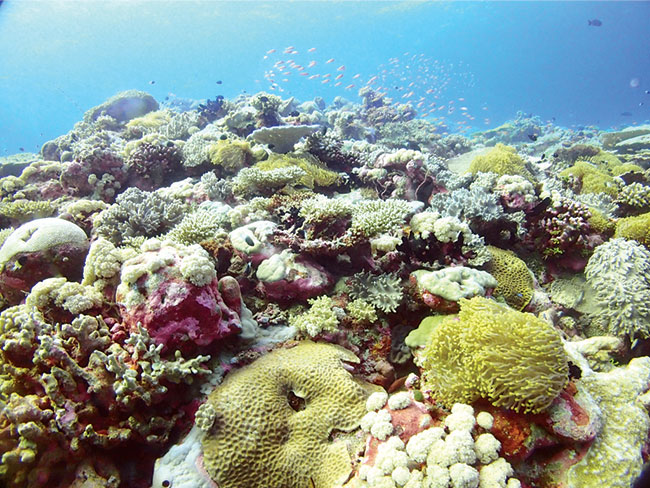
Coral reefs in remote or protected areas can recover quickly after mass coral bleaching events, new research shows.
University of Exeter researchers are investigating “reef carbonate budgets” — the net production or erosion of reef structure over time, said a report published by Science Daily
To study the impacts of climate change on reef functions, they examined 12 reefs in the remote Chagos Islands in the Indian Ocean before and after the global coral bleaching event in 2015/16.
In 2018, the formerly thriving reefs were “shrinking,” with coral cover and carbonate production down by more than 70% and erosion processes exceeding new coral growth.
When the researchers returned in 2021, all reefs were on a trajectory of recovery, although the speed varied from place to place.
Where key coral species returned quickly and the underlying physical reef structure had stayed intact, reefs showed a rapid transition back to positive growth only six years after the bleaching event.
Bleaching is caused by warmer water temperatures, which can trigger corals to expel their symbiotic algae and turn white. Corals can survive this, but an extreme heat wave causes large-scale mortality.
The speed of subsequent recovery is an important indicator of a reef’s health and resilience.
“Such high rates of coral recruitment and the rapid restoration of reef functions are a very nice surprise and imply that this location is showing some resilience, thus far, to ongoing ocean warming,” said lead author Dr Ines Lange, a postdoctoral research fellow in a multi-institutional project funded by the Bertarelli Program in Marine Science.
“A full recovery of reefs across the Chagos Archipelago over the next few years is likely if the region is spared from reoccurring marine heating events.”
Dr Lange added: “The study shows that in remote and protected areas without local impacts such as fishing or pollution from land, coral reefs and the important functions they provide are able to recover relatively quickly, even after large-scale disturbances.
“Proximity to healthy coral populations and the maintenance of a complex reef structure seems to boost recovery speed, which may help to manage reefs under the threat of increasing frequency of bleaching events predicted for the near future.”
Co-author Professor Chris Perry, from the University of Exeter, developed the census-based ReefBudget method to quantify reef carbonate budgets.
These carbonate budgets are important indicators of a reef’s ability to provide habitat to marine life, protect shorelines from wave energy and help reef islands to keep up with future sea level rise.
Over the last years, Prof Perry and Dr Lange optimised the method for the central Indian Ocean by quantifying and integrating local rates of coral growth and parrotfish erosion.
News
P M meets Sri Lankan community living in London
Prime Minister Dr. Harini Amarasuriya, who is currently on an official visit to the United Kingdom, met with members of the Sri Lankan community living in London on Wednesday [20th] and engaged in cordial discussions.
Despite the event being held on a weekday, it was notable that nearly one thousand Sri Lankans representing the Sinhala, Tamil, and Muslim communities attended with great enthusiasm.
Addressing the gathering, Prime Minister Dr. Harini Amarasuriya stated that despite natural disasters and international crises, the present government has succeeded in stabilizing the country’s economy while providing relief to the people. She further noted that Sri Lanka’s political culture has now undergone a positive transformation that is irreversible.
Minister of Women and Child Affairs Saroja Paulraj, addressing the event, stated that a governance system has now been established in the country where all communities are treated equally and the benefits of economic development are shared fairly among all citizens.
Moving away from the traditional method of political gatherings, the event also provided an open platform for members of the Sri Lankan community to directly raise questions and express their views to the Prime Minister and the Minister.
Commenting on the organization of the event, the organizing committee stated that all expenses, including dinner, were borne by the participants themselves. The organizers further remarked that it is unsurprising that opposition groups, accustomed to organizing such events through the misuse of public funds, appear unsettled by this transparent process.
The occasion was attended by the Minister of Women and Child Affairs Saroja Paulraj and Sri Lanka’s High Commissioner to the United Kingdom, Nimal Senadheera.


[Prime Minister’s Media Division]
Latest News
Prime Minister Dr Harini Amarasuriya meets Foreign Secretary of the United Kingdom
Prime Minister Dr Harini Amarasuriya currently undertaking an official visit to London, United Kingdom, to participate in the 43rd Commonwealth of Learning (COL) Board of Governors Meeting 2026 held a bilateral meeting with the Yvette Cooper MP, Foreign Secretary of the United Kingdom ON Wednesday [20]. The Prime Minister was accompanied by Sri Lanka’s High Commissioner to the United Kingdom, Nimal Senadheera, along with officials from the Sri Lankan High Commission.
During the meeting, the Prime Minister conveyed Sri Lanka’s appreciation to the United Kingdom for the support extended in the aftermath of Cyclone Ditwa, including ongoing rebuilding and recovery assistance. The Prime Minister also commended the United Kingdom’s support in facilitating increased bilateral trade and exports for Sri Lanka.
The Prime Minister briefed the UK delegation on Sri Lanka’s recent economic developments and policy priorities, the Government’s commitment to advancing human rights and reconciliation, as well as Sri Lanka’s positive growth trajectory.
The two sides also exchanged views on current global geopolitical developments, challenges in the energy sector, and the importance of enhancing regional connectivity and long-term energy security.
Both sides also emphasised the importance of strengthening structured academic mobility frameworks while ensuring fairness, clarity, and integrity within migration systems.
They also reaffirmed their commitment to further strengthening bilateral cooperation between the two countries in areas of mutual interest.
[Prime Minister’s Media Division]
News
Suspects involved in sureties controversy granted bail
Airbus bribe case:
Colombo Additional Magistrate Lahiru Silva yesterday (20) granted bail to Mohamed Riswan and Mohamed Irshan, who allegedly received money to stand as sureties for the late former SriLankan Airlines CEO, Kapila Chandrasena. They were identified as residents of Sanchi Arachchi Watta, situated next to the Hulftsdorp court complex.
Chandrasena was found dead at his brother-in-law, Aravinda De Silva’s residence, at No. 38, Pedris Road, Kollupitiya, on 8 May.
The Magistrate also granted bail to B. A. Tissa and Perumal Ganesh, who arranged for Riswan and Irshan to stand as sureties for Chandrasena, who is under investigation for allegedly receiving a USD 2 million bribe through his wife to facilitate an Airbus deal. They, too, residents of Sanchi Arachchi Watta, were granted bail on two personal bail of Rs. 500,000 each.
Airbus had to pay USD 4 billion in penalties after admitting it had paid huge bribes to secure contracts in 20 countries. Sri Lanka is among them.
The Magistrate directed that the Grama Niladhari should certify their residence and the relevant certificates submitted to court and to establish the financial status of those who stood as sureties for the four persons.
The court was told that Mohamed Riswan and Mohamed Irshan obtained 17 Grama Niladhari certificates from January till May 2026. On the basis of a statement recorded from Keselwatta Grama Niladhari S. Nilantha Silva police informed court that the first suspect had obtained 10 certificates and the second person seven.
Fourth suspect Ganesh had first met those who stood as sureties, on 05 May, in the court premises and struck the deal. Crime OIC of Keselwatta Police, Sub Inspector K.W.D. Anuruddha, told court that Mohamed Riswan, Mohamed Irshan and B. A. Tissa hadn’t even known who Chandrasena was and were not related to him in anyway, according to investigations. Police requested that the four persons be further remanded.
The Magistrate granted them bail and set the next hearing for 25 June.
Legal sources said that such illegal practices were rampant, and in this particular case the Court Registrar should have been able to see that the sureties were very much unlikely to be relatives of Chandrasena.
By Shamindra Ferdinando
-
Features5 days agoSri Lankan Airlines Airbus Scandal and the Death of Kapila Chandrasena and my Brother Rajeewa
-
News6 days agoLanka’s eligibility to draw next IMF tranche of USD 700 mn hinges on ‘restoration of cost-recovery pricing for electricity and fuel’
-
News5 days agoKapila Chandrasena case: GN phone records under court scrutiny
-
News5 days agoRupee slide rekindles 2022 crisis fears as inflation risks mount
-
Features2 days agoOctopus, Leech, and Snake: How Sri Lanka’s banks feast while the nation starves
-
Business5 days agoExpansion of PayPal services in Sri Lanka officially announced
-
Features7 days agoMysterious Death of United Nations Secretary General Hammarskjöld
-
News5 days agoCourt orders further arrests in alleged USD 42 Mn NDB fraud case