
Opinion
Remembering Batty Weerakoon


The first anniversary of the passing away of Richard (Batty) Weerakoon, who was Batty to all those who came to know him, falls on October 7th. He had a varied career as a political activist who rose to the position of the General Secretary of the Lanka Sama Samaja Party, lawyer who rose to the position of one of the leading lawyers of our time and creative writer with a collection of serious writings to his credit He studied at Trinity College, Kandy, and was a contemporary of Lakshman Kadiragamar, who was a life-long friend of his. He entered the University of Ceylon, in 1952, and there he was elected as the President of the Student’s Council in 1955. He read English under Prof. Ludowyke at Peradeniya. He was committed to left politics and well-known for leading the University students on the historic March from the Peradeniya campus on Harthal day in August 1953; it ended in a clash with the police at the entrance to the university. He was Minister of Science and Technology and Minister of Justice and Ethnic Affairs in the Chandrika Kumaratunge Cabinet.
The biggest achievement he was proud of was to have successfully led the Ceylon Federation of Labour, which was the largest Trade Union Federation at the height of Trade Unionism in our country for long years
Batty, born on the 20th of January 1932, at Mathale to a well-known respected Kandyan family in Tenne with a conservative background took to left politics at a very young age, and this shows how attractive and respected the left movement was at that time. After he left the university he joined the LSSP and was closely associated with left stalwarts of the time like NM, Colvin, Leslie, Doric de Sousa and Bernard Soysa. In fact, he served for sometime as Private Secretary to NM when the latter was the leader of the Opposition in the 1956 Parliament. He passed out as an Advocate of the Supreme Court and had the privilege of studying under Colvin R de Silva, and this opened up his life to professional greatness. But Batty was essentially a left activist. As Minister of Science and Technology he fought against the sale of Eppawala Phosphate Deposit to foreigners and campaigned the protection of natural resources and the environment.
His Prof. G. F C. Ludowyke memorial lecture in May 2003 at the Peradeniya University stunned many academics at his incisive understanding of English Literature. He specially mentioned with deep gratitude that it was Prof. Ludowyk in his first year helped him discover in himself the talent to write imaginatively. He remembered with joy the occasion when he was offered by Prof. Ludowyk the prize to the student who could best turnout a story and how that prize had introduced him to the pleasing engagement to story writing. In spite of his busy life as a left activist, trade unionist and lawyer, story writing he did and published several well studied books such as ‘Sinhala Jathaka Stories ‘(1974), ‘Sri Lanka Mythology’ (1985), ‘Mythology and the Early Aryan State ‘(1998), ‘Elephant Kraal and Other Stories ‘(1990), ‘Alexander Solzhenitsyn – Soldier, Prisoner and writer ‘ (1072), ‘ Kusumasana Devi as Dona Cathrina of Three Sinhale.’ (2013). He also authored a book, “Sri Lankan Labour Legislation.”
Batty put out numerous booklets on political issues relevant to the time . These are available for reference at the Dr. N. M. Perera Memorial Library.
His deep insight into Sri Lanka’s mythology is evident in the dedication of his book on the subject to his grandfather; he says, “My paternal grandfather, born in Aluwihara, bought to me a representative of the last generation on which the old traditions had as yet been relevant, Bernard Soysa, having looked at the book, told me that I have written about my ancestors meaning the Yaksas. That I think is a relevant comment because one can regard the Yaksas as a people who passed on to us a large part -if not all of our indigenous mythology. In cultures that is transfered downwards done by ancestors who in the Vedda language are called Nae-Yakas. Theravada Buddhism did not seek to incorporate it unlike what Hinduism did to the Mythologies especially of the Indian peninsula. Our Mythology was thus preserved in tact for us. It is the language of a people and I found that it was there for me.”
One salient feature of Batty’s illustrious life that touched me was that he did not go after cheap popularity. He stood by principles even at the most adverse circumstances. When I met him in his last days when he was bedridden I saw that his main concern was about the deteriorating political situation in the country and in no uncertain terms expressed his dismay at the politics of today and the plight of the underprivileged and the working class for whose rights he had fought throughout his life.
He was a Buddhist in his way of life and his philosophy of life. May he attain Nirvana!
Lal Wijenayake


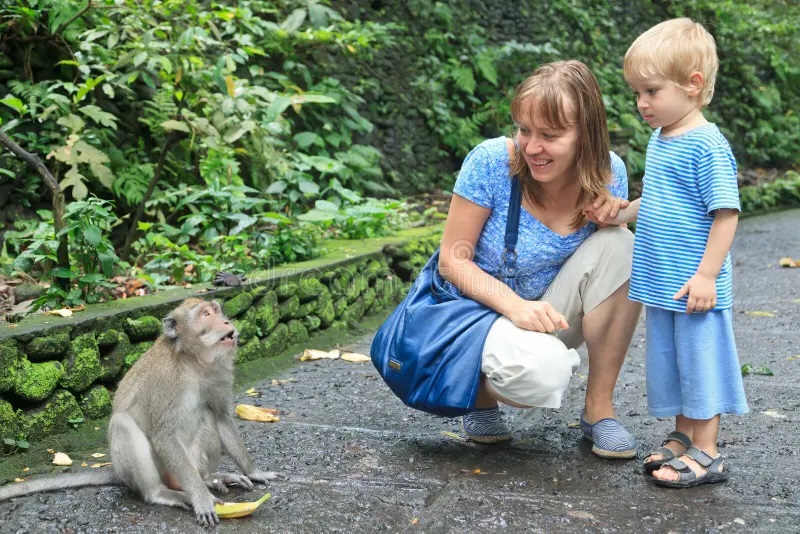
Being wildlife enthusiasts and bird watchers we took a river “safari” during a recent family trip to Bentota. We were dismayed to see that it seems to be the standard practice to feed the monkeys, I think they were the purple faced langurs, that were encountered on the river banks. Each boat that passed by stopped with boxed fruit, coconut and other odds and ends to feed them.
We managed to stop our guy from doing so but faced derision and laughter that we shouldn’t be afraid of monkeys. We tried to explain to him that this is a plague affecting Sri Lanka; elephants being fed on road sides and even in national parks, monkeys being fed from hotel balconies and apparently during river boat rides, birds being fed on hotel terraces etc.
This was met with further mockery and amused dismissal. An effort to make them understand that this was their livelihood that they were destroying it in this manner sailed over their heads. They even have a picture of a baby crocodile on the shoulders of a tourist on their billboard.
We need to consider the following:
Educate such tour operators about the importance of not interfering with the environment and the behaviour of wild animals.
Include education and training in the hotel school, and in schools in tourist resort towns about their duty and responsibility to the environment and the ecosystem on which we all depend.
If it is not already the case such operators should have licenses that should be revoked and fined if found to be engaging in such destructive acts.
Tamara Nanayakkara
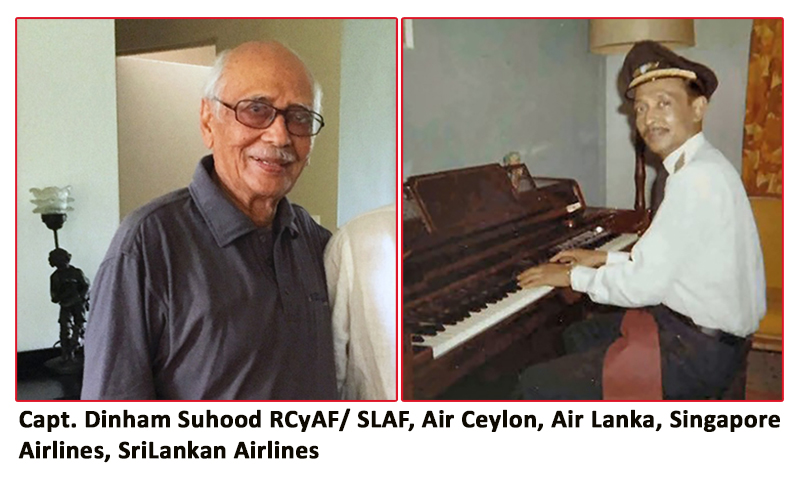
A few days ago, we heard the sad news of the passing on of Capt. Dinham Suhood. Born in 1929, he was the last surviving Air Ceylon Captain from the ‘old guard’.
He studied at St Joseph’s College, Colombo 10. He had his flying training in 1949 in Sydney, Australia and then joined Air Ceylon in late 1957. There he flew the DC3 (Dakota), HS748 (Avro), Nord 262 and the HS 121 (Trident).
I remember how he lent his large collection of ‘Airfix’ plastic aircraft models built to scale at S. Thomas’ College, exhibitions. That really inspired us schoolboys.
In 1971 he flew for a Singaporean Millionaire, a BAC One-Eleven and then later joined Air Siam where he flew Boeing B707 and the B747 before retiring and migrating to Australia in 1975.
Some of my captains had flown with him as First Officers. He was reputed to have been a true professional and always helpful to his colleagues.
He was an accomplished pianist and good dancer.
He passed on a few days short of his 97th birthday, after a brief illness.
May his soul rest in peace!
To fly west my friend is a test we must all take for a final check
Capt. Gihan A Fernando
RCyAF/ SLAF, Air Ceylon, Air Lanka, Singapore Airlines, SriLankan Airlines

The cause of global warming, they claim, is due to ever increasing levels of CO2. This is a by-product of burning fossil fuels like oil and gas, and of course coal. Environmentalists and other ‘green’ activists are worried about rising world atmospheric levels of CO2. Now they want to stop the whole world from burning fossil fuels, especially people who use cars powered by petrol and diesel oil, because burning petrol and oil are a major source of CO2 pollution. They are bringing forward the fateful day when oil and gas are scarce and can no longer be found and we have no choice but to travel by electricity-driven cars – or go by foot. They say we must save energy now, by walking and save the planet’s atmosphere.
THE DEMON COAL
But it is coal, above all, that is hated most by the ‘green’ lobby. It is coal that is first on their list for targeting above all the other fossil fuels. The eminently logical reason is that coal is the dirtiest polluter of all. In addition to adding CO2 to the atmosphere, it pollutes the air we breathe with fine particles of ash and poisonous chemicals which also make us ill. And some claim that coal-fired power stations produce more harmful radiation than an atomic reactor.
STOP THE COAL!
Halting the use of coal for generating electricity is a priority for them. It is an action high on the Green party list.
However, no-one talks of what we can use to fill the energy gap left by coal. Some experts publicly claim that unfortunately, energy from wind or solar panels, will not be enough and cannot satisfy our demand for instant power at all times of the day or night at a reasonable price.
THE ALTERNATIVES
It seems to be a taboo to talk about energy from nuclear power, but this is misguided. Going nuclear offers tried and tested alternatives to coal. The West has got generating energy from uranium down to a fine art, but it does involve some potentially dangerous problems, which are overcome by powerful engineering designs which then must be operated safely. But an additional factor when using URANIUM is that it produces long term radioactive waste. Relocating and storage of this waste is expensive and is a big problem.
Russia in November 2020, very kindly offered to help us with this continuous generating problem by offering standard Uranium modules for generating power. They offered to handle all aspects of the fuel cycle and its disposal. In hindsight this would have been an unbelievable bargain. It can be assumed that we could have also used Russian expertise in solving the power distribution flows throughout the grid.
THORIUM
But thankfully we are blessed with a second nuclear choice – that of the mildly radioactive THORIUM, a much cheaper and safer solution to our energy needs.
News last month (January 2026) told us of how China has built a container ship that can run on Thorium for ten years without refuelling. They must have solved the corrosion problem of the main fluoride mixing container walls. China has rare earths and can use AI computers to solve their metallurgical problems – fast!
Nevertheless, Russia can equally offer Sri Lanka Thorium- powered generating stations. Here the benefits are even more obviously evident. Thorium can be a quite cheap source of energy using locally mined material plus, so importantly, the radioactive waste remains dangerous for only a few hundred years, unlike uranium waste.
Because they are relatively small, only the size of a semi-detached house, such thorium generating stations can be located near the point of use, reducing the need for UNSIGHTLY towers and power grid distribution lines.
The design and supply of standard Thorium reactor machines may be more expensive but can be obtained from Russia itself, or China – our friends in our time of need.
Priyantha Hettige

Fairly heavy showers are likely at some places in the Rathnapura, Kalutara, Galle and Matara districts

India vs Pakistan is finally here. Over to cricket now

“We Are Building a Stable, Transparent and Resilient Sri Lanka Ready for Sustainable Investment Partnerships” – PM

US military kills 3 in latest attack on boat in the Caribbean

Prez AKD congratulates BNP’s Tarique Rahman on B’desh election win

Massive Sangha confab to address alleged injustices against monks

‘Dates have the highest sugar content to fight Coronavirus’

Sunday Island 27 December – Headlines

#SundayIsland 17th December – Headlines

Sunday Island – 28th March

Sunday Island Headlines – 21 March

Sunday Island – 21st February – Headlines
-
 Business4 days ago
Autodoc 360 relocates to reinforce commitment to premium auto care
-

 Midweek Review4 days ago
A question of national pride
-
 Opinion3 days ago
Will computers ever be intelligent?
-
 Midweek Review4 days ago
Theatre and Anthropocentrism in the age of Climate Emergency
-

 Editorial6 days ago
The JRJ syndrome
-
 Opinion4 days ago
The Walk for Peace in America a Sri Lankan initiative: A startling truth hidden by govt.
-

 Foreign News6 days ago
Portugal elects Socialist Party’s Seguro as president in landslide
-
 Foreign News7 days ago
Washington Post chief executive steps down after mass lay-offs