
News
Queensland based Sri Lankan professor receives $179 million on his innovations

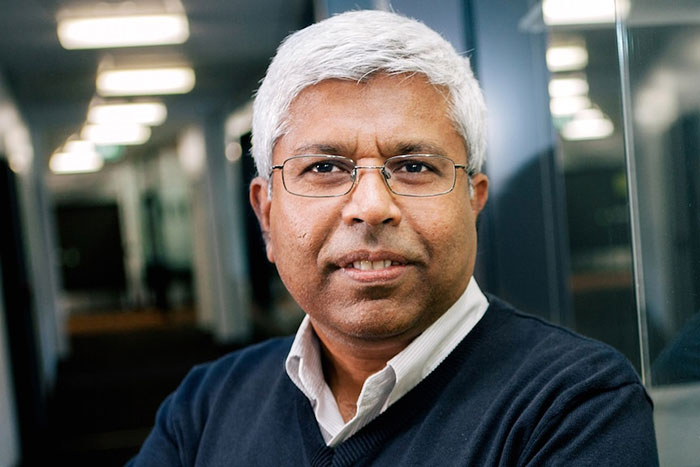
A Brisbane-based company that invented a smartphone app it says can diagnose COVID-19 and other respiratory illnesses by listening to someone cough has been purchased by Pfizer for nearly $180 million.ResApp Health Limited uses diagnostic technology developed by Associate Professor Udantha Abeyratne and his research team at the University of Queensland (UQ) to record and analyse a patient’s coughs on a smartphone.
The app also considers the self-reporting of simple symptoms like a runny nose or fever to diagnose and measure the severity of a range of pulmonary diseases, including asthma and pneumonia.Pfizer, which is one of the world’s largest bio-pharmaceutical companies, offered to buy ResApp earlier this year when the company announced positive results for its COVID-19 screening test.
Recent studies had shown the app had a 92 per cent success rate in diagnosing the virus among symptomatic patients, but more clinical trials were needed for it to gain regulatory approval.A Pfizer spokesperson said they were encouraged by the data they had seen so far and the $179 million acquisition, finalised on Monday, was another move toward enhancing the company’s expertise in digital health.
“We believe the COVID-19 screening tool is the next step to potentially provide new solutions for consumers that aim to quell this disease,” they said.
“We look forward to refining this algorithm further and working with regulators around the world to bring this important product to consumers as quickly as possible.”
UQ Vice-Chancellor Professor Deborah Terry said it was an “outstanding” outcome for ResApp and associated researchers as well.
“The value of translating research into new point-of-care diagnostics to improve healthcare on a global scale cannot be understated,” Professor Terry said.
UQ’s commercialisation company UniQuest licensed the technology to ResApp in September 2014.
Dr Abeyratne, from the School of Information Technology and Electrical Engineering, said the research that led to the breakthrough began more than a decade ago with grant funding from the Bill and Melinda Gates Foundation.
“When I open up my lungs, open up the airway, that is what I call an ‘information super highway’, so I wondered whether it’s possible to use cough sounds, advanced signal processing and AI technology to pick out features,” he said.
“From the very beginning, I had a big vision to develop scalable, cheap technologies to diagnose pulmonary diseases all over the world – not only in remote sub-Saharan Africa, but even in developed urban cities like New York and Brisbane.”
Dr Abeyratne said the smartphone technology, which was developed in consultation with medical practitioners, operates similarly to a doctor using a stethoscope to listen for sounds produced by a patient’s body.
“The diagnosis comes immediately, within a minute or so, telling the patient whether they have a particular disease, using only their smartphone – nothing else – and there’s no need for a network connection either,” he said.A Pfizer spokesperson said ResApp’s solutions in respiratory health align well with their own areas of focus.
“As the world becomes more digitally connected, and as respiratory illnesses — including COVID-19 — increasingly threatens the global population, digital apps provide consumers and patients with easy to use, non-invasive and cost-effective ways to detect, suspect and eventually, diagnose respiratory illness,” they said.
“Ultimately, we believe that science and health technology can be advanced in ways that can provide better information for clinicians and regulators, reduce patient and physician burden, and reduce time and costs across the development cycle.”
Dr Abeyratne said he is hopeful Pfizer’s acquisition of the app will help realise his dream of improving patient outcomes around the world.
“I hope they will be able to diagnose killer diseases like pneumonia in very remote communities in Africa and Asia because they don’t have access to sophisticated hospitals,” he said.
He said the technology could also benefit GP clinics and hospitals in developed countries by speeding up the screening process and preventing costly hospital admissions.
“It could be used in telehealth services, so patients don’t have to visit the doctor in-person. The doctor can do a diagnosis using the app on their smartphone first.
“In a pandemic or disaster-stricken area, respiratory diseases come quickly. So the technology could be used at airports or in areas affected by hurricanes and flooding.”
Dr Abeyratne said the app could also be used to monitor and manage chronic illnesses like asthma from home.
“I think in the future, with more resources, more could be done,” he said.
“There are many other applications … there are other skills, techniques and instruments that can be added [to the diagnostic technology] at low cost.” – ABC



In terms of the provisions of the Establishments Code on payment of festival advance to government officers, there’s a possibility of obtaining rupees 10,000/- as an advance for celebrating festivals of Theipongal, Ramazan, Sinhala and Hindu New Year, Wesak, Deepavali, and Christmas as well as for pilgrimages (Sri Paada pilgrimage and Hajj pilgrimage).
Provisions have been given to recover the said advance in 08 installments or if required earlier without interest. It has been proposed by the Budget 2026 to increase the said festival advance up to rupees 15,000/-.
Accordingly, the Cabinet of Ministers granted approval to the proposal submitted by the Minister of Public Administration, Provincial Councils and Local governments to revise the relevant provisions so that the festival advance can be increased up to rupees 15,000/- .
As per the approval given by the cabinet meeting held on 02-06-2025, action is being taken at present to offer the underutilized lands/properties of the Sri Lanka State Plantation Corporation, the Janatha Etate Development Board, and the Elkaduwa Plantation Company which are under the Ministry of Plantation and Community Infrastructure which have been identified under stage one to suitable investors.
Accordingly, the Cabinet of Ministers has approved the proposal presented by the Minister of Plantations and Community Infrastructure to provide following lands/properties on a lease basis to the suitable investors for optimal utilization following the prescribed procurement procedure.
• underutilized lands/properties identified under stage two owned by the Sri Lanka State Plantation Corporation, the Janatha Estate Development Board, and the Elkaduwa Plantation
Company,
• The Mawarala watte land and the Tea factory 40.48 hectares in extent, located in Matara District belonging to the Tea Shakthi Fund.
• The underutilized land of 1,541 hectares in extent of Kondachchi Estate is enjoyed by the Sri Lanka Cashew Corporation.
The drafting of the National Fisheries and Aquaculture Policy has commenced with the objective of equitable distribution of the benefits of the fisheries industry and the sustainable management of fisheries and aquaculture. This policy has been updated from time to time according to current requirements. However, steps have not been taken to obtain the approval of the Cabinet of Ministers for that purpose.
According to the policy declaration of the present government, ‘Vistas of Prosperity and Splendor’ the National Fisheries and Aquaculture Policy has been redrafted, updating the aforementioned policy in line with the economic and development objectives of the government.
The recommendations of the Department of National Planning have been received for the drafted policy.
Accordingly, the Cabinet of Ministers has approved the proposal presented by the Minister of Fisheries, Aquaculture, and Marine
Resources to implement the National Fisheries and Aquaculture Policy, integrating it with other relevant policies.

Lanka Premier League draft set to take place on March 22

Trump to meet Venezuelan opposition leader Machado at the White House

Festival advance for government officers to be increased
Providing underutilized lands/properties to suitable investors for optimal utilization.
Implementation of the National Fisheries and Aquaculture Policy

Expressions of Interest called to develop selected locations within the Pelawatte Sugar Factory premises

‘Dates have the highest sugar content to fight Coronavirus’

Sunday Island 27 December – Headlines

#SundayIsland 17th December – Headlines

Sunday Island – 28th March

Sunday Island Headlines – 21 March

Sunday Island – 21st February – Headlines
-

 News3 days ago
Sajith: Ashoka Chakra replaces Dharmachakra in Buddhism textbook
-

 Business3 days ago
Dialog and UnionPay International Join Forces to Elevate Sri Lanka’s Digital Payment Landscape
-

 Features3 days ago
The Paradox of Trump Power: Contested Authoritarian at Home, Uncontested Bully Abroad
-

 Features3 days ago
Subject:Whatever happened to (my) three million dollars?
-

 News2 days ago
Level I landslide early warnings issued to the Districts of Badulla, Kandy, Matale and Nuwara-Eliya extended
-

 News2 days ago
National Communication Programme for Child Health Promotion (SBCC) has been launched. – PM
-

 News3 days ago
65 withdrawn cases re-filed by Govt, PM tells Parliament
-

 Opinion5 days ago
The minstrel monk and Rafiki, the old mandrill in The Lion King – II