
News
Quadriplegic Gold Coast spinal doctor is Queensland’s Australian of the Year

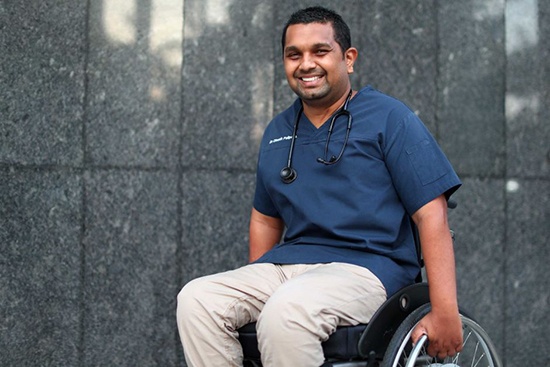
The 36-year-old founder of Doctors with Disabilities Australia is Queensland’s 2021 Australian of Year.
Dr Dinesh Palipana OAM is senior resident at the Gold Coast University Hospital, a recent law graduate as well as the doctor for the Gold Coast Titans physical disability rugby league team.
Dr Palipana has built an international profile through his speeches with TEDx talks and has contributed immensely to spinal research in Australia.
He was named by Premier Annastacia Palaszczuk at a special presentation on Tuesday night, ahead of the national Australia Day awards in January.
“Dr Dinesh Palipana knows no barriers,” Palaszczuk said on Tuesday night.
“He is a truly inspiring person and a much-deserved recipient of the Queensland Australian of the Year Award.”
Dr Palipana is the first quadriplegic medical graduate and medical intern in Queensland.
“As co-founder of Doctors with Disabilities Australia, he helped create national policies for inclusivity in medical education and employment,” Palaszczuk said.
“He speaks, writes and advocates for the equitable treatment of people with a disability and has contributed significantly to the advancement of treating spinal cord injuries and restoring functions for people with paralysis.”
Dr Palipana was seriously injured in a car crash on Brisbane’s Gateway Bridge in 2010 that robbed him of the use of his legs and left him with limited use of his arm.
In 2019 he began research on equipment that could – in the future – help people with disabilities walk, or even ride a bike again.
Dr Palipana and fellow researchers are working on a BioSpine which reads brain patterns, bypasses the spine and sends electrical signals to a patient’s legs.
Torres Strait Islander elder Aunty McRose Elu was named Queensland’s Senior Australian of the Year for her community advocacy and work in climate change management.
She negotiated to legally recognise the traditional customary adoption practices of Torres Strait Islander families, which led to the introduction of a landmark Bill to the Queensland Parliament.
Since 1980, McRose has been drawing global attention to the impact of climate change on the Torres Strait, including speaking at the United Nations and to business and political leaders.
Brothers Daniel, 24, and William Clark, 22, were named Queensland’s Young Australians of the Year for their work and fundraising efforts to protect endangered orangutans in Borneo and Sumatra.
Since 2008, they have highlighted the species’ plight and raised more than $900,000 to help protect the animals.
The funds have supported orangutan care centres and enabled investment in veterinary equipment.
Together they have also sponsored more than 50,000 hectares of orangutan habitat and adopted more than 100 animals.
Natasha Johnston, 47, the founder and director of Drought Angels, a group which supports drought-stricken Queensland and New South Wales’ families, was named Queensland’s Local Hero.
Drought Angels is described as a “personalised lifeline for farmers”, who often don’t reach out for help.
“Natasha’s work plays a vital role in reducing rates of depression and suicide, as well as helping to keep farmers on their land,” the judges said.
National Australia Day Council chief executive Karlie Brand congratulated the Queensland award recipients.
“The contributions of the 2021 QLD Australians of the Year are inspirational,” Brand said. – Brisbane Times


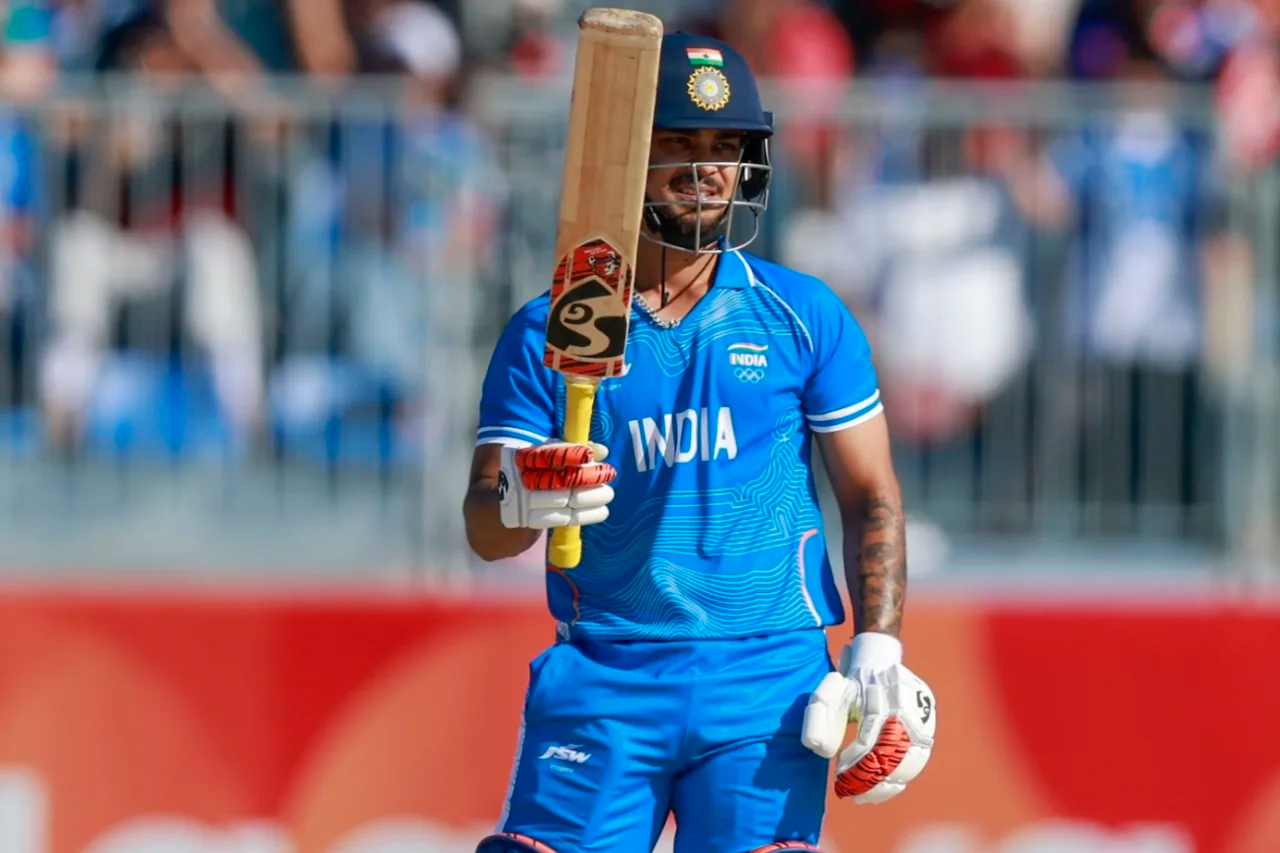
Defending champions India registered their biggest T20I win against Sri Lanka to make the final of the 2026 Asian Games men’s competition in Nisshin on Thursday.
A day after the ODI side chased down 406 against West Indies like it was child’s play on a flat Guwahati pitch, the T20I side scraped their way to 169, well above-par on a treacherous track filled with cracks. Sri Lanka were no match after that.
The result sets up the first India vs Pakistan final of 2026, and there will be a gold medal at stake.
Sri Lanka were a touch unlucky as Ishan Kishan miscued many aerial shots but they all fell in no-man’s land. But Nuwanidu Fernando did drop Kishan on 56, and that didn’t help as he went on to make 80* in just 46 balls. There were a couple of balls that misbehaved wildly, and it was a sign of things to come.
The chase felt like an act of cruelty against batters. Jasprit Bumrah bowled Test lengths and added new degrees of unplayability to the existing ones. Axar Patel bowled 14 dots and got a two-for and India finished the game with a team hat-trick. On top of all that, Sri Lanka suffered three run outs, two of which were of top-four batters.
In the end, they were rolled over for 45, the second lowest total in men’s games at the Asian Games and the joint-lowest total for a Full-Member team in men’s T20Is, alongside West Indies’ 45 against England in 2019.
India picked four spinners in their XI and Sri Lanka three in what was their first bit of action at the competition after their quarter-final fixtures were rained out. It proved to be the right strategy as spinners bowled 83% of all the balls bowled (149 out 179) across the 29.5 overs of play. They took 12 wickets, bowled 73 dots and went at an economy of 6.56. The quick bowlers conceded 44 runs in 30 balls. Bumrah’s share in that: 2 for 7 in two overs.
The bowlers’ domination started early in the game as the weather held for the second game running on the day.
Both Abhishek Sharma and Sanju Samson fell to fingerspin while trying to open up the off side. Samson made room and looked to go inside out over cover and was beaten by extravagant spin, but went for it again and Tharindu Ratnayake fired the ball in to smash his stumps. Sahan Arachchige, who had Abhishek lob one to short third, then checked every form of deviation to knock over Shreyas Iyer – the ball angled in, dipped, drew the batter forward and turned away to hit the stumps.
In the chase, Sineth Jayawardena looked to take Bumrah on early and looked hapless as the ball seamed in to beat the across-the-line swing and hit him on the back leg in front of all three. Sohan de Livera fell victim to Bumrah’s exaggerated angle from over the wicket and nicked to the keeper. For the first time in a men’s T20I, India has taken two wickets before conceding a run.
The fifth ball of Bumrah’s second over trampolined off a length, seemed to pick up pace off the pitch, and needed Samson to leap right up to catch it. Nuwanidu, the batter, was lucky that the line of the ball was not straighter.
Despite the Bumrah threat, India did not turn to pace for the remainder of the innings. That was likely because Lasith Croospulle was run out by sharp work from Ravi Bishnoi at short third in the over before, and Arachchige and Ashen Bandara committing the cardinal sin of sweeping Axar and giving away their wickets.
Washington Sundar’s introduction with Sri Lanka on 18 for 5 did not faze Nuwanidu. The first ball spun big but went down leg. Next three balls had two sixes, the second an effortless twirl of the bat to send the ball over long-on. Then Nuwanidu went for a non-existent single to short third and Sri Lanka ran their way out to a point of no return.
In conditions where batting was far from easy, Kishan and Vaibhav Sooryavanshi found ways to maximise the strengths of their respective games.
Sooryavanshi opened up the off side repeatedly by either making room or standing still and slapping balls, even when they were angling in. He brought up India’s 50 with 4, 6, 4 off Tharindu Ratnayake but fell to Arachchige, in similar fashion to Abhishek, soon after. He made 38 off 21. Only behind Kishan’s 80 not out. The next highest individual score was Nuwanidu’s 15.
Kishan then walked out and hit two sixes in his first 12 balls. He waited for the bad ball and wasn’t going to miss out if he got one… or two. However, he had to take chances as Shreyas Iyer fell and Axar – promoted above Tilak Varma – got stuck. Kishan’s reverse sweep off Arachchige from a leg-stump line during this slowdown showed he could pull off risks on demand.
Both Axar and Tilak fell cheaply but took India past 100 with handy stands with Kishan, who forced errors out of bowlers and brought up a 33-ball fifty in the 17th. He could have been out twice in the next two balls but survived a ball that turned in a right angle and Nuwanidu’s drop at mid-off.
India hit four sixes and four fours in the last eight overs. Kishan hit all of them bar the last six, hit by Washington. That took them to 169 for 7, a par score in general, maybe twice the par on the day.
Scores:
India 169 for 7 in 20 overs (Vaibhav Sooryavanshi 38, Shreyas Iyer 13, Ishan Kishan 80*; Tharindu Ratnayake 2-32, Sahan Arachchige 2-28, Wanuja Sahan 1-17, Lasith Croospullle 1-25, Nuwanidu Fernando 1-20) beat Sri Lanka 45 in 905 overs (Nuwanidu Fernando 15; Jasprit Bumrah 2-07, Axar Patel 2-08, Washington Sundar 1-18, Abhishek Sharma 2-2, ) by 124 runs
[Cricinfo]
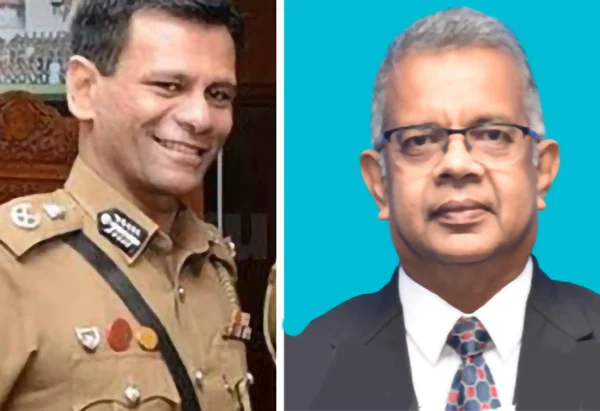
Senior DIG among those slated for transfer
By Shamindra Ferdinando
The National Police Commission (NPC) is expected to take up Police Headquarters recommendation to transfer a group of police officers responsible for a major ‘Ice’ bust at the Colombo port recently.
NPC sources told The Island that recommendation in respect of transfers was received last week. Sources said that though the NPC was scheduled to meet today (01), whether IGP Priyantha Weerasooriya’s recommendation would be discussed and decided today was not known.
Members of the NPC are retired High Court Judge Lalith Ekanayake (Chairman), K. Karunaharan, Dilshan Kapila Jayasuriya, A.A.M. Illiyas and Jayantha Jayasinghe
The IGP directed the Special Investigation Unit (SIU) to probe those who carried out the 31 August, 2026 raid that resulted in the detection of 463 kgs of ‘Ice’ concealed in a container that arrived from Pakistan.
The US Embassy declined to comment on the probe though it declared that the largest ever narcotics detection was made on intelligence made available by the US Drug Enforcement Administration (DEA).
The officers investigated for what an authoritative Headquarters source called shortcomings and lapses on the part of the raiding party, belonged to the Central Crime Investigation Bureau (CCIB). Senior DIG Ranmal Kodituwakku who, on behalf of the CCIB, received information directly from the DEA, is among those Police Headquarters wanted to transfer.
CCIB carried out the raid after having obtained a search order from the Aluthgama Magistrate court. Among the suspects taken in this connection are three Pakistani nationals.

* First Reading of the Budget on 7 October
The Committee on Parliamentary Business has decided that the Second Reading of the Appropriation Bill for the year 2027 (Budget Speech/presentation of Budget proposals) will take place on 12 November, followed by the Second Reading debate from 13 November to 14 December.
Secretary General of Parliament Kushani Rohanadeera said this had been decided at a meeting of the Committee on Parliamentary Business held recently under the chairmanship of Speaker Dr. Jagath Wickramaratne.
Accordingly, the Appropriation Bill was scheduled to be presented to Parliament for its First Reading on 7 October, the Secretary General said.
It was also decided that the Second Reading of the Appropriation Bill (Budget Speech) would be delivered by President Anura Kumara Dissanayake, in his capacity as the Minister in charge of Finance, on Thursday, 12 November, 2026.
Thereafter, the Second Reading debate will be held for seven days, from 13 November to 20 November. Accordingly, the vote on the Second Reading will be held at 6.00 pm on 20 November.
Thereafter, the Committee Stage debate will be held for 19 days, from 21 November to 14 December , with the vote on the Third Reading of the Budget scheduled for 6.00 pm on 14 December.
During this period, the Budget debate will be held every day, including Saturdays, except on public holidays and Sundays. Parliament is scheduled to meet at 9.30 am on each of these days.
From 9.30 am to 10.00 am each day, time will be allocated for the Parliamentary business specified under Standing Order 22(1) to (6). Thereafter, five Questions for Oral Answers will be taken up from 10.00 am to 10.30 am, followed by one question under Standing Order 27(2) from 10.30 am to 11.00 am.
Accordingly, the debate is scheduled to be held from 11.00 am to 6.00 pm on all days, except the two days on which votes are scheduled to be taken, Motions at the Adjournment Time will be taken up for debate from 6.00 pm to 6.30 pm, based on a 50:50 time allocation between the Government and the Opposition, the Secretary General stated.
It was also approved that during the Second Reading debate, 60% of the debate time will be allocated to the Government and 40% to the Opposition, while during the Committee Stage debate, 40% will be allocated to the Government and 60% to the Opposition.
Furthermore, if a division is called for on an Expenditure Head, relating to a Ministry, the relevant vote will be held at 6.00 pm at the conclusion of the proceedings on the respective day.

India enter Asian Games final after Kishan and Bumrah ride roughshod over Sri Lanka

Sri Lanka bowl first in semi final clash against India

Trump hints US could strike Iran, warns time coming

Showers or thundershowers will occur at most part of the island after 1.00 p.m.

US-assisted ‘Ice’ detection: NPC to examine IGP’s move to transfer drug-busting team

2027 Budget to be held from 12 Nov. to 14 Dec.

‘Dates have the highest sugar content to fight Coronavirus’

Sunday Island 27 December – Headlines

#SundayIsland 17th December – Headlines

Sunday Island – 28th March

Sunday Island Headlines – 21 March

Sunday Island – 21st February – Headlines
-

 Editorial5 days ago
Birth of a bad law
-

 Features6 days ago
Beyond traditional jobs: Why Sri Lanka needs to facilitate the gig economy
-

 News3 days ago
Police remove Thileepan statue in Jaffna
-
 Latest News7 days ago
Kusal, Wellalage star as Sri Lanka defend 322 in Headingley thriller
-

 News5 days ago
TIN mandatory for key transactions from Nov. 1
-

 Features3 days ago
The 22nd Amendment, constitutional recovery and illiberal slippage
-

 Features3 days ago
Of foreigners as CEOs of Lankan ventures
-

 News3 days ago
Sajith rejects Jt. Opp. protest sabotage claim; SJB TU chief demands remedial action