
Sports
Pubudu Dassanayake resigns as Nepal head coach, takes up role with Canada


Pubudu Dassanayake has submitted his resignation as Nepal head coach citing “family reasons” with almost a year and a half left on his current contract in order to take up the same position with Canada. His contract with Canada will run until the end of 2023.
Dassanayake, 52, played Test cricket for Sri Lanka in the mid-1990s before migrating to Ontario in 2001. He eventually made his debut for Canada at the 2005 ICC Trophy in Ireland and helped them qualify for the 2007 World Cup. He went on to become the head coach of Canada for the first time from 2007 until the end of the 2011 World Cup, Canada’s last appearance in the 50-over ICC showpiece event, before taking up the Nepal head coach job for the first time, in 2011. He held the job until 2015, leading Nepal to their first T20 World Cup in 2014.
He coached USA from 2016 until 2019 before taking up the Nepal job for a second time in December 2021. But Dassanayake says that family considerations in a post-Covid world have forced him to reconsider his priorities.
“The one thing is that during the Covid time period, I was totally away from cricket,” Dassanayake told ESPNcricinfo. “My wife’s job, she got very busy during that time. She’s a practising veterinarian in Canada. She got really busy and I also got involved with that. In that period, once Covid is slowing down I got this offer from Nepal. Since I was away from cricket for a while, I wanted to get something going because that’s my passion. I was happy to jump in and help Nepal and put things in the right direction. So after a long break, I accepted the job.
“When I was in Nepal the last time between 2011-2015, it was different. I was so pumped up to do lots of things and my family was happy for me to go and work in my career. Now we are in a situation where my kids need my support for lots of other things when it comes to education. My mother-in-law also got sick in the last two months. So all of these things contributed to me thinking about the whole situation. My wife is managing all these things with her work. For me to be far away from there, it’s putting pressure on me and on all of us because I’m not there when the family needs me. I’m staying in hotels. I go from the hotel to the ground and back to the hotel the rest of the time. That lifestyle is not helping me.”
Dassanayake said he attempted to submit a resignation letter to the Cricket Association of Nepal before Nepal’s recent ODI tour of Scotland, where they won one of four matches against Scotland and Namibia. The board asked him to reconsider, and he continued leading the team on tour. Upon returning with the team to Kathmandu earlier this week, he had a meeting with the board where they accepted his resignation.
“It would be unfair if I just left like that because the Scotland tour was back-to-back after the USA tour,” Dassanayake said, referring to Nepal’s prior ODI tour to Texas in June as part of ICC Cricket World Cup League Two. “These thoughts came in around the first week of July. When I was convinced what I wanted to do, I sent a letter to the Cricket Association of Nepal. But I didn’t say anything to the playing group. I just wanted them to focus on cricket and complete this tour.
“Normally when I’m given a challenge, I don’t leave halfway. I’m a person who really wants to see things through and take teams into a good era from tough times. If I talk about Nepal before, Canada earlier and even USA, if you see the pathway, I took more than a year to go down and come back again because the changes we put in place take time to bear fruit. Nepal is also in a situation where we have done a lot of changes and I was confident if I was there for the next 12 months, they are basically heading into a top team with this young group and the talent they have. We just need to have patience with them.”
‘Nepal has come a long way in a short period with a young group’
During his stint, Dassanayake had to spend a significant amount of time and energy to smooth over simmering disputes between players and the cricket board that took their attention away from their ability to perform on the field.
“When I was here in Nepal before [from 2011-2015], one thing that I never had was issues within the playing group. They were one team and they were very focused on winning, giving their 200% to win games. When I came this time, I’ve seen there’s a lot of small groups. The thinking was totally different. Some period of time has contributed to that in Nepal. Whatever it was, I’m not sure. The focus wasn’t there for playing cricket. There was so much of other issues around the system. It took some time to clear that.
“When we were in Oman for the T20 World Cup Qualifier, it was right in the middle of it but we managed to do things there to get the best out of the team. Then tour by tour, we did a lot of outside cricket workouts to get people into the right frame of mind, it’s the national team and we need to play together to win matches for the country. So I think we’ve come a long way in a short period with a young group, and a young captain, but there’s still a long way to go.
Despite these clashes, Dassanayake believes the right nucleus of players is in place to achieve successful results on the field. Apart from captain Sandeep Lamichhane, Dassanayake also has a lot of faith in 19-year-old vice-captain Rohit Paudel and 17-year-old No. 3 batter Dev Khanal.
“When I came to Nepal, there were a lot of clashes between the organisation and the players,” Dassanayake said. “There was no real dialogue between the players and the new board. Both sides were very adamant about lots of things. I was able to mediate because I am very close to the playing group and the board gave me the assurance that whatever way I want to do things, they will back me up. We put the playing group in the right direction. The board was very supportive. Once the board saw the young talent coming through, they were very confident with what we are doing. From their side, they increased the player salaries, their match fees, their daily allowance. We had to drop a few senior players at the beginning because of the whole issue.
“The reason we are losing games, some of these top-order batters who are 17 and 19 years old haven’t played enough cricket at this level. It will take a bit of time, but I think the best talent has been picked and it’s just that we need to put them into a good program for them to perform. I have seen all these Associate countries in World Cricket League Two. From talent wise, they are not far from anyone. They just need to get experience and settle down in this level and learn how to handle situations. Even if I’m not here, I’m still going to support the youngsters.”
His first assignment with Canada will be the second round of ICC Cricket World Cup Challenge League A, which is set to run from July 27 to August 6. Canada is at the top of the six-team table with four wins from their first five matches, and they will host Singapore, Qatar, Denmark, Malaysia and Vanuatu in the event.
(Cricinfo)

UNDER 19 DIVISION 1 TIER A
Trinity reached 223 for five wickets at stumps on the second day as Dimantha Mahavithana anchored the innings with an unbeaten century after Royal poated a a mammoth 493 for nine wickets declared in the Under 19 Division I Tier ‘A’ semi-final at Surrey ground on Thursday.
Scores
Royal 328 for 4 overnight 493 for 9 dec in 119.3 overs (Hirun Liyanarachchi 78, Dushen Udawela 105, Vimath Dinsara 68, Ramiru Perera 57, Udantha Gangewatta 98, Himaru Deshan 29; Sethmika Senevirathne 4/111)
Trinity 223 for 5 in 53 overs (Dimantha Mahavithana 125, Puleesha Thilakarathne 32, Chaniru Senarathne 20, Malika Vithanage 22n.o.;Himaru Deshan 2/63, Ramiru Perera 2/68) (RF)
Latest News
Mukul Choudhary stuns Kolkata Knight Riders to seal last-ball thriller for Lucknow Super Giants

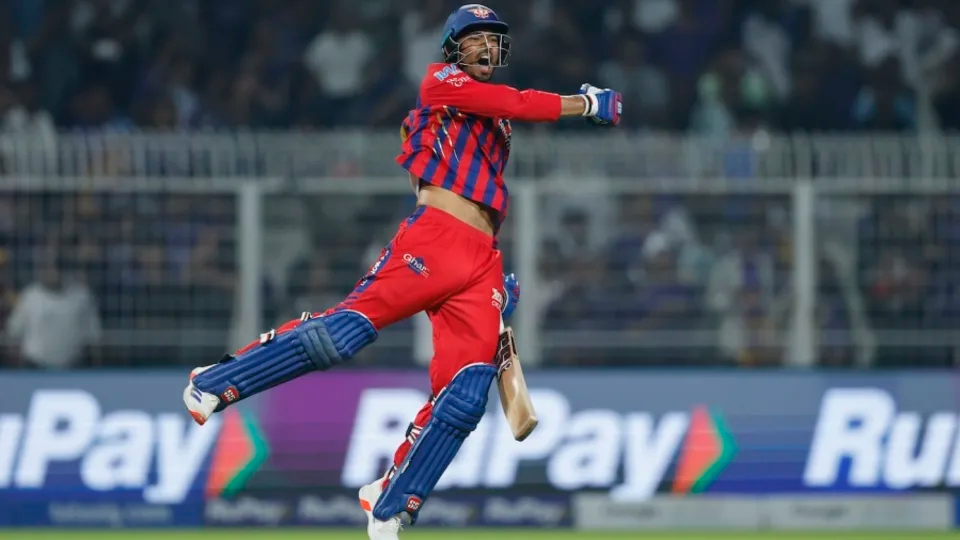
In the lead-up to IPL 2026, Lucknow Super Giants coach Justin Langer believed that rookie <ukul Choudhary had the potential to become the “scariest” finisher in India. The 21-year-old showcased his potential and power in only his third IPL game, bashing a 25-ball half-century, which snatched victory for LSG from Kolkata Knight Riders’ grasp.
When Choudhary came into bat, LSG were 104 for 5 in the 13th over in pursuit of 182. Choudhary watched them slump further to 125 for 6 and then 128 for 7. He was on 2 off eight balls at one point. But with LSG needing 54 off 24 balls, he single-handedly won it for them. Only one other batter – Kieron Pollard in 2013 – has scored more than 50 runs in the last four overs of a successful IPL chase.
It was anybody’s game when LSG required 14 off the final over, with three wickets in hand. After Avesh Khan got a single off the first ball, Choudhary monstered Arora over square leg for six. Arora then responded with two dots, but a barely believable six off the next ball – a near wide yorker – brought the equation to one off one.
Choudhary swung and missed the slower bouncer, but he scampered across for a leg-bye and completed a stunning turnaround for LSG. A new star was born in the IPL.
At the halfway stage of the game, Rovman Powell said this wasn’t a typical Eden Gardens pitch. As the game wore on, the deliveries dug into the surface, especially the slower ones, were difficult to put away. Aiden Markram, Mitchell Marsh, Nicholas Pooran and Rishabh Pant were all done in by steepling bounce.
Arora had bounced out Markram and Marsh with the new ball, but when he tried something similar against Choudhary with the older one, Choudhary muscled him over square leg. When Arora tried to york him next ball, Choudhary helicoptered the seamer over long-on. Of the seven sixes Choudhary hit in 27 balls, this was the pick of the lot. “MS Dhoni, eat your heart out! The helicopter shot is back,” Faf du Plessis said on commentary
But still KKR were favourites with 42 to defend off 18 balls. Until Choudhary intervened again. He tonked Kartik Tyagi for a brace of sixes and reduced the equation to 30 needed off 12 balls.
Cameron Green, who had earlier bested Pant with a slower bouncer, bowled that variation to Choudhary and drew a mis-hit, but it fell into no-man’s land. Choudhary missed another slower bouncer next ball, but struck back to hit Green for 6,4,6 in his next four balls.
Choudhary then whacked another slower short ball from Arora for six in the final over. Arora responded by switching his angle to around the wicket and nailed two wide yorkers. He marginally missed his mark the next ball, but Choudhary scythed it flat and hard over cover with his fast hands to stun KKR.
Earlier Ayush Badoni had laid the platform, from which Choudhary launched, for LSG with a contrasting 54. Coming in at No.4, Badoni helped LSG overcome an early wobble with his calculative approach. He was particularly circumspect against Sunil Narine, who had recovered from an illness that had put him out of KKR’s previous game, scoring only eight off ten balls from him. In all, Narine conceded just 13 runs in his four overs for the wicket of Mohammed Shami.
Badoni found runs from elsewhere. He took 26 off 12 balls from Tyagi and Navdeep Saini, the weaker links in the KKR attack. He brought up his half-century, off 33 balls, when he carted left-arm spinner Anukul Roy over midwicket for six. Next ball, however, Roy hid the ball away from Badoni’s reach and had him holing out to wide long-off.
Prince Yadav had struck in his first over when he had Finn Allen caught at deep third by Digvesh Rathi in controversial circumstances. After a few replays, Allen was given out for 9 off 8, but later another replay suggested that Rathi’s foot was touching the boundary when he was holding the ball with both hands.
KKR captain Ajikya Rahane and Angkrish Raghuvansh, who was promoted to No.3 ahead of Green, then countered the early blow with an 84-run partnership off 52 balls. Rahane manufactured swinging room and pumped both Rathi and M Siddharth for fours over cover.
Raghuvanshi was slow to start: he was on 6 off 12 balls at one point, but shifted gears when he lined up Avesh Khan for 4,6,4 in the last over of the powerplay.
LSG’s spinners Rathi and Siddharth then loosened KKR’s grip on the game by taking out Rahane and Raghuvanshi in successive overs.
Green needed 14 balls to find the boundary and in all managed only three fours and a six in the 24 balls he faced. Rovman Powell, who retained his place in KKR’s XI, was more fluent, finishing with an unbeaten 39 off 24 balls.
KKR went 31 balls without a boundary until Powell charged at Siddharth and cracked him over his head for six. Then when Prince missed his yorker, his drilled drive down the ground left both the bowler and the umpire in the firing line.
KKR were firm favourites – they had an 86% chance of beating LSG after 36 overs in the game – but Choudhary flipped the script and overpowered the hosts.
Brief scores:
Lucknow Super Giants 182 for 7 in 20 overs (Mitchell Marsh 15, Aiden Markram 22, Rishbah Pant 10, Ayush Badoni 54, Nicholas Pooran 13, Mukul Choudhary 54*; Anukul Roy 2-32, Vaibhav Arora 2-38, Sunil Narine 1-13, Kartik Tyagi 1-31, Cameron Green 1-28) beat Kolkata Knight Riders 181 for 4 in 20 overs (Angkrish Raghuvanshi 45, Ajinkya Rahane 41, Cameron Green 32*, Rovman Powell 39*; Prince Yadav 1-47, Manimaran Siddharth 1-34, Digvesh Rathi 1-25, AveshKhan 1-44) by three wickets
[Cricinfo]
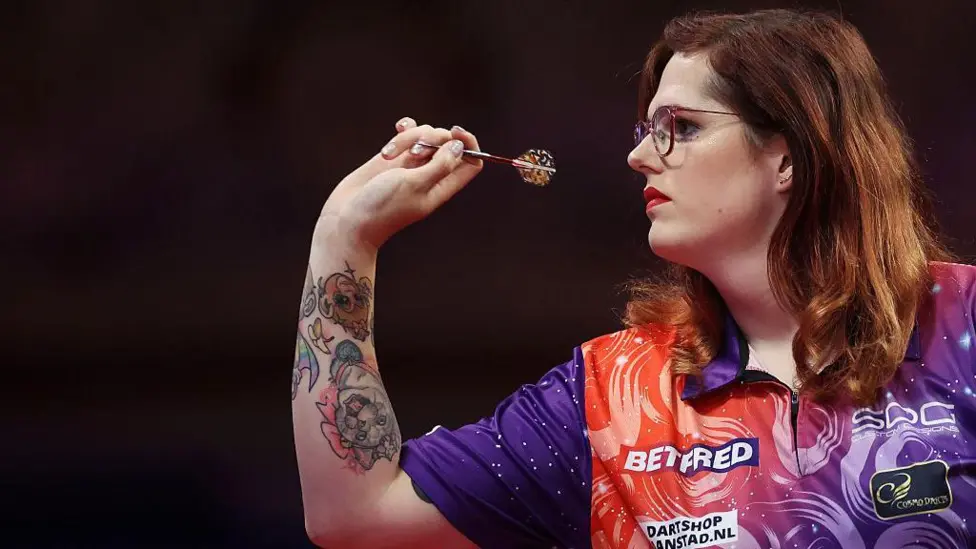
The Darts Regulation Authority has banned transgender women from competing in its women’s events with immediate effect.
The DRA, which governs the Professional Darts Corporation (PDC), said “only biological females should be eligible to compete in women’s tournaments regulated by DRA Rules”.
It comes after the DRA completed a review of its Trans and Gender Diverse Policy, which began in 2025.
Noa-Lynn van Leuven, who in 2024 became the first transgender woman to compete in the PDC World Championship, said the decision had “effectively retired her”.
She remains eligible to play in open tournaments for men and women.
“I just got an email and apparently I just got retired, not by choice but because I am no longer allowed to compete,” Van Leuven said in a video posted on Instagram.
“The DRA just decided that trans women are no longer allowed in women’s events which basically means I am out.
“Everyday it is getting harder for trans people to exist, to compete. If you think this stops with me, it doesn’t. We just want to be.”
Sex-based rights charity Sex Matters said “men’s physical advantages in darts may be small but they all add up”.
“Darts is a male-dominated world, played in pubs and clubs, and the top darts players are all men. That’s why women need their own tournaments.
“The Darts Regulation Authority followed the lead of the old, unfair IOC [International Olympic Committee] policy, so it’s great to see this rapid return to fairness for women players.”
The DRA said it “seeks to be inclusive” and it encouraged “all players – irrespective of their biological sex, legal sex, and/or gender identity” to continue competing in open tournaments.
It said its decision is based on legal advice and a commissioned report by Dr Emma Hilton – an academic developmental biologist who has published several papers on sex and categories in sport.
Dr Hilton’s report concluded “that multiple, small-magnitude sex differences accumulate to generate male advantage over females in darts”.
Last year, the World Darts Federation (WDF) banned transgender women from competing in its women’s tournaments.
Last month, the president of the IOC, Kirsty Coventry, announced a blanket ban on transgender women, as well as athletes with differences in sex development (DSD) from the 2028 Los Angeles Games.
(BBC)

PM on inspection tour of newly renovated Colombo Central Bus Stand

Israel to hold direct talks with Lebanon but no ceasefire, Netanyahu says

Sun directly overhead Nagawilluwa, Galgamuwa, Sigiriya, Palugasdamana and Mankerni about 12:11 noon today (10)

Showers expected in the Western, Sabaragamuwa, Southern and Uva provinces and in Kandy and Nuwara-Eliya districts after 2.00 p.m

Opposition tells Minister Kumara Jayakody to resign

Coal tender scandal: FSP to move court against illegal deals

‘Dates have the highest sugar content to fight Coronavirus’

Sunday Island 27 December – Headlines

#SundayIsland 17th December – Headlines

Sunday Island – 28th March

Sunday Island Headlines – 21 March

Sunday Island – 21st February – Headlines
-

 Features5 days ago
Ranjith Siyambalapitiya turns custodian of a rare living collection
-

 News5 days ago
Global ‘Walk for Peace’ to be held in Lanka
-

 News3 days ago
Lankan-origin actress Subashini found dead in India
-

 Features5 days ago
Beyond the Blue Skies: A Tribute to Captain Elmo Jayawardena
-

 Features5 days ago
Aspects of Ceylon/Sri Lanka Foreign Relations – 1948 to 1976
-

 Business1 day ago
Hayleys Mobility introduces Premium OMODA C9 PHEV
-

 News1 day ago
AG: Coal procurement full of irregularities
-

 Sports1 day ago
DS to face St. Anthony’s in ‘Bridges of Brotherhood’ cricket encounter