
News
Prof. Peiris complains of continuing shenanigans by President in the run-up to presidential poll

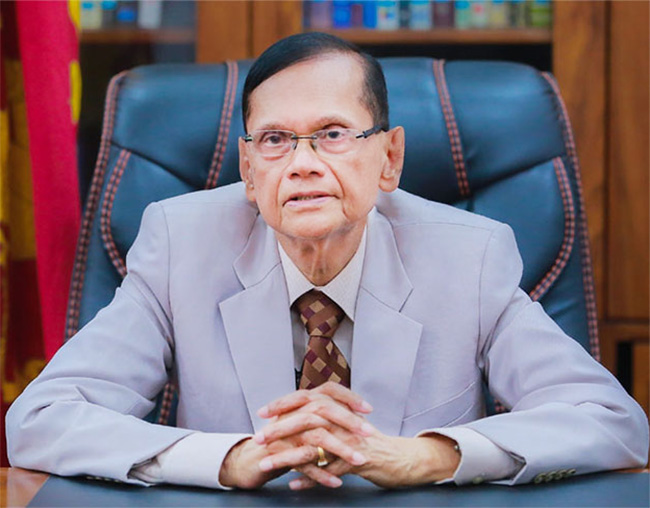
Vote on Economic Transformation Bill acid test for SLPP group – Prof. Peiris
By Shamindra Ferdinando
The Opposition has questioned President Ranil Wickremesinghe’s recently concluded visit to the Northern Province, where he declared open a new hospital and university facilities, etc., as part of his Presidential Poll campaign.
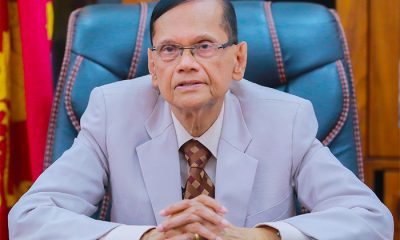
Prof. G. L. Peiris raised the latest alleged violation at his regular media briefing at his Kirula Avenue residence on Monday (27). The former External Affairs Minister pointed out that the President, in line with his overall campaign, took advantage of the opening of foreign funded projects.
The dissident SLPP MP accused the President of taking advantage of the foreign funded projects and also campaigning at the public expense. The former Minister was referring to the inauguration of two hospitals built with funds provided by the Netherlands.
MP Peiris alleged that the distribution of free rice, awarding of free land ownership in terms of the Urumaya programme, granting of proprietorship of over 50,000 housing units and opening of hospital and university facilities were meant to win votes at the forthcoming Presidential Poll.
Prof. Peiris said that the people couldn’t be deceived by such a propaganda campaign. The former Minister recently switched his allegiance to the main Opposition Samagi Jana Balawegaya (SJB) along with several of his colleagues in July 2022 over the SLPP’s decision to elect Ranil Wickremesinghe as the President.
Declaring that Wickremesinghe’s job was to complete the remainder of Gotabaya Rajapaksas’s five-year term, Prof. Peiris took exception to a proposal to conduct a referendum meant to extend Wickremesinghe’s term instead of conducting the scheduled Presidential Poll by Sept/Oct this year, as per the Constitution.
The academic emphasized that constitutionally a Presidential Poll couldn’t be substituted by a referendum under any circumstances. Prof. Peiris challenged efforts to compare the proposed referendum on the next Presidential Poll and President J.R. Jayewardene extending the life of Parliament by a period of six years in 1982, through a rigged referendum.
Prof. Peiris said that JRJ didn’t run away from the Presidential Poll. The first President called for a referendum – the only national referendum held so far in the country after winning the 1982 Presidential Poll. That allowed JRJ to put off the Parliamentary Poll that was to be held by August 1983 to Feb 1989.
Having been appointed President by Parliament in July 2022, Wickremesinghe shouldn’t contemplate extending his disputed term by way of a referendum, the ex-Minister said, alleging that the UNP leader feared facing the electorate.
Commenting on the SLPP’s proposal to conduct the Parliamentary Poll ahead of the presidential election, Prof. Peiris said that if the President so desired he could dissolve Parliament immediately and the election could be held within 52 days, or in seven and a half weeks. The former law professor said that the President is constitutionally empowered to dissolve Parliament after the Parliament completed two and half years of its five-year term.
However, in case the President hadn’t been willing to dissolve Parliament, those who desired so could submit a resolution to Parliament to that effect, Prof. Peiris said. But, the Parliamentary Poll couldn’t be conducted in a way that affected the Presidential Poll, he said, urging the Wickremesinghe-Rajapaksa government to reach consensus on this contentious matter without further delay.
Prof. Peiris dismissed suggestions that the much delayed Local Government poll should be held instead of the Presidential Poll. Blaming President Wickremesinghe for indefinitely putting off LG polls that should have been held in March last year, Prof. Peiris stressed that the Presidential Poll couldn’t be delayed on the promise of LG poll.
Referring to funds required for the elections, Prof. Peiris said that Rs. 10 bn had been allocated through the last Budget to conduct the Presidential Poll. In case the President on his own, or under pressure from the SLPP, decided to advance the Parliamentary Poll, Rs 11 bn should be allocated in terms of the relevant constitutional provision.
Prof. Peiris said that the Presidential and Parliamentary Polls couldn’t be conducted simultaneously, though some said so. Responding to such suggestions the Election Commission has pointed out the difficulty in simultaneously conducting two national polls, the retired top law academic said.
The former Minister backed SLPP leader Mahinda Rajapaksa’s recent call for the suspension of the ongoing controversial privatization and restructuring programme pending the conclusion of the Presidential Poll.
Recalling how he campaigned with the SLPP in the run-up to the 2019 Presidential and 2020 Parliamentary Polls assuring the public that state assets wouldn’t be privatized, Prof. Peiris alleged that President Wickremesinghe was on a privatization spree.
Declaring that 6.9 mn people voted for the SLPP at the Presidential Polls and the party won 145 seats at the last Parliamentary Poll, Prof. Peiris emphasized that it would be the responsibility of the SLPP parliamentary group to uphold the mandates received at those national polls.
“We believe the parliamentary group would abide by the SLPP Chairman’s position on privatization and restructuring,” Prof. Peiris said. The SLPP parliamentary group would face an acid test when the Parliament voted on the highly debatable Economic Transformation Bill next week.
Prof. Peiris said that the moves to fully privatize cash cows – Sri Lanka Insurance and Sri Lanka Telecom (SLT) – couldn’t be justified. Alleging that privatization of the SLT would compromise national security, he said that the SLPP couldn’t absolve itself of the responsibility for President Wickremesinghe’s actions.
Responding to SJB Chairman Field Marshal Sarath Fonseka’s criticism of the party accepting ‘outsiders’ at the expense of their original ideals, Prof. Peiris said that the leadership was selective in accepting those willing to join the main Opposition.
The Field Marshal’s criticism has been primarily over the SJB accommodating former Army Commander General Daya Ratnayake to the fold. Prof Peiris said that there had been cases of some of those interested in joining the SJB being rejected.
Defending SJB and Opposition Leader Sajith Premadasa’s projects, Prof. Peiris said that they couldn’t be compared with the President’s as the latter campaigned on taxpayers’ money and timed the opening of foreign funded projects for his benefit.






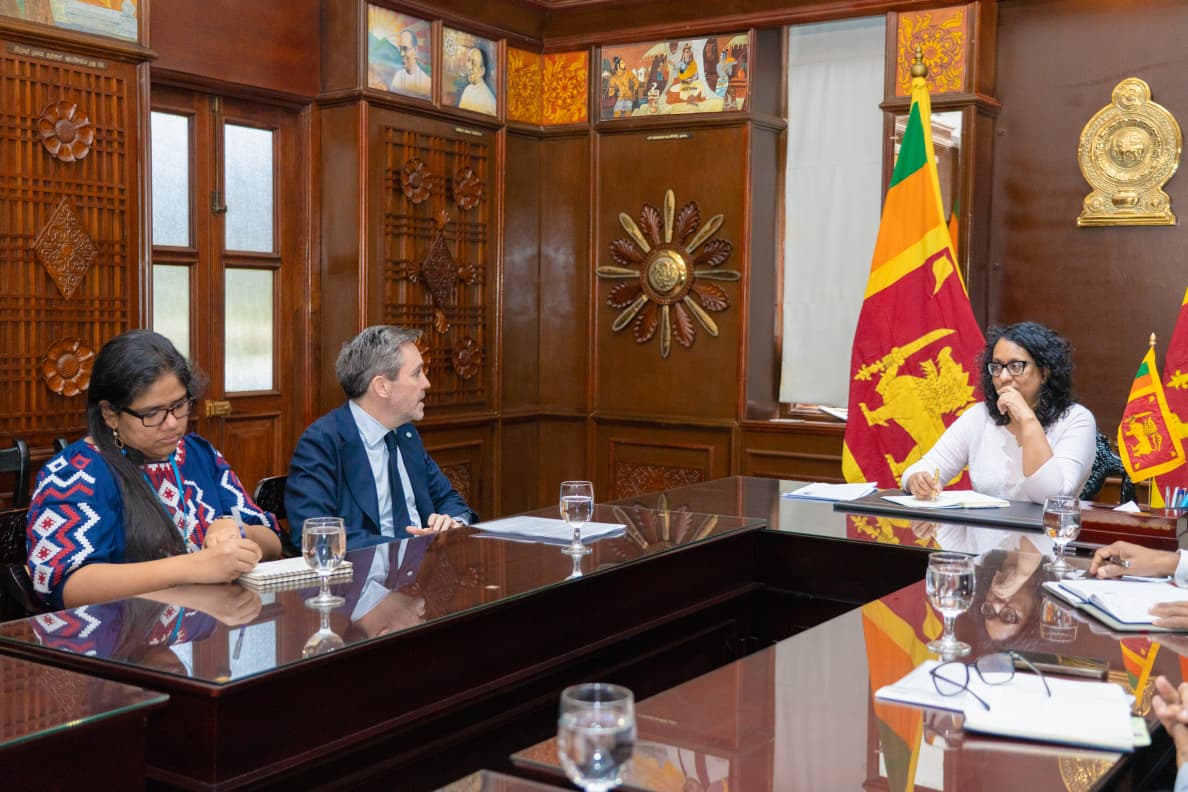
A meeting between Prime Minister Dr. Harini Amarasuriya and the United Nations Resident Coordinator in Sri Lanka, Marc-Andreé Franche, was held on the 20th of December 2025 at the Prime Minister’s Office.
During the meeting, Mr. Marc-Andreé Franche commended the swift coordination in which the Government acted to rescue affected communities and provide relief following the recent natural disaster situation faced by Sri Lanka.
Comparing experiences from other countries around the world, he noted that the level of international support Sri Lanka has received during such a disaster is exceptionally high. He further emphasized that he would utilize both his professional capacity and personal commitment to the fullest extent to ensure that Sri Lanka receives the necessary assistance.
Expressing appreciation for the continuous support extended by the United Nations to Sri Lanka, the Prime Minister stated that the role played by both the political authority and public officials in the field during this disaster management effort was exemplary. She highlighted that the collective and coordinated efforts of all parties from district leadership to the ground-level officials have become part in this success.
The Prime Minister also affirmed that the Government remains committed to properly managing the international assistance received and to rapidly restoring normalcy to the lives of people in the affected areas.
The meeting was attended by the secretary to the Prime Minister Pradeep Saputhanthri and Secretary to the Ministry of Education Nalaka Kaluwewa
[Prime Minister’s Media Division]
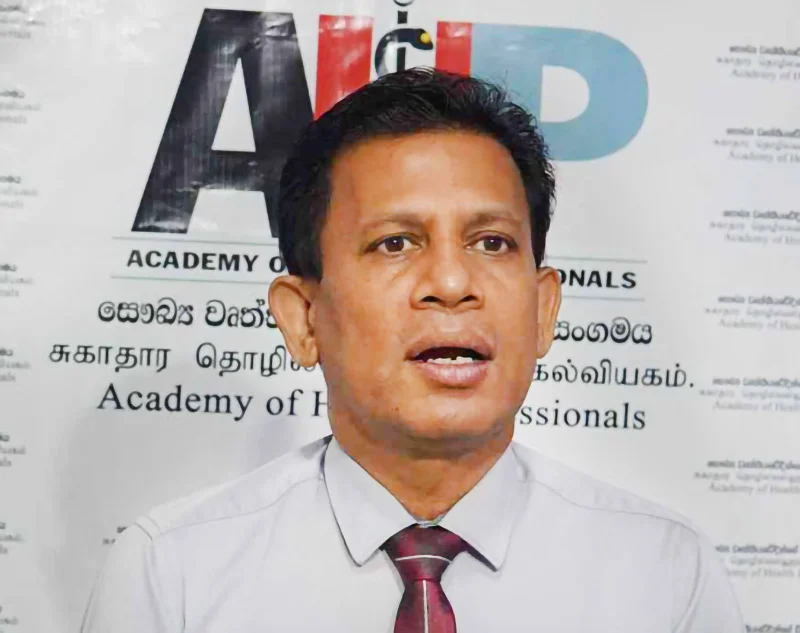
President, Academy of Health Professionals, Ravi Kumudesh, yesterday (22), alleged that the National Medicines Regulatory Authority’s (NMRA) decision to suspend several batches of Ondansetron Injection USP 8 mg/4 mL (Batch Nos: OD24021E, OD25009E, OD25024E, OD25023E), following suspicions of patient complications, and a few reported deaths, seemed to be a bid to cover-up the latest public health sector crisis.
Kumudesh said so responding to The Island queries.
Kumudesh pointed out that the Chief Executive Officer of the NMRA, and other responsible officials of the Ministry of Health, were on record as having said that the alleged bacterial contamination in the medicine in question was based on laboratory test results generated at the Microbiology Laboratory of the National Hospital, Kandy.
He, however, emphasised that the Kandy facility lacked legally mandated facilities, validated systems, or regulatory accreditation required to conduct pharmaceutical sterility testing in accordance with internationally accepted regulatory standards.
“The Academy of Health Professionals is aware that the Microbiology Laboratory of the National Hospital, Kandy, does not possess the required facilities,” Kumudesh said, urging the government to come clean in this matter.
Kumudesh said the regulatory action taken by the political authority was aimed at deceiving the public, and theAcademy of Health Professionals had raised the issues with Health Minister Dr. Nalinda Jayatissa, Health Secretary Dr. Anil Jasinghe, NMRA head Dr. Ananda Wijewickrama and Director General Health Services (DGHS) Dr. Asela Gunawardena.
Kumudesh pointed out that the Kandy facility was meant to meet requirements within the Kandy National Hospital and not a world standard testing lab. Kumedesh sought an explanation as to how the suspended Ondansetron Injection had been administered on 13 December to a person warded at the hospital where NMRA head is based, a day after the NMRA decided to suspend it.
Public health sector trade union activist Kumudesh said that the Health Ministry couldn’t turn a blind eye to the disclosure that post-mortem reports of two persons, who allegedly died after being given the same medicine by the National Institute of Infectious Diseases, did not identify the medicine as the cause of death. According to him, the National Institute of Infectious Diseases administered the same medicine to patients, on multiple occasions, in the wake of the controversy.
Kumudesh said that it would be the responsibility of the government to ensure a comprehensive technical, legal, and administrative investigation into, what he called, Ondansetron affair. Having lambasted all previous governments of waste, corruption and irregularities, at the expense of the hapless public, the NPP couldn’t, under any circumstances, side-step the issue. “In the interest of transparency, regulatory credibility, and the protection of public health, this should be properly investigated,” Kumudesh said.
The crux of the matter was that the very basis of NMRA’s suspension of Ondansetron batches seemed to be irregular and questionable, Kumudesh said.
The Academy of Health Professionals, in its letter to Dr. Jayatissa, sought the Health Ministry’s response to the following questions: 1. Who requested the Microbiology Laboratory of the National Hospital, Kandy, to conduct sterility testing on this medicinal product?
2. Under what legal provisions was such a request made, and on what basis was the laboratory authorised to accept and perform such testing?
3. Who conducted the test, and who issued the report? Did those individuals possess the requisite professional qualifications, regulatory authorisation, and legal mandate to do so?
4. Did the laboratory possess the required infrastructure, validated testing systems, quality assurance mechanisms, and specialised training necessary to perform pharmaceutical sterility testing in compliance with regulatory standards?
5. If patient complications were attributed to microbial contamination, were all related materials—including syringes, IV lines, infusion fluids, and other associated devices—systematically tested? If not, on what scientific basis was it concluded that the contamination originated exclusively from the medicine?
6. Given that the NMRA is legally empowered to suspend a medicine as a precautionary measure, even without laboratory confirmation, when serious safety concerns arise, what was the justification for relying on an irregular and non-regulatory laboratory test instead?
Kumudesh stressed that Ondansetron, and nine other injectable medicines that had been suspended, were all ordered by the State Pharmaceutical Corporation (SPC) from an Indian manufacturer, Maan Pharmaceuticals.
By Shamindra Ferdinando
Amidst the ongoing controversy over the suspension of several batches of Indian manufactured Ondansetron Injection USP 8 mg/4 mL (Batch Nos: OD24021E, OD25009E, OD25024E, OD25023E) over safety fears, Health Minister Dr. Nalinda Jayatissa undertook a visit to New Delhi.
The Indian HC in Colombo said: ‘Dr. Jayatissa, the Minister of Health and Mass Media of the Government of Sri Lanka led a delegation to India from 17–19 December 2025 to participate in the 2nd WHO Traditional Medicine Global Summit held at Bharat Mandapam, New Delhi. The Summit was jointly organized by the World Health Organization and the Ministry of Ayush, Government of India.
The Summit was held under the theme “Restoring Balance: The Science and Practice of Health and Well-Being” and aimed to advance a global movement focused on restoring balance for individuals and the planet through the scientific understanding and practice of traditional medicine.
During the Summit, the Minister participated in the Ministerial Roundtable and delivered his remarks, highlighting Sri Lanka’s perspectives and rich traditions in Ayurveda and traditional healing.
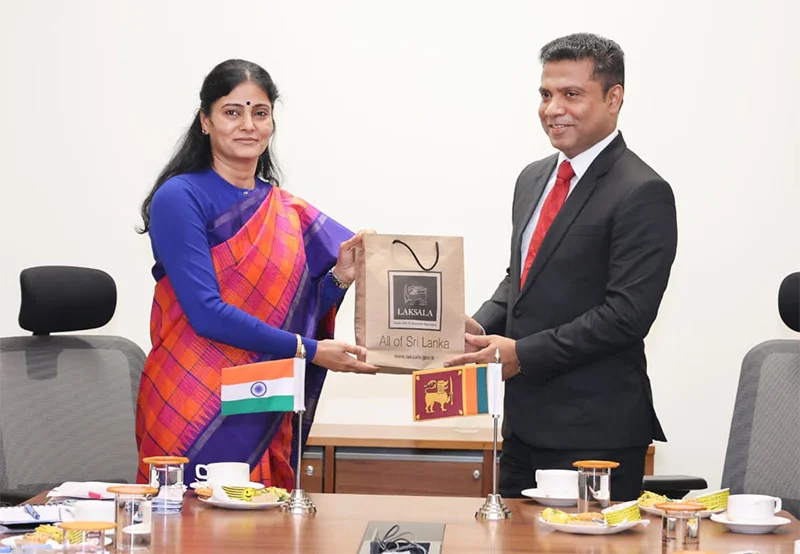
During the visit, the Minister held bilateral meetings with Anupriya Patel, Minister of State for Health & Family Welfare, Government of India, and Prataprao Ganpatrao Jadhav, Minister of State (Independent Charge), Ministry of Ayush, Government of India. Discussions focused on strengthening cooperation in healthcare and traditional medicine, including regulatory collaboration, research linkages, and capacity-building initiatives.
On the sidelines of the programme, Minister Jayatissa also visited Apollo Hospitals to gain insights into the implementation of Public-Private Partnership (PPP) models and to explore best practices.
The visit reaffirmed the shared commitment of India and Sri Lanka to deepen collaboration in the fields of health and traditional medicine and to explore new avenues of partnership for the benefit of the people of both countries.’

PM meets UN Resident Coordinator

Showers may occur in the Uva and Eastern provinces and in Matale, Nuwara-Eliya, Polonnaruwa and Hambantota districts.

Suspension of Indian drug part of cover-up by NMRA: Academy of Health Professionals

Dr. Jayatissa visits India amidst Ondansetron controversy

Inquiry launched into burnt elephant death at Seeppukulama as toll mounts

Members of Lankan Community in Washington D.C. donates to ‘Rebuilding Sri Lanka’ Flood Relief Fund

‘Dates have the highest sugar content to fight Coronavirus’

Sunday Island 27 December – Headlines

#SundayIsland 17th December – Headlines

Sunday Island – 28th March

Sunday Island Headlines – 21 March

Sunday Island – 21st February – Headlines
-

 Midweek Review6 days ago
How massive Akuregoda defence complex was built with proceeds from sale of Galle Face land to Shangri-La
-
 News5 days ago
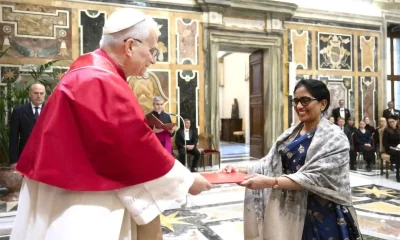
Pope fires broadside: ‘The Holy See won’t be a silent bystander to the grave disparities, injustices, and fundamental human rights violations’
-

 News5 days ago
Pakistan hands over 200 tonnes of humanitarian aid to Lanka
-

 Business4 days ago
Unlocking Sri Lanka’s hidden wealth: A $2 billion mineral opportunity awaits
-
 News6 days ago
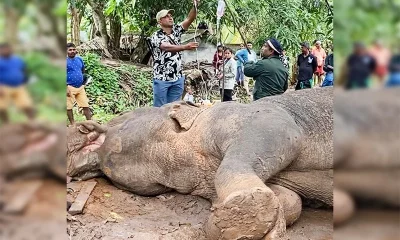
Burnt elephant dies after delayed rescue; activists demand arrests
-

 Editorial6 days ago
Colombo Port facing strategic neglect
-

 News4 days ago
Army engineers set up new Nayaru emergency bridge
-

 News6 days ago
Sri Lanka, Romania discuss illegal recruitment, etc.