
News
Politically motivated efforts to sabotage Covid-19 inoculation project alleged

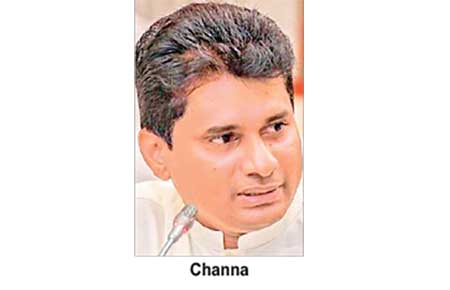
… despite shortcomings, vaccination drive on track
By Shamindra Ferdinando
State Minister of Pharmaceutical Production, Supply and Regulation Prof. Channa Jayasumana says despicable attempts are being made to derail the ongoing Covid-19 inoculation drive.
In a wide ranging interview with Dasun Wasantha on ITN on Wednesday (16) night, Anuradhapura District lawmaker Prof. Jayasumana alleged that the recent inoculation of a group of people from Colombo at a vaccination centre in Galle was certainly part of their strategy.
When the interviewer pressed for an explanation, the medical academic turned politician said a senior Opposition politician’s younger brother was behind the moves to discredit those engaged in the vaccination programme.
Pointing out that the matter was now before courts, Prof. Jayasumana emphasised that the government could not ignore the threat posed by those who were out to prevent it from overcoming the Covid-19 challenge.
Prof. Jayasumana said that the government was also countering a threat on the political front. Answering another query, he alleged that an influential section of medical administrators and doctors, too, were trying to sabotage the vaccination programme for political reasons.
Conspiracy to derail vaccination drive
The state minister compared those who had been trying to sabotage the vaccination programme with the political groups which could not bear the eradication of terrorism. He recalled how certain influential persons had tried to thwart the combined security forces campaign on the Vanni front during eelam war IV (August 2006-May 2009).
Prof. Jayasumana said that some of those pursuing politically motivated strategy had been removed, moved out or neutralised to ensure that the vaccination programme would be conducted efficiently, but action could not be taken against some elements as they were under the Public Service Commission (PSC).
Acknowledging shortcomings and some failures on the part of the SLPP administration in the implementation of the vaccination programme, Prof. Jayasumana said he was confident that the vaccination drive could be steered to a successful conclusion.
Lanka refused to allow clinical trials
At the onset of the interview, Prof. Jayasumana explained why the government had refused to involve Sri Lanka in Covid-19 clinical trials. “We were given the opportunity. If agreed, we could have secured some privileges such as priority access to vaccines. Brazil and Peru were among those countries involved in clinical trials and were given priority in the distribution of vaccines.”
Prof. Jayasumana denied the interviewer’s assertion that Sri Lanka was late in launching the vaccination programme. “How could that be? We launched inoculation drive on January 29, within 24 hours after taking delivery of 500,000 free covishield doses from India.”
Prof. Jayasumana pointed out that Sri Lanka had launched the inoculation drive two weeks before the World Health Organization (WHO) approved AstraZeneca/Oxford COVID-19 vaccine aka covishield produced at Serum Institute, Pune in India for emergency use.
Sinopharm jab
Commenting on the introduction of the Sinopharm vaccine here, Prof. Jayasumana said that the Chinese product encountered serious challenges due to a highly politically motivated campaign meant to sabotage the inoculation campaign. He alleged a section of the print media contributed to that project carried out by disruptive elements, who also directed a high-profile social media campaign targeting Sinopharm.
Prof. Jayasumana said that the campaign against Sinopharm had delayed the administration of it. Referring to political influence exerted on medical specialists to discourage them from approving its use, Prof. Jayasumana acknowledged that finally a new regulatory committee had been appointed to secure approval for the Chinese jab.
Prof. Jayasumana said that the government had first used Sinopharm on May 8 though China delivered stock of 600,000 doses on March 31. “Doctors felt threatened. They believed a decision on Sinopharm could boomerang.”
Asked whether the government could have tackled Covid-19 if Sinopharm had been introduced much earlier, the State Minister said the vaccination process could have been advanced.
Prof. Jayasumana said, adding that Sri Lanka recently received sufficient Sinopharm doses to sustain the inoculation drive. He revealed that another consignment of one million vaccine doses was awaited in addition to six million doses expected in July and August.
Prof. Jayasumana said that the unexpected Covid-19 eruption in India had disrupted Sri Lanka’s inoculation project. Having received 500,000 free covishield doses from India, the government expected to buy 10 mn doses from Serum Institute, but only 500,000 could be bought. Besides, Sri Lanka had received 264,000 doses through Covax facility, Prof. Jayasumana said, adding that the breaking up of the supply chain had resulted in about 575,000 being deprived of the covishield second dose. “We are quite concerned about the situation.”
Commenting on difficulties experienced in procurement efforts, Prof. Jayasumana said that there was no point in denying the fact that both the US and Russia pursued what he called vaccine diplomacy in line with their geopolitical strategy.
Prof. Jayasumana said that those who seek to discourage the use of Sinopharm had recently propagated the lie China sold Sinopharm dose at USD 15 a piece to Sri Lanka whereas Bangladesh received the same for USD 10 each. He alleged social media had been abused to mislead the public into believing that Sinopharm was unsafe and China was engaged in unfair trading practices.
‘200-million-rupee property’
Prof. Jayasumana said he had been accused of building a Rs 200 mn house in Etul Kotte. “Neither I nor my family members own any property in Etul Kotte or Pita Kotte,” Prof. Jayasumana said, adding that he had called for a police investigation.
Declaring that Sri Lanka had procured the Sinopharm vaccine at the lowest possible price, Prof. Jayasumana explained the procedures adopted in the procurement process.
Prof. Jayasumana insisted that no other country had received Sinopharm at lower prices.
The State Minister also discussed efforts to provide the second dose of covishield to those denied it so far. According to him, the WHO has promised to deliver 264,000 covishield doses as booster shots. “We expect to take delivery of the consignment within the first two weeks of July,” Prof. Jayasumana said, adding that Sri Lanka had also requested additional 300,000 doses for those deprived of the second dose. Those countries having additional stocks of that vaccine had said they could make available the vaccines only through the Covax programme, the state minister said.
Possible AZ-Pfizer mix
Prof. Jayasumana said that if their efforts to procure sufficient stock of covishield failed, the Pfizer vaccine could be used for the second dose. However, this would be subjected to approval by the regulatory body though the WHO had approved the vaccine mix.
Prof. Jayasumana said that 300,000 doses of Pfizer vaccines were expected to be delivered next month. Sri Lanka expected to take delivery of as many as 5 mn Pfizer vaccines this year, including 300,000 expected next month.
Responding to another query, Prof. Jayasumana said that there had been only three cases of those who had received Sinopharm experiencing side-effects though 1.4 mn received the vaccine since May 8. The recent problem at a garment factory in Anuradhapura had not been caused by Sinopharm, but an issue caused by poor ventilation, the state minister said.


Appointment of committee eyewash, says UNP
The government is considering changes to prison regulations pertaining to the treatment of Buddhist monks serving jail terms, including their right to wear monastic robes when taken outside prison.
Justice and National Integration Minister Harshana Nanayakkara announced the proposed changes yesterday (14) following the submission of an interim report by a committee appointed to review the rules and procedures governing prisons.
The report was handed over to Secretary to the President Dr Nandika Sanath Kumanayake at the Presidential Secretariat.
One of the key recommendations is to amend Prison Standing Order 356 by introducing a new provision, 356(A). The proposed revision would require prison authorities to consult the Department of Buddhist Affairs on the removal of a monk’s robes upon admission to prison. The Commissioner of Prisons would be allowed 10 days to notify the department and take the necessary steps.
A separate amendment to Departmental Order 550 would allow Buddhist monks to wear their robes whenever they are taken outside prison, unless their respective Nikaya formally requests that the privilege be withdrawn.
The committee has also recommended extending similar arrangements, with suitable modifications, to members of other religious clergy who are imprisoned.
The proposals follow concerns raised over the treatment of Ven. Galagoda Aththe Gnanasara Thera after he was taken into custody. President Anura Kumara Dissanayake subsequently held discussions with representatives of the three main Buddhist Nikayas and appointed the committee to examine the existing legal framework.
Nanayakkara said the interim report had been forwarded to the Acting Commissioner General of Prisons, along with instructions to revise the relevant standing orders in accordance with its recommendations.
The proposed amendments have yet to be confirmed as formally implemented.
Meanwhile, the UNP yesterday criticised the government’s decision to appoint a committee to make recommendations on the attire to be worn by imprisoned Buddhist monks and other religious leaders when taken outside prison, describing the move as unnecessary.
In a statement issued yesterday (14), the UNP said the procedures governing the matter were already clearly set out in the Department of Prisons’ Standing Orders, making the appointment of a separate committee unwarranted.
The party cited remarks by Professor G.L. Peiris, Convenor of the Janathawadi Joint Opposition, who had described the committee’s appointment as a
“complete eyewash” and questioned the need for such a move.
Referring to Standing Order 550 of the Prisons Department, the UNP said convicted prisoners appearing before court for legal proceedings should not be required to wear prison uniforms.
It further stated that the regulations allowed prisoners to wear civilian clothing consistent with what they wore before imprisonment, including attire appropriate to their cultural and religious backgrounds.
The UNP accused the government of unnecessarily prolonging the issue by appointing a committee, despite the existence of regulations governing prisoners’ attire.
The party also called on the government to seek forgiveness from the Mahanayake Thera and the Sangha Council of the Kotte Sri Kalyani Samagri Dharma Maha Sangha Sabha of the Siyam Maha Nikaya over the decision concerning the religious attire of Ven. Galagoda Aththe Gnanasara Thera.
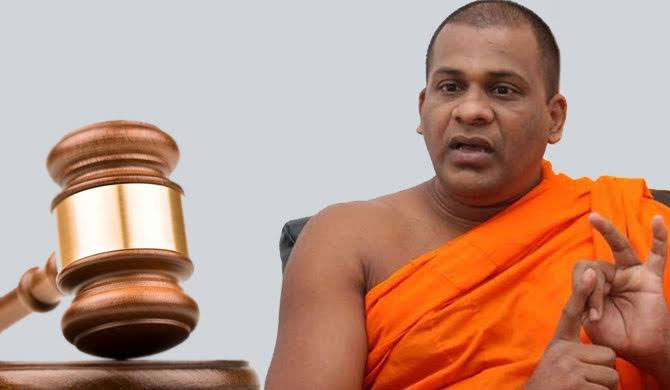
Court of Appeal President Justice Rohantha Abeysuriya yesterday withdrew from the bench hearing petitions challenging the decision by prison authorities to require Ven. Galagoda Aththe Gnanasara Thera to wear prison attire following his imprisonment.
The decision was announced when the petitions seeking to invalidate the prison authorities’ decision were taken up for consideration on October 14.
Following his withdrawal, a three-judge bench was appointed to hear the petitions.
The petitions relate to the prison authorities’ decision to require Gnanasara Thera to wear prison attire after he was taken into custody to serve the remainder of his sentence for contempt of court.
In September this year, the Supreme Court annulled the presidential pardon granted to Gnanasara Thera by former President Maithripala Sirisena in May 2019.
Following the ruling, the Court of Appeal directed the Commissioner General of Prisons to take the necessary steps to enforce the remainder of the monk’s prison sentence.
Gnanasara Thera had originally been sentenced to six years’ imprisonment for contempt of court but had served only around nine months before receiving the presidential pardon in 2019.
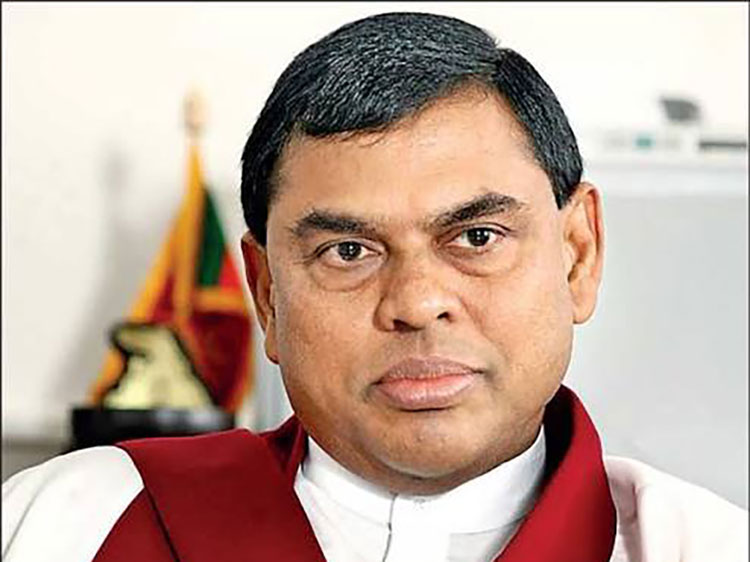
The Fort Magistrate’s Court yesterday issued an arrest warrant for former Minister Basil Rajapaksa over the alleged misuse of funds belonging to the Sri Lanka Tourism Promotion Bureau during the 2014 Uva Provincial Council election.
The Magistrate also directed the CID Illegal Assets Investigation Division to take necessary steps to obtain a Red Notice through Interpol.
The orders were issued following submissions made by the CID in connection with the alleged financial irregularities.
The CID’s Illegal Assets Investigation Unit informed the court that Rs. 7.8 million allocated to the Sri Lanka Tourism Promotion Bureau in 2014 had allegedly not been used for the Bureau’s promotional activities.
Instead, the funds had allegedly been used to provide 12,000 T-shirts during the Uva Provincial Council election, causing a financial loss to the government, the CID told court.

Showers or thundershowers will occur at most parts of the island

Prison rules to be revised over monks’ attire

AC President recuses himself from hearing prison attire case pertaining to Gnanasara Thera

Court orders steps to obtain INTERPOL Red Notice against Basil

CID informs Fort Magistrate’s Court investigation into money laundering case against Namal completed

No force used to make Gnanasara Thera wear prison garb – Prisons

‘Dates have the highest sugar content to fight Coronavirus’

Sunday Island 27 December – Headlines

#SundayIsland 17th December – Headlines

Sunday Island – 28th March

Sunday Island Headlines – 21 March

Sunday Island – 21st February – Headlines
-

 News6 days ago
NDB fraud Rs 60mn more than reported
-

 News6 days ago
Removing monk’s robes matter for Sangha to decide: Mahanayake Theras
-

 News4 days ago
Sri Lanka escalates anti-graft drive with Shiranthi’s jailing
-

 News5 days ago
NPP govt. reminded of its responsibilities as US warship leaves Colombo
-
 Latest News5 days ago
Farhan, Sadaqat help Pakistan ace 183 chase to go 1-0 up
-
 News6 days ago
BHC, Colombo: “LTTE remains a proscribed org. in the UK”
-

 Latest News3 days ago
Farhan and Sadaqat help Pakistan seal series in style
-

 News4 days ago
Iranian ships stranded, Lanka fears US sanctions