
Features
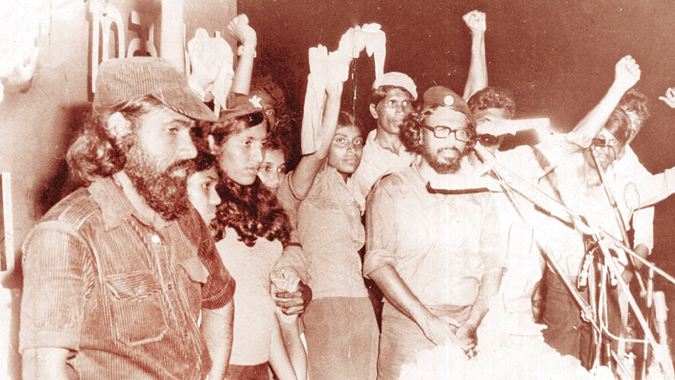
Petitions, Trevor Moy and the story of a Vidyodaya graduate driven to JVP

by Capt. FRAB Musafer, 4th Rgt. SLA (Retd.)
(Continued from last week)
On my return I was ordered to take over Tissamaharama from Lt Wijesuriya and Lt Gemunu Wijeratne who were based in the comfort of the Tissa Rest House. During this time we were issued with a rationed quota of duty free local cigarettes , Kandos chocolates and beer, (not to be consumed but as a take home item) for the first and perhaps only time.
Operations were fairly routine based on informants. The daily mail received consisted of anonymous petitions blatantly incriminating persons with no involvement whatsoever in the insurgency. In addition I was called upon to look into land disputes, recovery of money lent, fraud, infidelity and a host of other problems people encountered and had no avenues of seeking redress in a hurry. Much to the dismay of my sergeant I tended to ignore most of them. One day the sergeant walked in with a wry smile on his face and asked me ” What are you going to do about this Sir?”.
The petition was addressed to the Army Captain threatening me with castration, to put it better language. It was signed bearing the name of a local strong man. We found this person and asked him to name the likely letter writer. He named a few, whom we picked up and took them to the camp. Having lined them all in front of a light machine gun on the banks of the Tissa Wewa, an ultimatum was given that the entire lot would be shot unless the person who sent the petition stepped forward.
After a few minutes one of them meekly owned up and said he did it, stating the named person was committing an injustice to them by extorting money and preventing them from selling and despatching their produce out of Tissa at favourable prices. The rest did not hesitate to support his claims. We warned the person concerned and asked him to refrain from carrying on this intimidation and threatened him that we would arrest him and send him to prison with the thrasthwadayas (insurgents),
Whilst at Tissa a suspected insurgent surrendered at the camp. He said that he was surrendering because the police had threatened to burn his father’s home and that it was the last thing he wanted. His father, he said, had mortgaged his properties and had got into debt to spend for his tertiary education at the Vidyodaya university. He had successfully graduated but could not find any employment to pay back or help his father sort out the debts incurred. In desperation he had applied for a labourers position at the salt pans and the interviewer had told him that he could not give him the job since he was more qualified than the interviewer.
He pleaded with him but to no avail. Looking back he said that he should have not presented himself as a graduate but again was not sure he would have got the job anyway as he had no political connections. The reason he was sympathetic to the cause was because there was no other avenues to pursue and there was no hope for the future. He asked me a question “What would you have done Sir in my circumstances”? I was in no position to answer him, he was more qualified than me albeit with an arts degree. To me it summed up the causes, an over supply of arts graduates, no jobs to placate them and undue hardships and frustrations of the youth in the rural areas. There were no job opportunities available in this region. It was an area that was totally neglected. He was a no hoper and driven to desperation.
Based at Tissa I was asked to escort three bus loads of suspected insurgents from the Tangalle prison to the Vidyodaya University which was converted as a temporary prison. Driving into Colombo at dusk I found a city under siege, with roads closed and barricaded and well lit with searchlights directed skywards. There were plenty of troops deployed and a dusk to dawn curfew imposed and military checkpoints established at key points. I was stopped at the Kirullapona bridge by no less a person than Brigadier Jayaweera and Major Ranjith Wanigasundera, a fellow regimental officer. Brig Jayaweera was shocked that my convoy of three jeeps was the only security for the three busloads of detainees. It never occurred to me that Colombo itself was also under threat. I proceeded to Vidyodaya University and handed over the detainees to the prison officials.
Next day I had to collect a staff car for Col Nugawela and also pick up Mr Trevor Moy, Managing Director of George Stuarts, who was Colonel Nugawela’s boss. On our way we had tea at the NOH at Galle and Mrs Brohier the manageress of the Hotel made some remarks about some North Korean involvement. The Sunday papers used to have a full page supplement on Kim ul Sung the north Korean leader. There had been rumours that there were some North Korean ships waiting offshore loaded with weapons to support the insurgents.
The North Koreans were expelled from Sri Lanka. The extent of their involvement was never made public and there was no evidence that arms had been supplied to the insurgents. Had they received arms the outcome may have been prolonged and different.
On arriving at Tissa around noon with Mr Trevor Moy I found that Lt Jayakumar a volunteer officer and a planter by profession who was holding the fort at Tissa was not in camp. Colonel Nugawela was looking for him and no one had a clue to his whereabouts. He had taken a jeep with an army driver and driven off and was missing from the previous night. However, much to our relief he turned up shortly looking tired and worried. He was not keen to go back to Hambantota to face the Coordinating officer and tell him of his ordeal at the Yala national park.
What was a drive through the park turned out to be a night to remember. His jeep had a flat tyre at the furthest end of the park and had no spare. He had no torch , no food or water and no idea where he was and made the decision to walk along the beach till light permitted. Continued his walk in the morning and eventually with the help of the park authorities repaired the flat tyre and made it back to the camp.
I was told another volunteer officer Lt Nilaweera nearly killed himself when his sterling sub machine gun went off as he attempted to free the weapon which had got stuck in the front seat of his jeep. the bullet whizzing past his ear.
An Embarrassment
The following day Colonel Nugawela dropped in at Tissa and enquired if Mr Moy has had breakfast, I replied “Yes, Sir.” The next question was what did he have to which I replied “toast, fried eggs and sauteed liver with onions in butter.” He blew a fuse and repeated “liver liver?” (this was the menu suggested by the rest house manager) but before I could say anything else Mr Moy butted in and said “Derrick I quite enjoyed it, in fact I haven’t eaten it for such a long time.” His intervention and diplomacy saved the day for me. I was totally unaware that liver which was expensive and deemed nutritious to the locals was offal and a cheap food to most westerners.
During the five hour drive from Colombo I was engaged in a long conversation which covered many topics and I found that Mr Moy was very knowledgable of Ceylon and a very amiable individual. I was told he loved Ceylon so much that his last wish was that his ashes be scattered over the tea estates he managed during his planting days.
Life’s experiences
Whilst at Tissa I was asked to relieve my batchmate from Pakistan. Lt Gamini Angamanna, who was stationed at Wellawaya to enable him to participate in a counter insurgency operation in Moneragala being undertaken by the Gemunu watch troops under Col Bull Weeratunga. Gamini was shocked to see me drive in my trusted army jeep windscreen down and no canopy, the truck was no better. He admonished me for not adequately protecting myself.
His vehicles were boarded with sawn satin timber logs giving some protection from shot gun fire. The troops in this area had been subjected to ambushes and had been under fire, whereas I had never been subjected to any enemy fire and was oblivious to any danger. Looking back I think I was foolhardy and naïve but extremely lucky to have operated in an area where the insurgency had lost its momentum or for that matter not got off the ground.. On the other hand I wonder if the presence of the Army since mid March had a detrimental effect on the planning process of the JVP in the Hambantota area.
Sri Lankan hospitality despite being poor.
On information provided to coordinating headquarters I was ordered to take a platoon of volunteer troops in search of a suspected insurgent hideout. With no maps and only the informant as our guide we took off at the crack of dawn. It was not long after we realized we were lost. The platoon sergeant suspected we were being led into a trap and suggested that we should bump off the informant. I took no notice of his request. We eventually located the hideout that had been abandoned leaving traces of food and packaging materials. which may have been used to protect the weapons if any.
Heading back to camp we lost our way once more. The volunteer soldiers were not the fittest and were finding it hard to keep up in this elephant infested jungle. We had no clue where we were headed for but continued to trudge in one direction till we hit a cart track that eventually led to a hut. We asked the occupant how we could go to Kataragama to which he replied he did not know but said he could show the way to Wellawaya. As we were parched and exhausted we asked him for some water. He produced two Kala Gediyas of water and said that he will get us some more as there were around twenty of us. Before he left he cut a few papaws and served us apologizing that this was all he had. He said it wont be long but he took over an hour to get back. Something which I will remember all my life is the hospitality of this one man who virtually had nothing and was struggling to make a living by planting chillies in an elephant infested jungle. He was surviving on the government subsidized free rice ration and a miris sambol. The true extent of poverty is never identified by our ruling elite.
Hospitality is synonymous with Sri Lanka but in my mind nothing epitomizes this unselfish act of a very poor man with such a big heart thinking nothing about himself. Sri Lanka is blessed with such good men.
Having rested and with him as the guide we set off towards Wellawaya, crossed the Menik Ganga where we saw crocodiles lazing on the banks. Soon after we found a typical tractor track which took us back to civilization. We came across a house where a wedding was being celebrated with the bridal car parked nearby. With the consent of the wedding party we commandeered the Morris station wagon to enable a few of us to get back to camp and bring transport back to pick up the rest. We did not forget our good Samaritan to whom we sent some of our dry rations and also cash to reimburse the cost of petrol. The soldiers were not only grateful but had realized the hardships he was enduring to make a living.
Rural poverty- bartering
There was also another incident in 1972 during mopping up operations in the jungles off Kantalai that stays vivid in my memory of the hardships and poverty which people in the villages endure. Here whilst on a patrol we came across a little girl no more than six to seven years walking alone on a track in an elephant infested area. She was on an errand to get some panadols for her mother in exchange for the little bit of rice she carried in a paper bag. The rice incidentally was the free or subsidized issue given by the government, which establishments like the World Bank and IMF wanted stopped. This was the first time we had encountered bartering and was moved by the plight of this little girl.
This has served me as a reminder that there are so many needy people out there struggling to survive in these areas and wonder what their plight is today. A myth prevails that villagers can make do to survive and will not starve. They are simple and hard working but neglected and a forgotten lot by the city dwellers. The politicians who are entrusted to improve their lot and provided with gas guzzling SUV’s sadly fail to do so. They, the rural poor too have their dreams and aspirations to improve their lot.
Sri Lanka’s was no comparison to the poverty in India. On an overnight train journey to Assam to follow a course in counter insurgency and jungle warfare I witnessed a pathetic sight. A little boy with oversize shorts and his fly open picked up the paper wrapping of the sandwiches we had eaten and licked it just for the taste of it. What a cruel world!



 The abduction of Venezuelan President Nicolas Maduro by US special forces on January 3rd and his coercive conveying to the US to stand trial over a number of allegations leveled against him by the Trump administration marks a dangerous degeneration of prevailing ‘world disorder’. While some cardinal principles in International Law have been blatantly violated by the US in the course of the operation the fallout for the world from the exceptionally sensational VVIP abduction could be grave.
Although controversial US military interventions the world over are not ‘news’ any longer, the abduction and hustling away of a head of government, seen as an enemy of the US, to stand trial on the latter soil amounts to a heavy-handed and arrogant rejection of the foundational principles of international law and order. It would seem, for instance, that the concept of national sovereignty is no longer applicable to the way in which the world’s foremost powers relate to the rest of the international community. Might is indeed right for the likes of the US and the Trump administration in particular is adamant in driving this point home to the world.
Chief spokesmen for the Trump administration have been at pains to point out that the abduction is not at variance with national security related provisions of the US Constitution. These provisions apparently bestow on the US President wide powers to protect US security and stability through courses of action that are seen as essential to further these ends but the fact is that International Law has been brazenly violated in the process in the Venezuelan case.
To be sure, this is not the first occasion on which a head of government has been abducted by US special forces in post-World War Two times and made to stand trial in the US, since such a development occurred in Panama in 1989, but the consequences for the world could be doubly grave as a result of such actions, considering the mounting ‘disorder’ confronting the world community.
Those sections opposed to the Maduro abduction in the US would do well to from now on seek ways of reconciling national security-related provisions in the US Constitution with the country’s wider international commitment to uphold international peace and law and order. No ambiguities could be permitted on this score.
While the arbitrary military action undertaken by the US to further its narrow interests at whatever cost calls for criticism, it would be only fair to point out that the US is not the only big power which has thus dangerously eroded the authority of International Law in recent times. Russia, for example, did just that when it violated the sovereignty of Ukraine by invading it two or more years ago on some nebulous, unconvincing grounds. Consequently, the Ukraine crisis too poses a grave threat to international peace.
It is relevant to mention in this connection that authoritarian rulers who hope to rule their countries in perpetuity as it were, usually end up, sooner rather than later, being a blight on their people. This is on account of the fact that they prove a major obstacle to the implementation of the democratic process which alone holds out the promise of the progressive empowerment of the people, whereas authoritarian rulers prefer to rule with an iron fist with a fixation about self-empowerment.
Nevertheless, regime-change, wherever it may occur, is a matter for the public concerned. In a functional democracy, it is the people, and the people only, who ‘make or break’ governments. From this viewpoint, Russia and Venezuela are most lacking. But externally induced, militarily mediated change is a gross abnormality in the world of democracy, which deserves decrying.
By way of damage control, the US could take the initiative to ensure that the democratic process, read as the full empowerment of ordinary people, takes hold in Venezuela. In this manner the US could help in stemming some of the destructive fallout from its abduction operation. Any attempts by the US to take possession of the national wealth of Venezuela at this juncture are bound to earn for it the condemnation of democratic opinion the world over.
Likewise, the US needs to exert all its influence to ensure that the rights of ordinary Ukrainians are protected. It will need to ensure this while exploring ways of stopping further incursions into Ukrainian territory by Russia’s invading forces. It will need to do this in collaboration with the EU which is putting its best foot forward to end the Ukraine blood-letting.
Meanwhile, the repercussions that the Maduro abduction could have on the global South would need to be watched with some concern by the international community. Here too the EU could prove a positive influence since it is doubtful whether the UN would be enabled by the big powers to carry out the responsibilities that devolve on it with the required effectiveness.
What needs to be specifically watched is the ‘copycat effect’ that could manifest among those less democratically inclined Southern rulers who would be inspired by the Trump administration to take the law into their hands, so to speak, and act with callous disregard for the sovereign rights of their smaller and more vulnerable neighbours.
Democratic opinion the world over would need to think of systems of checks and balances that could contain such power abuse by Southern autocratic rulers in particular. The UN and democracy-supportive organizations, such as the EU, could prove suitable partners in these efforts.
All in all it is international lawlessness that needs managing effectively from now on. If President Trump carries out his threat to over-run other countries as well in the manner in which he ran rough-shod over Venezuela, there is unlikely to remain even a semblance of international order, considering that anarchy would be receiving a strong fillip from the US, ‘The World’s Mightiest Democracy’.
What is also of note is that identity politics in particularly the South would be unprecedentedly energized. The narrative that ‘the Great Satan’ is running amok would win considerable validity among the theocracies of the Middle East and set the stage for a resurgence of religious fanaticism and invigorated armed resistance to the US. The Trump administration needs to stop in its tracks and weigh the pros and cons of its current foreign policy initiatives.

 The British School in Colombo (BSC) hosted its Annual Christmas Carnival 2025, ‘Gingerbread Wonderland’, which was a huge success, with the students themseles in the spotlight, managing stalls and volunteering.
The event, organised by the Parent-Teacher Association (PTA), featured a variety of activities, including: Games and rides for all ages, Food stalls offering delicious treats, Drinks and refreshments, Trade booths showcasing local products, and Live music and entertainment.

The carnival was held at the school premises, providing a fun and festive atmosphere for students, parents, and the community to enjoy.
The halls of the BSC were filled with pure Christmas magic and joy with the students and the staff putting on a tremendous display.
Among the highlights was the dazzling fashion show with the students doing the needful, and they were very impressive.

The students themselves were eagerly looking forward to displaying their modelling technique and, I’m told, they enjoyed the moment they had to step on the ramp.
The event supported communities affected by the recent floods, with surplus proceeds going to flood-relief efforts.

 Hi! This week I’m giving you some beauty tips so that you could look forward to enjoying 2026 with a glowing younger looking skin.
Face wash for natural beauty
* Avocado:
Take the pulp, make a paste of it and apply on your face. Leave it on for five minutes and then wash it with normal water.
* Cucumber:
Just rub some cucumber slices on your face for 02-03 minutes to cleanse the oil naturally. Wash off with plain water.
* Buttermilk:
Apply all over your face and leave it to dry, then wash it with normal water (works for mixed to oily skin).
Face scrub for natural beauty
Take 01-02 strawberries, 02 pieces of kiwis or 02 cubes of watermelons. Mash any single fruit and apply on your face. Then massage or scrub it slowly for at least 3-5 minutes in circular motions. Then wash it thoroughly with normal or cold water. You can make use of different fruits during different seasons, and see what suits you best! Follow with a natural face mask.
Face Masks
* Papaya and Honey:
Take two pieces of papaya (peeled) and mash them to make a paste. Apply evenly on your face and leave it for 30 minutes and then wash it with cold water.
Papaya is just not a fruit but one of the best natural remedies for good health and glowing younger looking skin. It also helps in reducing pimples and scars. You can also add honey (optional) to the mixture which helps massage and makes your skin glow.
* Banana:
Put a few slices of banana, 01 teaspoon of honey (optional), in a bowl, and mash them nicely. Apply on your face, and massage it gently all over the face for at least 05 minutes. Then wash it off with normal water. For an instant glow on your face, this facemask is a great idea to try!
* Carrot:
Make a paste using 01 carrot (steamed) by mixing it with milk or honey and apply on your face and neck evenly. Let it dry for 15-20 minutes and then wash it with cold water. Carrots work really well for your skin as they have many vitamins and minerals, which give instant shine and younger-looking skin.

Greenland allies vow action if Trump moves to seize world’s largest island

Landslide early warnings issued to the Districts of Badulla, Kandy, Matale and Nuwara Eliya

Coe commits World Athletics support to Jamaica

Rare mountain gorilla twins born in Africa’s oldest national park

ECB launch ‘thorough review’ in wake of 4-1 Ashes defeat

Warning for deep depression over South-east Bay of Bengal Sea area

‘Dates have the highest sugar content to fight Coronavirus’

Sunday Island 27 December – Headlines

#SundayIsland 17th December – Headlines

Sunday Island – 28th March

Sunday Island Headlines – 21 March

Sunday Island – 21st February – Headlines
-

 News3 days ago
Interception of SL fishing craft by Seychelles: Trawler owners demand international investigation
-
 News3 days ago
Broad support emerges for Faiszer’s sweeping proposals on long- delayed divorce and personal law reforms
-
 News4 days ago
Private airline crew member nabbed with contraband gold
-

 News2 days ago
Prez seeks Harsha’s help to address CC’s concerns over appointment of AG
-

 News2 days ago
Govt. exploring possibility of converting EPF benefits into private sector pensions
-

 Features3 days ago
Educational reforms under the NPP government
-

 News6 days ago
Health Minister sends letter of demand for one billion rupees in damages
-
 Features4 days ago
Pharmaceuticals, deaths, and work ethics