
Latest News
Peru holds presidential election amid decade of political tumult

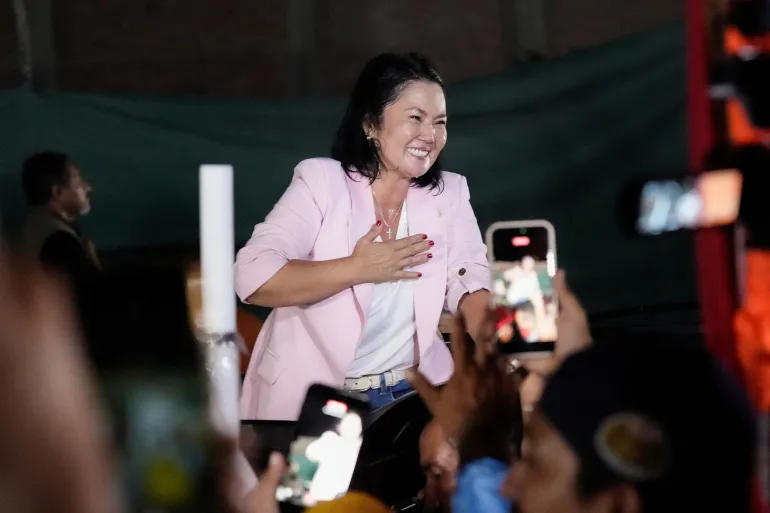
On Tuesday, from a balcony in Lima’s historic San Martin Square, Ricardo Belmont — who, at 80, is Peru’s oldest presidential hopeful — closed his campaign with a message to his supporters.
It was time, he told the crowd, to kick out the corruption that has gripped Peru over the past decade.
“We are no longer a nation. We are just surrogates for these corrupt parties,” said Belmont, a conservative who served as mayor of Lima in the early 1990s. Though initially lesser-known, Belmont has, in recent days, emerged as one of several viable candidates to make the run-off.
As voters head to the polls this Sunday for the first round of Peru’s presidential election, many candidates, like Belmont, are pledging a break from the tumult that has dominated the country’s politics.
In the past decade, nine presidents have passed through the government palace, some only lasting a few months.
Only one has completed a full term. Nearly all have either been imprisoned or involved in criminal investigations, largely related to corruption.
Peruvians have also grown so accustomed to a revolving door of presidents that experts fear it has contributed to an unprecedented level of volatility in this year’s election cycle, not to mention voter apathy.
“We have voters who are frustrated. We have voters who are tired. We have voters who are apathetic,” said Fernando Tuesta, a political scientist at Peru’s Pontifical Catholic University and a former chief of the national elections authority.
He described many voters as sceptical, “approaching this electoral process without enthusiasm”.
The fractures, corruption and infighting in Peru’s politics have resulted in a record list of 35 presidential candidates, many of whom are unknown to most voters.
From this crowded field, two presidential hopefuls are expected to advance to a run-off election in June. Voting is mandatory in the country of 34 million people, but pollsters still expect a high number of blank ballots.
In a country where “outsider” candidates emerge rapidly and fall dramatically, predictions about Sunday’s outcome are changing daily.
And analysts question how much staying power even a successful candidate might have after the race reaches its end.
Signs of uncertainty are easy to spot. Polls have signalled that about one-tenth of Peruvian voters are still undecided about whom to vote for, even days ahead of the election.
Many of the front-runners are also within a few percentage points of each other.
Right-wing candidate Keiko Fujimori, 50, has been consistently at the top in recent weeks, but the race for second place has been a toss-up so far.
Aside from Belmont, top contenders include Lima’s former right-wing mayor, Rafael Lopez Aliaga, the comedian Carlos Alvarez and Jorge Nieto, a former left-wing minister and sociologist.
Tuesta speculates the wide field of candidates emerged as a reaction to the unpredictability of Peru’s current politics. With the margins so tight, many are angling to be this year’s dark horse, the surprise candidate who catapults into the run-off.
“All the candidates think they’re the next outsider and that they’ll shoot up in the polls, so they think, ‘Why would I make an alliance with you if I can do this alone?'” said Tuesta.
The breadth of the field is likely to contribute to voter confusion. To accommodate all the candidates, there were six separate nights of televised debates.
The candidates will also be packed onto one large ballot for election day, which national election authorities have acknowledged will be complicated for voters to understand. On Sunday, voters will also elect members of Congress.
Fujimori, the daughter of the late President Alberto Fujimori, faced political outsider Pedro Castillo, a socially conservative leftist teacher from Peru’s rural north.
She lost by less than a percentage point. This year marks her fourth presidential bid.
But shortly after his term began, Castillo faced impeachment proceedings. Less than a year and a half into his tenure, he attempted to dissolve Congress. He was convicted last year of conspiracy for a rebellion and sentenced to 11 and a half years in prison.
Gonzalo Banda, a political analyst and researcher at the University College London, said Peru’s left wing hasn’t managed to come together around a single candidate in the years following the Castillo administration.
Part of the problem, he explained, is deep-rooted division and a general lack of substantive policies to address voter concerns, like violence and organised crime. That lack of unity has contributed to the long list of candidates this year.
“Overall, it has been a very, very mediocre cast of candidates. Perhaps the most mediocre we’ve had in the last few years. And the tragedy of all this is that Peru is confronting one of its worst security crises, with one of the worst political casts of our times,” said Banda.
Experts like Tuesta argue that the last decade of political instability has all but rendered Peru’s executive branch a secondary power.
By contrast, its unicameral Congress has expanded its might, though its members are largely unpopular among Peruvians.
Part of its influence comes from its impeachment powers. Peru’s Congress can remove presidents for “moral incapacity”, a catch-all term that has been used to denounce anything from undisclosed meetings to security crises.
Paulo Vilca, a researcher at the Institute of Peruvian Studies, explained that the shifting power dynamics have made it difficult for presidents to remain in office.
“In the past, we used to elect presidents for five years. Now, what’s more likely is that they will not last five years,” said Vilca.
But Peru’s unicameral Congress will come to an end this year. On Sunday, Peruvians will vote for a second congressional chamber, a Senate, for the first time since 1990.
Vilca argues that the congressional election may be even more important than this year’s presidential race. But it will also likely deepen Peru’s ongoing political crisis, he added.
He predicts that Congress’s chambers will soon be in conflict with each other, as well as with the president, in a three-way battle for power.
“It is very likely that those who are elected deputies, for example, will not be very satisfied with having a subordinate position in front of the Senate,” Vilca said. “So we’re going to move from a crisis of two to a crisis of three.”

The Senate was eliminated in 1992 by the late President Fujimori, Keiko Fujimori’s father, after he dissolved Peru’s bicameral Congress and implemented military rule.
The younger Fujimori has sought to build on her father’s legacy, and her right-wing party, Fuerza Popular, has become a deciding force in the unicameral legislature.
Keiko Fujimori even pledged to use her party’s power to “govern from Congress” after her defeat in the 2016 presidential race.
Since then, analysts have argued that Fuerza Popular has led efforts to change governmental processes to maintain or expand its power, even at the expense of democratic participation.
One change that it championed and passed in 2025 requires parties to earn at least 5 percent of the overall vote and a minimum of seven seats in the lower chamber to maintain their official political registration. For the Senate, parties must get at least three seats and 5 percent of votes.
Critics have said the measure creates a nearly insurmountable threshold.
“This whole system has been designed by the parties that are currently in Congress. And in particular, the one that has controlled the Constitutional Committee all these years has been Fuerza Popular,” said Vilca.
“I think the purpose of designing this whole model has been to maintain a status quo, which the Fujimori wing has also created in the last five years.”
Vilca is not optimistic that a new Senate will resolve the erosion of power away from the presidency. If anything, he anticipates more conflicts to come.
“My most likely scenario is that the crisis continues,” he said, “that whoever is elected president will enter into confrontation with the Senate”.
[Aljazeera]


The new Public Library Building of the Batticaloa Municipal Council was ceremonially vested in the public on Wednesday (20) morning in the presence of President Anura Kumara Dissanayake, with former Member of Parliament M.A. Sumanthiran officially declaring the building open.
In parallel with the opening ceremony, the official website of the library was launched by the President.
Addressing the gathering, President Anura Kumara Dissanayake stated that he was pleased to witness the successful completion of the library project, which had previously remained stalled midway.
A notable feature of the newly opened library building is the establishment of a separate unit dedicated to providing children with scientific and technological knowledge.
The President further stated that, at a time when the culture of reading is gradually declining in the country, the continued enthusiasm shown by the Tamil community towards reading should be appreciated. He remarked that opening a library is akin to eliminating the need for a prison and expressed confidence that the opening of the new Batticaloa Public Library Building would help sustain and encourage the reading culture among the people.
The President also joined an inspection tour of the new library building and engaged in a cordial discussion with the staff of the Municipal Council. During the occasion, the Mayor of the Batticaloa Municipal Council, K. Sivam Packiyanathan, presented a commemorative memento to the President.
Marking the occasion, the President also planted a sapling within the library premises.
Minister of Industry and Entrepreneurship Development Sunil Handunnetti, Eastern Province Governor Professor Jayantha Lal Ratnasekera, Kandasamy Prabhu, G. Srineshan, S. Rasamanickam and M.L.A.M. Hizbullah, along with government and opposition Members of Parliament, members of the Batticaloa Municipal Council and several state officials, were present at the event.
(PMD)
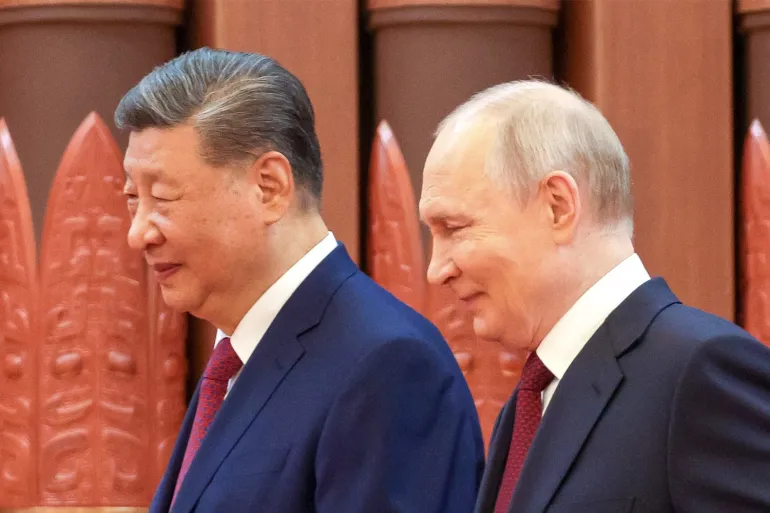
A meeting between Chinese leader Xi Jinping and visiting Russian President Vladimir Putin has started in Beijing, Chinese state media report.
Xi welcomed Putin to the Chinese capital on Wednesday, shaking hands with the Russian leader outside the Great Hall of the People before their talks, video by Russian media showed.
Before entering the Great Hall, Putin and Xi walked down a red carpet, rolled out to greet the Russian leader, and stood as a military band played both their countries’ national anthems.
Putin began the talks by hailing the “strong, positive” momentum in cooperation between Russia and China, according to Russian media.
“Even amid unfavourable external factors, our cooperation and economic cooperation is showing strong, positive momentum,” Putin told Xi.
Addressing Putin, Xi lauded the “unyielding relationship” between China and Russia.
“We have been able to continuously deepen our political mutual trust and strategic coordination with a resilience that remains unyielding despite trials and tribulations,” Xi told Putin, according to China’s Xinhua news agency.
The Chinese leader also addressed the US-Israel war on Iran, telling his Russian counterpart that further conflict was “inadvisable” and a ceasefire was necessary.
“A comprehensive ceasefire is of utmost urgency, resuming hostilities is even more inadvisable and maintaining negotiations is particularly important,” Xi said, according to Xinhua.

Al Jazeera’s Katrina Yu, reporting from Beijing, noted that Putin’s visit and that of the recently concluded trip by US President Donald Trump to China were very different.
Putin, she said, is marking 25 years of the Sino-Russian friendship, has visited China dozens of times, and met with Xi on more than 40 other occasions.
“So this visit will really be about deepening existing coordination and cooperation,” Yu said.
“We are expecting that the two sides will update each other on the situation in the Middle East, as well as Ukraine. No doubt, Xi Jinping will also talk to Putin about what was discussed with Donald Trump last week,” Yu said.
Putin is being accompanied by a large delegation of Russian businesspeople and government leaders, and the Kremlin has announced that the two leaders will sign some 40 different agreements, Yu said, covering everything from the economy and tourism to education.
“But I think for Putin, the main topic of discussion with Xi Jinping is going to be on energy security,” Yu said.
“Since the war in Ukraine, any gas sales that were previously heading to Europe – that is all dried up – and Russia is in desperate need of revenue to replace that, especially since we are in the fifth year of the Ukraine war,” she added.
In a video address released before meeting Xi, Putin said Russia and China were prepared to cooperate with each other on the “core interests of the two countries, including the protection of sovereignty and national unity”, the Reuters news agency reports.
Both countries are actively expanding ties in economy, politics and defence, Putin said, adding that “a close” and “strategic” connection between Moscow and Beijing was playing “a stabilising role” in global relations.
“We are not aligning against anyone, but working for the cause of peace and universal prosperity,” Putin said.
[Aljazeera]

Bangladesh overcame one hour of nerves on the fifth morning to beat Pakistan by 78 runs in the Sylhet Test and complete a consecutive 2-0 sweep over them. For the first time in their history, Bangladesh have won four successive Test series. Taijul Islam led the way with a six-wicket haul in the fourth innings, but the credit will also go to Litton Das for his 126, which resurrected Bangladesh from the dead on the first day.
It is a landmark moment for Bangladesh cricket. They played solid cricket across ten days in the Test series. While their pace attack got rave reviews, their spinners too stepped up as the experienced Taijul took two of the last three wickets on the final morning.
Before that, Mohammad Rizwan held Bangladesh at bay for nearly an hour, until Sajid Khan edged Taijul for 28. In the next over, Rizwan guided Shoriful Islam to Mehidy Hasan Miraz at gully for 94. Mehidy had earlier dropped a tough chance at gully when Rizwan had tried a similar shot in the day’s first over, while a Sajid top edge had dropped in front of wicketkeeper Litton.
Taijul took the final wicket when Khurram Shahzad swung him towards deep midwicket, where debutant Tanzid Hasan held a high catch.
Chasing 437, Pakistan started the day on 316 for 7. It was a spirited response from the under-fire visitors, who were bumped by two decent partnerships. Shan Masood and Babar Azam added 92 for the third wicket, which mitigated their early losses of openers Azan Awais and Abdullah Fazal. The partnership ended when Mehidy nabbed Babar down the leg side for 47. Masood scored 71 before Taijul had him caught at short leg.
Rizwan and Salman Agha staved off any further batting collapse with a 134-run partnership for the sixth wicket. The pair batted at a fair clip, frustrating the home side who, in their attacking mindset, hardly bowled a maiden over during that period.
With the second new ball, Taijul finally breached Agha’s defence with an arm-ball. The batter made 71. Rizwan kept the fight on but the task proved to be too monumental.
Brief scores:
Bangladesh 278 in 77 overs (Litton Das 126; Mohammed Abbas 3-45, Khurram Shahzad 4-81) and 390 in 102.2 overs (Mushfiqur Rahim 137, Litton Das 69; Khurram Shahzad 4-86, Sajid Khan 3-126) beat Pakistan 232 in 57.4 overs (Babar Azam 68; Nahid Rana 3-60, Taijul Islam 3-67) and 358 in 97.2 overs (Mohammad Rizwan 94, Shan Masood 71, Salman Agha 71; Taijul Islam 6-120) by 78 runs
[Cricinfo]

Husband killed, wife injured after falling off embankment

CEB’s Rs. 8.5 bn VRS package signals deeper power sector restructuring

Vella earns Great Place To Work Certification Tm, marking a milestone in its people-first journey

AIA Sri Lanka hosts the annual Company Conference to honour performance, passion and purpose

Colombo stocks trade lower amid currency pressure and rising oil prices

New Batticaloa Public Library vested in the public

‘Dates have the highest sugar content to fight Coronavirus’

Sunday Island 27 December – Headlines

#SundayIsland 17th December – Headlines

Sunday Island – 28th March

Sunday Island Headlines – 21 March

Sunday Island – 21st February – Headlines
-

 Features4 days ago
Sri Lankan Airlines Airbus Scandal and the Death of Kapila Chandrasena and my Brother Rajeewa
-
 News5 days ago
Lanka’s eligibility to draw next IMF tranche of USD 700 mn hinges on ‘restoration of cost-recovery pricing for electricity and fuel’
-
 News4 days ago
Kapila Chandrasena case: GN phone records under court scrutiny
-

 News4 days ago
Rupee slide rekindles 2022 crisis fears as inflation risks mount
-

 Opinion7 days ago
Electricity tariffs have skyrocketed: Can further increases be prevented?
-

 Business4 days ago
Expansion of PayPal services in Sri Lanka officially announced
-
 Features6 days ago
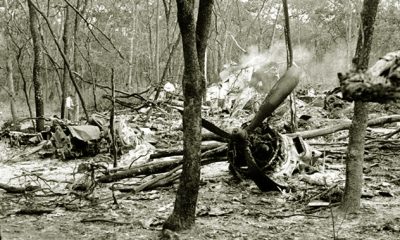
Mysterious Death of United Nations Secretary General Hammarskjöld
-

 News4 days ago
Court orders further arrests in alleged USD 42 Mn NDB fraud case