
News
‘Perpetrators of violence should be dealt with under criminal and civil laws’


By Shamindra Ferdinando
Senior Attorney-at-Law Manoli Jinadasa Monday (24) said that illegal acts, such as arson and trespass, couldn’t be vindicated on the basis of ‘trade union’ action, under any circumstances. Thus, the normal law should operate against the perpetrators of such violations, Jinadasa said, adding that they could be dealt with under the criminal law, as well as the civil law, for damages caused.
The lawyer said so in response to The Island query where deliberate ‘actions,’ perpetrated during the protest campaign, that also involved trade unions affiliated to political parties, as well as other groups, such as Government Medical Officers’ Association (GMOA) and Federation of University Teachers Association (FUTA), be dealt with under current laws?
President Gotabaya Rajapaksa was forced out of office, in the second week of July last year. Subsequent violence destroyed the then Premier Ranil Wickremesinghe’s private residence at Kollupitiya. Altogether over 70 houses, belonging to incumbent members of Parliament, were set ablaze.
Asked to explain, the Attorney-at-Law said that FUTA, GMOA and other groups would say that they were involved in ‘Aragalaya’ to protect the rights of their members to safe and secure employment which was under threat due to the breakdown of industry and governance. They would justify their participation in the change of government on the basis of their right to protect the interests of the members.
Jinadasa, with over 28 years of experience specialises in Industrial Law, Constitutional Law, Administrative Law, Contract Law and Commercial Law.
“However, it would be pertinent to ask that though FUTA and GMOA participated in the protest campaign, is there any evidence directly implicating them in illegal activity at the point of the overthrow. It is only illegal activity that will attract punishment,” the outspoken lawyer said.
The Island
raised the issue with Manoli Jinadasa in the wake of her recent interview with Derana 24 in which the top lawyer dealt with ongoing trade union actions, primarily directed at the government and rights of both the employees and employers.
Responding to Derana interviewer Anuradhie Wickramasinghe, she stressed that strike is a legitimate weapon but should be the last option after all attempts to resolve a particular matter failed. Appearing on ‘Law, Land and Liberty,’ Jinadasa explained the nexus between trade unions and political parties represented in Parliament. Likewise, employers could resort to lockouts, Jinadasa said, underscoring the fact that the Supreme Court has upheld the right to strike.
“Strike is a legitimate weapon a trade union has. There is no doubt about it as much as a lockout for an employer. So, you have strike action for the employees and lockouts for the employer. That is how it goes, Jinadasa said.
Referring to ILO Conventions and comparing them with the relevant domestic laws and regulations, Jinadasa discussed the denial of trade union rights to judicial officers, armed forces, police and prison officers here. In terms of the ILO Conventions, Sri Lanka has ratified over the years, no one could be deprived of trade union rights though the situation on the ground is different, she said.
Having dealt with the origins of trade union activity, both here and abroad, Jinadasa asserted that the nature of trade union strategies had changed. She dealt with several specific issues, including the widely practiced ‘sick note campaign’
“Now the morality of that kind of strike is a subject matter for discussion because especially for professionals such as medical, legal or teaching professions. What we are doing is presenting a note which is false because you are not sick,” Jinadasa said. “It is the view even of the Supreme Court. There were judgments to the effect that submitting false medical certificates is not an acceptable form of a strike.”
Jinadasa recalled a judgment delivered by the late Justice Mark Fernando in respect of termination of employment over submitting of false medical certificates and going on ‘sick note campaigns’. The case referred to was Bandara vs Ministry of Lands. Fernando was quoted as having declared…”the President’s Counsel for petitioners contended with little enthusiasm that submitting false sick notes and medical certificates was a legitimate trade union action as part of the work to rule campaign. I have equally little hesitation in rejecting that contention. The court will not condone the conduct of an employee who lies or otherwise deceives his employer as to the reason for his failure to work whether individually or collectively.”
Jinadasa strongly questioned the despicable practice of teachers submitting false medical certificates against the backdrop of students having to prove valid reason in case they didn’t attend classes conducted by those who falsely fell sick. Such actions couldn’t be acceptable under any circumstances, she said, explaining the stand taken by courts as regards the deliberate reduction of output. Courts have held such actions illegal, she said. To highlight the illegality of such trade union strategies, Jinadasa recalled the fundamental rights action filed by the Joint Apparel Manufacturers Association against relevant trade union for bringing down the output by 60 percent. The court held in their favour, she said.
However, work to rule campaign is a legitimate form of trade union action, she declared.
Responding to another query, Jinadasa said that collective agreements facilitate better relations between employees and employers. Commenting on a person’s right to strike, Jinadasa, while referring to the late justice Sharvananda, said that he held that one couldn’t invoke fundamental rights for strikes. “One can invoke fundamental rights if he/she is prevented from joining a trade union, but not for strikes.” She gave several instances where courts have rejected such applications.

News
AgriConnect Sri Lanka’ to be launched on 30 October to Modernise the Agricultural Sector Through Digitalisation

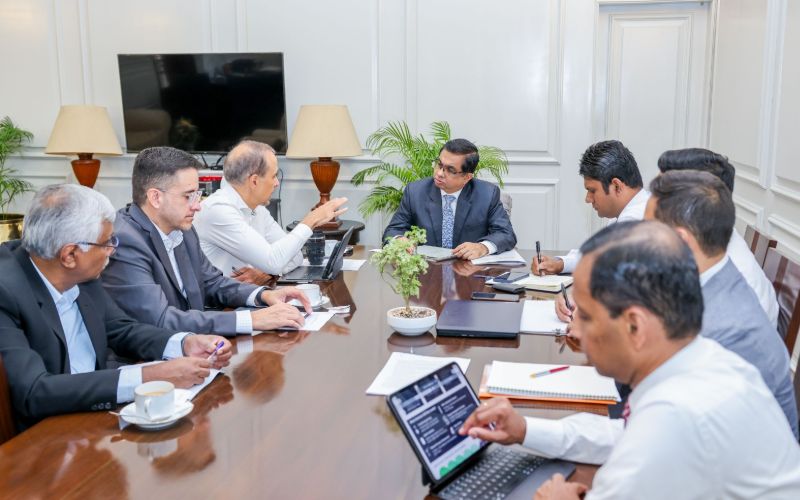
A discussion on the official launch of the ‘AgriConnect Sri Lanka’ programme was held at the Presidential Secretariat on Tuesday (13) morning between Secretary to the President Dr. Nandika Sanath Kumanayake and a delegation led by Gevorg Sargsyan, World Bank Group Manager for Sri Lanka and the Maldives.
The discussion focused on the official launch of the ‘AgriConnect Sri Lanka’ programme, scheduled to take place on 30 October at TRACE Expert City.
The World Bank delegation provided a comprehensive briefing on the programme and emphasised that Sri Lanka is set to become the first country in South Asia to join this global initiative of the World Bank Group, marking a significant milestone.
Victor Anthonypillai, Senior Country Officer of the International Finance Corporation (IFC), Tomas Ricardo Rosada Villamar Practice Manager at the World Bank, Felipe F. Dizon, Senior Economist and Athula Senaratne, Senior Agriculture Specialist, also attended the meeting. The Presidential Secretariat was represented by Senior Assistant Secretary to the President Dr Danushka Perera and Assistant Secretary to the President R. A. Ruwanpathirana.
President’s Media Division (PMD)

Appointment of committee eyewash, says UNP
The government is considering changes to prison regulations pertaining to the treatment of Buddhist monks serving jail terms, including their right to wear monastic robes when taken outside prison.
Justice and National Integration Minister Harshana Nanayakkara announced the proposed changes yesterday (14) following the submission of an interim report by a committee appointed to review the rules and procedures governing prisons.
The report was handed over to Secretary to the President Dr Nandika Sanath Kumanayake at the Presidential Secretariat.
One of the key recommendations is to amend Prison Standing Order 356 by introducing a new provision, 356(A). The proposed revision would require prison authorities to consult the Department of Buddhist Affairs on the removal of a monk’s robes upon admission to prison. The Commissioner of Prisons would be allowed 10 days to notify the department and take the necessary steps.
A separate amendment to Departmental Order 550 would allow Buddhist monks to wear their robes whenever they are taken outside prison, unless their respective Nikaya formally requests that the privilege be withdrawn.
The committee has also recommended extending similar arrangements, with suitable modifications, to members of other religious clergy who are imprisoned.
The proposals follow concerns raised over the treatment of Ven. Galagoda Aththe Gnanasara Thera after he was taken into custody. President Anura Kumara Dissanayake subsequently held discussions with representatives of the three main Buddhist Nikayas and appointed the committee to examine the existing legal framework.
Nanayakkara said the interim report had been forwarded to the Acting Commissioner General of Prisons, along with instructions to revise the relevant standing orders in accordance with its recommendations.
The proposed amendments have yet to be confirmed as formally implemented.
Meanwhile, the UNP yesterday criticised the government’s decision to appoint a committee to make recommendations on the attire to be worn by imprisoned Buddhist monks and other religious leaders when taken outside prison, describing the move as unnecessary.
In a statement issued yesterday (14), the UNP said the procedures governing the matter were already clearly set out in the Department of Prisons’ Standing Orders, making the appointment of a separate committee unwarranted.
The party cited remarks by Professor G.L. Peiris, Convenor of the Janathawadi Joint Opposition, who had described the committee’s appointment as a
“complete eyewash” and questioned the need for such a move.
Referring to Standing Order 550 of the Prisons Department, the UNP said convicted prisoners appearing before court for legal proceedings should not be required to wear prison uniforms.
It further stated that the regulations allowed prisoners to wear civilian clothing consistent with what they wore before imprisonment, including attire appropriate to their cultural and religious backgrounds.
The UNP accused the government of unnecessarily prolonging the issue by appointing a committee, despite the existence of regulations governing prisoners’ attire.
The party also called on the government to seek forgiveness from the Mahanayake Thera and the Sangha Council of the Kotte Sri Kalyani Samagri Dharma Maha Sangha Sabha of the Siyam Maha Nikaya over the decision concerning the religious attire of Ven. Galagoda Aththe Gnanasara Thera.
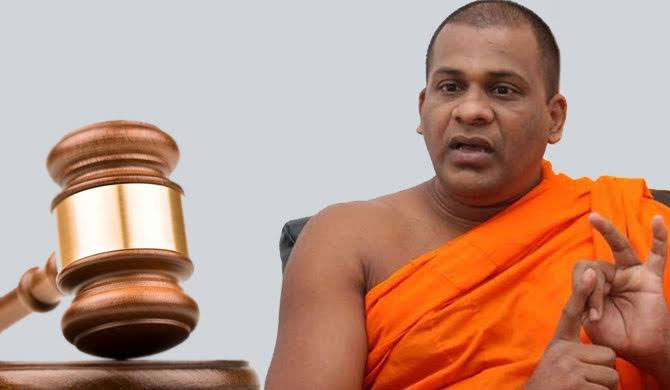
Court of Appeal President Justice Rohantha Abeysuriya yesterday withdrew from the bench hearing petitions challenging the decision by prison authorities to require Ven. Galagoda Aththe Gnanasara Thera to wear prison attire following his imprisonment.
The decision was announced when the petitions seeking to invalidate the prison authorities’ decision were taken up for consideration on October 14.
Following his withdrawal, a three-judge bench was appointed to hear the petitions.
The petitions relate to the prison authorities’ decision to require Gnanasara Thera to wear prison attire after he was taken into custody to serve the remainder of his sentence for contempt of court.
In September this year, the Supreme Court annulled the presidential pardon granted to Gnanasara Thera by former President Maithripala Sirisena in May 2019.
Following the ruling, the Court of Appeal directed the Commissioner General of Prisons to take the necessary steps to enforce the remainder of the monk’s prison sentence.
Gnanasara Thera had originally been sentenced to six years’ imprisonment for contempt of court but had served only around nine months before receiving the presidential pardon in 2019.

AgriConnect Sri Lanka’ to be launched on 30 October to Modernise the Agricultural Sector Through Digitalisation

57th Annual Saints’ Quadrangular Tournament on Saturday and Sunday

Showers or thundershowers will occur at most parts of the island

Prison rules to be revised over monks’ attire

AC President recuses himself from hearing prison attire case pertaining to Gnanasara Thera

Court orders steps to obtain INTERPOL Red Notice against Basil

‘Dates have the highest sugar content to fight Coronavirus’

Sunday Island 27 December – Headlines

#SundayIsland 17th December – Headlines

Sunday Island – 28th March

Sunday Island Headlines – 21 March

Sunday Island – 21st February – Headlines
-

 News7 days ago
NDB fraud Rs 60mn more than reported
-

 News7 days ago
Removing monk’s robes matter for Sangha to decide: Mahanayake Theras
-

 News6 days ago
NPP govt. reminded of its responsibilities as US warship leaves Colombo
-

 News5 days ago
Sri Lanka escalates anti-graft drive with Shiranthi’s jailing
-

 Latest News6 days ago
Farhan, Sadaqat help Pakistan ace 183 chase to go 1-0 up
-
 News7 days ago
BHC, Colombo: “LTTE remains a proscribed org. in the UK”
-

 Latest News4 days ago
Farhan and Sadaqat help Pakistan seal series in style
-

 News5 days ago
Iranian ships stranded, Lanka fears US sanctions