
News
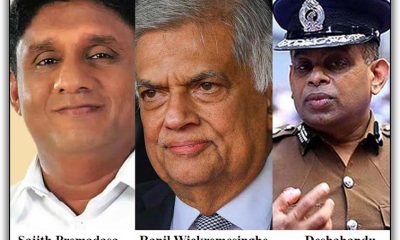
Performance of the Constitutional Duties of the President and the Constitutional Council

PRESS RELEASE ISSUED BY THE PRESIDENT’S MEDIA DIVISION
The President of the Republic of Sri Lanka under Article 4(b) of the Constitution is the organ of government through which the executive power of the People including the Defence of Sri Lanka is exercised.
The President as the head of the executive is duty bound to make certain appointments to high offices, including the Inspector General of Police, according to the procedure stipulated by the Constitution and in line with the President’s Constitutional duty to exercise powers pertaining to the Defence of Sri Lanka.
Therefore, the President must perform his Constitutional duties without any impediment or interference. Under Article 41C of the Constitution, the appointment of the Inspector General of Police is carried out subsequent to a recommendation made by the President to the Constitutional Council, and on the approval of such recommendation by the Constitutional Council.
Any restraint placed on the President in the performance of his Constitutional duty would be in contravention of the Constitution. If the President exercises his powers contrary to the Constitution, the remedies available have been provided for in the Constitution itself.
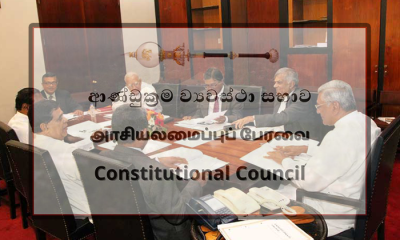
The Constitutional Council, which is chaired by the Hon. Speaker of Parliament and established under the Constitution has been empowered to assist the President in the making of certain decisions and is part of the Executive.
The Constitutional Council is duty bound to perform its functions in terms of the Constitution. Requiring the Constitutional Council to refrain from performing its functions pertaining to the appointment of the Inspector General of Police under Article 41C of the Constitution would be in violation of the Constitution.
If the Constitutional Council exercises the power conferred on it in violation of the Constitution, remedies have been provided for in the Constitution itself.
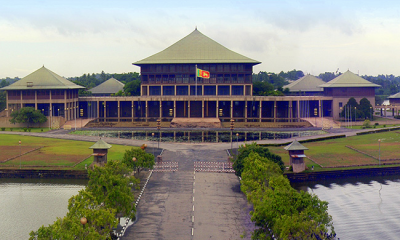
The Hon. Speaker is the head of Parliament and under Article 4C of the Constitution the Parliament exercises the judicial power of the people through Courts. The Parliament is therefore responsible only to the people.
The President will refer these matters to the Parliament for further elucidation.




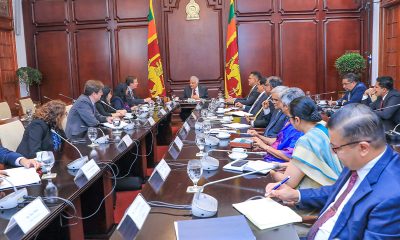




An International Monetary Fund (IMF) delegation held discussions with Party Leaders in Parliament on Sri Lanka’s current economic landscape, including post-cyclone recovery challenges and global economic uncertainties, as the country prepares for the upcoming fifth and sixth review of its reform programme, Parliament media Division said yesterday
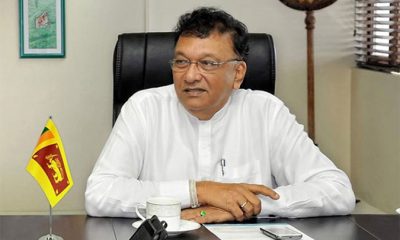
The delegation, led by Evan Papageorgiou, Deputy Division Chief of the International Monetary Fund, met with parliamentary leaders during a session presided over by Deputy Speaker Rizvie Salih. Members of Parliament Ravi Karunanayake, Dilith Jayaweera, M. L. A. M. Hizbullah and Ramanathan Archchuna were among those present.
The discussions centred on key economic concerns, including tariff adjustments, inflation management, pressures on the external sector and the need to sustain structural reforms to ensure long-term macroeconomic stability.
Earlier, the IMF delegation also met with Speaker of Parliament Jagath Wickramaratne and the Deputy Speaker as part of consultations ahead of the IMF’s fifth and sixth review mission to Sri Lanka, scheduled from March 26 to April 8.
During the meeting, Speaker Dr. Wickramaratne expressed appreciation for the continued support extended by the IMF during Sri Lanka’s economic recovery process. He said the Tenth Parliament represented a strong and inclusive legislature, holding a two-thirds majority and reflecting the country’s diversity, including representation for the disabled community.
The Speaker reaffirmed Sri Lanka’s commitment to the IMF’s Extended Fund Facility programme and stressed the importance of maintaining sound monetary and fiscal policies.
He also highlighted recent legislative measures, including the Public Financial Management Act and the Anti-Corruption Act, noting that they were central to strengthening fiscal discipline, improving governance and enhancing public financial transparency.
Special emphasis was placed on strengthening mechanisms to combat bribery and corruption while ensuring greater accountability in public finance management.
Dr. Wickramaratne also outlined plans to establish a Parliamentary Study Centre aimed at enhancing the capacity of Members of Parliament and local government representatives and sought IMF support for capacity-building initiatives.
Mr. Papageorgiou said Sri Lanka’s performance under the Extended Fund Facility programme remained strong and noted that the country was on a positive economic trajectory.
He underscored the critical role played by Parliament as the guardian of legislation and policy oversight and encouraged continued parliamentary support to sustain the reform momentum.
The discussions also touched on the possible economic impact of ongoing tensions in the Middle East, as well as relief, recovery and reconstruction efforts following the recent Cyclone Ditwah.
The IMF delegation also participated in a guided tour of Parliament during the visit.
Assistant Secretary-General Hansa Abeyratne, along with a group of parliamentary officials, was also present at the meetings.

Agrarian Service Centres will remain open on public holidays to facilitate the distribution of fertiliser to farmers in areas where Yala season paddy cultivation has commenced, the Department of Agrarian Development said.
In a statement, Commissioner General of Agrarian Development Dhammika Ranatunga said arrangements had been made to keep Agrarian Service Centres in the relevant areas operational throughout public holidays and weekends to ensure an uninterrupted supply of fertiliser to farmers.
He said the Government had decided that fertiliser required for paddy cultivation would be issued exclusively through Government-run Agrarian Service Centres.
The move follows concerns over possible disruptions to the fertiliser supply chain arising from the ongoing conflict in the Middle East as well as attempts by certain parties to hoard fertiliser stocks.
Ranatunga said the distribution of fertiliser had already commenced in areas where Yala season paddy cultivation is currently underway.
According to the Department, a 50 kilogramme bag of Urea fertiliser is being sold through Agrarian Service Centres at a price ranging between Rs. 9,900 and Rs. 10,200.
Officials said the measures were aimed at ensuring farmers receive an uninterrupted supply of fertiliser during the ongoing Yala cultivation season.
Latest News
Heat Index at Caution Level in the Western, Sabaragamuwa, Southern, Eastern, North-western, Northern and North-central provinces and in Monaragala district

Warm Weather Advisory
Issued by the Natural Hazards Early Warning Centre
Issued at 3.30 p.m. on 03 April 2026, valid for 04 April 2026.
The Heat index, the temperature felt on human body is likely to increase up to ‘Caution level’ at some places in the Western, Sabaragamuwa, Southern, Eastern, North-western, Northern and North-central provinces and in Monaragala district.
The Heat Index Forecast is calculated by using relative humidity and maximum temperature and this is the condition that is felt on your body. This is not the forecast of maximum temperature. It is generated by the Department of Meteorology for the next day period and prepared by using global numerical weather prediction model data.

Effect of the heat index on human body is mentioned in the above table and it is prepared on the advice of the Ministry of Health and Indigenous Medical Services.
ACTION REQUIRED
Job sites: Stay hydrated and takes breaks in the shade as often as possible.
Indoors: Check up on the elderly and the sick.
Vehicles: Never leave children unattended.
Outdoors: Limit strenuous outdoor activities, find shade and stay hydrated.
Dress: Wear lightweight and white or light-colored clothing.
Note:
In addition, please refer to advisories issued by the Disaster Preparedness & Response Division, Ministry of Health in this regard as well. For further clarifications please contact 011-7446491.

IMF holds talks with party leaders on economic reforms

Agrarian Centres to open on holidays for farmers

Chamodi Prabodha to lead Sri Lanka women’s U19 National Team for the tour of Australia

Ceylinco Life chairman R. Renganathan honoured by CMA

Kodituwakku’s early burst keeps Royal on top

Statement from NDB Bank

‘Dates have the highest sugar content to fight Coronavirus’

Sunday Island 27 December – Headlines

#SundayIsland 17th December – Headlines

Sunday Island – 28th March

Sunday Island Headlines – 21 March

Sunday Island – 21st February – Headlines
-

 Features7 days ago
A World Order in Crisis: War, Power, and Resistance
-
 News4 days ago
Tariff shock from 01 April as power costs climb across the board
-
 News7 days ago
Minister Jayakody indicted in Colombo High Court over alleged corruption
-
 News5 days ago
Inquiry into female employee’s complaint: Retired HC Judge’s recommendations ignored
-

 News2 days ago
2025 GCE AL: 62% qualify for Uni entrance; results of 111 suspended
-
 Features5 days ago
New arithmetic of conflict: How the drone revolution is inverting economics of war
-
 Features6 days ago
When seabed goes dark: The Persian Gulf, cable sabotage, and race for space-based monopoly
-

 Business3 days ago
Hour of reckoning comes for SL’s power sector