
Sports
Patience and stability the missing pieces in Sri Lanka’s T20 puzzle


The upcoming T20 World Cup, featuring 20 teams across a frenetic three-week carnival, has whetted appetites among fans, players and administrators alike. Scratch beneath the surface and the contenders fall neatly into three baskets. There are the heavyweights; Australia, England and India, with South Africa firmly in that front rank. Then come the dark horses: Pakistan, New Zealand and Afghanistan, sides capable of blowing hot and cold but dangerous on their day. And finally, the also-rans, teams largely battle-hardened through the qualifying grind.
As co-hosts, Sri Lanka would like to believe they belong in the second bracket, coming into the tournament as dark horses rather than merely making up numbers. But form, that most unforgiving of judges, tells a harsher story. Six months out from the World Cup, the former champions have looked closer to the third category than the second. In an era where 200 has become par for the course in T20Is, Sri Lanka are struggling to bat out their 20 overs, a red flag if ever there was one. Their opening skirmish against Pakistan in the ongoing series did little to lift the mood or the belief.
The obvious question is: what have Pakistan done right that Sri Lanka haven’t?
No one expects Sri Lanka to suddenly roll out a production line of express quicks to rival Pakistan’s fearsome fast-bowling arsenal. That cupboard is well stocked in Pakistan and admired by all and sundry. But their batting depth and spin options have not materialised overnight. They are the dividends of continuity and clarity, commodities Sri Lanka have been short of.
Take Kamindu Mendis. Across formats, he has been a reliable all-rounder, even if he hasn’t always set the world on fire. Yet the evidence is there: his skill set is good enough to win you games. Once you identify such a player, you give him a long rope. You don’t pull the plug after a couple of low scores.
Then there is the curious case of Kusal Janith Perera. It is hard to fathom how a player deemed good enough for the squad struggles to crack the playing XI. KJP is a destructive batter, a high-risk, high-reward operator. His methods won’t always win him admirers, but impatience with a proven match-winner smacks of short-term thinking.
Continuity, after all, is the bedrock of a successful cricket team. There was little logic in stripping Charith Asalanka of the T20 captaincy. Now low on confidence, he risks sliding out of World Cup contention altogether.
Selectors have also dusted off an old playbook by turning again to Dhananjaya de Silva. Before and during the last World Cup, he was tasked with batting through the innings to arrest collapses. The experiment failed and he was axed. Now, on the eve of another World Cup, he is back in the saddle. It feels less like strategy and more like musical chairs.
The other burning issue is the gaping hole in the lower order. Too many bowlers are passengers with the bat, leaving the tail exposed. Dunith Wellalage offers a partial solution, yet he has failed to cement his place. Yes, his bowling can be a weak link, but if he was identified as a future star, the onus was on the management to back him, build his confidence and tell him he belongs in the big league.
With the World Cup at home and conditions tailor-made for spin, an operator like Wellalage should have been banked on long ago.
Rex Clementine
in Dambulla ✍️



Pulisha Thilakarathne top scored with 89 runs and held the top order batting together as Trinity scored first innings points and took major honours in the Ranil Abeynayake Memorial Trophy cricket encounter at BRC ground on Wednesday.
Trinity took a first innings lead of over 50 runs and declared their innings with two wickets in hand to find Thomians doing better in the second essay.
Jayden Amaraweera was in the forefront of the Thomian revival in the second innings as he scored his second half century of the match. Aaron Kodituwakku missed a second half century by five runs.
For Trinity, Mahendra Abeysinghe and Dinal Fernando were the others to make contributions with over 40 runs, while Aadham Hilmy made 32.
Scores:
S. Thomas’ 189 all out in 77.4 overs
(Aaron Kodituwakku 72, Jaden Amaraweera 50, Shanil Perera 37n.o.; Kanika Anthony 5/66, Dinal Fernando 3/34) and 182 for 5 in 53 overs (Jaden Amarawera 68, Aaron Kodituwakku 45;
Chaniru Senarathne 2/44)
Trinity 54 for 1 overnight 246 for 8 decl. in 58.2 overs (Pulisha Thilakarathne 89, Mahendra Abeysinghe 44, Dinal Fernando 45, Adam Hilmy 32; Abheeth Paranawidana 4/95, Gimhan Mendis 3/41) (RF)
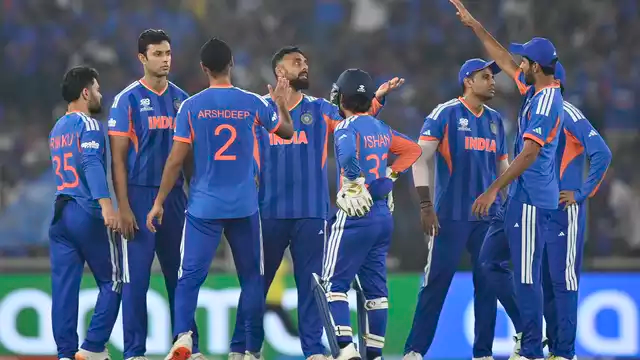
Blue jerseys on the backs of a teeming crowd along the Walajah Road on Thursday evening will finally not be out of context. Fans in Chennai have embraced every team that has set foot in the city and played at the iconic venue, turning up in tens of thousands even for sweltering afternoon matches here. But India are finally in town, with everything riding on their fixture.
[Cricbuzz]
Latest News
South Africa vs West Indies: Clash of heavyweights in another high-stakes battle in Ahmedabad


Is the ICC’s Super Eight the silliest qualifying process in the sporting universe? The unfathomable permutations of UEFA’s rejigged Champions League might beg otherwise. But it’s surely in a club of two.
After precisely two completed fixtures in an impressively sub-standard Group 2 of this T20 World Cup, we already knew our first semi-finalists … and even England themselves might be wondering how on earth they are still pointing in the right direction after their endless flirtations with catastrophe.
Over in Ahmedabad, however, there’s significantly more jeopardy brewing in Group 1. West Indies and South Africa, the two remaining unbeaten teams in the tournament, are gearing up for a heavyweight clash of the most literal variety, but even after they’ve finished battering seven bells out of each other, the victors will have no gurantees of progression just yet.
For West Indies, in particular, this feels like a must-win contest. They could hardly have laid out a more emphatic marker than their 107 run win over Zimbabwe on Monday. But, even allowing for that hefty NRR boost, a wounded India await as their final Super Eight fixture on Sunday. If that ends up being a straight knockout, then it’d be best to lay the killer blow here and now.
West Indies certainly have the form and the focus to do so. But, thrillingly, so do their opponents. In a tournament marked by reticence from a host of likely contenders, West Indies and South Africa have both been refreshingly route-one in their approach. Shimron Hetmyer’s 85 from 34 balls against Zimbabwe may have been the apogee of attacking batting in the tournament to date, but it was merely a continuation of the pedal-to-metal approach that enabled his team to out-muscle England by 13 sixes to six in their statement victory in Kolkata a fortnight ago.
South Africa, similarly, have not been backward in coming forward. India must have thought their last contest was in the bag when Jasprit Bumrah reprised his Barbados impact to reduce them to 20 for 3 after four overs at this same venue. They reckoned without a relentlessly aggressive middle order of Dewald Brevis, David Miller and Tristan Stubbs, who kept piling into the breach to produce a total of 187 for 7 that Marco Jansen soon proved to be more than enough to defend. A win on Thursday will almost certainly place South Africa in the semis, unless India lose all three games in the Super Eight.
More such bravery will be the requirement on Thursday. On a localised level, it’s thrilling to have such a high-stakes encounter at this stage of the competition. In reality, though, each of the tournament’s three likeliest winners would appear to have been crammed into the same under-sized pool. It’s sink-or-risk-being-sunk time at the Narendra Modi Stadium.
With 11 wickets at 12.18 – including eight in his last two outings, at this very venue, against New Zealand and India – Marco Jansen has the form and the method to make another statement impact for his team. Five of those wickets came in the powerplay – three against New Zealand, though they used his pace and bounce against him in between whiles, and two against India, who were never allowed to rally after his first-ball extraction of Tilak Varma. Every team craves a rangy left-arm seamer in this format, and Jansen’s combinations of angle, accuracy and steepling bounce mark him out as one of the very best.
If West Indies are to win, their batters need to keep swinging with the freedom and confidence that has brought them this far already. And no-one epitomises their current mood better than Shimron Hetmyer. With 219 runs at 54.75, he is the tournament’s second-highest run-scorer, behind Sahibzada Farhan’s tally of 283. In terms of pure six-hitting, his tally of 17 puts him way out on his own. If his game can sometimes seem too loose to function consistently, then it is entirely in keeping with West Indies’ mighty T20I heritage, including his 2016 forebears who counted almost exclusively in boundaries as they powered to their second world title, here on Indian soil, a decade ago.
No obvious reasons for West Indies to tinker with their winning formula, although Roston Chase’s offspin could be a consideration, especially with the significant core of left-handers in South Africa’s batting ranks. He would also add further depth to the batting line-up.
West Indies (probable): Brandon King, Shai Hope (capt & wk), Shimron Hetmyer, Rovman Powell, Sherfane Rutherford, Romario Shepherd, Jason Holder, Matthew Forde, Akeal Hosein / Roston Chase, Gudakesh Motie, Shamar Joseph.
The team that took on India was the strongest that South Africa could have put out, and for such a crunch contest, there’s no reason to think they’ll fiddle with their options.
South Africa (probable): Aiden Markram (capt), Quinton de Kock (wk), Ryan Rickelton, Dewald Brevis, David Miller, Tristan Stubbs, Marco Jansen, Corbin Bosch, Keshav Maharaj, Kagiso Rabada, Lungi Ngidi.
[Cricinfo]

’Reimagining International Relations from a Global South Perspective’ offers a timely and rigorous contribution, providing key insights into policy, diplomacy, and global governance – PM

Fair weather will prevail over most parts of the island

CID arrests former top military intelligence officer under PTA

Corruption in coal procurement: CP demands action against all responsible

Jaffna University leads campaign against PTA and PSTB

Indian Naval Sail Training Ship INS Tarangini here soon

‘Dates have the highest sugar content to fight Coronavirus’

Sunday Island 27 December – Headlines

#SundayIsland 17th December – Headlines

Sunday Island – 28th March

Sunday Island Headlines – 21 March

Sunday Island – 21st February – Headlines
-

 Features4 days ago
Why does the state threaten Its people with yet another anti-terror law?
-

 Features4 days ago
Reconciliation, Mood of the Nation and the NPP Government
-

 Features4 days ago
Victor Melder turns 90: Railwayman and bibliophile extraordinary
-

 Features3 days ago
LOVEABLE BUT LETHAL: When four-legged stars remind us of a silent killer
-
 Features4 days ago
Victor, the Friend of the Foreign Press
-
 Latest News5 days ago
New Zealand meet familiar opponents Pakistan at spin-friendly Premadasa
-

 Latest News5 days ago
Tariffs ruling is major blow to Trump’s second-term agenda
-

 Latest News6 days ago
ECB push back at Pakistan ‘shadow-ban’ reports ahead of Hundred auction