
Latest News
Ravindra, Santner, McConchie eliminate Sri Lanka


A stunning rearguard from Mitchell Santner and Cole McConchie knocked Sri Lanka out of the 2026 T20 World Cup in spite of an electric start for the hosts as New Zealand sealed a crushing 61-run win. At an electric R Premadasa Stadium that crackled with perhaps the best atmosphere of the tournament, Sri Lanka’s spinners put New Zealand’s top and middle order to the sword, reducing them to 84 for 6.
But just as New Zealand’s innings looked to be petering out, Santner and McConchie responded with a fierce counterattack in the last four overs. McConchie began it with a takedown of Dushmantha Chameera before Santner flayed Maheesh Theekshana, up till then the game’s best bowler. The last four overs produced 70 runs as the duo put on 84, the highest seventh-wicket stand in T20 World Cup history.
Punch-drunk Sri Lanka never got up off the floor following that flurry of attacks. The first ball of the innings saw them lose their talisman Pathum Nissanka to Matt Henry’s inswinger, and Charith Asalanka fell in his following over. In response, Sri Lanka retreated into their shell as New Zealand strangled them with spin.
Rachin Ravindra only had a part-time role in India but he was thrust in as the main character. He responded with two wickets in his first over and rounded out his spell with 4 for 19 – his best T20I figures. The game was long done even as it meandered to a dispiriting conclusion for a crowd that had shown its side it was ready to play its part. As Sri Lanka limped to 107 for 8, and out of the tournament, the team itself simply couldn’t keep up its end of the bargain.
It was a boomerang of a day for Maheesh Theekshana for the extremes it swung between. It began inauspiciously when he put down a diving catch of Tim Seifert at short third off the bowling of Dilshan Madushanka – and copped a spray from the bowler for his trouble.
The following over, Theekshana would make no such mistake off his own bowling, diving sharply forward to send Finn Allen packing. It began three sensational overs for the spinner as he engineered a New Zealand collapse, dismissing Ravindra and Mark Chapman within three balls of each other. At that stage, his figures read 3-0-9-3. However, New Zealand’s late counterattack sullied them somewhat, with the spinner unable to stem the run-flow as Santner took him apart for 21 in his last over.
New Zealand had the momentum at the halfway mark thanks to the Santner-McConchie stand, and Henry made sure it carried on uninterrupted. Off the first ball of the chase, he produced an unplayable inswinger that burst past Nissanka’s inside edge to knock off the top of the stumps. It was the start of a wicket-maiden, and that dagger already plunged, he returned for his second to take another wicket to open the over. This time, it was Charith Asalanka, a listless heave merely ballooning up in the infield.
To add insult to injury, McConchie and Santner returned to strangle Sri Lanka through half of the powerplay, their three overs inside the first six going for 14. It all combined for the hosts limping along to 20 for 2 in six, the lowest powerplay score all tournament.
New Zealand played most of this World Cup on the flat Chennai surfaces, but tonight’s bowling performance revealed their impressive flexibility. Coming to Colombo, they demonstrated they were fully prepared for slower, turning surfaces. McConchie was added in place of James Neesham to add bowling depth, with Ish Sodhi playing his first game of the tournament, not counting the Pakistan fixture that was washed out.
But it was Ravindra who epitomised New Zealand’s vast flexibility with a career-best performance, taking four wickets across his spell and carving the heart out of Sri Lanka’s middle order. All told, the visitors used five different spin options with only three overs of seam bowled all innings – the fewest for New Zealand in a completed T20I innings.
Brief scores:
New Zealand 168 for 7 in 20 overs (Finn Allen 23, Mitchell Santner 47, Rachin Ravindra 32, Glenn Phillips 18, Cole McConchie 31*; Dunith Wellalage 1-27, Maheesh Theekshana 3-30, Dushmantha Chameera 3-38) beat Sri Lanka 107 for 8 in 20 overs (Kusal Mendis 11, Pavan Rathnayaka 10, Kamindu Mendis 31, Dunith Wellalage 29; Rachin Ravindra 4-27, Matt Henry 2-03, Mitchell Santner 1-19, Glenn Phillips 1-21) by 61 runs
[Cricinfo]

Latest News
Landslide Early Warnings issued to the Districts of Kandy, Kegalle, Matale and Ratnapura

The Hational Building Research Institute (NBRI) has issued landslide early warnings to the Districts of Kandy, Kegalle, Matale and Ratnapura valid from 2200 hrs on 03rd October upto 2200 hrs on 04th October 2026.
Accordingly,
LEVEL II (AMBER) landslide early warnings have been issued to the Divisional Secretaries Divisions and surrounding areas of Udu Dumbara and Minipe 8n the Kandy district, Dehiowita in the Kegalle district, and Ambanganga Korale and Matale in the Matale district.
LEVEL I (YELLOW) landslide early warnings have been issued to the Divisional Secretaries Divisions and surrounding areas of Rambukkana in the Kegalle district, Rattota in the Matale district, and Eheliyagoda in the Ratnapura district.

The head of Turkiye’s football refereeing body and four other officials have been placed in pretrial detention by a court as part of a corruption investigation, the state news agency Anadolu reports.
Ferhat Gundogdu, head of the Central Referees Committee, and six others appeared before a judge over allegations of manipulation of the referee administration process, Anadolu said on Saturday.
They appeared on Friday before a judge at Istanbul’s Caglayan courthouse on several charges, including forgery of official documents, breach of trust and illegal acquisition of personal data, the report said.
The judge remanded five people in custody and granted the other two conditional release, Anadolu said.
It was the latest scandal to shake football in Turkiye, coming exactly a year after the Turkish Football Federation (TFF) suspended 149 referees on charges of illegal betting.
On Thursday night, police from the illegal betting and sports crime unit also detained Yasin Kol, a referee from Turkiye’s top-flight Super Lig, as well as an assistant referee, media reports said.
Justice Minister Akin Gurlek said prosecutors are examining claims about “interference in the processes of referee classification, assignments, scoring and appointments as well as the exams on rules”.
During raids on Tuesday, police searched the VAR room at TFF’s headquarters in Istanbul. Observers said the investigation was likely linked to last year’s betting scandal and would have implications for the federation.
“It does seem to be a continuation of 2025, and it looks like it will continue further,” sports journalist Ayhan Sensoy told the AFP news agency.
Sensoy, who wrote a 2024 book on the issue called The Gambling Pit, said it was unlikely that federation bosses “have any chance of staying in office”.
So far, the TFF has not directly addressed the arrests as its top officials are due to fly home on Saturday after attending Friday night’s Belgium-Turkiye UEFA Nations League clash in Liege, which Turkiye lost 3-0.
[Aljazeera]
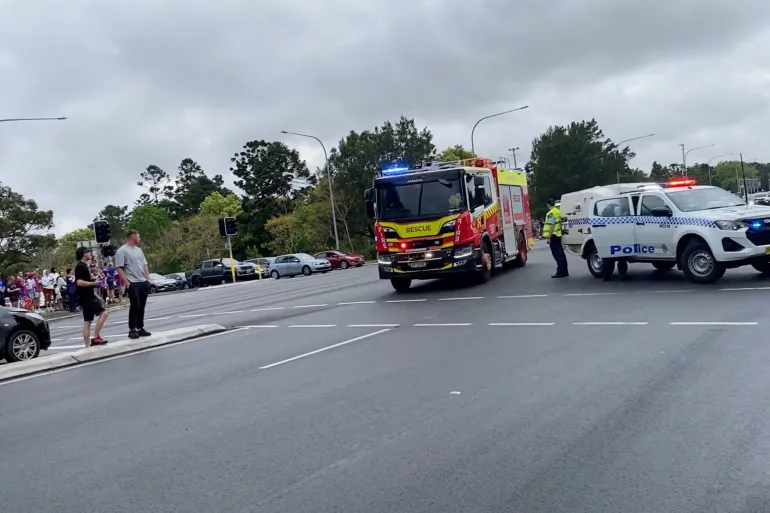
A car has crashed into a crowd of rugby league supporters in the eastern Australian city of Newcastle, injuring 10 people, including three children.
New South Wales police said on Saturday that two of the injured – a five-year-old girl and a 67-year-old man – were in a critical condition and the other eight were in stable condition in hospital.
Police said they had arrested the 18-year-old man driving the vehicle and were investigating what happened. They said the crash was not believed to be related to “terrorism”.
The crowd had gathered to farewell the local rugby league side, the Newcastle Knights, ahead of their grand final against the Sydney Roosters on Sunday.
Newcastle Lord Mayor Gavin Morris said the driver, a rugby league fan, had lost control of his vehicle and had been taken into custody.
“He was revving the car, he was excited, he was a supporter, he was there for the joy of the moment,” Morris told the national broadcaster ABC.
“Somehow he lost control of the car … and he’s gone into the crowd,” he added.
Prime Minister Anthony Albanese said: “My thoughts are with everyone injured or involved in the horrible incident this morning in Newcastle.”
“Rugby league brings people together, and this should have been a weekend of excitement and pride for Newcastle fans,” he wrote in a social media post.
[Aljazeera]

GS1 Lanka drives Sri Lanka’s shift to 2D barcodes

Geneva takes up Sallay’s case and govt. ignores opportunity to answer accusations

Section of wartime KKS High Security Zone vacated to facilitate economic development in the area

Lawyer lodges complaint against Govt. Printer, Media Ministry Secy.

Sri Lankan troops in joint anti-terrorist exercise in Russia

Nine Indian poachers brought to KKS with their boat

‘Dates have the highest sugar content to fight Coronavirus’

Sunday Island 27 December – Headlines

#SundayIsland 17th December – Headlines

Sunday Island – 28th March

Sunday Island Headlines – 21 March

Sunday Island – 21st February – Headlines
-

 Latest News5 days ago
Gold winner Tharanga gets brand-new Honda Vezel from SLAAJ
-

 Features5 days ago
Why Sri Lanka needs an Inclusive Civic Nationalism – urgently
-

 News4 days ago
US-assisted ‘Ice’ detection: NPC to examine IGP’s move to transfer drug-busting team
-

 Features6 days ago
Thailand’s biggest new global star …
-

 News6 days ago
First cases taken up by SC after enactment of 22A dismissed
-

 News5 days ago
Civil society activist accuses govt. of favouring Ven. Gnanasara
-

 Editorial6 days ago
Aftershocks of 22A
-

 Editorial3 days ago
Colombo Port drug bust: The plot thickens