
Features
Pastor Moses shows the power of a free lunch

by Munza Mushtaq
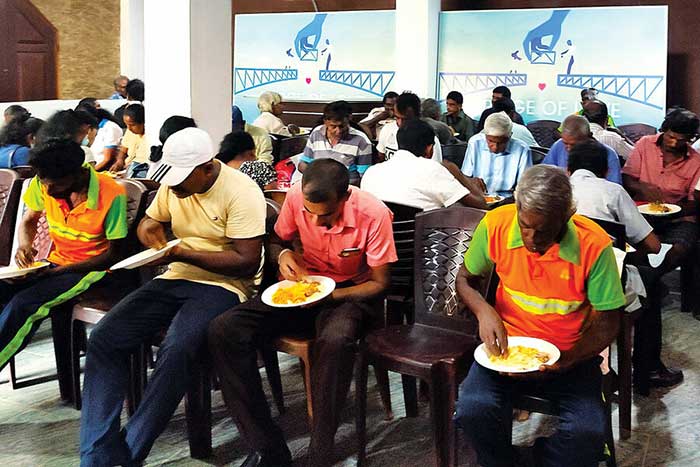
It’s just past noon, and on the sweltering rooftop of the Bethany Church in Rajagiriya, Sri Lanka, Pastor Moses Akash de Silva and a team of volunteers are grating piles of carrots while K.D. Iranie hovers over a large pan, stirring a spicy fish curry atop a makeshift firewood cooker.
Ms. Iranie, who’s in her 60s, has served as the main cook for the church’s community kitchen since Pastor Moses started the project in June. “I come all five days a week,” she says. “Seeing the people getting a delicious meal makes me so happy. … I am doing what God wishes me to do.”
At 12:30 p.m. sharp, after trays of fresh food are carried down four flights of steps, Pastor Moses signals a volunteer to open the church’s grilled gates. At least a hundred men, women, and children eagerly file in, following the aromas of turmeric-infused fluffy yellow rice, fish and pumpkin curries, carrot sambol, and papadums. More will arrive with time. For many, this is their first proper meal in days.
Sri Lanka’s worst-ever economic crisis has left nearly 30% of its 22 million people food insecure, according to the World Food Program, with food inflation soaring to 73% in November. The Voice Community Kitchen helps out by providing some 6,000 free lunches every week across roughly two dozen locations throughout Sri Lanka, while also bringing together different ethnoreligious communities that have historically struggled to find common ground. Pastor Moses says the initiative was born of pragmatism, compassion toward all Sri Lankans, and a desire to model the same generosity he experienced as a young person.
“I have gone for days without food, so I understand how these people feel,” he says. “It does not matter to us what religion they are from, or if they have family, or what they do. If they are hungry, they are welcome to eat at our community kitchen.”
Raised in an orphanage in the hill capital of Kandy, Pastor Moses moved to Colombo at age 17 seeking better opportunities. He lived at a bus stop for three days before finding work as a cleaner at a polyethylene factory. It’s there he met the senior pastor of Bethany Church, Dishan de Silva, who took him in.
Pastor Moses explains with a bright smile how he lived with the senior pastor for seven years, eventually adopting his mentor’s surname. He still goes by Pastor Moses to honor the name given to him at the orphanage.
Senior Pastor de Silva founded the Voice for Voiceless Foundation in 2015 and later handed over the reins to Pastor Moses, who has since spearheaded multiple charitable initiatives as the foundation’s national director. The community kitchen idea came to him earlier this year when Voice Foundation volunteers were distributing dry rations to families on the outskirts of Colombo.
“In one house we met a mother with a 2-year-old child who had been surviving on ripened breadfruit and water spinach for three days due to the shortage of cooking gas in the market,” he says. “That was when we thought, there was no point giving dry rations if people were unable to cook.”
So they started cooking up meals themselves. Many of the current community kitchens are based in schools, while others, such as the flagship Bethany Church program in a Colombo suburb, serve lunch every day to a mix of children and adults. At least 60% of the people who come to the kitchen do not eat breakfast or dinner due to financial hardship, according to the Voice Foundation.
There is only one rule at the Voice Foundation’s community kitchens: Guests can eat as much as they want, but they can’t take food outside the premises. At the Bethany Church, there is not a single garbage bin. According to Pastor Moses, there’s no need – there are never leftovers.
“The community kitchen attracts different people from different walks of life, including beggars, street cleaners, security guards, and anyone else who needs a meal,” Pastor Moses says.
N.K. Karunawathie works at a bank nearby. Even as the cost of living skyrockets, her salary has remained stagnant, meaning her family can “no longer afford three meals a day,” she says.
To help make ends meet, she and her husband, both Buddhists, have been visiting the Voice Community Kitchen since it started this summer. “My husband and I come here daily for lunch. … This is a very meritorious gesture by the church,” Ms. Karunawathie says.
Most of the funding for the Voice Foundation’s activities, including the community kitchens, comes from Sri Lankans living locally and overseas. The organization has also partnered with several supermarkets to collect unsold vegetables.
For a small country, Sri Lanka frequently faces religious-based conflict. Apart from a quarter-century-long war with the Liberation Tigers of Tamil Eelam, which strained the relationship between the majority Buddhists and minority Hindus, the country has also seen a rise in attacks against Muslims since 2013. The Easter Sunday bombings in 2019 further exacerbated tensions.
Mehdi Ghouse started volunteering at the kitchen months ago after learning about the project on social media.
“It doesn’t matter that I am Muslim, or this project is run by the church. What matters is the satisfaction we all get when we see people eating and leaving happy,” he says.
Not only are all religions welcome at the Voice Community Kitchen, but experts also say such initiatives could be key to improving ethnoreligious engagement and lead to better conflict mediation in the future.
“It has been said with a degree of cynicism that the way to a hungry man’s heart is through his stomach,” says Dr. Jehan Perera, executive director of the National Peace Council, a Colombo-based educational and advocacy organization. He believes that community kitchens are one way to build trust between different ethnoreligious groups, even amid economic and political turmoil.
“The economic crisis affects all ethnic and religious communities the same. So this is a good opportunity to forge bonds of community solidarity and overcome the challenges of the past,” he says.
For Pastor Moses, the community kitchen’s mission is simple: Feed the hungry. But he does hope the work will have a ripple effect by inspiring generosity among all who engage with the project.
“I am who I am because of the upbringing I had in the orphanage and the help I got throughout the years since I came to Colombo,” he says. “I hope others who volunteer here and those who I have taken under my wings will follow my footsteps by serving the people.”
(Christian Science Monitor)


 SAARC or the South Asian Association for Regional Cooperation has been declared ‘dead’ by some sections in South Asia and the idea seems to be catching on. Over the years the evidence seems to have been building that this is so, but a matter that requires thorough probing is whether the media in South Asia, given the vital part it could play in fostering regional amity, has had a role too in bringing about SAARC’s apparent demise.
That South Asian governments have had a hand in the ‘SAARC debacle’ is plain to see. For example, it is beyond doubt that the India-Pakistan rivalry has invariably got in the way, particularly over the past 15 years or thereabouts, of the Indian and Pakistani governments sitting at the negotiating table and in a spirit of reconciliation resolving the vexatious issues growing out of the SAARC exercise. The inaction had a paralyzing effect on the organization.
Unfortunately the rest of South Asian governments too have not seen it to be in the collective interest of the region to explore ways of jump-starting the SAARC process and sustaining it. That is, a lack of statesmanship on the part of the SAARC Eight is clearly in evidence. Narrow national interests have been allowed to hijack and derail the cooperative process that ought to be at the heart of the SAARC initiative.
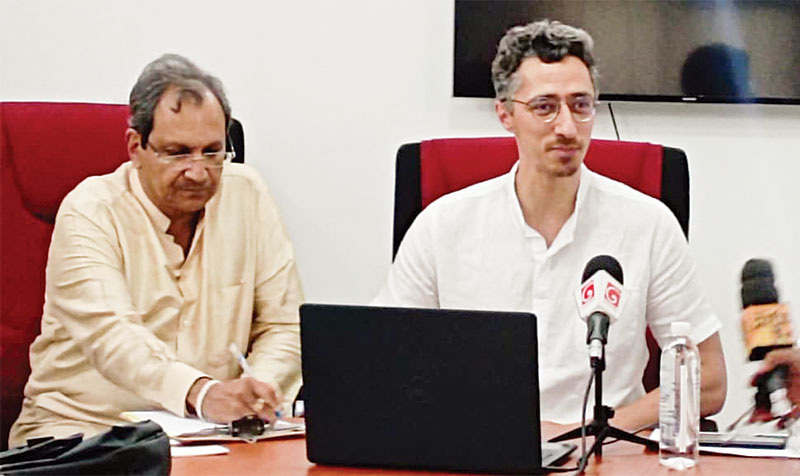
However, a dimension that has hitherto gone comparatively unaddressed is the largely negative role sections of the media in the SAARC region could play in debilitating regional cooperation and amity. We had some thought-provoking ‘takes’ on this question recently from Roman Gautam, the editor of ‘Himal Southasian’.
Gautam was delivering the third of talks on February 2nd in the RCSS Strategic Dialogue Series under the aegis of the Regional Centre for Strategic Studies, Colombo, at the latter’s conference hall. The forum was ably presided over by RCSS Executive Director and Ambassador (Retd.) Ravinatha Aryasinha who, among other things, ensured lively participation on the part of the attendees at the Q&A which followed the main presentation. The talk was titled, ‘Where does the media stand in connecting (or dividing) Southasia?’.
Gautam singled out those sections of the Indian media that are tamely subservient to Indian governments, including those that are professedly independent, for the glaring lack of, among other things, regionalism or collective amity within South Asia. These sections of the media, it was pointed out, pander easily to the narratives framed by the Indian centre on developments in the region and fall easy prey, as it were, to the nationalist forces that are supportive of the latter. Consequently, divisive forces within the region receive a boost which is hugely detrimental to regional cooperation.
Two cases in point, Gautam pointed out, were the recent political upheavals in Nepal and Bangladesh. In each of these cases stray opinions favorable to India voiced by a few participants in the relevant protests were clung on to by sections of the Indian media covering these trouble spots. In the case of Nepal, to consider one example, a young protester’s single comment to the effect that Nepal too needed a firm leader like Indian Prime Minister Narendra Modi was seized upon by the Indian media and fed to audiences at home in a sensational, exaggerated fashion. No effort was made by the Indian media to canvass more opinions on this matter or to extensively research the issue.
In the case of Bangladesh, widely held rumours that the Hindus in the country were being hunted and killed, pogrom fashion, and that the crisis was all about this was propagated by the relevant sections of the Indian media. This was a clear pandering to religious extremist sentiment in India. Once again, essentially hearsay stories were given prominence with hardly any effort at understanding what the crisis was really all about. There is no doubt that anti-Muslim sentiment in India would have been further fueled.
Gautam was of the view that, in the main, it is fear of victimization of the relevant sections of the media by the Indian centre and anxiety over financial reprisals and like punitive measures by the latter that prompted the media to frame their narratives in these terms. It is important to keep in mind these ‘structures’ within which the Indian media works, we were told. The issue in other words, is a question of the media completely subjugating themselves to the ruling powers.
Basically, the need for financial survival on the part of the Indian media, it was pointed out, prompted it to subscribe to the prejudices and partialities of the Indian centre. A failure to abide by the official line could spell financial ruin for the media.
A principal question that occurred to this columnist was whether the ‘Indian media’ referred to by Gautam referred to the totality of the Indian media or whether he had in mind some divisive, chauvinistic and narrow-based elements within it. If the latter is the case it would not be fair to generalize one’s comments to cover the entirety of the Indian media. Nevertheless, it is a matter for further research.
However, an overall point made by the speaker that as a result of the above referred to negative media practices South Asian regionalism has suffered badly needs to be taken. Certainly, as matters stand currently, there is a very real information gap about South Asian realities among South Asian publics and harmful media practices account considerably for such ignorance which gets in the way of South Asian cooperation and amity.
Moreover, divisive, chauvinistic media are widespread and active in South Asia. Sri Lanka has a fair share of this species of media and the latter are not doing the country any good, leave alone the region. All in all, the democratic spirit has gone well into decline all over the region.
The above is a huge problem that needs to be managed reflectively by democratic rulers and their allied publics in South Asia and the region’s more enlightened media could play a constructive role in taking up this challenge. The latter need to take the initiative to come together and deliberate on the questions at hand. To succeed in such efforts they do not need the backing of governments. What is of paramount importance is the vision and grit to go the extra mile.

By Ifham Nizam
As the sun softened over Colombo and the city’s familiar noise began to loosen its grip, the Beddagana Wetland Park prepared for its quieter hour — the hour when wetlands speak in their own language.
World Wetlands Day was marked a little early this year, but time felt irrelevant at Beddagana. Nature lovers, students, scientists and seekers gathered not for a ceremony, but for listening. Partnering with Park authorities, Dilmah Conservation opened the wetland as a living classroom, inviting more than a 100 participants to step gently into an ecosystem that survives — and protects — a capital city.
Wetlands, it became clear, are not places of stillness. They are places of conversation.
Beyond the surface
In daylight, Beddagana appears serene — open water stitched with reeds, dragonflies hovering above green mirrors.
Yet beneath the surface lies an intricate architecture of life. Wetlands are not defined by water alone, but by relationships: fungi breaking down matter, insects pollinating and feeding, amphibians calling across seasons, birds nesting and mammals moving quietly between shadows.
Participants learned this not through lectures alone, but through touch, sound and careful observation. Simple water testing kits revealed the chemistry of urban survival. Camera traps hinted at lives lived mostly unseen.
Demonstrations of mist netting and cage trapping unfolded with care, revealing how science approaches nature not as an intruder, but as a listener.
Again and again, the lesson returned: nothing here exists in isolation.
Learning to listen
Perhaps the most profound discovery of the day was sound.
Wetlands speak constantly, but human ears are rarely tuned to their frequency. Researchers guided participants through the wetland’s soundscape — teaching them to recognise the rhythms of frogs, the punctuation of insects, the layered calls of birds settling for night.
Then came the inaudible made audible. Bat detectors translated ultrasonic echolocation into sound, turning invisible flight into pulses and clicks. Faces lit up with surprise. The air, once assumed empty, was suddenly full.
It was a moment of humility — proof that much of nature’s story unfolds beyond human perception.
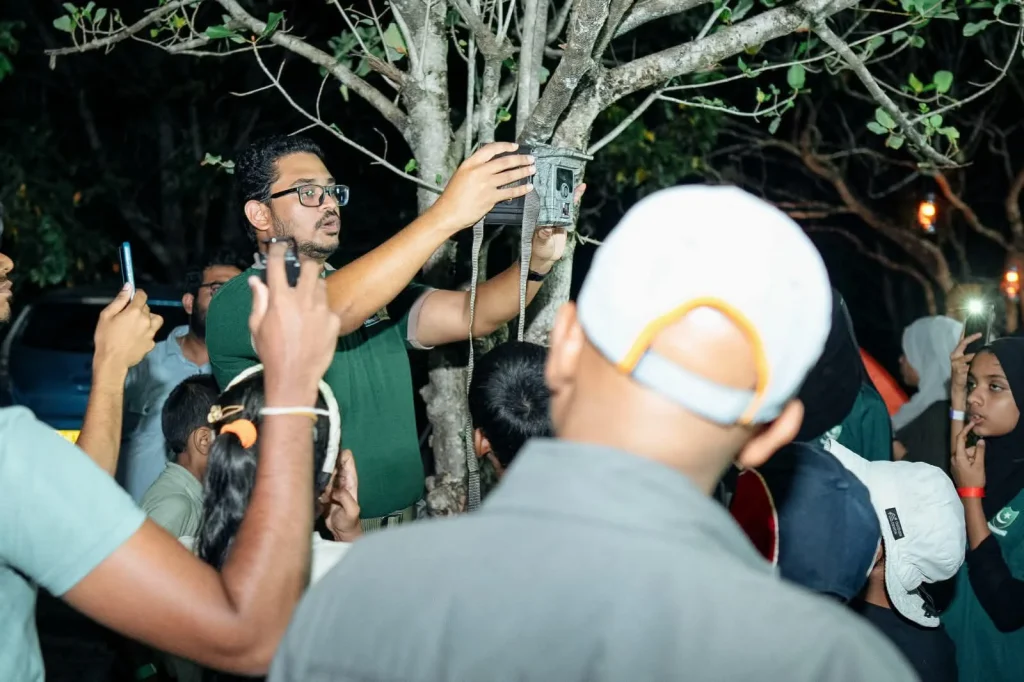
Sethil on camera trapping
The city’s quiet protectors
Environmental researcher Narmadha Dangampola offered an image that lingered long after her words ended. Wetlands, she said, are like kidneys.
“They filter, cleanse and regulate,” she explained. “They protect the body of the city.”
Her analogy felt especially fitting at Beddagana, where concrete edges meet wild water.
She shared a rare confirmation: the Collared Scops Owl, unseen here for eight years, has returned — a fragile signal that when habitats are protected, life remembers the way back.
Small lives, large meanings
Professor Shaminda Fernando turned attention to creatures rarely celebrated. Small mammals — shy, fast, easily overlooked — are among the wetland’s most honest messengers.
Using Sherman traps, he demonstrated how scientists read these animals for clues: changes in numbers, movements, health.
In fragmented urban landscapes, small mammals speak early, he said. They warn before silence arrives.
Their presence, he reminded participants, is not incidental. It is evidence of balance.
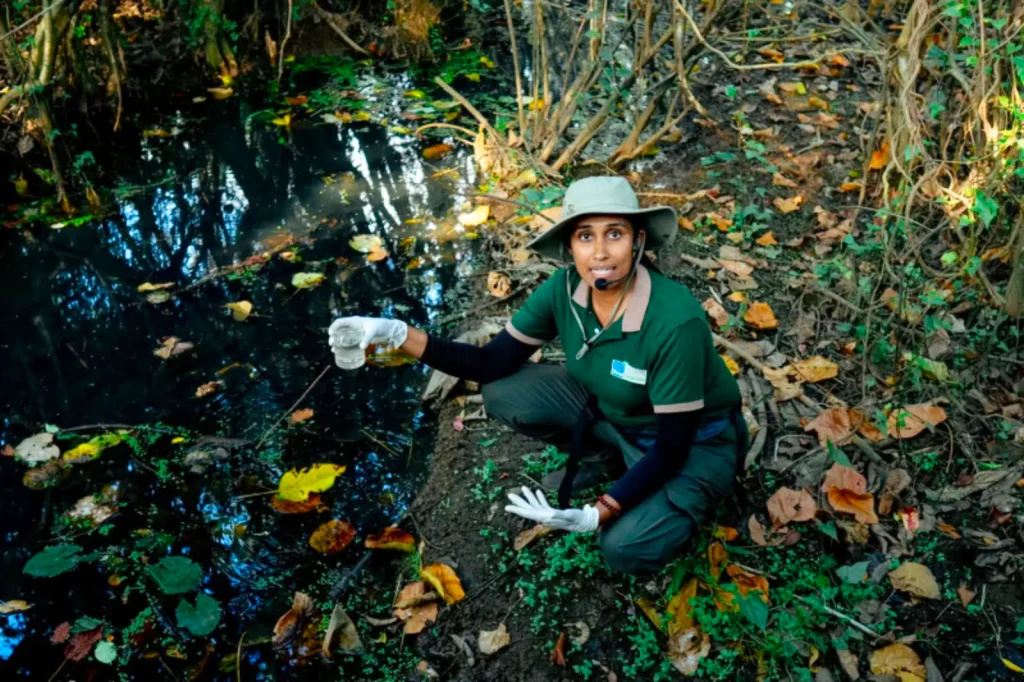
Narmadha on water testing pH level
Wings in the dark
As twilight thickened, Dr. Tharaka Kusuminda introduced mist netting — fine, almost invisible nets used in bat research.
He spoke firmly about ethics and care, reminding all present that knowledge must never come at the cost of harm.
Bats, he said, are guardians of the night: pollinators, seed dispersers, controllers of insects. Misunderstood, often feared, yet indispensable.
“Handle them wrongly,” he cautioned, “and we lose more than data. We lose trust — between science and life.”
The missing voice
One of the evening’s quiet revelations came from Sanoj Wijayasekara, who spoke not of what is known, but of what is absent.
In other parts of the region — in India and beyond — researchers have recorded female frogs calling during reproduction. In Sri Lanka, no such call has yet been documented.
The silence, he suggested, may not be biological. It may be human.
“Perhaps we have not listened long enough,” he reflected.
The wetland, suddenly, felt like an unfinished manuscript — its pages alive with sound, waiting for patience rather than haste.
The overlooked brilliance of moths
Night drew moths into the light, and with them, a lesson from Nuwan Chathuranga. Moths, he said, are underestimated archivists of environmental change. Their diversity reveals air quality, plant health, climate shifts.
As wings brushed the darkness, it became clear that beauty often arrives quietly, without invitation.

Sanoj on female frogs
Coexisting with the wild
Ashan Thudugala spoke of coexistence — a word often used, rarely practiced. Living alongside wildlife, he said, begins with understanding, not fear.
From there, Sethil Muhandiram widened the lens, speaking of Sri Lanka’s apex predator. Leopards, identified by their unique rosette patterns, are studied not to dominate, but to understand.
Science, he showed, is an act of respect.
Even in a wetland without leopards, the message held: knowledge is how coexistence survives.
When night takes over
Then came the walk: As the city dimmed, Beddagana brightened. Fireflies stitched light into darkness. Frogs called across water. Fish moved beneath reflections. Insects swarmed gently, insistently. Camera traps blinked. Acoustic monitors listened patiently.
Those walking felt it — the sense that the wetland was no longer being observed, but revealed.
For many, it was the first time nature did not feel distant.

Faunal diversity at the Beddagana Wetland Park
A global distinction, a local duty
Beddagana stands at the heart of a larger truth. Because of this wetland and the wider network around it, Colombo is the first capital city in the world recognised as a Ramsar Wetland City.
It is an honour that carries obligation. Urban wetlands are fragile. They disappear quietly. Their loss is often noticed only when floods arrive, water turns toxic, or silence settles where sound once lived.
Commitment in action
For Dilmah Conservation, this night was not symbolic.
Speaking on behalf of the organisation, Rishan Sampath said conservation must move beyond intention into experience.
“People protect what they understand,” he said. “And they understand what they experience.”
The Beddagana initiative, he noted, is part of a larger effort to place science, education and community at the centre of conservation.
Listening forward
As participants left — students from Colombo, Moratuwa and Sabaragamuwa universities, school environmental groups, citizens newly attentive — the wetland remained.
It filtered water. It cooled air. It held life.
World Wetlands Day passed quietly. But at Beddagana, something remained louder than celebration — a reminder that in the heart of the city, nature is still speaking.
The question is no longer whether wetlands matter.
It is whether we are finally listening.

 Valentine’s Day is all about spreading love and appreciation, and it is a mega scene on 14th February.
People usually shower their loved ones with gifts, flowers (especially roses), and sweet treats.
Couples often plan romantic dinners or getaways, while singles might treat themselves to self-care or hang out with friends.
It’s a day to express feelings, share love, and make memories, and that’s exactly what Indunil Kaushalya Dissanayaka, of Cuteefly fame, is working on.
She has come up with a novel way of making that special someone extra special on Valentine’s Day.

Indunil is known for her scented and beautifully turned out candles, under the brand name Cuteefly, and we highlighted her creativeness in The Island of 27th November, 2025.
She is now working enthusiastically on her Valentine’s Day candles and has already come up with various designs.
“What I’ve turned out I’m certain will give lots of happiness to the receiver,” said Indunil, with confidence.
In addition to her own designs, she says she can make beautiful candles, the way the customer wants it done and according to their budget, as well.
 Customers can also add anything they want to the existing candles, created by Indunil, and make them into gift packs.
Another special feature of Cuteefly is that you can get them to deliver the gifts … and surprise that special someone on Valentine’s Day.
Indunil was originally doing the usual 9 to 5 job but found it kind of boring, and then decided to venture into a scene that caught her interest, and brought out her hidden talent … candle making
And her scented candles, under the brand ‘Cuteefly,’ are already scorching hot, not only locally, but abroad, as well, in countries like Canada, Dubai, Sweden and Japan.
 “I give top priority to customer satisfaction and so I do my creative work with great care, without any shortcomings, to ensure that my customers have nothing to complain about.”
Indunil creates candles for any occasion – weddings, get-togethers, for mental concentration, to calm the mind, home decorations, as gifts, for various religious ceremonies, etc.
In addition to her candle business, Indunil is also a singer, teacher, fashion designer, and councellor but due to the heavy workload, connected with her candle business, she says she can hardly find any time to devote to her other talents.
Indunil could be contacted on 077 8506066, Facebook page – Cuteefly, Tiktok– Cuteefly_tik, and Instagram – Cuteeflyofficial.

‘Our flight is booked, we’re going’: Suryakumar on India vs Pakistan

Captain’s knock helps Petes

Delhi Capital’s fourth shot at elusive trophy as Royal Challengers Bengaluru look to make winning a habit

Gunmen kill nearly 200 people in Nigeria’s Kwara and Katsina states

SLAF men’s Judo team crowned overall champs at 62nd National Judo Championship

Showers above 75 mm are likely at some places in the Uva province and in Batticaloa, Ampara, Hambantota and Nuwara-Eliya districts

‘Dates have the highest sugar content to fight Coronavirus’

Sunday Island 27 December – Headlines

#SundayIsland 17th December – Headlines

Sunday Island – 28th March

Sunday Island Headlines – 21 March

Sunday Island – 21st February – Headlines
-
 Opinion7 days ago
Sri Lanka, the Stars,and statesmen
-

 Business6 days ago
Hayleys Mobility ushering in a new era of premium sustainable mobility
-

 Business3 days ago
SLIM-Kantar People’s Awards 2026 to recognise Sri Lanka’s most trusted brands and personalities
-
 Business6 days ago
Advice Lab unveils new 13,000+ sqft office, marking major expansion in financial services BPO to Australia
-
 Business6 days ago
Arpico NextGen Mattress gains recognition for innovation
-

 Business5 days ago
Altair issues over 100+ title deeds post ownership change
-

 Editorial6 days ago
Govt. provoking TUs
-

 Business5 days ago
Sri Lanka opens first country pavilion at London exhibition