
News
Opp. seeks IMF intervention to rein in corruption


‘How come gold smuggling MP remains on Ethics and Privileges Committee’?
By Shamindra Ferdinando
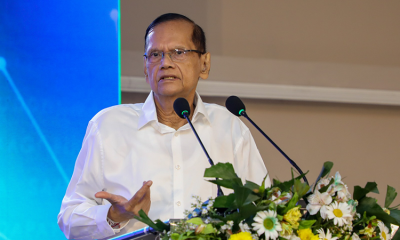
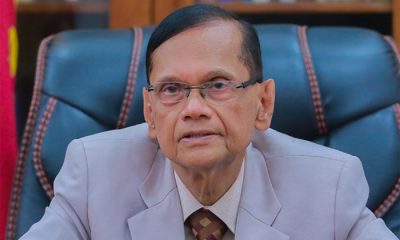
The Opposition would seek the IMF’s commitment to rein in rampant corruption with the Wickremesinghe-Rajapaksa government in spite of the country being declared bankrupt over a year ago, former External Affairs Minister Prof. G. L. Peiris said yesterday (11).
Addressing the media at the Nawala Office of Nidahasa Janatha Sabhawa, the senior SLPP rebel group member said that the Opposition intended to furnish transcripts of the three-day debate on the No-Confidence-Motion (NCM) against Health Minister Keheliya Rambukwella to the IMF delegation. The former minister said that the outcome of the debate had proved beyond any doubt that the government was bent on making a killing at the expense of the public.
The IMF visit is scheduled for this week ahead of their approval of the second tranche of the bailout package.
“We’ll ask the IMF to pressure the government over corruption,” Prof. Peiris said, adding that the international lending agency couldn’t absolve itself of the responsibility against backdrop of its commitment to make available USD 2.9 bn over a period of four years.
The Opposition could muster the support of only 73 lawmakers whereas 113 voted against the NCM. Thirty-eight MPs failed to cast their ballot at the vote held last Friday (08).
The top SLPP spokesperson said that the Opposition would brief the IMF of two other contentious issues to emphasize the failure not only on the part of the government to reign in corruption but how the Parliament encouraged the same.
Prof. Peiris said that there couldn’t be a better example than the favoured treatment received by Muslim National Alliance (MNA) MP Ali Sabry Raheem, arrested at the BIA in March this year, after being caught in a massive smuggling bid, to prove the Parliament as an institution protected such elements.
Regardless of representations made by Opposition Leader Sajith Premadasa and other Opposition MPs, the government parliamentary group and Speaker Mahinda Yapa Abeywardena continued to shield the MP, Prof. Perris said.
Customs at the BIA in early March thwarted an attempt made by lawmaker Raheem to smuggle in undeclared gold worth Rs. 74 mn and a large consignment of smartphones valued at Rs. 4.2 mn. The MP walked free within hours after paying a Rs 7.5 mn fine, though in terms of Customs Ordinance, the MP could have been imposed a fine three times the value of confiscated goods, in this particular case gold and smartphones.
Prof. Peiris found fault with Speaker Abeywardena turning a blind eye to the incident that tarnished the image of Parliament at a time the public expected the House to take a tougher stand on corruption. The former internationally distinguished law academic pointed out that the Parliament was in a dilemma as the gold smuggling MP continued to serve the Committee on Ethics and Privileges.
How the Parliament could explain the Ethics and Privileges Committee being asked to examine the conduct of one of its members accused of gold smuggling at a time the government was struggling to increase State revenue, Prof. Peiris asked.
All Ceylon Makkal Congress (ACMC) nominated Raheem to contest Puttalam at the last general election in August 2020. ACMC and Sri Lanka Muslim Congress (SLMC) fielded a group of candidates under the MNA banner.
Prof. Peiris said that they would also brief the IMF delegation regarding a major loophole in recently enacted much touted anti-corruption law that conveniently left out provision to deal with stolen funds now stashed overseas. “When we sought an explanation as to why the new law didn’t deal with the issue at hand, the government assured necessary amendments would be made later. That explanation cannot be accepted,” Prof. Peiris said, alleging that the powers that be were continuing in their cavalier fashion regardless of the further deterioration of the overall situation.
Prof. Peiris said that recently a parliamentary watchdog committee examined how a foreign investor received tax free status for a period of 17 years while those struggling to make ends meet were burdened with further taxes. The government resorted to domestic debt-restructuring regardless of the consequences caused by the inclusion of EPF and ETF in the process, the lawmaker said. But those who invested heavily here under an emergency situation were not touched, the MP said. The IMF should be mindful of the situation, the former minister said, urging all stakeholders to reexamine the situation here.






Latest News
Heat Index at Caution Level in the Western, Sabaragamuwa, Southern, Eastern, North-western, Northern and North-central provinces and in Monaragala district

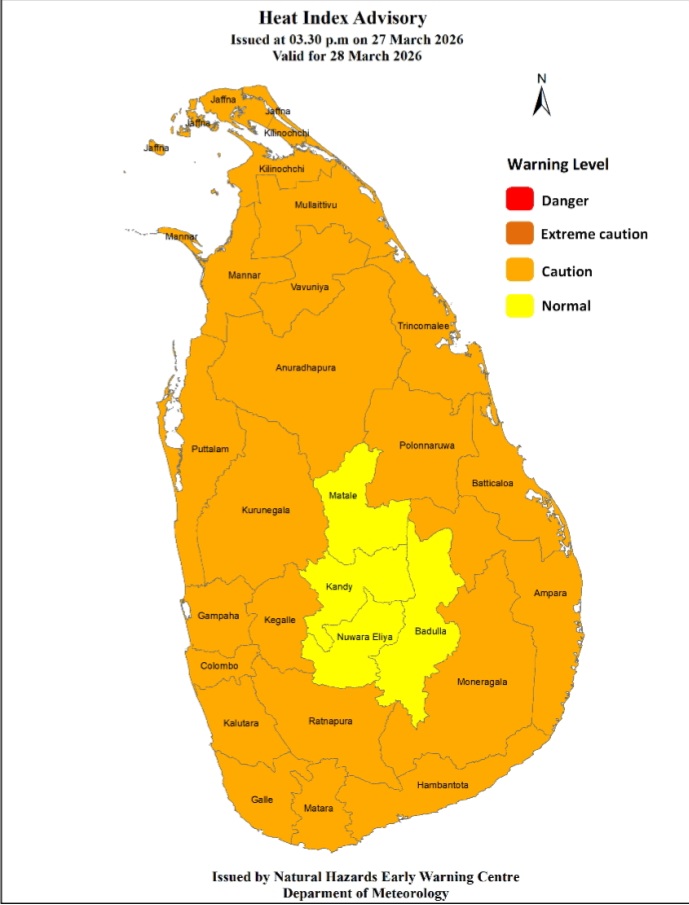
Warm Weather Advisory
Issued by the Natural Hazards Early Warning Centre of the Department of Meteorology
Issued at 3.30 p.m. on 27 March 2026, valid for 28 March 2026.
The ‘Heat index‘, the temperature felt on human body is likely to increase up to ‘Caution level’ at some places in the Western, Sabaragamuwa, Southern, Eastern, North-western, Northern and North-central provinces and in Monaragala district
The Heat Index Forecast is calculated by using relative humidity and maximum temperature and this is the condition that is felt on your body. This is not the forecast of maximum temperature. It is generated by the Department of Meteorology for the next day period and prepared by using global numerical weather prediction model data.

Effect of the heat index on human body is mentioned in the above table and it is prepared on the advice of the Ministry of Health and Indigenous Medical Services.
ACTION REQUIRED
Job sites: Stay hydrated and takes breaks in the shade as often as possible.
Indoors: Check up on the elderly and the sick.
Vehicles: Never leave children unattended.
Outdoors: Limit strenuous outdoor activities, find shade and stay hydrated.
Dress: Wear lightweight and white or light-colored clothing.
Note:
In addition, please refer to advisories issued by the Disaster Preparedness & Response Division, Ministry of Health in this regard as well. For further clarifications please contact 011-7446491.
The special ward at Sri Jayewardenepura General Hospital, which had until now been reserved exclusively for the use of the Executive President, was opened for the public for the provision of medical treatment to the general public from Tuesday (24).
This decision was taken jointly by the Ministry of Health and the hospital administration, in accordance with instructions given by President Anura Kumara Dissanayake.
Constructed in 1984 with a grant from the Government of Japan, Sri Jayewardenepura General Hospital was originally established with a capacity of 1,000 beds. However, in line with the initial design, an additional special unit, designated as Room No. 1001, was included exclusively for the personal use of the Executive President.
Over the 42 years since the hospital’s establishment, this facility has been utilised only on a very limited number of occasions. Nevertheless, it has been maintained over the years in anticipation of a possible visit by a sitting President, without being made available for patient use.
With effect from today, this special unit will be utilised for the benefit of general patients receiving treatment at the hospital. This step has been taken in line with the Government’s policy of ensuring the more efficient use of public assets and resources to meet the healthcare needs of the people.

The second meeting of the Cabinet Sub-Committee appointed to ensure the orderly functioning of the public service was held on Tuesday (24) afternoon at the Presidential Secretariat, under the patronage of Prime Minister Dr Harini Amarasuriya.
Extensive discussions were held on the immediate measures required to ensure the uninterrupted delivery of government services to the public and to address the challenges faced by public servants.
Attention was also drawn to maintaining the continuous operation of services under the Ministries of Public Administration, Provincial Councils and Local Government, Health, Education, and Justice. Accordingly, it was decided to ensure that examinations are conducted as scheduled and that essential medicines are supplied to hospitals without disruption.
The challenges in passenger transport services and the railway transport system, as well as future measures, were also discussed at length. Focus was also placed on the steps to be taken regarding the transportation of essential goods.
In addition, attention was given to introducing digital service systems to facilitate working from home and to enhance the efficiency of existing services. It was also noted that these activities would be supervised under the Ministry of Digital Economy.
Instructions were further issued to review the current energy management practices across all ministries and departments and to take steps to implement necessary policy changes.
Minister of Public Administration, Provincial Councils and Local Government A. H. M. M. H. Abeyaratne, Secretary to the Prime Minister Pradeep Saputhanthri, Chief of Staff to the President Prabath Chandrakeerthi, Secretary to the Ministry of Public Administration, Provincial Councils and Local Government S. Aloka Bandara, Secretary to the Ministry of Health and Mass Media Dr Anil Jasinghe, Secretary to the Ministry of Energy Professor T. M. Udayanga Hemapala, Secretary to the Ministry of Digital Economy T. R. W. S. Dhanapala, Secretary to the Ministry of Justice and National Integration Ayesha Jinasena, PC, Senior Additional Secretary to the President Roshan Gamage, and Chairman of the Ceylon Petroleum Corporation D. J. A. S. S. Rajakaruna, along with other committee members, were also present at the occasion.

Import price shocks of the Hormuz Crisis 2026: How will this affect Sri Lanka?

Sri Sumangala cruise to semis after Kumarasiri heroics

Australia hosts ‘Thought Leadership Session’ on disaster recovery

BOC launches Agri Banking Unit: Financing the roots of Sri Lanka’s future

Ceylon Cold Stores honoured for Export Excellence

SELVE: AI-powered speaking practice

‘Dates have the highest sugar content to fight Coronavirus’

Sunday Island 27 December – Headlines

#SundayIsland 17th December – Headlines

Sunday Island – 28th March

Sunday Island Headlines – 21 March

Sunday Island – 21st February – Headlines
-

 News3 days ago
Senior citizens above 70 years to receive March allowances on Thursday (26)
-

 Features5 days ago
Trincomalee oil tank farm: An engineering marvel
-

 News24 hours ago
Energy Minister indicted on corruption charges ahead of no-faith motion against him
-

 News2 days ago
US dodges question on AKD’s claim SL denied permission for military aircraft to land
-

 Features5 days ago
The scientist who was finally heard
-

 Business2 days ago
Dialog Unveils Dialog Play Mini with Netflix and Apple TV
-

 News3 days ago
CEB Engineers warn public to be prepared for power cuts after New Year
-

 Sports1 day ago
SLC to hold EGM in April