
Features
On the move again… Engleberg-Vienna-London-Mount Lavinia


Part Eleven : PASSIONS OF A GLOBAL HOTELIER
Dr. Chandana (Chandi) Jayawardena DPhil
President – Chandi J. Associates Inc. Consulting, Canada
Founder & Administrator – Global Hospitality Forum
chandij@sympatico.ca
Visits to Engleberg and Weggis in Switzerland
As the Acting Director of the School of Hotel Management at Schiller International University (SIU), my work primarily centred on the London campus. When I received an opportunity to visit the SIU campus in Switzerland, I eagerly accepted. Visiting the quaint Swiss town of Engelberg, with its population of fewer than 3,000, was a delight. Engelberg, located 25 km south of Lake Lucerne in a wide mountain valley at an altitude of around 1,000 meters, is one of Switzerland’s top 10 ski regions. The town’s rustic charm was complemented by its famous Benedictine monastery, founded in 1120 and still active today.
A highlight of my brief visit to Engelberg was meeting Mr. Jorge Müller, a lecturer at SIU. Mr. Müller had been an ILO Expert Maître d’hôtel at the Ceylon Hotel School in 1971 when I was a student. Over three years, he taught me food and beverage service and was always a supportive and kind mentor. Now, in 1990, he was happy to see us as colleagues at SIU.
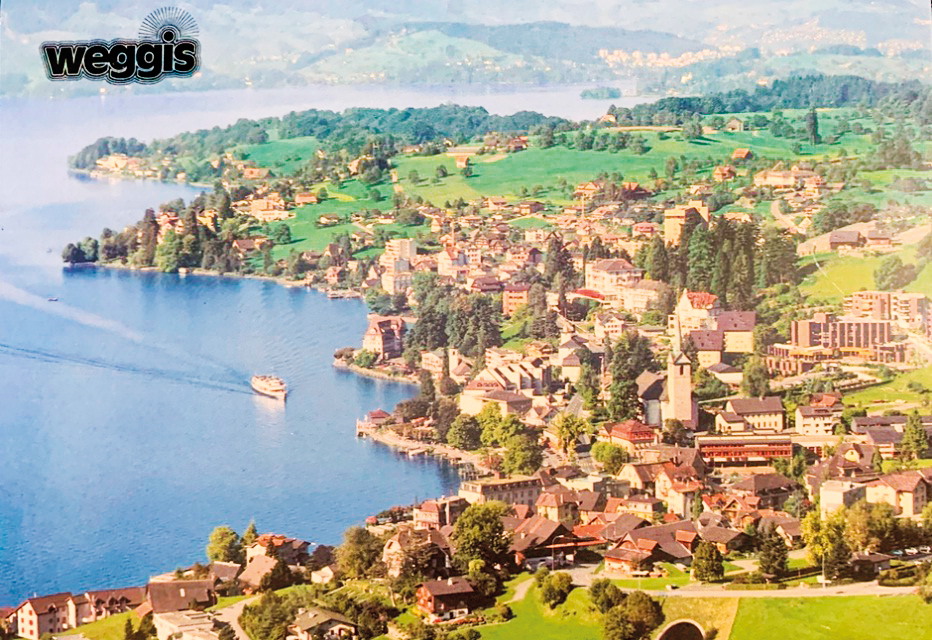
I also made a quick visit to the small Swiss village of Weggis, located in the district of Lucerne on the northern shore of Lake Lucerne. Like Engelberg, Weggis had a population of fewer than 3,000. There, I was hosted by Heinz Bürki, whom I had met during a business visit to Hotelconsult Hotel School (now César Ritz Colleges Switzerland) at Brig in 1985. Our family business, Streamline Services, represented Hotelconsult in Sri Lanka.
Five years later, Heinz had left his teaching job at Hotelconsult to establish his own hotel school in Weggis, the International Management Institute (now IMI University Centre Luzern). IMI too appointed Streamline Services as their sole agent in Sri Lanka. As I was about to leave Weggis, Heinz told me, “Chandi, we will open IMI with a bang in 1991. We will recruit a small team of Visiting Professors from around the world for short teaching assignments in Switzerland. I invite you to join us as a Professor.” That brief visit opened new doors for me, and I went on to do two short teaching contracts in Switzerland in 1992 and 1993, marking my first appointment as a Vising Professor.
-
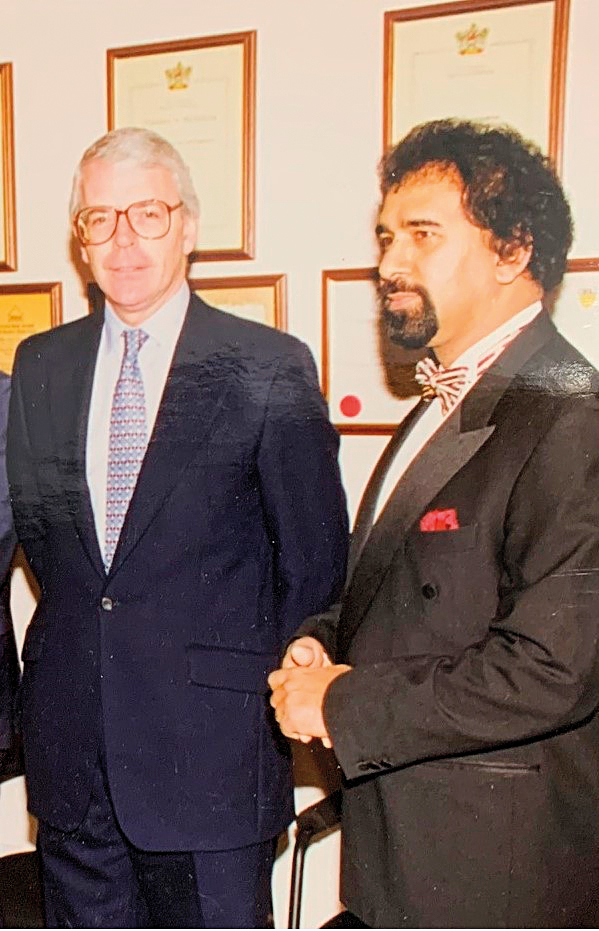
- A few years later, when I hosted Margaret Thatcher’s successor, Prime Minister John Major for champagne, at my office at Le Meridien Jamaica Pegasus Hotel.

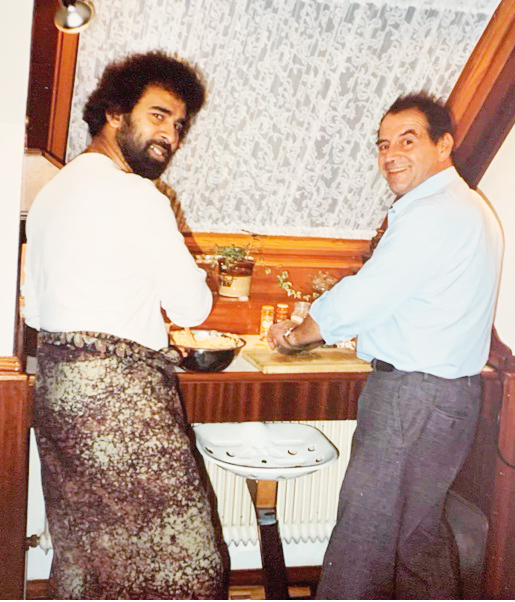
Preparing an Austrian and Sri Lankan infused dinner in Vienna
Fall of the Iron Lady
Having spent the summer of 1979 in London, soon after Margaret Thatcher became the Prime Minister of the UK, I had closely followed her leadership for 11 years. Fascinated by her rise from a humble lower-middle-class upbringing to become the most powerful elected female leader in the world, I admired her hard work and tough leadership style, even though I did not agree with all her policies. I met her once on April 12, 1984, when I was chosen by The Dorchester, the best British hotel at that time, to serve her dinner at a royal banquet in honor of the Queen of England.
On my 37th birthday, I was glued to British TV, watching the major cracks in Margaret Thatcher’s premiership. On November 21, 1990, she was told by her own cabinet in a series of back-to-back one-on-one meetings that she could not continue as Prime Minister. The British media termed it “cabinet revolt.”
A week later, on November 28, 1990, I watched her final speech as Prime Minister. With a bold face in keeping with her “Iron-Lady” image, she said, “Ladies and gentlemen, we are leaving Downing Street for the last time after eleven and a half wonderful years…” Escorted by her biggest fan and supporter, her husband Dennis, she could not hold back her tears anymore.

A tearful Margaret Thatcher leaves the Prime Minister’s official residence for the last time
A Viennese Getaway
When it was reported that Margaret Thatcher, a workaholic, put in about 20 hours a day, Monday to Friday, sometimes falling asleep around 2 am, I was not surprised. “You are the same! It is useless being a workaholic. Chandi, you need a holiday!” my wife insisted, organizing a family holiday in Austria during my university mid-term break.
Between visits to our homes in Sri Lanka and England, and our three previous visits to Austria, this was the seventh time we were spending a holiday with our dear Austrian friends, Biggi and Wolfgang Fernau. They took a week off to host us, excited to show our son Marlon the main attractions of Vienna and its suburbs. We had a wonderful break, spending quality family time in one of our favourite cities.
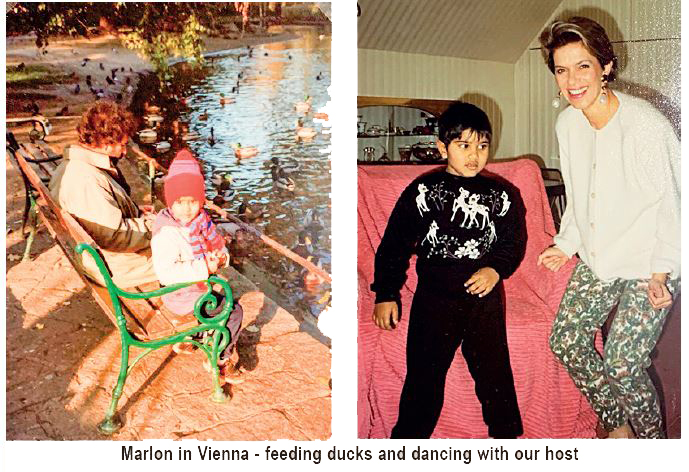
Schönbrunn Palace, the River Danube, and the Vienna Woods were Marlon’s favourites, but as a four-year-old, he did not enjoy our daily visits to Vienna’s famous coffee shops like Café Sacher, Café Demel, and L. Heiner Coffee Shop in Kärntner Strasse.
Marlon loved feeding ducks in the city park, listening to Uncle Wolfgang’s adventure stories, and dancing with Auntie Biggi. We ended our relaxing holiday with an Austrian and Sri Lankan infused dinner prepared by Wolfgang and me.
Balancing Work and Family Life
Returning to London, I was determined to spend more quality time with my wife and son, despite my hectic work, teaching, and doctoral research schedule. I started taking long walks with Marlon in the nearby large park and going to the movies more often. When my father-in-law visited us from Colombo, we attended Sri Lankan events and a dance in London themed “Joliya” (or fun time) headlined by Sunil Perera and the Gypsies.
Finally, I managed to achieve a balanced lifestyle in England. At the university, I helped organize a grand graduation at the end of the academic year. Many students had become my friends, and a few got emotional during my last class. One of them played a tape of the theme song from the popular 1967 movie, “To Sir with Love.”
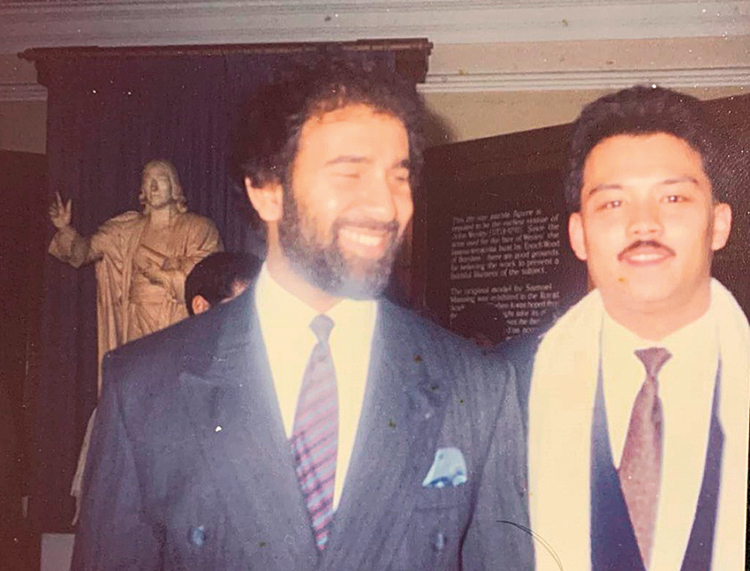
At the 1990 fall graduation of SIU, London Campus
Unplanned Destiny
We had settled well in the UK, with plans to stay until I completed my Ph.D. at the University of Surrey in another three or four years. Then, one Sunday, the phone rang at our house in London. “It’s Sanath Ukwatte, Chairman of Mount Lavinia Hotel (MLH),” my wife said, handing the phone to me.
I met Sanath for the first time in his father’s office at MLH in early 1985. His father, Mr. U. K. Edmund, was a humble Southerner who built significant business empires in mid-20th century Ceylon. He purchased MLH in 1975 and expanded the hotel while maintaining its early 19th-century architecture. In early 1985, the day I returned to Sri Lanka after completing my MSc in International Hotel Management at the University of Surrey, UK, I received a call from Prasanna Jayawardene, then General Manager of MLH, inviting me to join as Deputy General Manager. After an interview with Mr. U. K. Edmund and his young son, who was learning his father’s business, I considered offers from other companies before choosing to become the General Manager of John Keells’ two largest resort hotels, The Lodge and The Village at Habarana.
Sanath kept in touch, offering me the post of General Manager of MLH in 1988, but I declined as Prasanna Jayawardene’s plans to leave Sri Lanka changed. Two years later, Sanath called again, offering more benefits, an expatriate contract for three years, a percentage of profits, six weeks’ leave every summer for my doctoral research, and to pay my university fees. My wife remarked, “Chandi Boy, sounds like an offer difficult to refuse!”
And so, our journey took another unexpected turn, leading us to new adventures and opportunities in Mount Lavinia as the country becoming hopeful in entering a ceasefire with the LTTE separatists.


Life, by its very nature, invariably presents a myriad of challenges that are fundamental to the human experience. The various social ills that afflict humanity cannot be understood without recognizing the profound human dynamics at play. Navigating these challenges according to Buddhism involves shifting from attempting to control external circumstances to mastering one’s internal responses. Central to these challenges are certain detrimental drives stemming from pernicious distortions in the functioning of the human mind.
According to Buddhism, human suffering—both on a personal and societal level—arises from three unwholesome roots: greed, hatred, and ignorance or delusion. These roots manifest primarily as the unbridled proliferation of these negative states, serving as the foundation for our conduct. The Buddhist perspective offers profound insights for confronting these difficulties by emphasizing the nature of suffering, known as dukkha. Buddhism teaches that suffering (dukkha) is an inevitable part of life and is fueled by greed, hatred, and ignorance or delusion. This approach promotes mental transformation through mindfulness, ethical living, and the cultivation of wisdom, empowering individuals to confront their struggles with clarity and resilience.
Furthermore, accepting that suffering and difficulty are inherent parts of the human experience—while expecting life to be free of challenges—is, in itself, a cause of suffering. It is also important to recognize that all situations, whether good or bad, are temporary. This understanding helps reduce anxiety when facing difficult times, as these will eventually pass, and it prevents possessiveness during happy moments. Cultivating mindfulness (sati) and living in the present moment without dwelling on the past or worrying about the future is essential.
Understanding that all things—emotions, situations, relationships, and physical bodies—are constantly changing and in a state of flux helps reduce the fear of loss and provides comfort during difficult times, ensuring that we know pain will pass. Moreover, recognizing that the self, or ego, is not a fixed entity minimizes selfish grasping, arrogance, and the tendency to perceive challenges as personal attacks.
At the core of many human challenges lie the three unwholesome mental qualities identified by Buddhism: greed (raga), hatred (dovesa), and ignorance or delusion (avijja or moha). These states of mind serve as obstacles to spiritual progress and underlie a spectrum of harmful thoughts and actions. The Buddha employed powerful metaphors to illustrate these forces, referring to them as the three poisons or fires that ignite suffering and trap beings in the cycle of samsara.
Greed leads to insatiable desires that obscure our awareness of others’ needs, creating a cycle of frustration. Greed encompasses all forms of appetite, such as desire, lust, craving, and longing, manifesting in both physical and mental forms. It embodies the concept of grasping, leading to clinging and an inability to let go. As an unwholesome mental state, greed can become insatiable and inexhaustible. People are often drawn to pleasant things, and no amount of forms, sounds, smells, tastes, tangibles, or mental objects can satisfy their desires. In their intense thirst for possession or gratification of desire, individuals may become trapped in the wheel of samsara, overlooking the needs of marginalized groups based on religion and ethnicity (as noted by Piyadassi Thera). Those who overcome greed realize that all mundane pleasures are fleeting and transient. In a society driven by consumerism, people may find themselves endlessly chasing after things of little value, becoming enslaved by them.
Hatred is another unwholesome mental state that fosters division and conflict, distancing us from genuine relationships. It encompasses unwholesome mental states such as ill will, enmity, hostility, and prejudice. Hatred can be subtle, lying dormant in a person’s mind until it finds expression in unexpected moments. This destructive emotion can degenerate into mass-scale violence and bloodshed within society. Today, hatred and hostility against minorities based on religion and ethnicity are prevalent in many countries. People are often targeted by bigotry and hate, leading to a rise in antagonistic and derogatory behavior toward certain religious and ethnic groups. Hatred, enmity, and retaliation do not foster spiritual well-being; rather, they vitiate our own minds. Buddhists are encouraged to cultivate metta (loving-kindness). Greed and hatred, coupled with ignorance, are the chief causes of the evils that pervade this deluded world. As noted by Narada, “The enemy of the whole world is lust (greed), through which all evils come to living beings. This lust, when obstructed by some cause, transforms into wrath.”
The most profound of these afflictions, ignorance (avijja) or delusion (moha), clouds our judgment and obscures our capacity for understanding, causing us to harm ourselves and others through misguided actions. Addressing bhikkhus, the Buddha declared, ” I do not perceive any single hindrance other than the hindrance of ignorance by which mankind is obstructed, and for so long as in samsara, it is indeed through the hindrance of ignorance that humankind is obstructed and for a long time runs on, wanders in samsara. No other single thing exists like the hindrance of ignorance or delusion, which obstructs humankind and make wander forever. This unwholesome mindset generates negative speech, actions, and thoughts, perpetuating our own suffering. As stated in the Dhammapada, “All mental phenomena have mind as their forerunner; if one speaks or acts with an evil mind, suffering follows.”
Buddhism urges us to go beyond merely addressing the symptoms of our problems. Instead, it invites us to explore the roots of our suffering and examine how greed, hatred, and ignorance manifest in our lives. By uncovering these sources of distress, we can cultivate essential qualities such as compassion, loving-kindness (metta), and acceptance. These virtues are crucial for ethical engagement with significant societal issues, including environmental challenges and social inequality.
In a world marked by material prosperity and emotional chaos, many individuals may feel lost or overwhelmed. The teachings of the Buddha remain relevant today, reminding us that the origins of our struggles often reside within our own minds. By practising ethical self-discipline and steering clear of destructive emotions like jealousy, anger, and arrogance, we can transform our experiences and relationships.
Buddhism teaches that cultivating wholesome mental qualities is essential for spiritual advancement. The positive counterparts to the three unwholesome states are non-greed (alobha), non-hatred (adosa), and non-delusion (amoha). These virtues represent not merely the absence of negativity but also the active presence of beneficial qualities such as generosity (dana), loving kindness (metta), and wisdom (panna). Each of these six mental states serves as a foundation for both personal growth and societal harmony.
Human beings are often tempted by moral transgressions rooted in unwholesome qualities. Actions driven by greed, hatred and ignorance require wisdom and mindful awareness to overcome them, allowing us to see the interconnectedness of all beings and act accordingly.
As we strive to abandon these unwholesome states of mind and cultivate awareness, we contribute positively to our lives and the broader world. By embracing Buddhist teachings, we learn that transforming our minds can significantly impact our experiences and the lives of those around us. Through this mindful practice, we can aspire to create a more compassionate, harmonious existence, transcending the limitations of unwholesome mental states and fostering a deeper connection with ourselves and others.
by Dr. Chandradasa Nanayakkara

Buddhism, perhaps, is not a religion if the definition of religion is strictly applied. However, by an extension of that definition, as well as by consensus, Buddhism is considered a religion and is the fourth largest religion with about half a billion followers worldwide. Of the four great religions in the world, Christianity is still way ahead with 2.6 billion adherents, followed by Islam with 1.9 billion and Hinduism with 1.2 billion followers. In most Western Christian countries church attendances are on the decline whilst the numbers following Islam are increasing with Islamic youth displaying signs of increasing religious ardour. There are recent reports that Buddhism has also joined the ranks of shrinking religions. Is this cause for concern? Is this happening by the very nature of Buddhism?
Hinduism, the world’s oldest living religion rooted in the Indus Valley Civilization and dating back at least four millennia, is considered to have evolved from ancient cultural and religious practices than being founded by a single individual, unlike the other three religions. The Buddha differs from Jesus Christ and Prophet Mohammed in many ways, the most important being that there is no higher power involved in what the Buddha discovered.
Jesus Christ is considered the ‘Son of God’ and Christianity is built on the life, resurrection and teachings of Christ with emphasis on the belief in one God expressed through the Trinity: God the Father, Jesus the Son and the Holy Spirit. Therefore, there is no room for questioning the words of the Almighty passed through the Son.
Islam, with its Five Pillars of faith, frequent daily prayers, charity, fasting during Ramadan and pilgrimage to Mecca, is founded on revelations made by Almighty God, Allah, to Mohammed, the last of his Prophets, which are recorded in verse in the Holy Book, Quran. Muslims consider the Quran to be verbatim words of God and the unaltered, final revelation. This leaves even less room for questioning.
In contrast, the Buddha achieved everything by himself with no help from any higher source. Rebelling against some of the practices in the religion to which he was born and seeking a solution to the ever-pervading sense of dissatisfaction, Prince Siddhartha embarked on a journey of discovery that culminated in Enlightenment, under the Bodhi tree on the full moon day of the month of Vesak.
Hinduism, or Sanatana Dharma as traditionally referred to by followers, encompasses the concepts of Karma, Samsara, Moksha and Dharma with a creator Brahma, preserver Vishnu and destroyer Shiva. In addition, there are multitudes of gods serving various functions and there are ritual practices of Puja (worship), Bhakti (devotion), Yajna (sacrificial rites) in addition to meditation and Yoga. The one thing that has blighted Hinduism, on top of sacrifices, is the caste system. The uncompromising attitude of Brahmins led to the formation Sikhism as well, long after the establishment of Buddhism.
Prince Siddhartha studied under eminent teachers of the day, of which there were many, but realised the limitations of their knowledge. Having already given up the extreme of luxury, he went to the other extreme of self-deprivation which after a search for six years, he realised also was not the solution to the problem. Exploring through his mind he realised the truth and came up with the Four Noble Truths and the Noble Eightfold Path. He shunned extremes and proposed the Middle Path which seems to hold sway in many spheres of life, even today.
Buddha’s greatest achievement was the analysis of the mind and scientists are only now establishing the accuracy of the concepts the Buddha elucidated, not with the help of supernatural powers or sophisticated machinery at the disposal of modern-day scientists but by the exploration of the mind by turning the searchlight inwards.
Having discovered the cause of universal dissatisfaction and the path to overcome it, the Buddha walked across vast swathes of India, most likely barefoot, preaching to many, in terms they could understand, as evidenced by the different suttas illustrating the same fact in different ways; to the intelligent it was a short explanation but for others it was a more detailed discussion.
In sharp contrast to all other religious leaders, the Buddha encouraged discussion and challenge before acceptance. What the Buddha stated in the Kalama Sutta, acceptance only after conviction, laid the foundation for scientific thinking.
The Buddha, being a human not supernatural, never claimed infallibility as evidenced by his agreement with his father King Suddhodana that ordaining his son Rahula without permission was a mistake and took steps to ensure that this did not happen again. In fact, the entire Vinaya Pitaka is not an arbitrary rule book laid down by the Buddha, but are the rules the Buddha laid down for the Sangha, based on errant actions by Bhikkhus. Long before the legal concept of retroactive justice was established, the Buddha implemented it in the Vinaya Pitaka.
In an interesting video on YouTube titled “Nature of Buddhism”, Bhante Dhammika of Australia (https://www.youtube.com/watch?v=KY8WfGJq2FI) discusses some unique aspects of Buddhism. Some religions are ‘high demand’ religions where the followers are required to strictly adhere to certain rules which is not the case in Buddhism and he opines that this has led to the gentleness of Buddhists, at times leading to even being lackadaisical! Interestingly, as a widely travelled person, he describes his personal experience of the change of people’s attitudes on going from places with Buddhist influence to others. Speaking of Sri Lanka, where he spent many years, he commends the traditional hospitality as well as lack of cruelty to animals. He refers to “Law based religions” where some things are compulsory whereas in Buddhism there is no compulsion. Buddha was not a lawgiver but recommended good behaviour, giving reasons why and encouraged thinking. Some religions are exclusivist, claiming that there is nothing in other religions. Buddhism is not and Bhante Dhammika refers to an incident where the Buddha encouraged a disciple who converted from Jainism to continue to give alms to his former Jain colleagues.
Have all these strengths of Buddhism become its weakness and the reason for the shrinking number of followers? Had Buddhism demanded more from followers would it have flourished better? Is the numbers game that important? These are interesting questions to ponder over and I am sure, in time, researchers would write theses on these.
Whilst total numbers may diminish in traditional Buddhist areas, more people in the West are recognising the value of the philosophy of Buddhism. Mindfulness, a concept the Buddha introduced is gaining wide acceptance and is increasingly applied in many spheres of modern life. Perhaps, what is important is not the numbers that practise Buddhism as a religion but the lasting influence of the Buddha’s concepts and foundations he laid for modern scientific thinking and analysis of the mind!
By Dr Upul Wijayawardhana


 It would not be particularly revelatory to say that the US is plagued by ‘gun violence’. It is a deeply entrenched and widespread malaise that has come in tandem with the relative ease with which firearms could be acquired and owned by sections of the US public, besides other causes.
However, a third apparent attempt on the life of US President Donald Trump in around two and a half years is both thought-provoking and unsettling for the defenders of democracy. After all, whatever its short comings the US remains the world’s most vibrant democracy and in fact the ‘mightiest’ one. And the US must remain a foremost democracy for the purpose of balancing and offsetting the growing power of authoritarian states in the global power system, who are no friends of genuine representational governance.
Therefore, the recent breaching of the security cordon surrounding the White House Correspondents’ Dinner in Washington at which President Trump and his inner Cabinet were present, by an apparently ‘Lone Wolf’ gunman, besides raising issues relating to the reliability of the security measures deployed for the President, indicates a notable spike in anti-VVIP political violence in particular in the US. It is a pointer to a strong and widespread emergence of anti-democratic forces which seem to be gaining in virulence and destructiveness.
The issues raised by the attack are in the main for the US’ political Right and its supporters. They have smugly and complacently stood by while the extremists in their midst have taken centre stage and begun to dictate the course of Right wing politics. It is the political culture bred by them that leads to ‘Lone Wolf’ gunmen, for instance, who see themselves as being repressed or victimized, taking the law into their own hands, so to speak, and perpetrating ‘revenge attacks’ on the state and society.
A disproportionate degree of attention has been paid particularly internationally to Donald Trump’s personality and his eccentricities but such political persons cannot be divorced from the political culture in which they originate and have their being. That is, “structural” questions matter. Put simply, Donald Trump is a ‘true son’ of the Far Right, his principal support base. The issues raised are therefore for the President as well as his supporters of the Right.
We are obliged to respect the choices of the voting public but in the case of Trump’s election to the highest public position in the US, this columnist is inclined to see in those sections that voted for Trump blind followers of the latter who cared not for their candidate’s suitability, in every relevant respect, and therefore acted irrationally. It would seem that the Right in the US wanted their candidate to win by ‘hook or by crook’ and exercise power on their behalf.
By making the above observations this columnist does not intend to imply that voting publics everywhere in the world of democracy cast their vote sensibly. In the case of Sri Lanka, for example, the question could be raised whether the voters of the country used their vote sensibly when voting into office the majority of Executive Presidents and other persons holding high public office. The obvious answer is ‘no’ and this should lead to a wider public discussion on the dire need for thoroughgoing voter education. The issue is a ‘huge’ one that needs to be addressed in the appropriate forums and is beyond the scope of this column.
Looking back it could be said that the actions of Trump and his die-hard support base led to the Rule of Law in the US being undermined as perhaps never before in modern times. A shaming moment in this connection was the protest march, virtually motivated by Trump, of his supporters to the US Capitol on January 6th, 2021, with the aim of scuttling the presidential poll result of that year. Much violence and unruly behaviour, as known, was let loose. This amounted to denigrating the democratic process and encouraging the violent take over of the state.
In a public address, prior to the unruly conduct of his supporters, Trump is on record as blaring forth the following: ‘We won this election and we won by a landslide’, ‘We will stop the steal’, ‘We will never give up. We will never concede. It doesn’t happen’, ‘If you don’t fight like hell, you’re not going to have a country anymore.’
It is plain to see that such inflammatory utterances could lead impressionable minds in particular to revolt violently. Besides, they should have led the more rationally inclined to wonder whether their candidate was the most suitable person to hold the office of President.
Unfortunately, the latter process was not to be and the question could be raised whether the US is in the ‘safest pair of hands’. Needless to say, as events have revealed, Donald Trump is proving to be one of the most erratic heads of state the US has ever had.
However, the latest attempt on the life of President Trump suggests that considerable damage has been done to the democratic integrity of the US and none other than the President himself has to take on himself a considerable proportion of the blame for such degeneration, besides the US’ Far Right. They could be said to be ‘reaping the whirlwind.’
It is a time for soul-searching by the US Right. The political Right has the right to exist, so the speak, in a functional democracy but it needs to take cognizance of how its political culture is affecting the democratic integrity or health of the US. Ironically, the repressive and chauvinistic politics advocated by it is having the effect of activating counter-violence of the most murderous kind, as was witnessed at the White House Correspondents’ Dinner. Continued repressive politics could only produce more such incidents that could be self-defeating for the US.
Some past US Presidents were assassinated but the present political violence in the country brings into focus as perhaps never before the role that an anti-democratic political culture could play in unraveling the gains that the US has made over the decades. A duty is cast on pro-democracy forces to work collectively towards protecting the democratic integrity and strength of the US.

US said to be withdrawing 5,000 troops from Germany over Iran war spat

Bangladesh eye rare double-series win over New Zealand in rainy Dhaka

Rahul, Nissanka fifties lead 226 chase as Delhi Capitals return to winning ways

Pakistan High Commissioner pays courtsey call on PM

Ambassador of Nepal to Sri Lanka pays farewll call on PM

Heat Index at Caution Level in the Northern, North-central, Eastern, Sabaragamuwa, North-western provinces and in Monaragala district during the day time

‘Dates have the highest sugar content to fight Coronavirus’

Sunday Island 27 December – Headlines

#SundayIsland 17th December – Headlines

Sunday Island – 28th March

Sunday Island Headlines – 21 March

Sunday Island – 21st February – Headlines
-

 News4 days ago
Treasury chief’s citizenship details sought from Australia
-

 News6 days ago
BIA drug bust: 25 monks including three masterminds arrested
-

 Business7 days ago
Nestlé Lanka Announces Change in Leadership
-
 News7 days ago
Hackers steal $3.2 Mn from Finance Ministry
-

 News6 days ago
Banks alert customers to phishing attacks
-

 News3 days ago
Rooftop Solar at Crossroads as Sri Lanka Shifts to Distributed Energy Future
-
 News5 days ago
Govt. assures UN of readiness to introduce ‘vetting process’ for troops on overseas missions
-

 Business5 days ago
ADB-backed grid upgrade tender signals next phase of Sri Lanka’s energy transition