
Features
Political violence stalking Trump administration


 It would not be particularly revelatory to say that the US is plagued by ‘gun violence’. It is a deeply entrenched and widespread malaise that has come in tandem with the relative ease with which firearms could be acquired and owned by sections of the US public, besides other causes.
However, a third apparent attempt on the life of US President Donald Trump in around two and a half years is both thought-provoking and unsettling for the defenders of democracy. After all, whatever its short comings the US remains the world’s most vibrant democracy and in fact the ‘mightiest’ one. And the US must remain a foremost democracy for the purpose of balancing and offsetting the growing power of authoritarian states in the global power system, who are no friends of genuine representational governance.
Therefore, the recent breaching of the security cordon surrounding the White House Correspondents’ Dinner in Washington at which President Trump and his inner Cabinet were present, by an apparently ‘Lone Wolf’ gunman, besides raising issues relating to the reliability of the security measures deployed for the President, indicates a notable spike in anti-VVIP political violence in particular in the US. It is a pointer to a strong and widespread emergence of anti-democratic forces which seem to be gaining in virulence and destructiveness.
The issues raised by the attack are in the main for the US’ political Right and its supporters. They have smugly and complacently stood by while the extremists in their midst have taken centre stage and begun to dictate the course of Right wing politics. It is the political culture bred by them that leads to ‘Lone Wolf’ gunmen, for instance, who see themselves as being repressed or victimized, taking the law into their own hands, so to speak, and perpetrating ‘revenge attacks’ on the state and society.
A disproportionate degree of attention has been paid particularly internationally to Donald Trump’s personality and his eccentricities but such political persons cannot be divorced from the political culture in which they originate and have their being. That is, “structural” questions matter. Put simply, Donald Trump is a ‘true son’ of the Far Right, his principal support base. The issues raised are therefore for the President as well as his supporters of the Right.
We are obliged to respect the choices of the voting public but in the case of Trump’s election to the highest public position in the US, this columnist is inclined to see in those sections that voted for Trump blind followers of the latter who cared not for their candidate’s suitability, in every relevant respect, and therefore acted irrationally. It would seem that the Right in the US wanted their candidate to win by ‘hook or by crook’ and exercise power on their behalf.
By making the above observations this columnist does not intend to imply that voting publics everywhere in the world of democracy cast their vote sensibly. In the case of Sri Lanka, for example, the question could be raised whether the voters of the country used their vote sensibly when voting into office the majority of Executive Presidents and other persons holding high public office. The obvious answer is ‘no’ and this should lead to a wider public discussion on the dire need for thoroughgoing voter education. The issue is a ‘huge’ one that needs to be addressed in the appropriate forums and is beyond the scope of this column.
Looking back it could be said that the actions of Trump and his die-hard support base led to the Rule of Law in the US being undermined as perhaps never before in modern times. A shaming moment in this connection was the protest march, virtually motivated by Trump, of his supporters to the US Capitol on January 6th, 2021, with the aim of scuttling the presidential poll result of that year. Much violence and unruly behaviour, as known, was let loose. This amounted to denigrating the democratic process and encouraging the violent take over of the state.
In a public address, prior to the unruly conduct of his supporters, Trump is on record as blaring forth the following: ‘We won this election and we won by a landslide’, ‘We will stop the steal’, ‘We will never give up. We will never concede. It doesn’t happen’, ‘If you don’t fight like hell, you’re not going to have a country anymore.’
It is plain to see that such inflammatory utterances could lead impressionable minds in particular to revolt violently. Besides, they should have led the more rationally inclined to wonder whether their candidate was the most suitable person to hold the office of President.
Unfortunately, the latter process was not to be and the question could be raised whether the US is in the ‘safest pair of hands’. Needless to say, as events have revealed, Donald Trump is proving to be one of the most erratic heads of state the US has ever had.
However, the latest attempt on the life of President Trump suggests that considerable damage has been done to the democratic integrity of the US and none other than the President himself has to take on himself a considerable proportion of the blame for such degeneration, besides the US’ Far Right. They could be said to be ‘reaping the whirlwind.’
It is a time for soul-searching by the US Right. The political Right has the right to exist, so the speak, in a functional democracy but it needs to take cognizance of how its political culture is affecting the democratic integrity or health of the US. Ironically, the repressive and chauvinistic politics advocated by it is having the effect of activating counter-violence of the most murderous kind, as was witnessed at the White House Correspondents’ Dinner. Continued repressive politics could only produce more such incidents that could be self-defeating for the US.
Some past US Presidents were assassinated but the present political violence in the country brings into focus as perhaps never before the role that an anti-democratic political culture could play in unraveling the gains that the US has made over the decades. A duty is cast on pro-democracy forces to work collectively towards protecting the democratic integrity and strength of the US.


 The Editor-in-Chief of The Sri Lankan Anchorman, a Toronto-based monthly, celebrating Sri Lankan community life in Canada, is none other than veteran Sri Lankan journalist Dirk Tissera, who moved to Canada in 1997. His wife, Michelle, whom he calls his “tower of strength”, is the Design Editor.
According to reports coming my way, the paper has turned out to be extremely popular in Toronto.
In fact, The Sri Lankan Anchorman won a press award in Toronto for excellence in editorial content and visual presentation.
However, the buzz in the air in Canada, right now, is The Sri Lankan Anchorman’s 22nd Anniversary Gala, to be held on Friday, 12 June, 2026, at the J&J Swagat Banquet Convention Centre, in Toronto.
An action-packed programme has been put together for the night, featuring some of the very best artistes in the Toronto scene.
The Skylines, who are classified as ‘the local musical band in Toronto’, will headline the event.
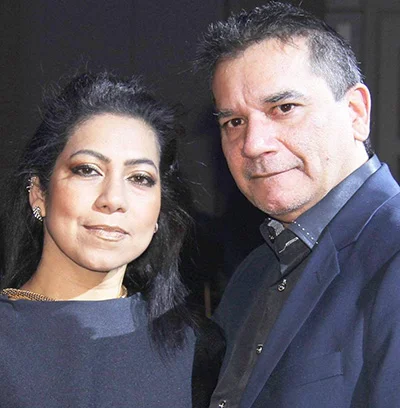
Dirk Tissera and wife Michelle: Supporting Sri Lanka-Canada community events, in Toronto, since launching The Anchorman
in 2002
They have performed and backed many legendary Sri Lanka singers.
According to Dirk, The Skylines can belt out a rhythm with gusto … be it Western, Sinhala or Tamil hits.
Also adding sparkle to the evening will be the legendary Fahmy Nazick, who, with his smooth and velvety vocals, will have the crowd on the floor.
Fahmy who was a household name, back in Sri Lanka, will be flying down from Virginia, USA.
He has captivated audiences in Sri Lanka, the Middle East and North America, and this will be his fourth visit to Toronto – back by popular demand,
Cherry DeLuna, who is described by Dirk as a powerhouse, also makes her appearance on stage and is all set to stir up the tempo with her cool and easy delivery.
“She’s got a great voice and vocal range that has captivated audiences out here”, says Dirk.
Chamil Welikala, said to be one of the hottest DJs in town, will be spinning his magic … in English, Sinhala, Tamil and Latin.

Both Jive and Baila competitions are on the cards among many other surprises on the night of 12 June.
This is The Anchorman’s fifth annual dance in a row – starting from 2022, 2023, 2024 and 2025 – and both Dirk and Michelle, and The Anchorman, have always produced elegant social events in Toronto.
“We intend to knock this one out of the park,” the duo says, adding that Western music and Sinhala and Tamil songs is something they’ve always delivered and the crowd loves it.
“We have always supported Sri Lanka-Canada community events, in Toronto, since launching The Anchorman, in 2002, and we intend to keep it that way.”
No doubt, there will be a large crowd of Sri Lankans, from all communities, turning up, on 12 June, to support Dirk, Michelle and The Anchorman.
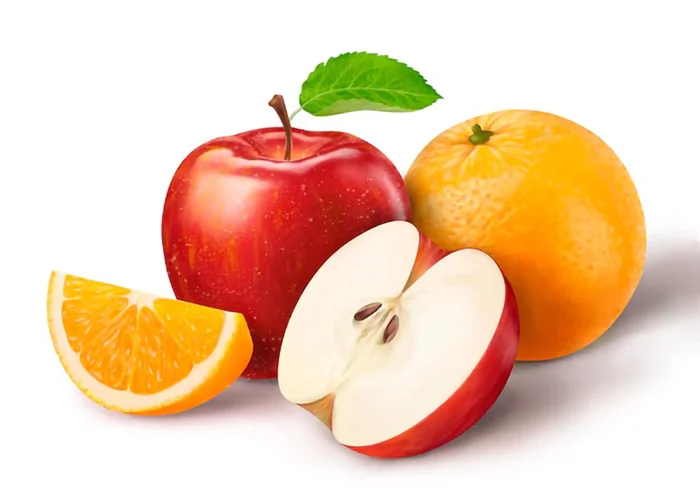
 * Apple and Orange:
Blend a few apple and orange pieces together. Add to it a pinch of turmeric and one tablespoon of honey. Apply it to the face and neck and rinse off after 30 minutes. This face pack is suitable for all skin types.
According to experts, apple is one of the best fruits for your skin health with Vitamin A, B complex and Vitamin C and minerals, while, with the orange peel, excessive oil secretion can be easily balanced.
* Mango and Curd:
Ripe mango pulp, mixed with curd, can be rubbed directly onto the skin to remove dirt and cleanse clogged pores. Rinse off after a few minutes.
Yes, of course, mango is a tasty and delicious fruit and this is the mango season in our part of the world, and it has extra-ordinary benefits to skin health. Vitamins C and E in mangoes protect the skin from the UV rays of the sun and promotes cell regeneration. It also promotes skin elasticity and fights skin dullness and acne, while curd, in combination, further adds to it.
* Grapes and Kiwi:
Take a handful of grapes and make a pulp of it. Simultaneously, take one kiwi fruit and mash it after peeling its skin. Now mix them and add some yoghurt to it. Apply it on your face for few minutes and wash it off.
Here again experts say that kiwi is the best nutrient-rich fruit with high vitamin C, minerals, Omega-3 fatty acids and vitamin E, while grapes contain flavonoids, which is an antioxidant that protects the skin from free radical damage. This homemade face pack acts as a natural cleanser and slows down the ageing process.

 The International Labour Organisation (ILO) now defines a living wage as the wage level necessary for workers and their families to afford a decent standard of living, given national circumstances, for normal hours of work. This standard of living is operationalised through the cost of essential goods and services, typically including food, housing, healthcare, education, transport, and a modest allowance for contingencies and social participation.
In contrast, “cost of living” in economics is a broader price index concept that tracks the overall prices of a representative consumption basket but is not inherently normative about what constitutes decency or dignity.
Living wage methodologies effectively translate a cost-of-living basket, specified for a given family size and living standard, into a monthly income requirement for workers, thereby linking real wages to human development objectives rather than only to market productivity.
Methodologies for computing a living wage
Most contemporary living wage estimates follow a structured “cost of a basic but decent life” approach built around three steps: defining a reference family, costing a normative consumption basket, and converting that cost into a wage per worker.
The Anker methodology, widely used in global supply chains and in Sri Lanka, is a leading example: it defines a model family (e.g., 2 adults and approximately 2–3 children), estimates the cost of a low-cost nutritious diet, adequate housing, and non-food essentials, and then allocates that cost over expected number of full-time workers per family.
Within the Anker framework, the food component is based on locally appropriate diets meeting caloric and nutritional norms, priced using local market surveys and adjusted for waste and home preparation.
Housing costs are derived from standards for minimally acceptable housing (e.g., durable materials, sufficient space, basic services), using rents or imputed rental values from empirical fieldwork. Other essential expenditures, health, education, transport, clothing, and a small margin for unexpected events, are typically estimated as a percentage mark-up over food and housing costs, derived from national household survey data.
Finally, the methodology sets a reference number of workers per family, divides total family living costs by this number to get a net living wage, and then adjusts to a gross living wage by adding payroll taxes and mandatory deductions. Periodic updates are made using consumer price indices (CPIs) to reflect inflation or deflation and, where necessary, new field surveys to capture structural shifts in prices and consumption patterns.
Sri Lanka’s living wage estimates and their link to cost of living (Anker Methodology)
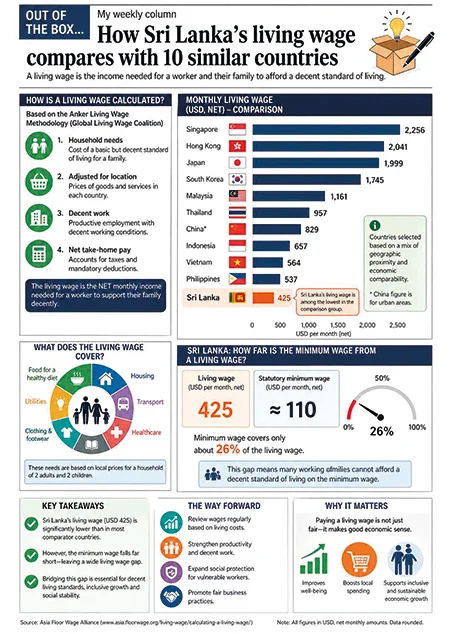 Sri Lanka has been the subject of several living wage studies, notably for the tea estate sector and for urban and rural areas, using the Anker methodology.
In the tea estate sector, an updated 2024 Anker report estimates the cost of a “basic but decent” standard of living for a typical family at about LKR 78,067 per month (approximately USD 260), implying a gross living wage of LKR 48,584 per month (USD 160) and a net, take-home living wage of LKR 44,357.
For urban Sri Lanka, the Anker Living Wage Reference Value was originally set at LKR 84,231 per month in April 2022, corresponding to a net living wage of LKR 77,492 plus social security contributions. After cumulative inflation of about 36.9 percent between April 2022 and June 2025, the updated gross urban living wage is estimated at approximately LKR 115,291 per month (around USD 385), consisting of a net living wage of LKR 106,068 and social security contributions of LKR 9,223
These Sri Lankan figures are explicitly derived from cost-of-living calculations: they incorporate the cost of food, housing, utilities, health, education, and other essentials at local prices and then convert these into wages per adult worker, assuming roughly 1.7–1.8 full-time earners per family. Because living wage estimates are indexed to actual price dynamics, periods of high inflation, as Sri Lanka experienced in 2022–2023, translate almost mechanically into sharp upward revisions in living wages, underlining the tight coupling between living wage levels and the evolving cost of living.
Comparative living wages: Sri Lanka and other countries
Cross-country comparisons require careful normalisation because living wages reflect local prices, family structures, and social norms, but several datasets provide a structured basis for comparison. [asia.floorwage](https://asia.floorwage.org/living-wage/calculating-a-living-wage/)
The Asia Floor Wage Alliance, for example, publishes a regional living wage benchmark expressed in purchasing power parity (PPP) terms, with a 2024 benchmark of 1,750.54 PPP dollars per month converted into local currencies using country-specific PPP exchange rates.
Using this PPP-based approach, the 2024 living wage equivalent for Sri Lanka is estimated at around LKR 158,353 per month, assuming a PPP exchange rate of about 90.5 Sri Lankan rupees per PPP dollar.
This PPP-normalised figure is substantially higher than the Anker 2024–2025 estate-sector and urban living wage estimates in nominal rupees, partly because the Asia Floor Wage benchmark is set to ensure a more harmonised standard across Asian garment-producing economies and uses a single PPP wage target.
These figures indicate that, within this PPP-based framework, Sri Lanka’s living wage in local currency is relatively high compared to countries such as India and Bangladesh, but the comparison reflects both different PPP exchange rates and domestic price structures.
From a cost-of-living perspective, this pattern is consistent with Sri Lanka being a lower-middle-income country with relatively higher prices for some essentials compared with low-income South Asian economies, especially after recent macroeconomic and inflationary shocks.
Global patterns and high-income economies
Global datasets covering more than 200 countries show that typical-family living wage levels, whether calculated in PPP or nominal terms, tend to correlate positively with national income levels, with North America, Western Europe, and Australia displaying the highest living wage values.
In this global distribution, living wages in middle- and low-income regions of Asia, Africa, and Latin America are lower in absolute terms, though the ratio of living wage to median wages or statutory minimum wages can be high, underscoring the gap between decent-work standards and prevailing labour market outcomes.
Interestingly, some studies note that rural living wage estimates can be relatively high in poorer countries because limited infrastructure and service availability raise the cost of accessing a given standard of living, such as safe water, transport, and education.
For Sri Lanka, rural Anker living wage benchmarks similarly reveal the importance of non-food costs, such as transportation to schools, health facilities, and workplaces, in shaping the total family budget, despite lower nominal rents in many rural areas.
Living wage, social policy, and Sri Lanka’s development trajectory
The emerging international consensus around a living wage is rooted in the human rights-based notion of a “decent life” rather than a subsistence minimum or an arbitrarily set statutory floor.
From a social science perspective, incorporating living wage benchmarks into wage-setting institutions, collective bargaining, and social dialogue reorients labour markets toward social reproduction, intergenerational mobility, and social cohesion, rather than merely cost competitiveness.
For Sri Lanka, where recent crises have eroded real wages and increased household vulnerability, living wage estimates such as the Anker urban and estate-sector benchmarks provide an analytically rigorous yardstick for evaluating whether current wage policies and social transfers are adequate relative to the actual cost of a basic but decent life.
Comparisons with regional PPP-based benchmarks like the Asia Floor Wage suggest that, while Sri Lanka’s living wage requirement in local currency is relatively high, the country also faces significant affordability challenges, especially for low-paid workers in export sectors and informal employment, whose earnings often fall short of these normative thresholds.
In policy terms, the living wage framework highlights the need for coordinated approaches that combine wage-setting reforms, inflation-sensitive social protection, and productivity-enhancing investments, so that rising living-cost-consistent wages do not simply translate into inflationary spirals or employment losses.
For empirical research in Sri Lanka, these benchmarks open avenues for micro-level analysis of wage gaps, household coping strategies, gendered labour outcomes, and the distributional effects of macroeconomic adjustment, all anchored to a transparent and internationally recognised living wage methodology.
(The writer, a senior Chartered Accountant and professional banker, is Professor at SLIIT, Malabe. The views and opinions expressed in this article are personal.)

Explanation sought from AKD on ‘Russian energy supplies’

US reiterates its commitment to enhancing relations with Northern Sri Lanka

Rooftop Solar at Crossroads as Sri Lanka Shifts to Distributed Energy Future

Indonesia-SL agreement on Visa Exemption for Diplomatic and Official passports soon

Six-year prison term for Rs 15,000 bribe

The pointer who showed the moon: Professor Y. Karunadasa (1934–2026)

‘Dates have the highest sugar content to fight Coronavirus’

Sunday Island 27 December – Headlines

#SundayIsland 17th December – Headlines

Sunday Island – 28th March

Sunday Island Headlines – 21 March

Sunday Island – 21st February – Headlines
-
 News6 days ago
Whistleblowers ask Treasury Chief to resign over theft of USD 2.5 mn
-

 News6 days ago
No cyber hack: Fintech expert exposes shocking legacy flaws that led to $2.5 million theft
-

 News3 days ago
BIA drug bust: 25 monks including three masterminds arrested
-

 Business4 days ago
Nestlé Lanka Announces Change in Leadership
-

 News3 days ago
Banks alert customers to phishing attacks
-
 News4 days ago
Hackers steal $3.2 Mn from Finance Ministry
-
 News1 day ago
Treasury chief’s citizenship details sought from Australia
-
 Business6 days ago
Dialog Enterprise partners Star Garments: Pioneering 5G innovation in Sri Lanka’s apparel industry