
Sports
Of Sports Schools and schools sports

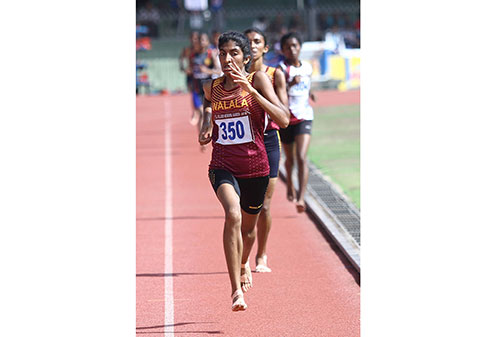
The absence of infrastructure at Ratnayake Central was compensated by well laid out individualized training plans for each sports scholarship holder. It was the key to Ratnayake Central dominating All Island Schools Games.
by Reemus Fernando
Introduced to the education structure with the objective of nurturing future sportsmen and women of Sri Lanka, the two dozen Sports Schools doting the island from north to south have lasted three decades without going through a proper scrutiny. Names of majority of Sports Schools are not even heard of when the All Island Schools Games are held annually. While semi government, private and international schools have gone on to dominate school sports, some half a dozen Sports Schools have survived the gross negligence of education authorities and storms of change that have swept through the schools set up during the last two decades to perform relatively well.
The success of these few schools were purely due to the dedication of a few qualified individuals who had gone out of their way to uplift standards. With the Education Ministry and the Sports Ministry preparing to upgrade the standard of Sports Schools around the country it should be noted that while addressing the infrastructure needs, emphasis should also be given to appoint qualified and dedicated officials to take responsibilities of these institutions.
When the Sports Schools were started in 1989 with the Ibbagamuwa Central as the first such school the project was overseen by an Education Ministry official who had obtained his sports education qualifications from a reputed institution in Germany. The decisions relating to physical education and sports in the Ministry of Education had his influence. Results were available to see in the form of success in athletics at Asian level during the late 90s and early 2000s with athletes who came through that system later graduating with the help of top level coaches. Ministry of Education has a handful of qualified individuals who are operating as instructors or coaches but at decision making level they do not have a say.
Infrastructure verses qualified officials
Ratnayake Central Walala, the only Sports School to have maintained the supremacy in track and field sports right throughout does not have a proper ground to date, not even a proper 200 metres track. The absence of infrastructure was compensated by well laid out individualized training plan for each sports scholarship holder. Susantha Fernando who was instrumental in guiding the destiny of many top level athletes also had an eye for talent identification and made sure the school had a continuous supply of raw talent every year. The school boasts of Asian Junior Athletics Championships medallists to Olympic participants to South Asian Games medallists. Fernando’s training was responsible for the majority of medals won at the last South Asian Games as well.
Sumana Balika, Ratnapura was probably the next best Sports School in the girls category taking in to consideration the number of times the school became runners-up to Ratnayake Central. Once again it was the coaching qualifications of an individual that mattered. Sumana Balika excelled as long as R.B. Palitha was their instructor. Seevali Central the other Sports School of Ratnapura had a similar experience. They could dominate as long as Palitha was their mentor.
Henegama Central did well during Prabath Fernando’s stint and Rajasinghe Central is the only Sports School in the Western Province to maintain its stature as a Sports School with Jayalal Ratnasuriya, a qualified World Athletics coach overseeing the progress of its athletes. Vijitha Central, Dickwella and Kuliyapitiya Central are among few other Sports Schools to have made their presence felt during the last several years.
No amount of infrastructure development can make a Sports School competitive. Once a stronghold of Sri Lanka’s national sport, volleyball, the name of Sports School Senanayake MV, Madampe is hardly heard these days. Ibbagamuwa Central, the first Sports School is not functioning though the school’s instructor trains a few high jumpers. Some of the 23 Sports Schools are either not operating at all or are performing below par. Had there been qualified individuals in the Ministry of Education to scrutinies these institutions.
Talent identification failures and emergence of private schools
One of the brightest prospects to emerge from the schools system during the last few years is Asian Junior Athletics Championship gold medallist Aruna Dharshana. Hailing from Seruwila, Trincomalee, Dharshana bypassed several Sports Schools in two other districts to find refuge at Weera Keppetipola MV, Akuramboda. He was lucky to have the guidance of Asanka Rajakaruna at that Sports School. Wasn’t there a system to identify his talent at his home place? Trincomalee is home to two Sports Schools.
While the standards of Sports Schools were crumbling, a good number of private and government schools had given priority to sports and athletics in particular. A number of schools in Colombo and Kandy and International Schools elsewhere started investing heavily on sports during the last one and half decades. Sports training at these schools are no longer overseen by officials attached to Ministry of Education. For example, the track and field coach of a leading government school in Colombo is a sports officer of the Ministry of Sports and a qualified World Athletics coach and instructor. These schools have been responsible in producing many athletes to represent Sri Lanka at junior Asian and junior World level. The emergence of these schools has also given rise to an unprecedented talent exodus from outstations.
A particular school in Colombo launched a recruitment drive during the last three years to an extent that that school now has the luxury of winning the All Island Schools track and field title with their second string. Some of these schools hellbent on winning have gone on to the extent of jeopardizing the education of these recruits from outstations. Many junior athletes recruited from outstations find themselves out of place in the midst of their English-speaking classmates and hardly attend classes. They are guaranteed jobs when they are recruited and find education non essential. To be continued……………..

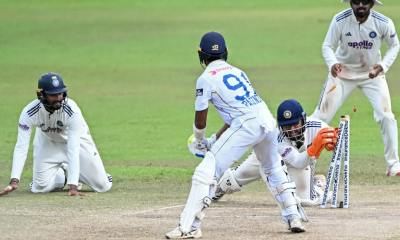


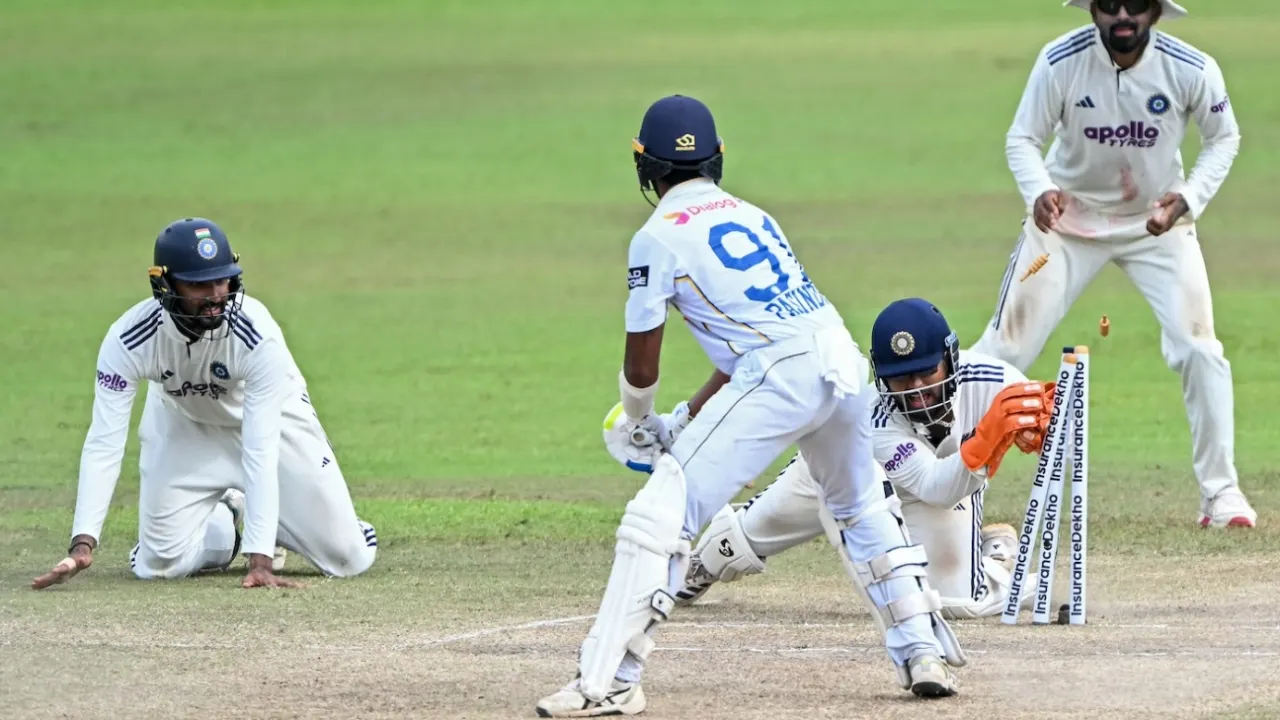
Playing just his second Test and the first in his team’s starting XI, Pasindu Sooriyabandara made Sri Lanka dream of the rarest of possibilities, but reality imposed itself on the SSC late on day four as India regained their grip on a Test match that had seemed to spiral out of control after the threat of bad weather led them to enforce the follow-on.
After Sooriyabandara put on 58 with Kamil Mishara for the second wicket and 115 with Kamindu Mendis for the third, Sri Lanka were at one stage 209 for 3, or just four runs behind with seven second-innings wickets in hand, on a day-four pitch that was still looking excellent for batting. India’s bowlers were into their 149th over across two consecutive innings, and looking short of both penetration and inspiration against a top order that had never allowed them to settle into their lengths.
Just then, however, Manav Suthar, who had borne the brunt of Sri Lanka’s positive intent, dismissed Dhananjaya de Silva and then Sooriyabandara in the space of two overs, the latter out eight short of a maiden Test hundred. Soon after, Saransh Jain trapped Niroshan Dickwella lbw, and Sri Lanka were effectively 5 for 6. By the time rain arrived to bring an early end to the day, Sri Lanka’s seventh-wicket pair had only added a further 11 runs to their tally.
If Sri Lanka still retain any hope going into the final day of this series, it will rest on the shoulders of Sonal Dinusha, batting on 7 in his final innings of a remarkable series. Earlier in the day, he had converted his overnight 85 into his second century of the series, with his only other completed innings bringing him 84.
Scores:
Sri Lanka 290 in 89.4 overs (Pasindu Sooriyabandara 80, Sonal Dinusha 103; Prasidh Krishna 3-52, Manav Suthar 3-85) and 229 for 6 in 72.4 overs (f/o) (Pasindu Sooriyabandara 92, Kamindu Mendis 55, Sonal Dinusha 7*; Manav Suthar 2-81) lead India 503 for 9 dec by 16 runs
[Cricinfo]

- Confirmation of the minutes of the 94th Annual General Meeting of BCCI held on September 28, 2025, at BCCI Headquarters, Mumbai, Maharashtra.
- Election and induction of 2 (two) representatives of the General Body in the Governing Council of the IPL.
- Induction of 1 (one) representative of the Indian Cricketer’s Association in the Governing Council of the IPL.
- Adoption of the Report of the Secretary for the year 2025-26 under review.
- Copies of the audited Statement of Accounts of BCCI for the year FY 2025-2026 including schedule for any tour or tours.
- Adoption of the Treasurer’s Report and the audited accounts for the year FY 2025-2026.
- Adoption of the Annual Budget for FY 2026-27.
- Appointment of the Auditor or Auditors for FY 2026-27 and fix their remuneration.
- Appointment of the Ombudsman and Ethics Officer.
- Appointment of the Standing Committees, Cricket Committees and Umpire Committee as mentioned in Rules 25, 26 and 27 respectively.
- Consideration of:(a) The Report and recommendations of the Apex Council, the CEO and the Committees and to propose policy directions to the Apex Council.(b) The Report and recommendations of the Governing Council and to propose policy directions to the Governing Council.(c) The reports of the Ombudsman and Ethics Officer and any recommendations made therein.
- Report of the Internal Committee of BCCI formed under the Prevention of Sexual Harassment Policy.
- Grant of Associate Membership to Cricket Association Andaman & Nicobar Island for the Union Territory of Andaman & Nicobar Islands.
- Consideration of any motion, notice whereof is given by a Full Member to the Secretary, 21 (twenty-one) days before the meeting.
- To appoint the BCCI’s Representative or Representatives on the International Cricket Council and/or any similar organization.
- Ratification of rules framed by the Apex Council, in terms of Rule 15 of BCCI’s Rules and Regulations.
- Consideration of any business, which the President may consider necessary to be included in the agenda.
- Transaction of any other business of an informal character as may be permitted by the Chairperson.


UPDATE: Flash flood on Nepal-Tibet border kills more than 100, with hundreds of tourists missing

At least eight killed, hundreds missing after Nepal flash flood

India close in despite Sooriyabandara, Kamindu fifties

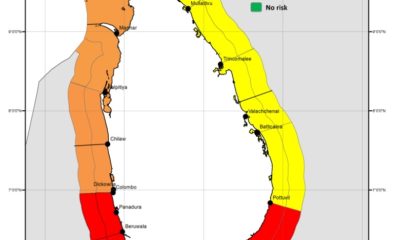
Advisory for High Waves for the sea areas extending from Colombo to Pottuvil via Galle, Matara and Hambantota

We must create social awareness to ensure the physical and mental well-being of children with disabilities – PM

BCCI AGM set for September 18 in Mumbai

‘Dates have the highest sugar content to fight Coronavirus’

Sunday Island 27 December – Headlines

#SundayIsland 17th December – Headlines

Sunday Island – 28th March

Sunday Island Headlines – 21 March

Sunday Island – 21st February – Headlines
-
 News6 days ago
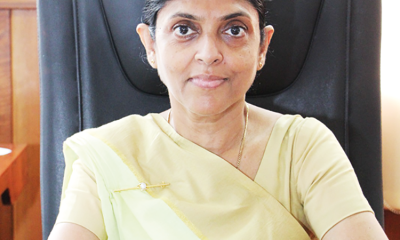
Country’s first woman Surveyor General appointed
-
 Business5 days ago
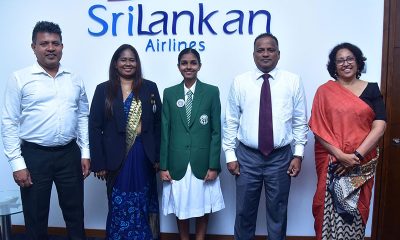
SriLankan Airlines makes ShakthiSAT Mission possible for talented Sri Lankan student
-
 Sports7 days ago
Tharanga, Weber headline stellar Lausanne javelin field
-

 Features6 days ago
Medical education in Sri Lanka: Then and now
-
 Business7 days ago
Mannar’s offshore opportunity: the dollar question behind Sri Lanka’s oil and gas search
-
 Latest News5 days ago
Imran Khan moved to private hospital amid deteriorating health
-
 Latest News6 days ago
Government has declared 21, 22 and 23 August 2026 as national days of mourning
-
 Features4 days ago
My secondary schooling after Royal Primary