
Features
Of Four Speakers at the 2025 G L F

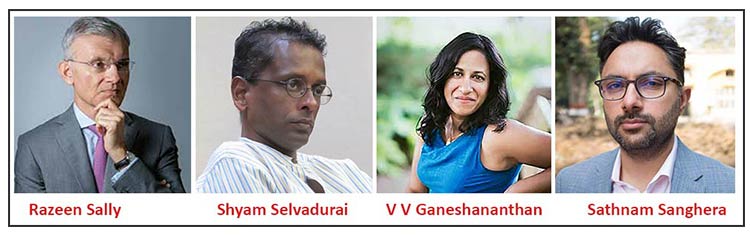
 The twelfth edition of the internationally well-known Galle Literary Festival will be from February 6 to 9. Started by hotelier Geoffrey Dobbs in 2007, the GLF progressed with ever increasing popularity, attendance, number of speakers and their fame. It suffered a hiatus from 2013 to 2017 due to Dobbs going to Australia and his re-entry to Sri Lanka was delayed. He returned and the GLF restarted in 2018 with an F prefixed to its initials since Fairway Holdings became principal sponsor of the annual event. A new feature was introduced: a prize awarded to the best novel of the previous year carrying a fabulous monetary prize and three short listed receiving one lakh of rupees each, from Fairway Holdings. Again an interruption from 2020 to 2023 due to Covid and monetary constrains. It must be said here that Shyam Sevadurai, who was curator of the event for a couple of years, was THE best.
I attended all festivals from its start to 2019. And I wrote about each of the festivals in this column. The choice of which event to attend got more difficult as the years passed with so many famous speakers being billed. Apart from the sessions, the camaraderie on the grounds of the Halle de Galle – main venue – was palpable. The GLFs were always memorable, and delightfully so.
This year too the list of speakers is illustrious. I have selected four to write about because I have met one several times and interviewed him; another I have known and written about. The woman writer I include because I found her book extremely interesting and commented on it in this column. I have listened to videos of interviews of the fourth and found this writer most interesting. Thus my selection is of two Sri Lankans, citizens overseas, and two Indians, also living in the West.
Razeen Sally
I was introduced to Razeen by Elmo Jayawardena and then knowing I had happy memories of Wales which is his mother’s country where she lives now, he visited me several times. I truly marveled at his book – Return to Sri Lanka: Travels in a Paradoxical Island (2019) since some facts in it were not known by me. It is very well written. He is interested in Buddhism and is vegetarian but his outstanding features are simplicity and humaneness.
His father Farouk Sally, met his mother Pat Kneen, when they were sailing eastwards from London. Farouk left the ship in Colombo and she proceeded for a nursing job in Australia, but by then they were in love. She was soon in Sri Lanka and they married and had three children; Razeen the eldest born in 1965. When he was 12, his mother decided to return to London and later to Wales with the three sons.
Prof Razeen Sally is billed as of Sri Lanka/Britain. He received his PhD from the London School of Economics and taught there too. Moving to Singapore he was a lecturer in the
National University of Singapore. He was Chairman of Sri Lanka’s Institute of Policy Studies and co-found Advocata Institute. He was also economic advisor to our government during the years 2015-2019. He is currently writing a travel book on Buddhist countries, to be published by Simon and Schuster. He has authored several books on economics, but his writing forté seems to be travel.
I quote a critique that was given both by Amazon.com and Goodreads: “Sri Lanka seemed like a version of paradise to Razeen Sally as a child, but conflict was soon to follow, tearing the family apart and severing their bond with Sri Lanka. Return to Sri Lanka is the story of a twenty-first-century reconciliation between Sally, now an academic and political advisor, and the land of his birth. A travel memoir with deep political concerns; full of spellbinding beauty and moving insight, from a writer who is a native, a tourist, both and neither.”
What I remember most of the book is the full page tribute to his mother whom he is devoted to.
Shyam Selvadurai.
Born in Colombo on February 12, 1965, to a Tamil father and Sinhalese mother, Shyam had his education at St Thomas’ College Mt Lavinia. The 1983 attack on Tamils by Sinhala extremists had the family migrating to Canada. Thus he is billed as a Sri Lankan Canadian novelist.
He got a first degree from York University in 1989 and a MFA in Creative Writing from the University of British Columbia in 2010. He is a frequent visitor to Sri Lanka and he would smile and say hello when I met him at weekly meditation session with Olanda Ananda Thera. He too is simple, sincere and never distances himself as a famous writer.
He published Funny Boy, a coming out and outing novel in 1994 which was a worldwide top seller. In 2020, Deepa Mehta directed the film of the book closely following it with the main character as a boy always joining the girls in dressing up games. Also featured were harrowing
scenes of the ’83 riots. The love blossoming between two boys was beautifully presented with sensitivity and finesse. Mehta and Shyam won the award for Best Adapted Screenplay at the 9th Canadian Screen Awards in 2021.
His other books are Swimming in the Monsoon Sea which won the award in the Children’s and Youth Literature category in 2006. In 2013 he released his novel The Hungry Ghosts and in 2022 Mansions on the Moon, a historical novel about Yashodara, Prince Siddhartha’s wife.
V V Ganeshananthan
Soon after her novel Brotherless Night was available over here, I wrote a comment on it in this column. I retrieved my article but I will extract from it the most salient bits since brevity is necessary in this article. I could not find what the double V stands for. In the GLF programme, her name is given with the initials, so VV it shall be.
VV was born in Connecticut, USA, in 1980. Her entire education was in America, her first degree earned in Harvard in 2002 and then Masters from Columbia Graduate School of Journalism. She is a journalist, essayist and of course novelist, her first book being Love Marriage which was published in April 2008 by Random House and named one of Washington Post’s World’s Best Books of the Year. It was also long listed for the Orange Prize.
She took 20 years to write Brotherless Night which necessitated much research and interviews, I suppose, with people who were in Sri Lanka during the infamous black day of July 23, 1983, and thereafter during the civil war. Her book is a first person, accurate record through Sashikala Kulendran of all those searing times and the LTTE. Nowhere in her biographies is it said she herself was in Sri Lanka. Bios of her are short and nothing much is revealed of her personal life except professional – teaching creative writing in prestigious universities.
She won the British award – 2024 Women’s Prize for Fiction. The Chair of Judges, Monica Ali said: “Brotherless Night is a brilliant, compelling and deeply moving novel that bears witness to the intimate and epic-scale tragedies of the Sri Lankan civil war. In rich, evocative prose, Ganeshananthan creates a vivid sense of time and place and an indelible cast of characters. Her commitment to complexity and clear-eyed moral scrutiny combined with spell binding story telling renders Brotherless Night a masterpiece of historical fiction.” I totally agree with this multi-faceted justified praise. The narrative includes the riots in Colombo, refugees shipped to Jaffna and LTTE conscription of youth in Jaffna. The LTTE and the SL Army killed three of Sashikala’s four brothers. The most commendable is that the narration is not biased but balanced in its unexpressed-in-words condemnation of both the LTTE and SL government.
Sathnam Sanghera
I first heard this name when it was mentioned at lunch on Sunday January 26 by a widely read male friend. Among a couple of close knit friends, an oft debated topic is: did the British colonizers do more good than harm to Ceylon and its people. I believe the giving of English and opening schools; Parliamentary government; civil service worth emulating; tea and the railway, were greater than the demerits of being governed by the British. Others strongly contest the fact. Hence this friend mentioned Sanghera as a historian with widely expressed views of British imperialism worldwide – India, Nigeria, West Indies, Australia – and sent me a link to an interview of Sanghera’s. I went to other YouTube videos and found him a less strident critic of the British Raj than Sashi Tharoor, but forceful. I appreciated more his relation of the personal, with no covering of warts and his feeling homesick whenever he was away from the parental home.
Sathnam’s parents were Punjabi Sikhs who migrated to Britain in 1968; they and their parents having suffered during the Partition. He was born in Wolverhampton in 1976. His early education was at Wolverhampton Grammar School and was government funded. He graduated in 1998 with first class honours in English Language and Literature from Christ’s College, Cambridge.
From the interviews I listened to, he had no easy life. His father was schizophrenic and so was a sister. However his mother who knew no English, weathered all storms, settled down to life in England and, as he said, loved her children dearly and guided them.
He worked in all sorts of places – a restaurant, a hospital, a sewing factory and then went to New York to be part of a literacy project. Between 1998 and 2006 he was a columnist and feature writer for the Financial Times. He moved to The Times in 2007.
His memoir The Boy with the Topknot: a memoir of love, secrets and lies in Wolverhampton was out in 2009, followed by Marriage Material in 2013. His first book earned him many awards including a PEN Prize. His journalism won him British Press Awards, Young Journalist of the Year 2002, Journalist of the Year 2006 and 2009 and several others. He was conferred an honorary doctorate by the University of Wolverhampton in 2009.
In his interviews he shows humaneness in the expressed love he has for his mother, siblings and extended family.

Article 2(4) of the United Nations Charter prohibits member states from using threats or force against the territorial integrity or political independence of any state. Violating international law, the United States and Israel attacked Iran on February 28, 2026. The ostensible reason for this unprovoked aggression was to prevent Iran from developing a nuclear weapon.
The United States is the first and only country to have used nuclear weapons in war, against Japan in August 1945. Some officials in Israel have threatened to use a “doomsday weapon” against Gaza. On March 14, David Sacks, billionaire venture capitalist and AI and crypto czar in the Trump administration, warned that Israel may resort to nuclear weapons as its war with Iran spirals out of control and the country faces “destruction.”
Although for decades Iran’s Supreme Leader, Ali Khamenei, opposed nuclear weapons on religious grounds, in the face of current existential threats it is likely that Iran will pursue their development. On March 22, the head of the WHO warned of possible nuclear risks after nuclear facilities in both Iran and Israel were attacked. Indeed, will the current war in the Middle East continue for months or years, or end sooner with the possible use of a nuclear weapon by Israel or the United States?
Widening Destruction
Apart from the threat of nuclear conflagration—and what many analysts consider an impending ground invasion by American troops—extensive attacks using bombs, missiles, and drones are continuing apace, causing massive loss of life and destruction of resources and infrastructure. US–Israel airstrikes have killed Ayatollah Ali Khamenei and top Iranian officials. Countless civilians have died, including some 150 girls in a primary school in Minab, in what UNESCO has called a “grave violation of humanitarian law.” Moreover, the targeting of desalination plants by both sides could severely disrupt water supplies across desert regions.
Iran’s retaliatory attacks on United States military bases in Persian Gulf countries have disrupted global air travel. Even more significantly, Iran’s closure of the Strait of Hormuz—the critical maritime energy chokepoint through which 20% of global oil and liquefied natural gas pass daily—has blocked the flow of energy supplies and goods, posing a severe threat to the fossil fuel–driven global economy. A global economic crisis is emerging, with soaring oil prices, power shortages, inflation, loss of livelihoods, and deep uncertainty over food security and survival.
The inconsistent application of international law, along with structural limitations of the United Nations, erodes trust in global governance and the moral authority of Western powers and multilateral institutions. Resolution 2817 (2026), adopted by the UN Security Council on March 12, condemns Iran’s “egregious attacks” against its neighbours without any condemnation of US–Israeli actions—an imbalance that underscores this concern.
The current crisis is exposing fault lines in the neo-colonial political, economic, and moral order that has been in place since the Second World War. Iran’s defiance poses a significant challenge to longstanding patterns of intervention and regime-change agendas pursued by the United States and its allies in the Global South. The difficulty the United States faces in rallying NATO and other allies also reflects a notable geopolitical shift. Meanwhile, the expansion of yuan-based oil trade and alternative financial settlement mechanisms is weakening the petrodollar system and dollar dominance. Opposition within the United States—including from segments of conservatives and Republicans—signals growing skepticism about the ideological and moral basis of a US war against Iran seemingly driven by Israel.
A New World Order?
The unipolar world dominated by the United States—rooted in inequality, coercion, and militarism—is destabilising, fragmenting, and generating widespread chaos and suffering. Challenges to this order, including from Iran, point toward a fragmented multipolar world in which multiple actors possess agency and leverage.
The BRICS bloc—Brazil, Russia, India, China, South Africa, along with Iran, the UAE, and other members—represents efforts to create alternative economic and financial systems, including development banks and reserve currencies that challenge Western financial dominance.
However, is BRICS leading the world toward a much-needed order, based on equity, partnership, and peace? The behaviour of BRICS countries during the current crisis does not indicate strong collective leadership or commitment to such principles. Instead, many appear to be leveraging the situation for national advantage, particularly regarding access to energy supplies.
A clear example of this opportunism is India, the current head of the BRICS bloc. Historically a leader of non-alignment and a supporter of the Palestinian cause, India now presents itself as a neutral party upholding international law and state sovereignty. However, it co-sponsored and supported UN Security Council Resolution 2817 (2026), which condemns only Iran.
India is also part of the USA–Israel–India–UAE strategic nexus involving defence cooperation, technology sharing, and counterterrorism. Additionally, it participates in the Quadrilateral Security Dialogue (QUAD) with the United States, Japan, and Australia, aimed at countering China’s growing influence. In effect, despite its leadership role in BRICS, India is closely aligned with the United States, raising questions about its ability to offer independent leadership in shaping a new world order.
As a group, BRICS does not fundamentally challenge corporate hegemony, the concentration of wealth among a global elite, or entrenched technological and military dominance. While it rejects aspects of Western geopolitical hierarchy, it largely upholds neoliberal economic principles: competition, free trade, privatisation, open markets, export-led growth, globalisation, and rapid technological expansion.
The current Middle East crisis underscores the need to question the assumption that globalisation, market expansion, and technological growth are the foundations of human well-being. The oil and food crises, declining remittances from Asian workers in the Middle East, and reduced tourism due to disruptions in the Strait of Hormuz and regional airspace all highlight the fragility of global interdependence.
These conditions call for consideration of alternative frameworks—bioregionalism, import substitution, local control of resources, food and energy self-sufficiency, and renewable energy—in place of dependence on imported fossil fuels and global supply chains.
Both the Western economic model and its BRICS variant continue to prioritise techno-capitalist expansion and militarism, despite overwhelming evidence linking these systems to environmental destruction and social inequality. While it is difficult for individual countries to challenge this dominant model, history offers lessons in collective resistance.
Collective Resistance
One of the earliest examples of nationalist economic resistance in the post-World War II period was the nationalisation of the Anglo-Iranian Oil Company and the creation of the National Iranian Oil Company in 1951 under Prime Minister Mohammad Mosaddegh. He was overthrown on August 19, 1953, in a coup orchestrated by the US CIA and British intelligence (MI6), and Shah Mohammad Reza Pahlavi was installed to protect Western oil interests.
A milestone for decolonisation occurred in Egypt in 1956, when President Gamal Abdel Nasser nationalised the Suez Canal Company. Despite military intervention by Israel, the United Kingdom, and France, Nasser retained control, emerging as a symbol of Arab and Third World nationalism.
Following political independence, many former colonies sought to avoid entanglement in the Cold War through the Non-Aligned Movement (NAM), officially founded in Belgrade in 1961. Leaders including Josip Broz Tito, Jawaharlal Nehru, Gamal Abdel Nasser, Kwame Nkrumah, Sukarno, and Sirimavo Bandaranaike promoted autonomous development paths aligned with national priorities and cultural traditions.
However, maintaining economic sovereignty proved far more difficult. Patrice Lumumba, the first democratically elected Prime Minister of the Democratic Republic of the Congo, was assassinated in 1961 with the involvement of US and Belgian interests after attempting to assert control over national resources. Kwame Nkrumah was similarly overthrown in a US-backed coup in 1966.
In Tanzania, Julius Nyerere’s Ujamaa (“African socialism”) sought to build community-based development and food security, but faced both internal challenges and external opposition, ultimately limiting its success and discouraging similar efforts elsewhere.
UN declarations from the 1970s reflect Global South resistance to the Bretton Woods system. Notably, the 1974 Declaration on the Establishment of a New International Economic Order (Resolution 3201) called for equitable cooperation between developed and developing countries based on dignity and sovereign equality.
Today, these declarations are more relevant than ever, as Iran and other Global South nations confront overlapping crises of economic instability, neocolonial pressures, and intensifying geopolitical rivalry. Courtesy: Inter Press Service
by Dr. Asoka Bandarage
The long standing foreign policy of Sri Lanka was Non-Alignment. However, in the context of emerging geopolitical rivalries, there was a need to question the adequacy of Non-Alignment as a policy to meet developing challenges. Neutrality as being a more effective Policy was first presented in an article titled “Independence: its meaning and a direction for the future” (The Island, February 14, 2019). The switch over from Non-Alignment to Neutrality was first adopted by former President Gotabaya Rajapaksa and followed through by successive Governments. However, it was the current Government that did not miss an opportunity to announce that its Foreign Policy was Neutral.
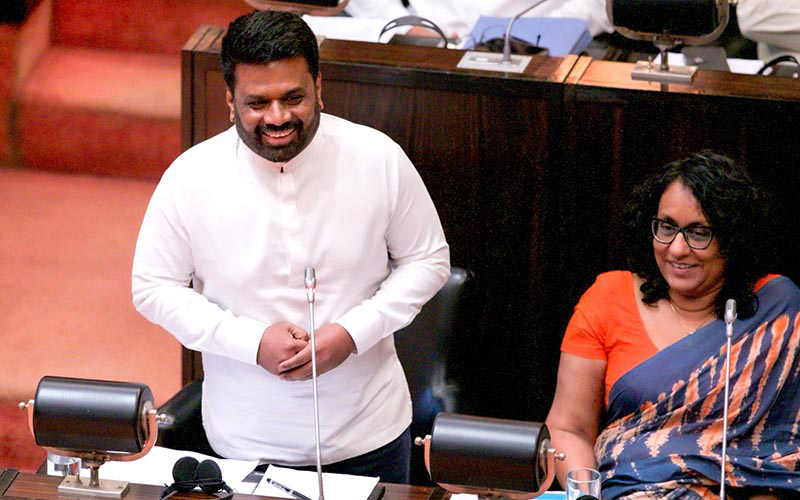
The policy of Neutrality has served the interests of Sri Lanka by the principled stand taken in respect of the requests made by two belligerents associated with the Middle East War. The justification for the position adopted was conveyed by President Anura Kumara Dissanayake to Parliament that Iran had made a formal request on February 26 for three Iranian naval ships to visit Sri Lanka, and on the same evening, the United States also requested permission for two war planes to land at Mattala International Airport. Both requests were denied on grounds of maintaining “our policy of neutrality”.
WHY NEUTRALITY
Excerpts from the article cited above that recommended Neutrality as the best option for Sri Lanka considering the vulnerability to its security presented by its geographic location in the context of emerging rivalries arising from “Pivot to Asia” are presented below:
“Traditional thinking as to how small States could cope with external pressures are supposed to be: (1) Non-alignment with any of the major centers of power; (2) Alignment with one of the major powers thus making a choice and facing the consequences of which power block prevails; (3) Bandwagoning which involves unequal exchange where the small State makes asymmetric concessions to the dominant power and accepts a subordinate role of a vassal State; (4) Hedging, which attempts to secure economic and security benefits of engagement with each power center: (5) Balancing pressures individually, or by forming alliances with other small States; (6) Neutrality”.
Of the six strategies cited above, the only strategy that permits a sovereign independent nation to charter its own destiny is neutrality, as it is with Switzerland and some Nordic countries. The independence to self-determine the destiny of a nation requires security in respect of Inviolability of Territory, Food Security, Energy Security etc. Of these, the most critical of securities is the Inviolability of Territory. Consequently, Neutrality has more relevance to protect Territorial Security because it is based on International Law, as opposed to Non-Alignment which is based on principles applicable to specific countries that pledged to abide by them
“The sources of the international law of neutrality are customary international law and, for certain questions, international treaties, in particular the Paris Declaration of 1856, the 1907 Hague Convention No. V respecting the Rights and Duties of Neutral Powers and Persons in Case of War on Land, the 1907 Hague Convention No. XIII concerning the Rights and Duties of Neutral Powers in Naval War, the four 1949 Geneva Conventions and Additional Protocol I of 1977” (ICRC Publication on Neutrality, 2022).
As part of its Duties a Neutral State “must ensure respect for its neutrality, if necessary, using force to repel any violation of its territory. Violations include failure to respect the prohibitions placed on belligerent parties with regard to certain activities in neutral territory, described above. The fact that a neutral State uses force to repel attempts to violate its neutrality cannot be regarded as a hostile act. If the neutral State defends its neutrality, it must however respect the limits which international law imposes on the use of force. The neutral State must treat the opposing belligerent States impartially. However, impartiality does not mean that a State is bound to treat the belligerents in exactly the same way. It entails a prohibition on discrimination” (Ibid).
“It forbids only differential treatment of the belligerents which in view of the specific problem of armed conflict is not justified. Therefore, a neutral State is not obliged to eliminate differences in commercial relations between itself and each of the parties to the conflict at the time of the outbreak of the armed conflict. It is entitled to continue existing commercial relations. A change in these commercial relationships could, however, constitute taking sides inconsistent with the status of neutrality” (Ibid).
THE POTENTIAL of NEUTRALITY
It is apparent from the foregoing that Neutrality as a Policy is not “Passive” as some misguided claim Neutrality to be. On the other hand, it could be dynamic to the extent a country chooses to be as demonstrated by the actions taken recently to address the challenges presented during the ongoing Middle East War. Furthermore, Neutrality does not prevent Sri Lanka from engaging in Commercial activities with other States to ensuring Food and Energy security.
If such arrangements are undertaken on the basis of unsolicited offers as it was, for instance, with Japan’s Light Rail Project or Sinopec’s 200,000 Barrels a Day Refinery, principles of Neutrality would be violated because it violates the cardinal principle of Neutrality, namely, impartiality. The proposal to set up an Energy Complex in Trincomalee with India and UAE would be no different because it restricts the opportunity to one defined Party, thus defying impartiality. On the other hand, if Sri Lanka defines the scope of the Project and calls for Expressions of Interest and impartially chooses the most favourable with transparency, principles of Neutrality would be intact. More importantly, such conduct would attract the confidence of Investors to engage in ventures impartial in a principled manner. Such an approach would amount to continue the momentum of the professional approach adopted to meet the challenges of the Middle East War.
CONCLUSION
The manner in which Sri Lanka acted, first to deny access to the territory of Sri Lanka followed up by the humanitarian measures adopted to save the survivors of the torpedoed ship, earned honour and respect for the principled approach adopted to protect territorial inviolability based on International provisions of Neutrality.
If Sri Lanka continues with the momentum gained and adopts impartial and principled measures recommended above to develop the country and the wellbeing of its Peoples, based on self-reliance, this Government would be giving Sri Lanka a new direction and a fresh meaning to Neutrality that is not passive but dynamic.
by Neville Ladduwahetty

The interference into affairs of other nations by the USA’s Central Intelligence Agency (CIA) started in 1953, six years after it was established. The Anglo-Iranian Oil Company supplied Britain with most of its oil during World War I. In fact, Winston Churchill once declared: “Fortune brought us a prize from fairyland beyond our wildest dreams.”
When in 1951 Dr. Mohammad Mosaddegh was reluctantly appointed as Prime Minister by the Shah of Iran, whose role was mostly ceremonial, he convinced Parliament that the oil company should be nationalised.
Mohammed Mosaddegh
Mosaddegh said: “Our long years of negotiations with foreign companies have yielded no result thus far. With the oil revenues we could meet our entire budget and combat poverty, disease and backwardness of our people.”
It was then that British Intelligence requested help from the CIA to bring down the Iranian regime by infiltrating their communist mobs and the army, thus creating disorder. An Iranian oil embargo by the western countries was imposed, making Iranians poorer by the day. Meanwhile, the CIA’s strings were being pulled by Kermit Roosevelt (a grandson of former President Theodore Roosevelt), according to declassified intelligence information.
Although a first coup failed, the second attempt was successful. General Fazlollah Zahedi, an Army officer, took over as Prime Minister. Mosaddegh was tried and imprisoned for three years and kept under house arrest until his death. Playing an important role in the 1953 coup was a Shia cleric named Ayatollah Abol-Ghasem Mostafavi-Kashani. He was previously loyal to Mosaddegh, but later supported the coup. One of his successors was Ayatollah Ruhollah Mostafavi Musavi Khomeini, who engineered the Islamic Revolution in 1979. Meanwhile, in 1954 the Anglo-Iranian Oil Company had been rebranded as British Petroleum (BP).
Map of the Middle East
When the Iran-Iraq war broke out (September 1980 to August 1988), the Persian/Arabian Gulf became a hive of activity for American warships, which were there to ensure security of the Gulf and supertankers passing through it.

CIA-instigated coup in Iran in 1953 Dr. Mohammad Mosaddegh
The Strait of Hormuz, the only way in and out of the Gulf, is administered by Oman and Iran. While there may have been British and French warships in the region, radio ‘chatter’ heard by aircraft pilots overhead was always from the US ships. In those days, flying in and out of the Gulf was a nerve-wracking experience for airline pilots, as one may suddenly hear a radio call on the common frequency: “Aircraft approaching US warship [name], identify yourself.” One thing in the pilots’ favour was that they didn’t know what ships they were flying over, so they obeyed only the designated air traffic controller. Sometimes though, with unnecessarily distracting American chatter, there was complete chaos, resulting in mistaken identities.
Air Lanka Tri Star
Once, Air Lanka pilots monitored an aircraft approaching Bahrain being given a heading to turn on to by a ship’s radio operator. Promptly the air traffic controller, who was on the same frequency, butted in and said: “Disregard! Ship USS Navy [name], do you realise what you have just done? You have turned him on to another aircraft!” It was obvious that there was a struggle to maintain air traffic control in the Gulf, with operators having to contend with American arrogance.
On the night of May 17, 1987, USS Stark was cruising in Gulf waters when it was attacked by a Dassault Mirage F1 jet fighter/attack aircraft of the Iraqi Air Force. Without identifying itself, the aircraft fired two Exocet missiles, one of which exploded, killing 37 sailors on board the American frigate. Iraq apologised, saying it was a mistake. The USA graciously accepted the apology.
Then on July 3, 1988 the high-tech, billion-dollar guided missile cruiser USS Vincennes, equipped with advanced Aegis weapons systems and commanded by Capt. Will Rogers III, was chasing two small Iranian gun boats back to their own waters when an aircraft was observed on radar approaching the US warship. It was misidentified as a Mirage F1 fighter, so the Americans, in Iranian territorial waters, fired two surface-to-air Missiles (SAMs) at the target, which was summarily destroyed.
The Vincennes had issued numerous warnings to the approaching aircraft on the military distress frequency. But the aircraft never heard them as it was listening out on a different (civil) radio frequency. The airplane broke in three. It was soon discovered, however, that the airplane was in fact an Iran Air Airbus A300 airliner with 290 civilian passengers on board, en route from Bandar Abbas to Dubai. Unfortunately, because it was a clear day, the Iranian-born, US-educated captain of Iran Air Flight 655 had switched off the weather radar. If it was on, perhaps it would have confirmed to the American ship that the ‘incoming’ was in fact a civil aircraft. At the time, Capt. Will Rogers’ surface commander, Capt. McKenna, went on record saying that USS Vincennes was “looking for action”, and that is why they “got into trouble”.
Although USS Vincennes was given a grand homecoming upon returning to the USA, and its Captain Will Rogers III decorated with the Legion of Merrit, in February 1996 the American government agreed to pay Iran US$131.8 million in settlement of a case lodged by the Iranians in the International Court of Justice against the USA for its role in that incident. However, no apology was tendered to the families of the innocent victims.
These two incidents forced Air Lanka pilots, who operated regularly in those perilous skies, to adopt extra precautionary measures. For example, they never switched off the weather radar system, even in clear skies. While there were potentially hostile ships on ground, layers of altitude were blocked off for the exclusive use of US Air Force AWACS (Airborne Warning and Control System) aircraft flying in Bahraini and southern Saudi Arabian airspace. The precautions were even more important because Air Lanka’s westbound, ‘heavy’ Lockheed TriStars were poor climbers above 29,000 ft. When departing Oman or the UAE in high ambient temperatures, it was a struggle to reach cruising level by the time the airplane was overhead Bahrain, as per the requirement.
In the aftermath of the Iran Air 655 incident, Newsweek magazine called it a case of ‘mistaken identity’. Yet, when summing up the tragic incident that occurred on September 1, 1983, when Korean Air Flight KE/KAL 007 was shot down by a Russian fighter jet, close to Sakhalin Island in the Pacific Ocean during a flight from New York to Seoul, the same magazine labelled it ‘murder in the air’.
After the Iranian coup, which was not coincidentally during the time of the ‘Cold War’, the CIA involved itself in the internal affairs of numerous countries and regions around the world: Guatemala (1953-1990s); Costa Rica (1955, 1970-1971); Middle East (1956-1958); Haiti (1959); Western Europe (1950s to 1960s); British Guiana/Guyana (1953-1964); Iraq (1958-1963); Soviet Union, Vietnam, Cambodia (1955-1973); Laos, Thailand, Ecuador (1960-1963); The Congo (1960-1965, 1977-1978); French Algeria (1960s); Brazil (1961-1964); Peru (1965); Dominican Republic (1963-1965); Cuba (1959 to present); Indonesia (1965); Ghana (1966); Uruguay (1969-1972); Chile (1964-1973); Greece (1967-1974); South Africa (1960s to 1980s); Bolivia (1964-1975); Australia (1972-1975); Iraq (1972-1975); Portugal (1974-1976); East Timor (1975-1999); Angola (1975-1980); Jamaica (1976); Honduras (1980s); Nicaragua (1979-1990); Philippines (1970s to 1990s); Seychelles (1979-1981); Diego Garcia (late 1960s to present); South Yemen (1979-1984); South Korea (1980); Chad (1981-1982); Grenada (1979-1983); Suriname (1982-1984); Libya (1981-1989); Fiji (1987); Panama (1989); Afghanistan (1979-1992); El Salvador (1980-1992); Haiti (1987-1994, 2004); Bulgaria (1990-1991); Albania (1991-1992); Somalia (1993); Iraq (1991-2003; 2003 to present), Colombia (1990s to present); Yugoslavia (1995-1995, and to 1999); Ecuador (2000); Afghanistan (2001 to present); Venezuela (2001-2004; and 2025).
If one searches the internet for information on American involvement in foreign countries during the periods listed above, it will be seen how ‘black’ funds were/are used by the CIA to destabilise those governments for the benefit of a few with vested interests, while poor citizens must live in the chaos and uncertainty thus created.
A popular saying goes: “Each man has his price”. Sad, isn’t it? Arguably the world’s only superpower that professes to be a ‘paragon of virtue’ often goes ‘rogue’.
God Bless America – and no one else!
BY GUWAN SEEYA

Courtesy call by the Heads of Mission- Designate on Prime Minister

Three dead after helicopter crash in Hawaii

Woods charged with driving under influence after crash

Showers may occur at a few places in the Rathnapura, Kaluthara, Galle, and Matara districts during the evening or night

SC finds Keheliya, others, guilty of violating FRs of public through corrupt drug procurement deal

Sajith nudges govt. to follow India’s example in giving relief to consumers by slashing taxes on fuel

‘Dates have the highest sugar content to fight Coronavirus’

Sunday Island 27 December – Headlines

#SundayIsland 17th December – Headlines

Sunday Island – 28th March

Sunday Island Headlines – 21 March

Sunday Island – 21st February – Headlines
-

 News4 days ago
Senior citizens above 70 years to receive March allowances on Thursday (26)
-

 Features20 hours ago
A World Order in Crisis: War, Power, and Resistance
-

 Features6 days ago
Trincomalee oil tank farm: An engineering marvel
-

 News2 days ago
Energy Minister indicted on corruption charges ahead of no-faith motion against him
-

 News3 days ago
US dodges question on AKD’s claim SL denied permission for military aircraft to land
-

 Features6 days ago
The scientist who was finally heard
-

 Business3 days ago
Dialog Unveils Dialog Play Mini with Netflix and Apple TV
-

 Sports2 days ago
SLC to hold EGM in April