
News
New tie-up with UK to protect marine environment here

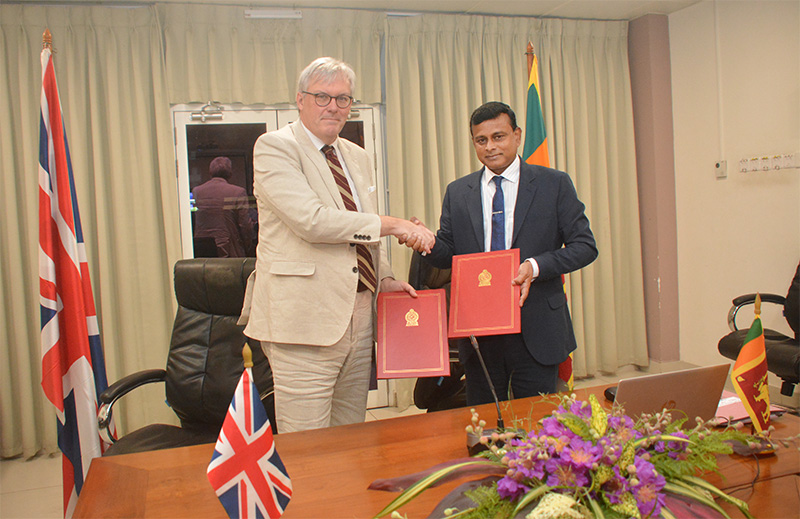
Sri Lanka and the United Kingdom have agreed on a new partnership to protect the marine environment.
The British High Commission in Colombo, Andrew Patrick, said yesterday that the Ministry of Environment and the UK government’s Department for Environment, Food and Rural Affairs signed a Memorandum of Understanding (MoU) between the two nations, to protect and enhance the marine environment.
Secretary, Ministry of Environment Prabath Chadrakeerthi, and Deputy Director for the UK’s Department for Environment, Food and Rural Affairs (Defra) Sara Rusling signed the agreement that represents a united effort to work together to protect and enhance marine ecosystems to support biodiversity and good water quality, whilst also providing sustainable seafood for Sri Lankans.
Through the UK’s Ocean Country Partnership Programme (OCPP), Sri Lanka and the UK will be collaborating to tackle the three key challenges of marine biodiversity, marine pollution and sustainable seafood.
The OCPP aims to support the marine environment and to make a positive impact on the livelihoods of coastal communities that depend on healthy marine ecosystems.
The MoU recognises work that has been taking place over the last few years that includes joint research on plastic pollution, setting up new microplastics laboratories, knowledge exchange on scientific methods to support water quality monitoring and collaboration to enhance Sri Lanka’s Marine Protected Areas to meet the country’s conservation ambitions and biodiversity commitments. The programme also focuses on marine pollution emergency response techniques, with a focus on the environmental aspects of prevention, preparedness and response. Joint work has also taken place around enabling safe and sustainable seafood production, particularly with regards to aquaculture. The OCPP programme also includes work with the Association of Commonwealth Universities (ACU), providing scholarships for Masters Students hosted by the University of Kelaniya and University of Peradeniya. The scholarships will enable scholars from Sri Lanka to harness their regional knowledge and conduct vital research that will contribute to the conservation and sustainable management of marine resources, and strengthen responses to marine environmental challenges.?
Secretary to the Ministry of Environment, Prabath Chandrakeerthi said: “We are going to celebrate a new chapter of collaboration and progress as we unite in purpose at the signing of this agreement. Together, we’re not just signing papers, we’re shaping the future, unlocking opportunities, and fostering innovation.
With the signing of this agreement between the Government of United Kingdom of Great Britain and Northern Ireland and the government of Sri Lanka, it is expected that the two parties may implement activities and exchange of relevant scientific and technical information, capacity building trainings and conduct collaborative research and execute pilot projects to sensitize local stakeholders on blue economy and marine spatial planning, provide consultation and exchange of good practices. This MoU will provide a framework within which the parties can discuss and investigate areas in which to make research collaborations under the Blue Planet Fund’s Ocean Country Partnership Programme covering marine pollution, biodiversity, ecosystem restoration, climate or environmental and other public health monitoring in order to protect the marine environment and reduce poverty, which may be of potential interest and benefit to both participants.”
The UK Marine Minister, Lord Benyon said: “The UK and Sri Lanka have a long history of collaboration, and through our joint work have already made important progress on tackling marine pollution and supporting the biodiversity of Sri Lanka’s waters. This agreement formalises our efforts to secure a healthy marine environment, and through the UK’s Ocean Country Partnership Programme, will help us tackle the pivotal challenges faced by marine life and coastal communities in the future.”
Next steps in the partnership will see the UK team continue to work with Sri Lanka Government departments and agencies, Sri Lanka Universities, NGO partners and civil society organisations to: • Increase data and evidence on the marine environment (habitats and species mapping and condition assessments), threats and impacts (such as pollution and Illegal Unreported U fishing), and supporting information needed for sustainable expansion of marine industry. • Collaborate with key Sri Lankan stakeholders to increase resource and capacity through targeted training and knowledge sharing. • Work together to reduce the prevalence of marine pollution and its impacts through a range of approaches. • Sustainably grow the Sri Lankan blue economy in an informed and inclusive manner to support sustainable livelihoods. • Increase the sustainability of the fisheries sector including, increasing yields and production in aquaculture and reducing impacts of fisheries on the marine environment, the High Commission release said.



Bus fares have been increased by 12.19% with effect from midnight today [23rd March 2026].
The minimum fare will be increased from Rs 27 to Rs 30 while the maximum fare of Rs2159/- will be increased to 2422/-
Latest News
Public will not be served as Computer system failure at Department of Registration of Persons

The Acting Commissioner General of Registration of Persons has announced that due to an unexpected failure of the computer system of the Department of Registration of Persons, all services, including the one day service will not be held on Tuesday (24th March) at the Head Office and all Provincial offices.

Latest News
Heat Index at Caution Level in the Western, Sabaragamuwa, Southern and North-western provinces and in Anuradhapura, Mannar and Vavuniya districts
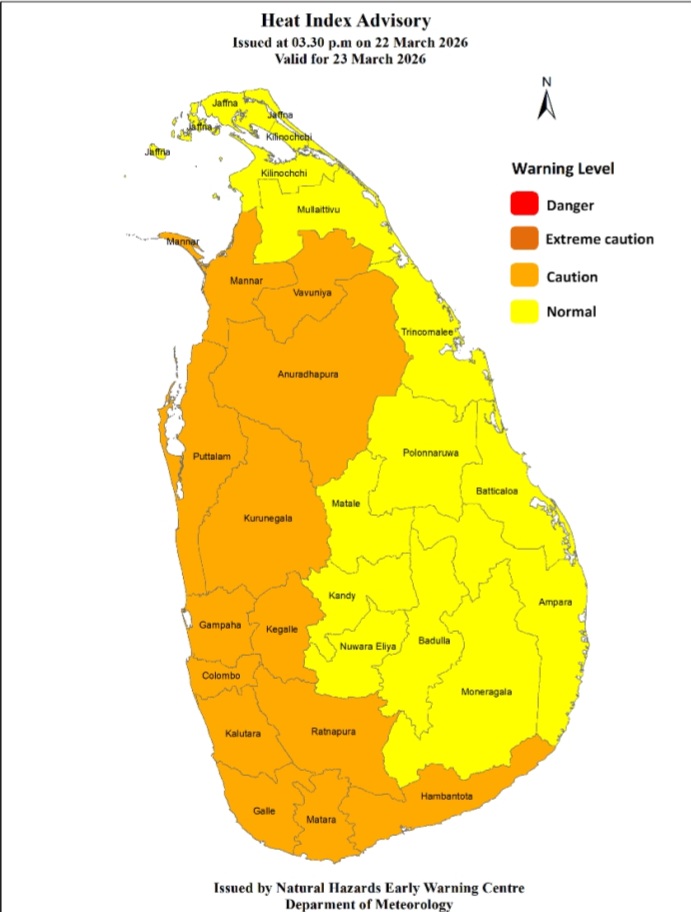
Warm Weather Advisory
Issued by the Natural Hazards Early Warning Centre of the Department of Meteorology
at 3.30 p.m. on 22 March 2026, valid for 23 March 2026.
The Heat index, the temperature felt on human body is likely to increase up to ‘Caution level’ at some places in the Western, Sabaragamuwa, Southern and North-western provinces and in
Anuradhapura, Mannar and Vavuniya districts.
The Heat Index Forecast is calculated by using relative humidity and maximum temperature and this is the condition that is felt on your body. This is not the forecast of maximum temperature. It is generated by the Department of Meteorology for the next day period and prepared by using global numerical weather prediction model data.

Effect of the heat index on human body is mentioned in the above table and it is prepared on the advice of the Ministry of Health and Indigenous Medical Services.
ACTION REQUIRED
Job sites: Stay hydrated and takes breaks in the shade as often as possible.
Indoors: Check up on the elderly and the sick.
Vehicles: Never leave children unattended.
Outdoors: Limit strenuous outdoor activities, find shade and stay hydrated.
Dress: Wear lightweight and white or light-colored clothing.
Note:
In addition, please refer to advisories issued by the Disaster Preparedness & Response Division, Ministry of Health in this regard as well. For further clarifications please contact 011-7446491.

Two killed when Air Canada jet hits fire truck at NYC’s LaGuardia Airport

Bus fares increased by 12.19% from midnight today [23]
Public will not be served as Computer system failure at Department of Registration of Persons

Trump says he is postponing strikes on Iran power plants after ‘productive’ talks on ending war

Asia stocks slide as US and Iran threaten to escalate war

Heat Index at Caution Level in the Western, Sabaragamuwa, Southern and North-western provinces and in Anuradhapura, Mannar and Vavuniya districts

‘Dates have the highest sugar content to fight Coronavirus’

Sunday Island 27 December – Headlines

#SundayIsland 17th December – Headlines

Sunday Island – 28th March

Sunday Island Headlines – 21 March

Sunday Island – 21st February – Headlines
-

 News6 days ago
CIABOC questions Ex-President GR on house for CJ’s maid
-

 News7 days ago
Sri Lankan marine scientist Asha de Vos honoured at UNGA opening
-

 News7 days ago
Australian HC debunks misleading travel risk claims for Sri Lanka
-

 News5 days ago
Bailey Bridge inaugurated at Chilaw
-

 News5 days ago
Pay hike demand: CEB workers climb down from 40 % to 15–20%
-
 News4 days ago
CIABOC tells court Kapila gave Rs 60 mn to MR and Rs. 20 mn to Priyankara
-

 Editorial6 days ago
Couple QR-based quota with odd-even rationing
-

 Features23 hours ago
Trincomalee oil tank farm: An engineering marvel