
Latest News
New government must uphold press freedom, says press freedom collective

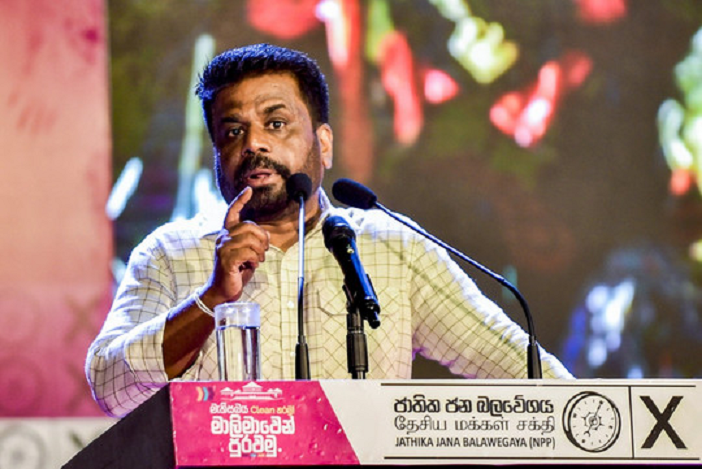
A coalition of trade unions, media advocacy groups, and journalist representative bodies have urged the newly-elected government of President Anura Kumara Dissanayake to uphold press freedom and challenge a culture of impunity for crimes against journalists in Sri Lanka. The International Federation of Journalists (IFJ) joins its affiliates, the Federation of Media Employees and Trade Unions (FMETU), the Sri Lanka Working Journalists Association (SLWJA), and the Free Media Movement (FMM), in stressing the historic importance of this transition and urging Dissanayake and the ruling National People’s Power (NPP) coalition to stand by their commitments in service of democracy, the media, and justice.
Following Sri Lanka’s Parliamentary and Presidntial elections in 2024, a coalition of 25 civil society organisations, unions, and media bodies, including the IFJ, FMETU, FMM, and SLWJA, called on the ruling NPP coalition and President Dissanayake to uphold press freedom and human rights in Sri Lanka through their terms in office.
The letter comes as Sri Lanka’s media community commemorates Black January, an annual remembrance of colleagues killed and disappeared between 2004 and 2010, with those responsible escaping with impunity in a vast majority of cases. Other attacks on the press, including harassment, abductions, intimidation, and assault continue to be met with inaction from authorities, if state forces are not directly responsible. In a report from the Office of the United Nations High Commissioner for Human Rights (OHCHR), a lack of accountability for historic and current human rights violations was identified as a significant impediment to human rights in Sri Lanka.
In the NPP’s election manifesto, the coalition criticised what it described as a partisan mass-media, announcing its plans to safeguard the professional integrity of journalists. In its principles, the coalition committed to remove sections of the controversial 2024 Online Safety Act impacting freedom of expression, while reviewing existing media legislation with a focus on press freedom.
Securing over 70 per cent of seats in November’s parliamentary elections, the NPP campaign promised to deliver sweeping reforms, including the enactment of a new constitution and legal reform amid the ongoing impacts of the country’s worst financial crisis. The election marks a significant departure from Sri Lanka’s recent political history, which has been dominated by the Rajapaksa political dynasty.
In the joint letter, the 25 organisations called on the new government to:
-
Reopen or initiate impartial and swift investigations to ensure accountability in cases of violence against the press under previous governments;
-
Ensure that law enforcement agencies end the harassment and intimidation of journalists;
-
Repeal the Online Safety Act;
-
Repeal the Prevention of Terrorism Act;
-
Amend the Parliamentary (Powers and Privileges) Act;
-
Amend the Personal Data Protection Act; and
-
Establish an independent, self-regulatory media commission.
The FMETU said: “Journalists In Sri Lanka often practice self-censorship due to fear of reprisals. This can lead to underreporting of important stories and a lack of critical coverage of the Government.”
The SLWJA said: “After the current government assumed power, there was widespread hope for a new era of freedom of speech and expression in Sri Lanka. However, these hopes are rapidly diminishing. The SLWJA urges the government to honour its commitments to safeguard media freedom and ensure the protection of journalists. Immediate steps must be taken to repeal oppressive legislation and foster an environment where the fundamental right to freedom of expression is respected and upheld.”
The FMM said: “The Free Media Movement commends President Dissanayake and the National People’s Power for their stated commitment to fostering a free and independent press in Sri Lanka. At this critical juncture, we urge the president to translate these commitments into concrete actions by ensuring justice for crimes against journalists, repealing repressive laws like the Online Safety Act, the draconian Prevention of Terrorism Act, and fostering an environment where journalists can work without fear of harassment or intimidation.”
The IFJ said: “The IFJ and its affiliates stand resolute in their defence of press freedom and accountability for Sri Lanka’s media. Justice for the families of colleagues killed, disappeared, or subject to other violence and attacks cannot be delayed any further, and the new Dissanayake government must ensure that it addresses the failings of its predecessors to combat impunity. At the same time, the NPP coalition must uphold democracy and commit to creating a media landscape free of laws affecting the fundamental freedoms of expression and the press.”
[IFJ]


Scotland take on West Indies in Leeds at 18:30 local time (17:30 GMT) in Group 2 of the Women’s T20 World Cup 2026. Both teams won their opening matches in this competition – Shemaine Campbelle’s unbeaten 90 aided by New Zealand’s dropped catches saw West Indies emerging victorious, while a strong all round performance from Scotland brushed aside Ireland.
Scotland and West Indies have played each other only three times across formats – their lone T20I meeting coming at the last World Cup. Crucially, though, Scotland dealt West Indies perhaps their biggest blow in recent times with their win in the Women’s ODI World Cup Qualifier last year. Scotland staved off an all-round show from Hayley Matthews to eke out an 11-run win, denying West Indies a chance to qualify for the ODI World Cup last year.
Coming on the back of a comfortable win, expect Scotland to go in unchanged.
Scotland (probable XI): Darcey Carter, Katherine Fraser, Kathryn Bryce (capt), Sarah Bryce (wk), Ailsa Lister, Megan McColl, Priyanaz Chatterji, Rachel Slater, Chloe Abel, Kirstie Gordon, Gabriella Fontenla
West Indies head coach Shane Deitz had said that Chinelle Henry was close to playing their opening game. If fit, she can add heft to their lower-middle order as well as the bowling department.
West Indies (probable XI): Qiana Joseph, Hayley Matthews (capt), Shemaine Campbelle (wk), Deandra Dottin, Jahzara Claxton/Chinelle Henry, Jannillea Glasgow, Aaliyah Alleyne, Zaida James, Shawnisha Hector, Afy Fletcher, Karishma Ramharack
Players to watch:
Kathryn Bryce: The Scotland captain had a big role to play in their first win at this T20 World Cup. She scored a rapid half-century and picked up two wickets against Ireland. Bryce has picked up at least one wicket in 11 of the 12 T20Is she has played this year, apart from being consistent with the bat. Her experience of playing regularly in England’s domestic circuit could be key for Scotland against West Indies.
Deandra Dottin: She was at her brutal best in the last iteration of the T20 World Cup (strike rate 165.54, average 39.4, 12 sixes) but since the start of 2025, Dottin has only one T20I half-century at a strike rate of 122.84. Dottin had scored an unbeaten 15-ball 28 the last time she faced Scotland. Can she find her mojo back against them?
While Australia’s bowlers bulldozed Bangladesh, India’s batters made merry to show the batting-friendly nature of the surface in Leeds. Weather wise, the evening is likely to become cooler, with temperatures ranging from 19 to 22 degrees Celsius. There is no forecast of rain, even though it grew slightly overcast towards the start of Netherlands’ innings on Wednesday.
[Cricinfo]
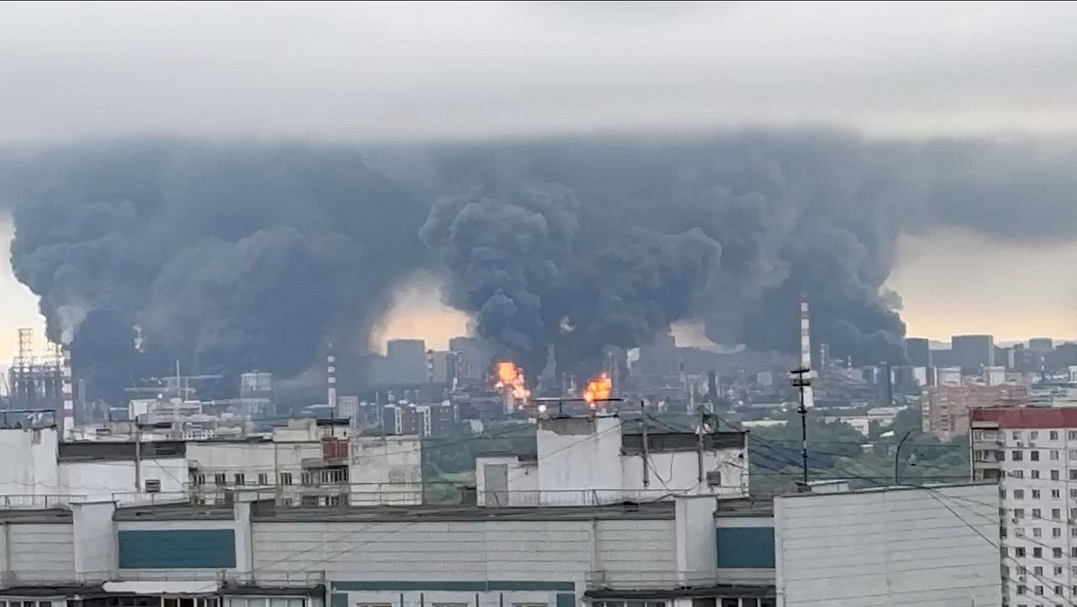
Moscow has come under the largest Ukrainian attack since the start of the full-scale war, with close to 200 drones hitting targets around the Russian capital and setting columns of thick smoke billowing high into the sky.
Seventeen people were wounded in the Moscow region, according to local governor Andrei Vorobyov.
Almost 1,000 drones and four Ukrainian cruise missiles were intercepted and destroyed across the country in 24 hours, Russia’s defence ministry was quoted as saying. An oil depot was struck in the southern Rostov region, where one person was killed.
Volodymyr Zelensky said Kyiv had once again hit the Moscow region with “long-range sanctions” – a euphemism for Ukrainian long-distance strikes on Russia.
“It’s time to end this war, and Russia must take the necessary steps in diplomacy,” he added.
He said the massive drone strike was in response to last week’s Russian attack on Kyiv, which set a major religious landmark ablaze.
“We don’t want this war and have never wanted it,” Zelensky said. “But if Ukraine burns, your Moscow will burn too.”
Fires broke out as the Kapotnya refinery in south-east Moscow was hit for the third time in a month and the second time this week, colouring the sky black with smoke. Numerous videos showed the lid of a large oil storage tank blown dozens of metres into the air by the force of an explosion.
A nearby shopping centre was also burning, reportedly after drone debris fell on the building, and several residential high-rise blocks were evacuated.
Moscow’s four airports were temporarily shut and more than 500 flights were cancelled or delayed.
Although local authorities across Russia have banned publication of images of the aftermath of drone strikes, dozens of videos were posted on social media showing drones flying across the sky in broad daylight and explosions over industrial areas on the outskirts of Moscow.
Four and a half years since Moscow launched its full-scale invasion of Ukraine, the war of attrition on the front line in Ukraine grinds on, out of sight for many ordinary Russians.
Kyiv’s long-range strikes on targets across Russia as well as Moscow and St Petersburg are an indication of Zelensky’s aim of “bringing the war home” to Russians.
Drone attacks on Moscow – about 500km (310 miles) from the Ukrainian border – have become more frequent as Kyiv has developed its long-range capabilities. Ukraine’s first successful drone strikes reached the Russian capital in spring 2023, although they were sporadic and rarely involved more than a handful of drones.
Since then, extensive air defences have been set up around Moscow – but the number of drones used by Ukraine in its attacks has also multiplied and some have penetrated those defences.
Meanwhile, Russia launched more than 200 drones and multiple ballistic missiles at Ukraine overnight, Kyiv said.
Vladimir Putin, who is hosting southeast Asian leaders for a summit in the central city of Kazan, has not commented on the large-scale attack on the Russian capital.
Writing on X, Ukrainian Foreign Minister Andriy Sybiha said: “One of the most popular questions asked by Muscovites this morning is ‘What is going on?'”
“I can answer. Your country started a war of aggression against ours. For years, it has been killing our people,” Sybiha wrote.
“Now that you know what’s going on, ask Putin when he is planning to end it.”
[BBC]
Oil prices have dropped following the United States and Iran’s signing of an interim peace agreement, resuming a slide interrupted by US President Donald Trump’s warning that he could restart his military campaign.
Brent crude fell 2.3 percent on Thursday in Asia, returning the international benchmark to near to where it was 24 hours previously
Brent futures for delivery in August stood at $77.73 as of 05:30 GMT, only about 7 percent higher than before the US and Israel launched their war on Iran on February 28.
After several days of declines, Brent briefly spiked above $81 a barrel on Wednesday after Trump warned that the US could “go right back to dropping bombs” on Iran if it doesn’t “behave”.
Shrugging off losses on Wall Street overnight, Asian stock markets rallied on renewed optimism for an end to nearly four months of disruption to global energy supply chains.
Japan’s benchmark Nikkei 225 and South Korea’s Kospi both hit all-time highs, gaining more than 2 percent and 1.7 percent, respectively.
Taiwan’s Taiex rose as much as 1.3 percent.
Hong Kong’s Hang Seng Index bucked the trend, dropping 1.7 percent.
US stock futures, which are traded outside of regular market hours and often foreshadow the next day’s performance, climbed, with those tied to the benchmark S&P 500 and the tech-heavy Nasdaq Composite climbing about 0.8 percent and 1.3 percent, respectively.
“Putting aside the contents of the MoU, markets are likely to be welcoming the fact that both the US and Iran signed it sooner than initially expected,” Norihiro Yamaguchi, lead economist for Japan at Oxford Economics, told Al Jazeera.
“The timing is also supportive, as the major central bank policy meetings have now passed, reducing a key source of uncertainty,” Yamaguchi said.
“For Asian markets, the renewed strength in US semiconductor stocks should provide an additional boost, given the region’s heavy exposure to tech shares.”

Pakistani Prime Minister Shehbaz Sharif, who mediated the negotiations between Washington and Tehran, said on Wednesday that the US-Iran memorandum of understanding (MoU) had entered into force with “immediate effect”.
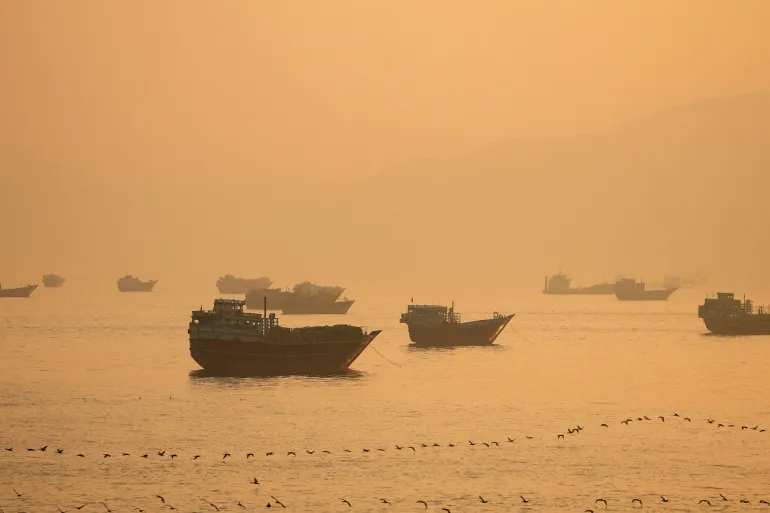
Sharif said Iran would “instantly reopen” the Strait of Hormuz and the US would “immediately” lift its naval blockade of Iranian ports, though it was not immediately clear if the announcement had any effect on boosting maritime traffic in the critical waterway.
Shipping in the strait has been reduced to a fraction of peacetime levels due to the threat of Iranian missiles, drones and mines, as well as the US blockade.
The blockage has resulted in an estimated daily shortfall of 14 million barrels in the global oil market, according to the International Energy Agency (IEA).
Fabien Yip, a market analyst at IG in Sydney, said that while markets have responded to the MoU with optimism, the relief is “largely priced in” as practical issues such as the backlog of vessels in the Gulf and mine clearing operations must still be resolved.
“There is a notable divergence between sentiment and physical supply – production ramp-up and logistics normalisation will take time,” Yip told Al Jazeera.
While more than 500 vessels are estimated to be waiting to exit the Gulf through the strait, shipping companies have expressed concern about the lack of clarity on how to ensure the safety of their vessels and crews in the channel.
In a statement earlier this week, the Baltic and International Maritime Council (BIMCO), one of the world’s largest associations for shipowners, said the US and Iran had yet to provide information about “key aspects such as timings and safe routes”.
“Due to lack of details and a history of overly optimistic reassurances, we believe the security situation for the shipping industry remains volatile, and we still consider it very risky for ships to commence transits at this point,” Jakob Larsen, chief safety and security officer at BIMCO, said in a statement on Monday, responding to the initial announcement of the MoU.
“We advise shipowners to continue doing thorough risk assessments and appeal to all parties to put the safety of seafarers first.”
[Aljazeera]

Scotland face West Indies with a chance to reopen World Cup wounds

Moscow hit by largest Ukrainian attack since start of Russia’s full-scale war

Sooryavanshi to have parents with him on tour of Ireland and England

Luis Diaz, Colombia defeat World Cup 2026 debutants Uzbekistan

Oil prices fall, stocks rally as US, Iran sign framework to end war

Kane double fires England past Croatia in World Cup thriller

‘Dates have the highest sugar content to fight Coronavirus’

Sunday Island 27 December – Headlines

#SundayIsland 17th December – Headlines

Sunday Island – 28th March

Sunday Island Headlines – 21 March

Sunday Island – 21st February – Headlines
-
 News7 days ago
CIABOC summons Yoshitha over his participation in British Navy training programme
-

 News4 days ago
Release of 2025 O/L results likely to be delayed
-

 News7 days ago
Justice Minister responds to social media claims he represented Easter Sunday ringleader
-

 Sports4 days ago
Tharanga set for high-profile javelin clash in Ostrava
-

 Features5 days ago
Politics of protected species
-

 News3 days ago
Beijing Capital Airlines to resume flights to Colombo signalling boost to tourism
-

 News4 days ago
Theft of USD 2.5 mn from Treasury: CoPF accused of complicity in NPP cover-up
-

 News6 days ago
Commonwealth lawyers urge Lanka to uphold rule of law