
Latest News
Nepal, Scotland chase win to close out what-if tournament

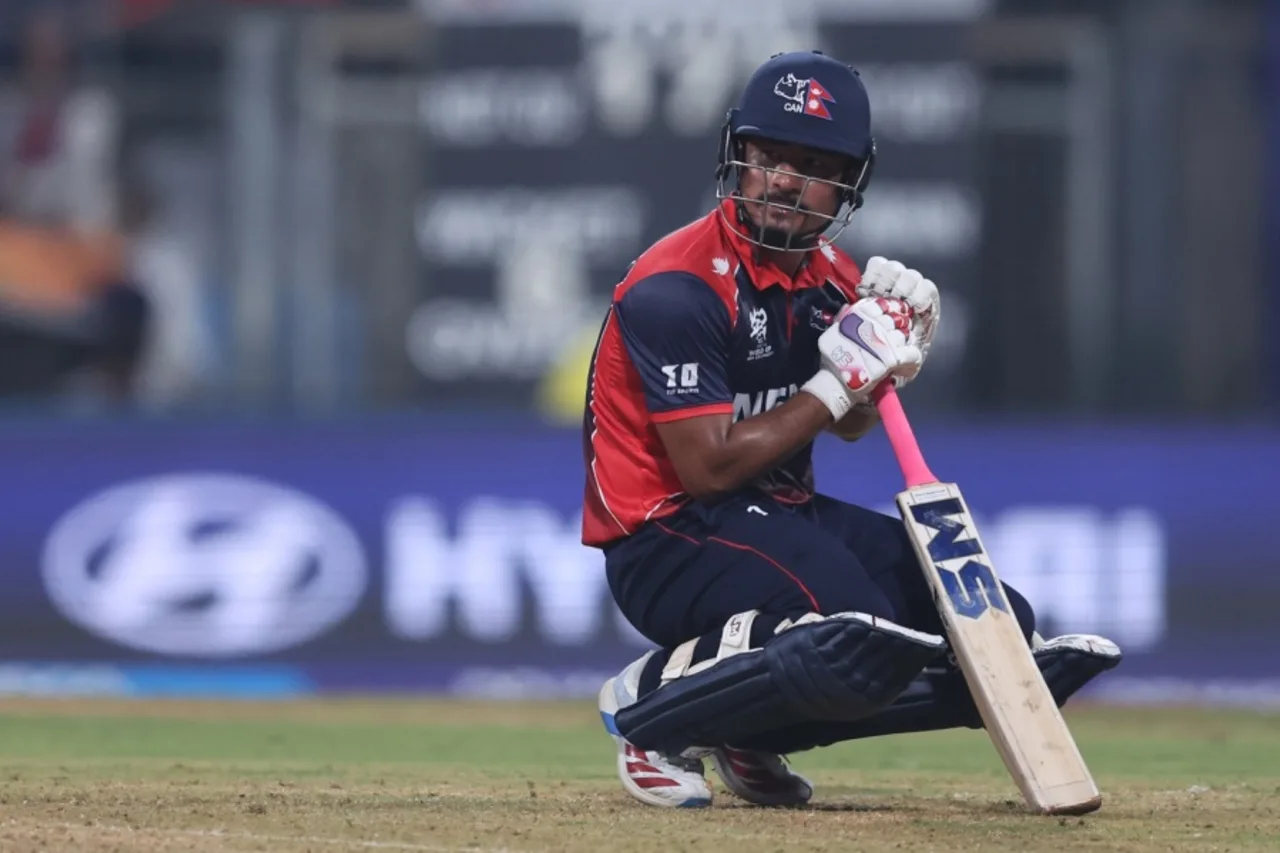
Regrets. Scotland and Nepal will have a few.
They arrived at the 2026 T20 World Cup with little to lose. Scotland’s 11th-hour entry after Bangladesh’s expulsion was an unexpected boost. Nepal, meanwhile, are a nation on the cusp of nailing the big time, and what better way to signal that intent by bloodying a few noses and perhaps even sneaking out of Group C?
And yet, both will go into their meeting in Mumbai wondering what could have been. Nepal were 11 runs from 8 balls away from victory in their opening against England, while Scotland spurned 30 runs in their innings against the same opponents, which might have afforded them more room to cash in the nerves they elicited in an ultimately unsuccessful defense of 152.
A comprehensive defeat to West Indies on Sunday closed all mathematical avenues for Nepal’s progression, before England’s second number on their Auld enemy was to come through another sketchy situation against Italy on Monday to secure their own Super Eights spot. And so, what might have been a genuine winner-takes-all bout is anything but. Regardless of the result, both teams will be heading home.
Of course, there is pride to play for, but perhaps a bit more on Nepal’s side of the ledger. Captain Rohit Paudel called for more opportunities against Full Member teams going forward, after making England sweat. Signing off with a maiden T20 World Cup win can further their push for more of a look-in. Their fans have made a compelling case in the stands.
The mullering at the hands of Italy felt like a blow to that cause, even though that should not be the case. It is counter-productive to pit Associate nations against one another to deem who is worthy of a bigger slice of pie, be that funding or opportunities against major sides, particularly when the deck is stacked against them on those grounds in the first place.
These are issues Scotland know plenty about, even if their surprise entry into this tournament is their sixth visit to a T20 World Cup. Between the 2024 T20 World Cup and this one, they had played just seven T20Is outside of qualification tournaments, and only three against a Full Member (a series against Australia in September 2024). They themselves have a statement to make on Tuesday.
Scotland’s initial three-match residence in Kolkata featured a 73-run win against Italy, as they became the first side at this World Cup to breach 200. That was sandwiched by losses to West Indies and England, though the latter did play out in front of a crowd of more than 40,000. This will be similarly well-attended.
One of these teams will take the lead after a 1-1 head-to-head established during a tri-series Scotland hosted and won last summer, with an emphatic win over Nepal. Their first meeting three days earlier was a low scoring shootout which Sandeep Lamichanne seized; the legspinner taking 4 for 11 then bagging the winning run off the penultimate delivery.
As such, there is plenty of familiarity on the ground for this encounter, which will been played out on what has been a game Wankhede track. Nepal’s three matches at this venue to Scotland’s none gives them a sizable advantage, but their batting has not come close to replicating the heights Kushal Bhurtel, Dipendra Singh Airee and Lokesh Bam threatened to take them to against England over a week ago.
They were tentative against Italy (who chased down 124 without loss and with ease) and overawed by Group C leaders West Indies. It spoke to the standards expected that consultant coach Nic Pothas used his pre-match press conference to lament the team for “not learning fast” and making familiar errors.
Scotland, too, have errors to learn from, particularly their leg-side missteps against England when it came to the sweep shot. “The nature of the wicket [at the Wankhede] probably looks even slower than Kolkata and might take more turn,” Tom Bruce said on Monday. We shall see.
It has been a peculiar tournament for Sandeep Lamichane. Nepal’s greatest cricketing export has just one wicket at an average of 94.00, with an economy rate of 9.4 – galling numbers for a seasoned wristspinner. The 25-year-old has shown no verve, and was bullied by Anthony Mosca in the defeat to Italy, with the opener carting him for three sixes, finishing with 28 off the 13 deliveries he faced from the leggie. As mentioned further up, Lamichanne has good recent form against Scotland which he could do with replicating to save what has otherwise been an abject tournament.
Mark Watt, meanwhile, will be keen to bounce back from the shellacking he received against England. His 0 for 43 from three overs contributed to Scotland’s inability to fully turn the screw against their neighbours to the south, hammered over the fence three times by Tom Banton in a first over that went for 22 – an exchange that got Banton out of a funk and on his way to a match-winning 63*. Watt is a canny enough operator to not let that aberration dull his shine.
Nepal have been relatively consistent with their selections, sticking by 10 players and shuffling between Sher Malla (offbreak), Lalit Rajbanshi (left arm orthodox) and Sompal Kami (medium-pace) for the final spot. The suggestion on the ground is they may go in unchanged from the West Indies match after Kami provided some handy but ultimately moot lower-order runs with an unbeaten 26. Should they err towards spin, Malla may get the nod over Rajbanshi, whose single over against Italy went for 19.
Nepal (probable): Aasif Sheikh (wk), Kushal Bhurtel, Rohit Paudel (capt), Dipendra Airee, Aarif Sheikh, Lokesh Bam, Gulsan Jha, Karan KC, Sompal Kami/Sher Malla, Nandan Yadav, Sandeep Lamichhane.
Scotland have called up seamer Jack Jarvis as a replacement for Safyaan Sharif, who has been nursing a groin strain picked up in training. But the sense is they will go in with the same XI they played against England.
Scotland (probable): George Munsey, Michael Jones, Brandon McMullen, Richie Berrington (capt), Tom Bruce, Michael Leask, Matthew Cross (wk), Mark Watt, Oliver Davidson, Brad Wheal, Brad Currie.
[Cricinfo]

Latest News
Heat Index at Caution Level in the Western, Sabaragamuwa and North-western provinces and Monaragala district.

Warm Weather Advisory issued by the Natural Hazards Early Warning Centre of the Department of Meteorology at 3.30 p.m. on 09 March 2026, valid for 10 March 2026.
The public are warned that the Heat index, the temperature felt on the human body is likely to increase up to ‘Caution level’ at some places in Western, Sabaragamuwa and North-western provinces and in Monaragala district.
The Heat Index Forecast is calculated by using relative humidity and maximum temperature and this is the condition that is felt on your body.
This is not the forecast of maximum temperature. It is generated by the Department of Meteorology for the next day period and prepared by using global numerical weather prediction model data.

Effect of the heat index on the human body is mentioned in the above table and it is prepared on the advice of the Ministry of Health and Indigenous Medical Services.
ACTION REQUIRED
Job sites: Stay hydrated and takes breaks in the shade as often as possible.
Indoors: Check up on the elderly and the sick.
Vehicles: Never leave children unattended.
Outdoors: Limit strenuous outdoor activities, find shade and stay hydrated.
Dress: Wear lightweight and white or light-colored clothing.
Note:
In addition, please refer to advisories issued by the Disaster Preparedness & Response Division, Ministry of Health in this regard as well. For further clarifications please contact 011-7446491.

Five members of the Iranian women’s football team have been granted humanitarian visas in Australia after their elimination in the Asian Cup, the government in Canberra says.
Immigration Minister Tony Burke said the women “were moved to a safe location” by Australian police. He said other squad members had been told they are welcome to stay in the country.
The women had been due to fly home, but supporters had raised fears for their safety after the team declined to sing the national anthem ahead of their match against South Korea last week.
This prompted criticism in Iran, with one conservative commentator accusing the team of being “wartime traitors” and pushing for harsh punishment.
Australia’s humanitarian visa programme grants permanent protection to refugees and people in humanitarian need. Visa holders can live, work and study in the country.
Speaking early on Tuesday, Burke said the five players were happy for their names to be confirmed as Fatemeh Pasandideh, Zahra Ghanbari, Zahra Sarbali, Atefeh Ramazanzadeh, and Mona Hamoudi.
“They want to be clear they are not political activists. They are athletes who want to be safe,” he said, adding that talks had been going on over several days.
He said that on Monday “it was made clear that there were five women who wanted to be able to stay in Australia”.
The group left their hotel the same day and were moved to a safe location by police.
Burke said he met the women at that location and then signed off for their applications to go onto humanitarian visas – a process completed at about 01:30 local time on Tuesday (15:30 GMT Monday).
“I say to the other members of the team, the same opportunity is there. Australia has taken the Iranian women’s soccer team into our hearts. These women are tremendously popular in Australia.
“But we realise they are in a terribly difficult situation with the decisions that they’re making,” the Australian minister said.
Australian Prime Minister Anthony Albanese later confirmed that the five players had been given humanitarian visas.
On Sunday evening, hundreds of supporters surrounded the Iranian Lionesses’ coach as it left the stadium on the Gold Coast, with chants of “save our girls”.
On Monday, the BBC witnessed dramatic scenes inside the team’s five- star hotel when several players left the lobby in a group after speaking to activists.
Shortly after they departed, a second group – including a translator and the head coach – burst in looking panicked, and rushed through the hotel before returning to their rooms.
A family member of one of the women – speaking on condition of anonymity – told Australian news site ABC they were being protected by police, and intended to claim asylum.
“I want to kiss the hands of everyone who helped,” the unnamed relative told ABC.
On Monday, US President Donald Trump took to his Truth Social platform to demand action.
Australia should “give asylum” to the women, Trump said in his initial post. “The US will take them if you won’t,” he added.
Around an hour later, Trump posted again to say he had spoken to Australia’s Prime Minister Anthony Albanese and “five have already been taken care of, and the rest are on their way”.
Trump’s post appeared to also suggest some of the team feared for the safety of their families back in Iran and so felt they must “go back”.
“In any event, the Prime Minister is doing a very good job having to do with this rather delicate situation. God bless Australia!” Trump said.
The Trump administration put all asylum decisions on hold at the end of last year, and has stopped issuing immigrant visas for citizens from dozens of countries including Iran. It has said the administration wants to bring “an end to the abuse” of the system.
Last year, two groups of Iranians – including people whose asylum applications had been unsuccessful – were deported from the US back to Iran. The groups reportedly included members of the LGBT community,who face severe legal and social repercussions in Iran.
[BBC]
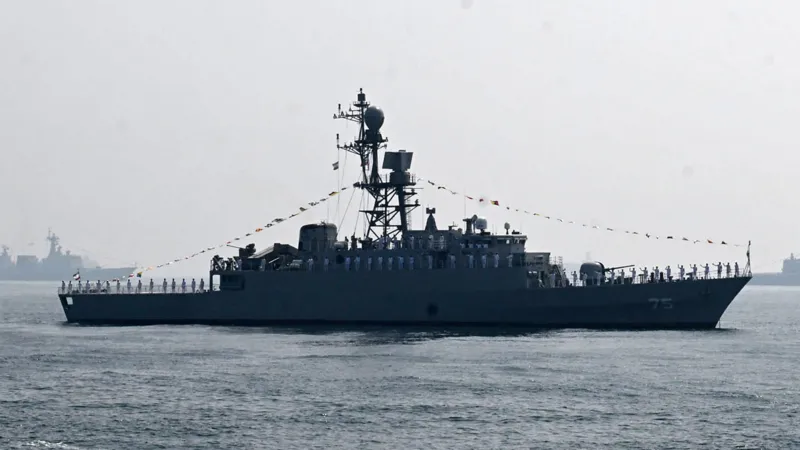
The Iranian warship Iris Dena was given permission by India to dock three days before it was torpedoed by a US submarine, India has said.
Foreign Minister S Jaishankar said Iran had sought permission for three of its ships to dock at Indian ports on 28 February – the day the US and Israel began a war on Iran – and permission was granted by India on 1 March.
The ships’ movements between 1 and 4 March are not clear and nor is why only one of them made it to India.
The sinking of the Iris Dena, with 130 sailors on board, in international waters off Sri Lanka’s southern coast on 4 March marked a dramatic widening of the war – and raised questions about India’s authority in its backyard.
It was the first military strike outside the Middle East since the US and Israel launched their war on Iran. President Donald Trump has said destroying Iran’s navy is one aim of the assault.
The three Iranian ships – Iris Dena, Iris Bushehr and Iris Lavan – had all participated in a military exercise hosted by India between 15 and 25 February in the coastal city of Visakhapatnam.
They left Indian waters on 25 February and were likely to have been in international waters on 28 February – when the US and Israel began attacking Iran.
“The Iranian side had requested permission on 28 February for three ships in the region to dock at our ports. This was accorded on 1 March,” Jaishankar told parliament on Monday. “Iris Lavan actually docked on 4 March in Kochi. The crew is currently in Indian naval facilities. We believe that this was the right thing to do.”
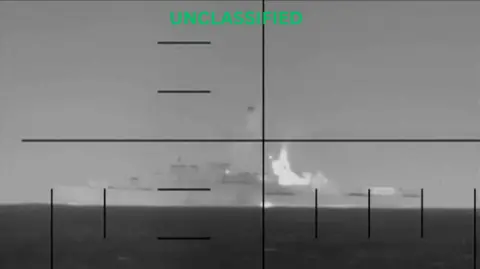
On 4 March, Iris Dena sank after being hit by a torpedo fired from a US submarine, killing at least 87 of its crew members.
According to the Indian Navy, the Iris Dena was operating about 20 nautical miles – roughly 23 miles (37km) – west of Galle in waters that fall under Sri Lanka’s designated search-and-rescue zone on the day it was struck.
The US tracks vessels across the world’s oceans, and a quarter of its submarine fleet of 65-70 is at sea at any given time, according to analysts.
Iran’s Foreign Minister Abbas Araghchi said last week the US had “perpetrated an atrocity at sea, 2,000 miles away from Iran’s shores” and that the warship was “struck in international waters without warning.”
Later, Sri Lanka said it had provided sanctuary for Iris Bushehr on 5 March, a day after it requested for docking following an engine malfunction.
Eventually, India also confirmed that Iris Lavan was docked in its southern city Kochi.
The BBC has written to the Iranian embassy in India and India’s external affairs ministry seeking clarification on the movements of the three Iranian naval vessels after Delhi granted them permission to dock.
US Defence Secretary Pete Hegseth has touted the attack on Iris Dena as an example of America’s military prowess, claiming it was “the first sinking of an enemy ship by a torpedo since World War Two”.
While it is the first time since 1945 that an American submarine has sunk an enemy ship this way, the UK and Pakistan have both sunk vessels using torpedoes since then.
The Iris Dena was one of about 20 Iranian navy vessels destroyed since Israel and the US launched co-ordinated strikes on Iran.
[BBC]

Heat Index at Caution Level in the Western, Sabaragamuwa and North-western provinces and Monaragala district.

Showers likely in the Northern province and in Trincomalee and Anuradhapura districts

Prof. Dunusinghe warns Lanka at serious risk due to ME war

Power sector restructuring completed; new state-owned entities established: Govt.

Pilleyan held over Eastern Uni VC’s 2006 disappearance seeks SC intervention: Case to be taken up on 18 March

Lanka takes part in Thai Red Cross Charity Bazaar

‘Dates have the highest sugar content to fight Coronavirus’

Sunday Island 27 December – Headlines

#SundayIsland 17th December – Headlines

Sunday Island – 28th March

Sunday Island Headlines – 21 March

Sunday Island – 21st February – Headlines
-

 News4 days ago
University of Wolverhampton confirms Ranil was officially invited
-

 News5 days ago
Legal experts decry move to demolish STC dining hall
-

 News4 days ago
Female lawyer given 12 years RI for preparing forged deeds for Borella land
-

 News3 days ago
Peradeniya Uni issues alert over leopards in its premises
-

 Business6 days ago
Cabinet nod for the removal of Cess tax imposed on imported good
-

 News4 days ago
Library crisis hits Pera university
-

 Business6 days ago
War in Middle East sends shockwaves through Sri Lanka’s export sector
-

 News3 days ago
Wife raises alarm over Sallay’s detention under PTA