
News
Nationalist groups ask govt. to repatriate Rohingyas

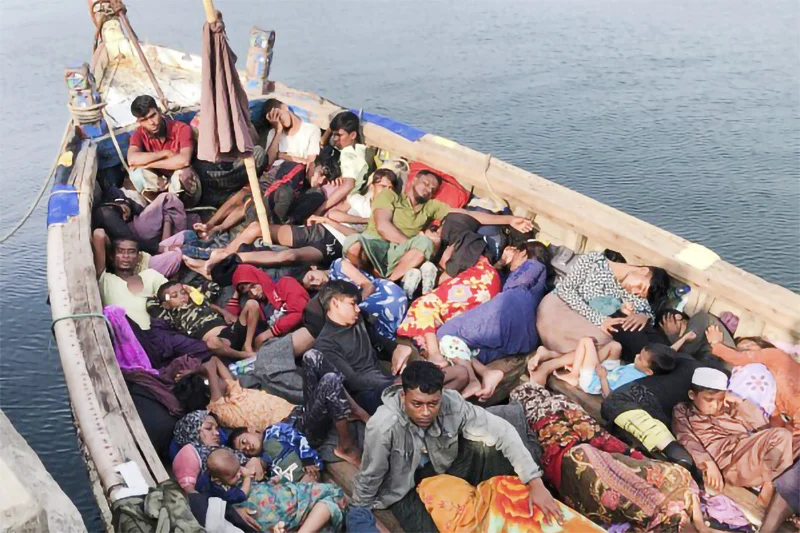
Nationalist Organisations have strongly objected to government providing refugee status to Rohingyas from Myanmar. In an open letter to Public Security and Parliamentary Affairs Minister Ananda Wijepala, the grouping has urged the government to send back those who arrived in northern Sri Lanka to Myanmar,
Excerpts of the letter: We are addressing this letter to present our grave concern over the arrivals of Rohingyas from Myanmar. The latest arrival of 113 Rohingyas on Dec 19, 2024 and the announcement by the Minister Wijayapala that a further 100,000 Rohingyas is expected to arrive prompted us to present some facts to the Government.
As per UN Refugee Council, there are 2.6m IDPs in Myanmar & 1.3m refugee/asylum seekers from Myanmar hosted in other countries. However, UN Member States are cutting humanitarian funding – from 70% in 2021, to 60% in 2022 & 30% in 2023. In 2023 WHO cut food rations from $12 per person to $8 per person.
Australia is also reducing aid to its NGOs supporting 390,000 Rohingyas ($11.2m in 2020 to $6.4m in 2023 which also covers NGO admin costs). Australia refuses to allow Rohingyas to resettle in Australia.
There are 1.1m Rohingyas living in Bangladesh detention camps since 2017. Rohingyas have been arriving in Bangladesh from Myanmar since 1970s with 30,000 new borns in the camps each year. The Bangladeshi goverment has accused Rohingyas of numerous crimes and the 2012 Ramu violence, displacing the indigenous people of the Chittagong Hill Tracts and importing narcotic drugs. To address this, the Bangladesh government proposed to relocate Rohingyas to a remote island (Bhasan Char) but was prevented by UNHCR. However, with increase in influx, the government proceeded to build 100,000 homes and relocated 20,000 Rohingyas in the island in December 2020.
The former Bangladeshi PM in 2022 asked the international community to help solve the Rohingya crisis Bangladesh was experiencing. The Bangladeshi government was spending $350million from its own resources to temporarily relocate 100,000 Rohingyas while Bangladesh spends $1.22billion every year for the Rohingyas alone. The former Bangladeshi PM said the refugees have caused loss of biodiversity, loss of forest area of around 6500 acres of land and “immeasurable adverse effects on the local population”.
Sri Lanka is facing an economic crisis of its own and has no financial wherewithal to spend on illegal arrivals and the situation Bangladesh is facing should be clear lessons for Sri Lanka, of the problems that may arise.
Sri Lanka is only just coming out of an economic bankruptcy declared crisis. Cost of living is skyrocketing, inflation is at an all-time high, the inequality-gap is widening, the government has an arduous task of resolving the problems of its own citizens first. We have 121,000 Sri Lankans displaced since 2021 from natural disasters and another 11,000 Sri Lankan refugees from the 30-year armed conflict who are still living in refugee camps and not resettled. Sri Lanka’s government must address these anomalies first.
Leaving aside the genuineness of asylum/refuge seekers, transporting people to another nation by boat for a payment is part of a global human smuggling/human trafficking/modern slavery that is a $150billion annual profitable “business” (ILO 2014) involving 50million people which includes forced sexual exploitation, domestic work, forced labour in agriculture and other economic activities, prostitution ($99b), pedophilia, child sex and marriage. As per ILO the business was generating $44b annual profits in 2005.
India and Bangladesh governments have also raised serious concern over Rohingya links to terror groups as well. This leads to the question of whether there is a link to local agents including politicians and NGOs who are part of the international human smuggling network who are promoting transportation of illegals by boats and pressuring governments to accept them. This entails the GoSL to open an investigation into all persons in Sri Lanka taking an unusual interest in keeping illegal boat arrivals in Sri Lanka.
As per the statement issued by Public Security Minister Ananda Wijayapala, the present group of Rohingyas that arrived in December 2024 had paid to be taken by boat and the boat had been arrested after entering Sri Lanka’s territorial waters and thereafter had claimed asylum/refugee status. If they had paid to be taken in boats to other countries, they cannot be categorised as refugees/asylum seekers. Sri Lanka cannot and should not become a hub for any form of human trafficking/modern slavery and its associated criminal activities.
Thus, the Government must request UNHCR to desist from encouraging refugees to arrive in nations that are not signatory to the 1951 Refugee Convention. Parking refugees for an unspecified period and thereafter looking for nations to accept them is not a solution and results in unnecessary problems for both refugee and temporary host nation.
We also observe there is a political element in the pressure being exerted on the government using the term “humanitarian” to accept an influx of Rohingyas. If the transportation of people by boat is part of the global human smuggling racket, the government should investigate if those promoting to accept these “refugees” be they politicians or NGOs picketing, to be on the human smuggling payroll. The sudden call to establish an immigration/emigration centre to issue visas in East Sri Lanka cannot be a coincidence and questions whether it will be used to provide visa for illegals arriving on boats. The involvement of Opposition political parties/MPs in this issue may well be to create a new problem to bring the government into disrepute and make it unpopular amongst the public. Therefore, the government must not embrace any new problems that it cannot handle.







The Public Utilities Commission of Sri Lanka (PUCSL) has granted approval to increase electricity tariffs with effect from 1st April .
The Ceylon Electricity Board (CEB) requested a 13.56% electricity tariff revision for the second quarter of this year.
The revision announced by the PUCSL for domestic consumers:
0–30 units category, electricity tariffs will rise by 4.3%,
31–60 units category, tariffs will rise by 6.9%,
61–90 units category, tariffs will rise by 6.9%,
91–120 units category, tariffs will rise by 7.2%,
Above 180 units, electricity tariffs will rise by 25.3%
The PUCSL has decided not to increase electricity tariffs for religious and charitable institutions that consume below 180 units monthly and a 9.6% increase for institutions that consume above 180 units.
Ectricity tariffs for the general and household consumer categories has been increased by 8%, while the electricity tariff increase for the industrial sector is 8.7%, the increase in tariff for government institutions is 14.4%.

It was decided at the committee appointed to oversee the distribution of essential goods to appoint five officials from the Ceylon Petroleum Corporation to cover all ministries in order to examine fuel-related issues and undertake the necessary interventions.
It was further discussed that the responsibility of these officials would be to examine fuel-related issues arising in institutions under each ministry and to intervene in providing solutions by maintaining coordination with the Corporation.
These matters were discussed at a meeting of the committee appointed to oversee the distribution of essential goods, chaired by Minister of Transport, Highways and Urban Development Bimal Rathnayake held on Friday (27) at the Presidential Secretariat.
It was also noted, with particular attention, that requests have been made by industrialists indicating that the current fuel quota allocated to vehicles for the distribution of their products across the country is insufficient. It was further discussed that, if these concerns are not addressed, there is a likelihood of an increase in the prices of goods, which could in turn cause significant hardship to the public during the festive season.
The committee also discussed the issuance of fuel for the distribution of essential food items by state and private institutions, including supermarkets such as Sathosa, wholesale importers, tourism-related service providers, hotels and other service-providing organisations.
Accordingly, it was discussed that requests for fuel quotas submitted by these institutions should be carefully considered and prompt action taken as necessary and that such requests should be forwarded to the Ministry of Energy through the relevant ministries.
Attention was also drawn to the need for the swift implementation of a QR code system for the issuance of fuel to other sectors, including agriculture and the fisheries industry, based on letters issued on the recommendations of the relevant government officials, including agricultural research officers, instead of the previous method of direct fuel allocation.
Minister Bimal Rathnayake emphasised the need to ensure a continuous and properly managed fuel supply, with particular focus on providing goods to the public without shortages and preventing excessive price increases during the forthcoming Sinhala and Hindu New Year season.
The discussion was attended by a group of government officials, including Minister of Trade, Commerce, Food Security and Cooperative Development Wasantha Samarasinghe, Deputy Minister of Power Arkam Ilyas, Senior Additional Secretary to the President, Kapila Janaka Bandara and Chairman of the Ceylon Petroleum Corporation, D. J. Rajakaruna.


Parliament:
… sexual harassment claims dismissed
Recommendations made by retired High Court Judge Ms. Sujatha Alahapperuma, following an inquiry into claims by a female employee of the Department of Information Systems and Management of Parliament, regarding sexual harassment, denial of due salary increments and other forms of harassment, were yet to be implemented, sources familiar with the investigation said.
The retired HC Judge handed over the report to Speaker Dr. Jagath Wickramaratne on 24 November, 2025. Secretary General of Parliament Kushani Rohanadeera was also present on that occasion.
The retired judge has recommended that administrative decisions be taken expeditiously to grant her salary increments due for 2024 and 2025, reevaluation of all employees attached to the Department of Information Systems and Management and keep them under close scrutiny and strengthening of the ‘Helpdesk’ to meet the requirements.
Sources said that none of the recommendations have been implemented and the concerned employee in spite of still being the Senior Helpdesk coordinator remained attached to the Supplies and Services Office. She had been ordered to report to the Supplies and Services Office in January 2025 following a continuing dispute with the top management of the Department of Information Systems and Management.
Parliamentary Staff Advisory Committee on 25.07.2025 decided to conduct an external investigation into the issue after the employee refused to accept the outcome of the internal inquiry conducted in the wake of SJB lawmaker Mujibur Rahman raising the issue in Parliament.
The retired judge has emphasised the urgent need to take tangible measures to address administrative issues with a view to enhance discipline and human resources management among other issues.
However, the retired judge has declared that the complainant or any other female employee attached to the of Department of Information Systems and Management hadn’t been subjected to any form of sexual harassment as alleged.
The retired judge further asserted that the complainant had been prejudicially treated by two interview boards when she appeared before them seeking posts of Database Administrator and Parliament Officer.
The retired judge has also asserted that the Supplies and Services Office where the complaint continued to serve even now was not suitable and not in line with her qualifications. Some of those who had appeared before the retired judge during the inquiry claimed that was a temporary transfer. However, the report dismissed that claim declaring that transfer appeared to have been done outside acceptable procedure and her increments stopped without giving any justifiable reason.
The retired judge has stated that for want of proper procedures and systems, the administration seems to be in turmoil.
By Shamindra Ferdinando

Electricity tariffs to be increased from 1st April

A QR code system to be introduced for agricultural lands and other sectors requiring fuel

Rickelton, Rohit, Shardul break Mumbai’s first-game jinx

Oil tops $116 a barrel as Iran accuses US of preparing invasion

Iranian attack damages Kuwait power and desalination plant, kills worker

Warm weather conditions prevailing over the island are expected to continue

‘Dates have the highest sugar content to fight Coronavirus’

Sunday Island 27 December – Headlines

#SundayIsland 17th December – Headlines

Sunday Island – 28th March

Sunday Island Headlines – 21 March

Sunday Island – 21st February – Headlines
-

 News6 days ago
Senior citizens above 70 years to receive March allowances on Thursday (26)
-

 Features3 days ago
A World Order in Crisis: War, Power, and Resistance
-

 News4 days ago
Energy Minister indicted on corruption charges ahead of no-faith motion against him
-

 News5 days ago
US dodges question on AKD’s claim SL denied permission for military aircraft to land
-

 Business5 days ago
Dialog Unveils Dialog Play Mini with Netflix and Apple TV
-

 News6 days ago
CEB Engineers warn public to be prepared for power cuts after New Year
-
 Business7 days ago
Postponement of Sri Lanka Investment Forum 2026
-

 Sports4 days ago
SLC to hold EGM in April