
Foreign News
Myanmar’s army is taking back territory with relentless air strikes – and China’s help

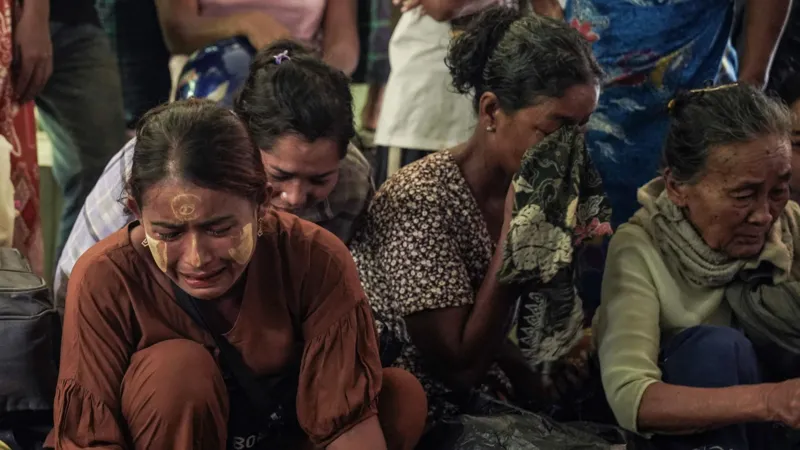
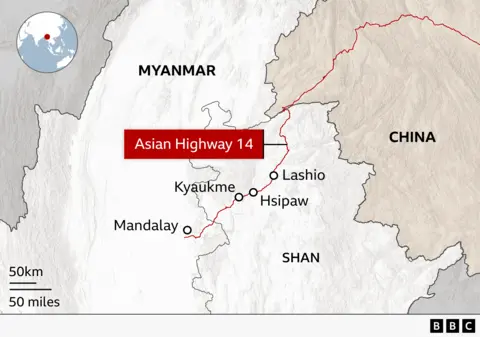
When insurgents finally gained control of the town of Kyaukme – on the main trade route from the Chinese border to the rest of Myanmar – it was after several months of hard fighting last year.
Kyaukme straddles Asian Highway 14, more famous as the Burma Road during World War Two, and its capture by the Ta’ang National Liberation Army (TNLA) was seen by many as a pivotal victory for the opposition. It suggested that the morale of the military junta which had seized power in 2021 might be crumbling.
This month, though, it took just three weeks for the army to recapture Kyaukme.
The fluctuating fate of this little hill town is a stark illustration of how far the military balance in Myanmar has now shifted, in favour of the junta.
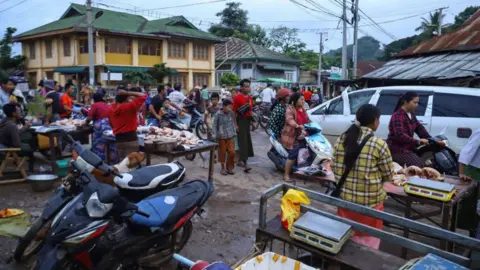
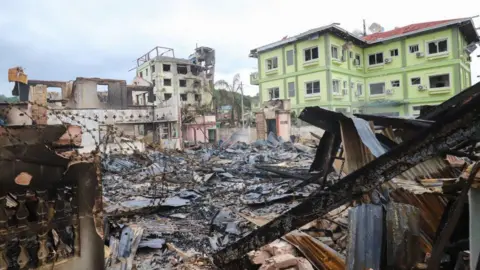
Kyakme has paid a heavy price. Large parts of the town have been flattened by daily air strikes carried out by the military while it was in the hands of the TNLA. Air force jets dropped 500-pound bombs, while artillery and drones hit insurgent positions outside the town. Much of the population fled the town, though they are starting to return now the military has retaken it.
“There is heavy fighting going on every day, in Kyaukme and Hsipaw,” Tar Parn La, a spokesman for the TNLA, told the BBC earlier this month. “This year the military has more soldiers, more heavy weapons, and more air power. We are trying our best to defend Hsipaw.”
Since the BBC spoke to him the junta’s forces have also retaken Hsipaw, the last of the towns captured by the TNLA last year, restoring its control over the road to the Chinese border.
These towns fell primarily because China has thrown its weight behind the junta, backing its plan to hold an election in December. This plan has been widely condemned because it excludes Aung San Suu Kyi’s National League for Democracy, which won the last election but its government was ousted in the coup, and because so much of Myanmar is in a state of civil war.
That is why the military is currently trying to take back as much lost territory as it can, to ensure the election can take place in these areas. And it is enjoying more success this year because it has learned from its past failures, and acquired new and deadly technology.
In particular, it has responded to the early advantage enjoyed by the opposition in the use of inexpensive drones, by buying thousands of its own drones from China, and training its forward units how to use them, to deadly effect.
It is also using slow and easy to fly motorised paragliders, which can loiter over lightly-defended areas and drop bombs with high accuracy. And it has been bombing relentlessly with its Chinese and Russian supplied aircraft, causing much higher numbers of civilian casualties this year. At least a thousand are believed to have been killed this year, but the total is probably higher.
On the other side, the fragmented opposition movement has been hampered by inherent weaknesses.
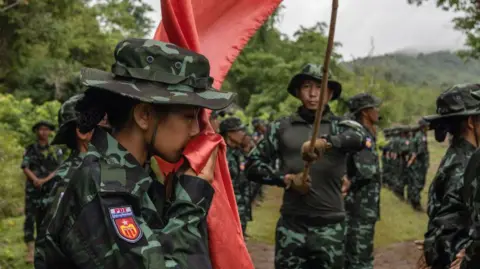
It comprises hundreds of often poorly-armed “people’s defence forces” or PDFs, formed by local villagers or by young activists who fled from the cities, but also seasoned fighters from the ethnic insurgent groups who have been waging war against the central government for decades.
They have their own agendas, harbouring a deep mistrust of the ethnic Burmese majority, and they do not recognise the authority of the National Unity Government which was formed from the administration ousted by the 2021 coup. So there is no central leadership of the movement.
And now, more than four years into a civil war that has killed thousands and displaced millions, the tide is turning once again.
When an alliance of three ethnic armies in Shan State launched their campaign against the military in October 2023 – calling it Operation 1027 – armed resistance to the coup had been going on in much of the country for more than two years, but making little progress.
That changed with Operation 1027. The three groups, calling themselves the Brotherhood Alliance – the Ta’ang National Liberation Army, the Myanmar National Democratic Alliance Army and the Arakan Army – had prepared their attack for months, deploying large numbers of drones and heavy artillery.
They caught military bases off-guard, and within a few weeks had overrun around 180 of them, taking control of a large swathe of northern Shan State, and forcing thousands of soldiers to surrender.
These stunning victories were greeted by the broader opposition movement as a call to arms, and PDFs began attacks in their own areas, taking advantage of low military morale.
As the Brotherhood Alliance moved down Asian Highway 14, towards Myanmar’s second-largest city of Mandalay, there was open speculation that the military regime might collapse.
That did not happen.
“Two things were overstated at the start of this conflict,” says Morgan Michaels, a research fellow at the International Institute of Strategic Studies.
“The three Shan insurgent groups had a long history of working together. When other groups saw their success in 2023, they then synchronised their own offensives, but this was misread as some sort of unified, nationwide opposition steaming towards victory. The second misreading was how bad military morale was. It was bad, but not to the extent where command and control was breaking down.”
The junta responded to its losses in late 2023 by starting a forced conscription drive. Thousands of young Burmese men chose to flee, going into hiding or exile overseas, or joining the resistance.
But more than 60,000 joined the army, replenishing its exhausted ranks. While inexperienced, they have made a difference. Insurgent sources have confirmed to the BBC that the new recruits are one of the factors, together with the drones and air strikes, which have turned the tide on the battlefield.
Drones have given the junta a decisive advantage, reinforcing its supremacy in the air, according to Su Mon, a senior analyst at the Armed Conflict Location and Event Data Project (Acled), which specialises in gathering data on armed conflicts. She has been monitoring the military’s use of drones
“The resistance groups have been telling us that the almost constant drone attacks have killed many of their solders and forced them to retreat. Our data also shows that military air strikes have become more accurate, possibly because they are being guided by drones.”
Meanwhile, she says tighter border controls and China’s ban on the export of dual-use products are making it harder for the resistance groups to get access to drones, or even the components to assemble their own drones.
Prices have risen steeply. And the military has much better jamming technology now, so many of their drones are being intercepted.
The TNLA is not the only ethnic army which is retreating. In April, after strong Chinese pressure, another of the groups in the Brotherhood Alliance, the MNDAA, abandoned Lashio, previously the headquarters of the military in Shan State and a much-heralded prize when the insurgents captured it last year.
The MNDAA has now agreed to stop fighting the junta. And the most powerful and best-armed of the Shan insurgent groups, the UWSA, has also buckled to Chinese demands and agreed to stop supplying weapons and ammunition to other opposition groups in Myanmar.
These groups operate along the border and need regular access to China to function. All China needed to do was close border gates and detain a few of their leaders to get them to comply with its demands.
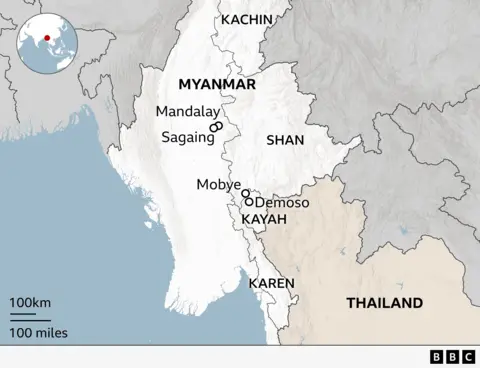
Further south, in Karen State, the junta has regained control of the road to its second most important crossing on the border with Thailand.
The insurgent Karen National Union, which overran army bases along the road a year and a half ago, blames the new conscripts, new drones and betrayal by other Karen militia groups for its losses. It has even lost Lay Kay Kaw, a new town built with Japanese funding in 2015 for the KNU, at a time when it was part of a ceasefire agreement with the central government.
In neighbouring Kayah, where a coalition of resistance groups has controlled most of the state for two years, the military has retaken the town of Demoso, and the town of Mobye, just inside Shan State. It is also advancing in Kachin State in the north, and in contested areas of Sagaing and Mandalay.
However, there are many parts of Myanmar where the junta has been less successful. Armed resistance groups control most of Rakhine and Chin States, and are holding the military at bay, and even driving it back in places.
One factor in the military’s recent victories is that it is concentrating its forces only in strategically important areas, Morgan Michaels believes, like the main trade routes, and towns where it would like to hold the election.
Tellingly Kyaukme and Hsipaw are both designated as places where voting is supposed to take place. The regime has acknowledged that voting will not be possible in 56 out of Myanmar’s 330 townships; the opposition believes that number will be much higher.
China’s influence over the ethnic armies on its border could have stopped them mounting the 1027 operation two years ago. That it chose not to is almost certainly down to its frustration then over the scam centres which had proliferated in areas controlled by clans allied to the junta. The Brotherhood Alliance made sure shutting down the scam centres was at the top of its list of goals.
Today, though, China is giving its wholehearted backing to the junta. It is promising technical and financial aid for the election, and has given visible diplomatic support, arranging two meetings this year between the junta leader Min Aung Hlaing and Xi Jinping. This despite China’s unease about the 2021 coup, and its hugely destructive consequences.
“China opposes chaos and war in Myanmar,” said Foreign Minister Wang Yi in August, which more or less sums up its concerns.
“Beijing’s policy is no state collapse,” Mr Michaels says. “It has no particular love for the military regime, but when it looked like it might teeter and fall, it equated that with state collapse, and stepped in.”
China’s interests in Myanmar are well-known. They share a long border. Myanmar is seen as China’s gateway to the Indian Ocean, and to oil and gas supplies for south-western China. Many Chinese companies now have big investments there.
And with no other diplomatic initiatives making any headway, China’s choice, to bolster the military regime through this election, is likely to be endorsed by other countries in the region.
But even China will find it hard to end the war The devastation and human suffering inflicted by the military on the people of Myanmar have left a legacy of grievances against the generals which may last generations.
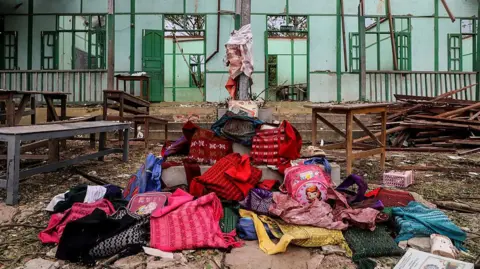
“The military has burned down 110 or 120,000 houses just across the dry zone,” Michaels says.
“The violence has been immense, and there are few people who have not been touched by it. That’s why it is difficult to foresee a political process right now. Being forced into ceasefire because you literally cannot hold your front lines is one thing, but political bargaining for peace still seems very distant.”
[BBC]

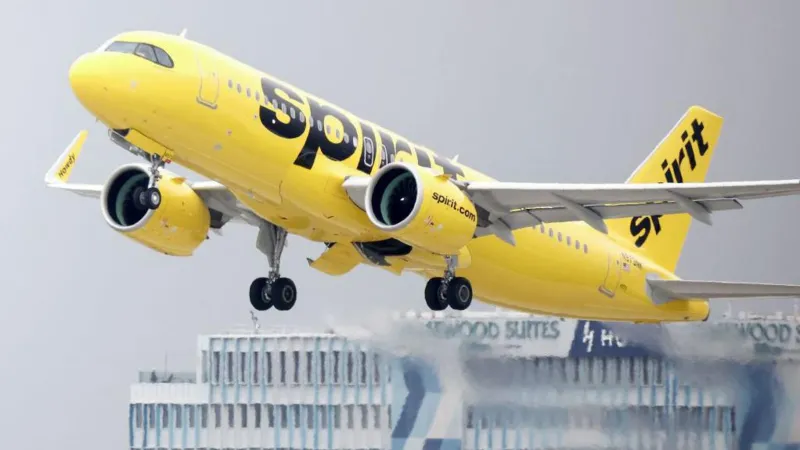
Spirit Airlines is shutting down as a business after failing to secure a $500m (£368m) bailout from the Trump administration.
The budget airline was in talks with the US government about a rescue deal which would have saved it from collapse.
But discussions collapsed and the carrier said in an announcement on its website on Saturday that with “great disappointment” the airline had “started an orderly wind-down of our operations, effective immediately”.
Spirit was emerging from its second bankruptcy filing in recent years before the US-Israel war in Iran, but the resulting surge in jet fuel costs pushed it over the brink.
All upcoming flights with Spirit have been cancelled.
In Saturday’s statement, the airline said it would automatically process refunds for any flights purchased through Spirit with a credit or debit card to the original form of payment.
Guests who booked flights via a travel agent should contact the travel agent directly to request a refund.
Compensation for those who booked flights using a voucher, credit, airline points or any other method will be determined at a later date through the bankruptcy court process.
The airline said it was unfortunately not able to reimburse guests for other related costs such as emergency hotel stays or replacement flights associated with cancelled trips.
Spirit’s customer service is no longer available, the airline said early on Saturday, but customers with questions can contact the carrier’s claims agent.
The airline’s demise was so abrupt that it has left some ticket holders in the lurch.
One Spirit customer, Yash Kothari, told the BBC’s US partner CBS News that he didn’t learn about the airline’s shutdown until he arrived at Philadelphia International Airport for a flight at 05:45 local time (09:45 GMT) on Saturday.
“The email came in at 1 am, so I was unaware,” Kothari told the outlet.
Fuel costs can make up as much as 40% of an airline’s outgoings, and airlines have seen the cost of jet fuel double since the US and Israeli strikes began at the end of February.
Savanthi Syth, airlines analyst at the investment bank Raymond James, said spiralling jet fuel costs in the wake of the Iran war had proved “the final nail in the coffin” for Spirit.
Speaking to the BBC, Syth said the operator had shied away from the radical overhaul it needed during a 2024 bankruptcy procedure.
Spirit had been in the process of making the changes it needed in its current bankruptcy process, scaling back the number of flights it was offering and aircraft it owned, she said.
But its ability to survive the year was in question even before the Iran war, Syth added.
“If it wasn’t for the fuel scenario, they would have been okay through the summer, beyond the summer I would have said it was still precarious.”
Some have been cutting flights and others have hiked fares to cope. with the cost increases. At the same time, the head of the International Energy Agency (IEA) has warned Europe could run out of jet fuel in as little as six weeks.
At the end of April, Spirit had been confident its rescue deal with the Trump administration was to be finalised imminently.
But after that deal fell through, Trump on Friday told BBC partner CBS the airline had been offered “a final proposal” to keep it in business.
The earlier plan, which would have seen the US government take effective ownership of as much as 90% of the airline, faced stiff opposition from Wall Street, Capitol Hill and even a member of Trump’s own cabinet. Transportation Secretary Sean Duffy told Reuters a rescue would amount to tossing “good money after bad”.
[BBC]
“We called it ‘moon dust’,” Jeffery Camp, a 61-year-old retired military veteran who lives in Sarasota, Florida, says when describing the terrain in Maidan Shar, Afghanistan, where he served with the United States Army from 2008 to 2009.
The fine particles of dust there would find their way into “your vehicles, your equipment, your lungs”, he says ruefully while describing the searingly dry summers and freezing windy winters in the eastern provincial capital.
Camp is one of the 832,000 US service members deployed to Afghanistan from 2001 to 2021 during what became the longest war in US history.
He joined the Army in 1983, well before the September 11, 2001, attacks on the US, which led to the war in Afghanistan. “Service was a calling, not a reaction to a national crisis,” he tells Al Jazeera.
During 20 years of war, 2,461 US soldiers were killed and at least 20,000 wounded.
“I left both Iraq and Afghanistan with a profound respect for the human cost of war, not just for American service members but for the populations of those countries. War is not clean, and the people who bear the longest burden are rarely the ones who made the decisions,” Camp says.
Tuesday marks 60 days of the US-Israel war on Iran.
Since February 28, US-Israeli attacks on Iran have killed at least 3,375 people, according to Iran’s Ministry of Health.
The US military has confirmed 13 combat-related deaths among its service members across the region, with more than 200 injuries.

Since the 1950s, US-led wars have killed millions of civilians and tens of thousands of military personnel.
According to an analysis by the Cost of War Project at Brown University’s Watson Institute of International and Public Affairs, US-led wars since 2001 have directly caused the deaths of about 940,000 people across Afghanistan, Pakistan, Iraq, Syria, Yemen and other post-9/11 conflict zones.
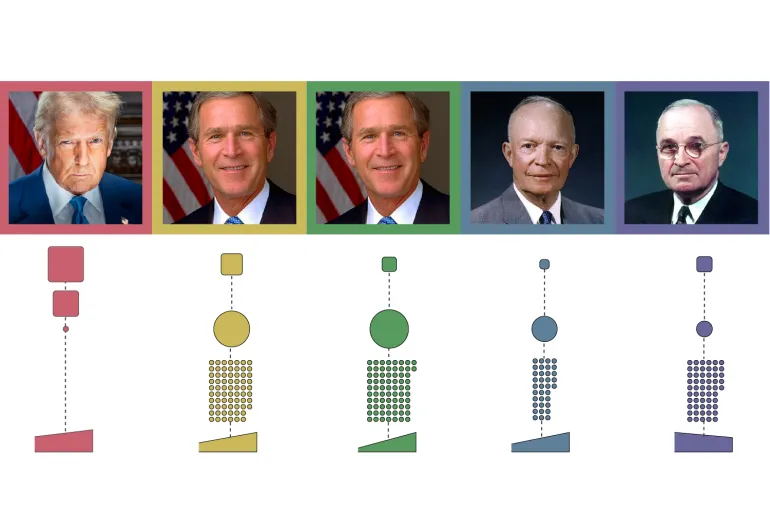
The graphic below breaks down the estimated number of civilians killed for every US soldier in the Korean, Vietnam, Afghanistan and Iraq wars.

Iran war: $11.3bn spent on munitions in first six days
According to the Pentagon, the Trump administration spent $11.3bn during the first six days of the war, with an estimated $1bn subsequently spent on the war every day until the April 8 ceasefire.
According to Mark Cancian, a senior adviser with the Defense and Security Department at the Center for Strategic and International Studies, the $1bn per day figure is “a little high”.
Speaking to Al Jazeera, he says the war “was very expensive in the first few days” because the US used costly long-range munitions, including Tomahawk missiles. They cost $2.5m each, and the US military used hundreds of them.
Cancian calculates that in addition to the $11.3bn spent on munitions, an additional $1.4bn should be added for combat losses and infrastructure damage and a further $26.5m for support costs, bringing the total for the first six days to $12.7bn.
Cancian estimates that after the first week of its air strikes, the US spent “about half a billion dollars a day”, and now, during the ceasefire, that figure is likely “under $100m per day” because the US is not using any munitions.
On a per-day cost basis, the Iran war may be one of the most expensive in recent history.
According to figures from the Costs of War Project, the 20-year Afghanistan war cost an estimated $2.3 trillion, averaging more than $300m per day, while the eight-year Iraq War, which began in 2003, cost an estimated $2 trillion, averaging about $684m per day.

‘Another prolonged war’
Naveed Shah is the political director of Common Defense, a grassroots veteran-led organisation based in Washington, DC, that aims to engage, organise and mobilise veterans.
Shah, who served in Iraq from 2006 to 2010, believes the US must defend its national interests and has a vital role to play in deterring threats, but too often overreaches with open-ended wars of choice that create more problems than they solve.
“The current conflict with Iran is repeating the mistakes that led us to spending 20 years in Iraq and Afghanistan: shaky evidence at best, moving goalposts and dangerous rhetoric that risks drawing us into another prolonged war,” Shah tells Al Jazeera.
“At the same time, while we’re deploying troops overseas, the government is trying to claw back the care we promised for our veterans,” Shah says.
“The true cost of war extends far beyond the battlefield. It echoes for decades in veterans’ bodies and minds and for their families. For the families of the troops who won’t come home, it will be an empty seat at the dinner table and a hole in their heart for eternity,” he says.
According to the Cost of War Project, the US is expected to spend at least $2.2 trillion on obligations for veterans’ healthcare over the next 30 years.
Iran war most unpopular in US history
According to a Reuters/Ipsos poll from April 12, 60 percent of Americans disapprove of US military strikes on Iran. This is up from a 43 percent disapproval rating at the start of the war.
Historically, US wars have mostly enjoyed a “rally around the flag” effect, which causes low disapproval at the outset.
The chart below compares the disapproval rating at the start and end of the five main wars the US has led since the 1950s.

US consumers are paying the price
Marwa Jadoon, 40, from Oklahoma, whose name has been changed to keep her identity concealed, says her out-of-pocket expenses have increased by more than 35 percent over the past couple of months.
“As someone with multiple considerably expensive health conditions, I’m paying more than I’ve ever paid before just to cover only my essential medications and recurring testing. It’s limited my ability to afford additional treatments since healthcare costs are astronomical in the US. I’ve cut costs in groceries and anything outside of essentials,” Jadoon says.
Jadoon feels she’s been shortchanged with the policy shifts that came at the same time she was made redundant, further complicating her life.
“I find it appalling that my tax dollars are funding a war when we have repeatedly been told that we cannot afford universal healthcare. At the end of last year, I lost my job and had to apply for unemployment and Soonercare,” she says, referring to state-covered healthcare.
She explains that unemployment benefits would not even cover her rent.
“How can my tax dollars afford to pay for wars and foreign governments while I can’t even receive Medicaid because they deemed $400 is too much a month? My phone bill alone is $116 a month. My student loan payments are almost $200 a month. I would love to see anyone in the current administration survive on $400 a week with no medical coverage,” Jadoon says.
Another woman in Oklahoma, who also wished to remain anonymous due to her job with the state government, says, “The war in Iran and its funding has made me feel cornered. I feel it at the gas pump, I feel it at the doctor, dentist. I feel it at the bank. I feel it when I’m at the grocery store, thinking how exactly everyone is acting so calm. And it moves me, literally. Emotions carry little power. I’m ready to do something about it. I’ve been stolen from and lied to, and I’ve had enough.
According to the Climate Solutions Lab at the Watson Institute for Public and International Affairs at Brown University, the total consumer burden from the increase in petrol and diesel prices across the US as a result of the war on Iran is estimated at $27.8bn, roughly $200 per household.
The national average price of petrol has increased nearly 40 percent from $2.90 per gallon ($0.76 per litre) before the war to $4.10 per gallon ($1.08 per litre) now.

[Aljazeera]
The United States declared independence from the British crown 250 years ago – but this week, it could not get enough of it.
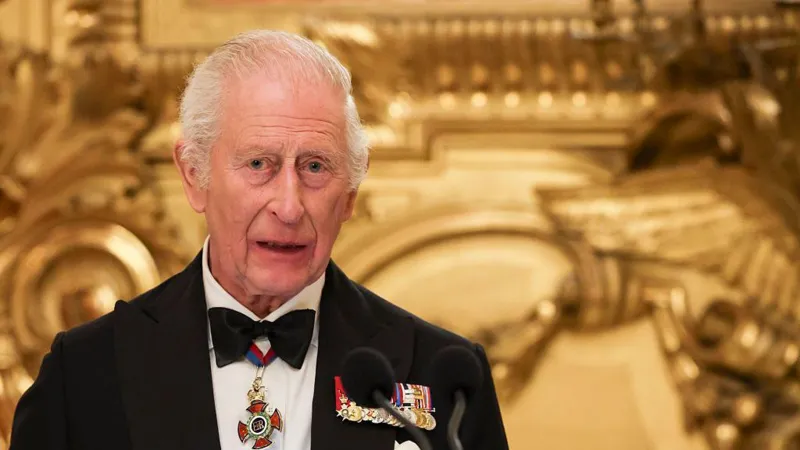
From the minute King Charles and Queen Camilla stepped onto the White House South Lawn, US networks dumped their standard diet of political warfare and breaking news for something rare: pure pageantry.
In a country that seems to agree on almost nothing, the British royals managed something close to a clean sweep – drawing warm receptions from both sides of a political spectrum where neutral ground is rare.
The visit came at a fraught time in US-British relations, with the White House and Downing Street at odds over the war in Iran, straining a relationship both governments insist remains unshakeable.
The reviews following the King’s appearances at the White House, in Congress and in New York were warm across the political divide.
A commentator in the conservative Washington Examiner wrote that the UK needed more than conventional diplomacy – and that King Charles delivered.
“His Majesty’s Government under scandal-plagued Labour Prime Minister Keir Starmer needed the monarchy to do what only the king could do,” the editorial said.
The King’s comments in Congress and at the White House’s lavish banquet on Tuesday – mixing humour with history and a call for unity – also were widely praised.
Some saw them as a subtle rebuke of President Trump.
“Sometimes it takes an outside perspective to see what’s really going on,” an opinion writer wrote in the Arizona Republic. “It’s striking to have a king remind us of what democracy is all about.”
For months, Donald Trump – a committed Anglophile and avid fan of the Royals – repeatedly told reporters that he was excited for the King’s visit. That excitement was on full display throughout the King’s visit to Washington, in which the world saw a warmer version of a president not shy to make his feelings known.
Uncharacteristically, Trump largely stuck to a script, making no mention of policy disagreements with Downing Street and lauding the long ties between the US and Britain.
“Before we ever proclaimed our independence, Americans carried within us the rare gifts of moral courage,” he said. “And it came from a small but mighty kingdom from across the sea.”
On Capitol Hill, where the King became only the second British monarch to address a joint session of Congress, Charles received a standing ovation – though some in the room heard something more pointed in his words.
“As opposed to Keir Starmer, who is looked at…as a leftist weenie, we saw in King Charles – someone who is proud of Britain,” Washington Republican Representative Michael Baumgartner told the BBC. “I think that was good.”
The warm welcome on Capitol Hill was not lost on President Trump.
“He got the Democrats to stand, I’ve never been able to do that. I couldn’t believe it,” Trump said at the banquet a few hours later. “They liked him more than they’ve ever liked any Republican or Democrat, actually.”
Elizabeth Holmes, an expert on the Royal Family and author, told the BBC that many members of the American public are broadly interested in the family, even as that interest has ebbed and flowed over the years.
“I think the fascination is rooted in a combination of novelty and distance,” she said. “It’s not something we have here.”
The King and Queen traveled to New York City on Wednesday where they made a few stops, including one at the 9/11 Memorial. Jacob Knutton, who manages a British-themed restaurant and store in New York, says business has been “a lot busier” around the King’s visit.
“There’s definitely been a lot of people talking about it,” said Knutton, who grew up in London and Australia. “Americans are talking about it and trying to get our opinions on it.”
But not every American is as enthused.
While recent statistics are hard to come by, a YouGov poll conducted in 2024 found that only 42% of Americans held a favourable view of King Charles.
In comparison, his mother, Queen Elizabeth, garnered a 67% approval rating. Over three quarters of those polled – 76% – held a favourable view of the King’s ex-wife, Princess Diana, who died in 1997.
According to Holmes, in the eyes of some Americans, Charles had a “far less compelling” narrative than his mother, who became Queen at a young age.
US feelings about King Charles are further complicated by his complex relationship with son Prince Harry, Holmes added.
Data from Google Trends suggests that US-based searches for the King during the visit spiked by 20 to 25 times over normal, and by 50 times during his speech to Congress.
Others who haven’t followed the royal visit closely, still are excited. “I think it’s cool that he’s here,” said Harry James, 21, who works in a fish and chips shop in New York. “It’s cool we can keep these traditions going.”
Holmes believes the visit already has improved US perceptions of the King. “Trump is such a polarising figure, and I think people were very eager to see their interactions,” she said.
His dinner comments, in particular, have “really taken off”.
“I think people are delighted to see British wit on display,” she added.
Near the White House on Tuesday, some of those who turned out to watch the King’s motorcade pass said they felt hopeful.
“It’s natural for human beings to disagree,” said Maribeth Massie, of Maine, who watched the King’s motorcade near the White House on Monday. “Hopefully they’ll lay some common ground together and move forward.”
Knutton also hopes the visit helps – in part for his business’ sake. His store imports nearly all of its goods from the UK, and feels the pinch of Trump’s tariffs, he said.
“I’m sure it will have an effect,” he said. “But I’m not expecting magical wand-waving.”
[BBC]

PM participated in ’Swarnabhivandana 2026,’ Sacred Relic Veneration Ceremony

Holder and Washington star in Gujarat Titans’ nervy last-over win

Varun and Narine push Sunrisers Hyderabad’s off switch

Aaron Hardie owns big stage to help Peshawar Zalmi lift second PSL title

Showers expected in the the Western, Sabaragamuwa, Central, North-western and Eastern provinces and in Polonnaruwa, Galle and Matara districts after 2.00 pm.

Heat Index at Caution Level in the Northern, North-central, Eastern, Sabaragamuwa and North-western provinces and in Colombo, Gampaha, Hambantota and Monaragala districts during the day time

‘Dates have the highest sugar content to fight Coronavirus’

Sunday Island 27 December – Headlines

#SundayIsland 17th December – Headlines

Sunday Island – 28th March

Sunday Island Headlines – 21 March

Sunday Island – 21st February – Headlines
-

 News5 days ago
Treasury chief’s citizenship details sought from Australia
-

 News4 days ago
Rooftop Solar at Crossroads as Sri Lanka Shifts to Distributed Energy Future
-
 News6 days ago
Govt. assures UN of readiness to introduce ‘vetting process’ for troops on overseas missions
-

 News3 days ago
“Three-in-one blood pressure pill can significantly reduce risk of recurrent strokes”
-
 Business6 days ago
ADB-backed grid upgrade tender signals next phase of Sri Lanka’s energy transition
-

 News5 days ago
Central Province one before last in AL results
-

 Sports5 days ago
Well done AKD!
-

 Business6 days ago
Update on independent forensic review