
Features
My Decision to Leave Home, 1970 A fateful decision

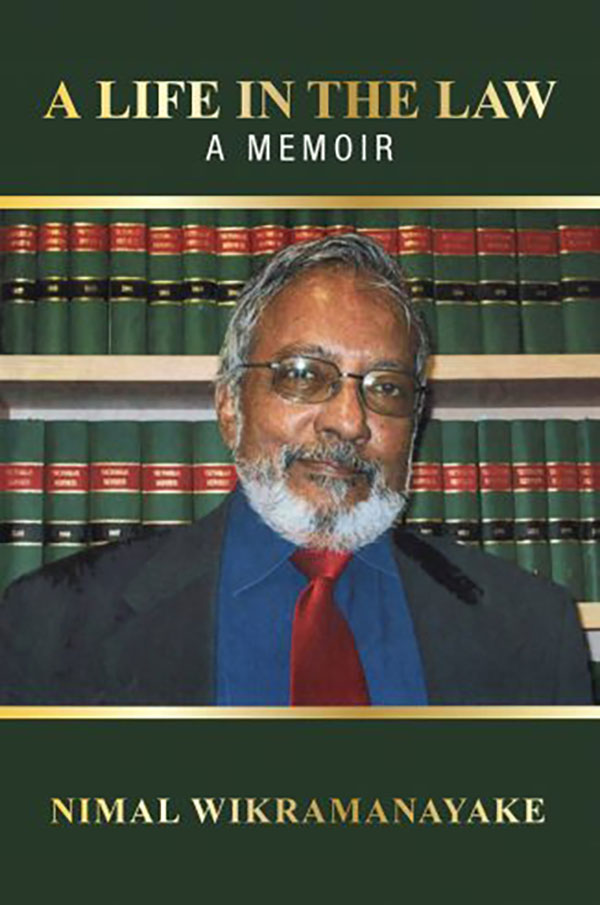
By Nimal Wikremanayeke
(Excerpted from A Life In The Law)
I will now turn to the events that made me leave my wonderful country, my beautiful home and my large practice at the Ceylon Bar in order to emigrate to Australia, a land where I knew no one. Today, looking back, I cannot understand what fit of insanity must have overtaken me to make such a stunning, life-changing decision.
It was May 27, 1970, the day when our prime minister, Dudley Senanayake, decided to fight an election against the combined might of Mrs Sirimavo Bandaranaike’s Sri Lanka Freedom Party, Dr Colvin R De Silva’s Trotskyite Lanka Sama Samaja Party, Mr Pieter Keuneman’s Communist Party and several other miscellaneous parties. We were all extremely confident that Mr Senanayake would triumph and we would have stability in our country for another five years.
My father decided to hold a card party on election night so that we could have an enjoyable night while listening to the election results. Dad was an extremely generous host and he was to provide dinner – a gourmet’s dinner – yellow rice with numerous curries washed down with large quantities of French wines.I woke early that morning, shaved, showered, had my breakfast and went off to vote. The polling booths were filled with supporters of the various parties loudly touting their wares. I took my place in the queue and when it came for my turn to vote, the electoral officer brushed the first joint of my right thumb with indelible ink to prevent me from voting again, took my particulars and gave me my ballot papers. I returned home after voting, confident that our party would be returned to power.
Shortly after 12 noon I left with my wife to go to my club the Twentieth Century Club in Dawson Road, Havelock Town, Colombo. This was a ritual we followed every Saturday morning. When we arrived there, a group of my friends had already commenced their usual Saturday afternoon drinking session. They were seated in a semi-circle outside on the club house lawn and my wife and I joined them.
Life in those days was gracious and we were attended to by solicitous, subservient attendants. After many rounds of fairly heavy drinking, we left for home. We arrived at our well-appointed air-conditioned three-bedroom apartment, with a sitting cum dining room which had French windows opening out onto a covered veranda, and an impressive courtyard. We had two servants, a female cook and a houseboy.
Shortly after three o’clock the cook warmed up our lunch which the houseboy laid out on the dining table. We had our lunch and retired to bed where we were joined by our German shepherd, Sweetheart.We got up later that afternoon, made ourselves ready and went to my parents’ home. My father was one of the leading Queen’s Counsel at the Ceylon Bar. He had a large and spacious home which was built on a quarter of an acre of land over 11,000 square feet together with a quarter-acre of garden.
In addition to his study, the house had five well-appointed bedrooms, with en suite bathrooms in four of them. The home had a large entrance hall, a sitting room, an open-air patio in the middle of the home, a fountain filled with goldfish, an exceptionally large dining room, and attached to it was the billiard room, with a full-sized billiard table and sufficient room to accommodate a large card table.By 7 pm all my father’s guests had arrived and we indulged ourselves in a rousing game of Down the River. This was seven-card stud poker, together with as many jokers as there were players -eleven of us. At about 8.30 pm we sat down to dinner, which we finished by 10 pm. We returned to the card room and sat down to resume playing cards when someone turned on the radio to listen to the election results.
It was customary in Ceylon for the election results to start flooding in at about 10 pm. We did not hear any election results for several hours; all we heard from the local radio station was music, and this went on till about 1 am. We were all extremely puzzled as to why no election results were being declared. Our suspicions should have been aroused by the fact that every half hour, the local radio station kept playing Roger Whittaker’s “New World in the Morning.”
This should have been a warning, a portent of things to come. The local radio station kept repeating this piece of music every half hour until around 1 am, when the election results started flooding in. It was not a defeat, it was not a rout – it was a massacre. As I recall, the Ceylon Parliament consisted of 160 seats in 1970 prior to the election, with the UNP (United National Party) holding 90 seats and the other parties 70 among them. This time, the UNP lost 65 seats and the other parties won 65 seats.The poker game came to an end by 1.30 am and all of us, save for my parents, left for our respective homes. We were shattered. We were completely unaware of the extent to which our lives would change dramatically in the next 12 months as a result of this election.
Astrology
An interesting feature of this election was that Mr Dudley Senanayake’s astrologer was horribly wrong when he predicted that the prime minister would win the election if it was held on May 27, 1970. As a result of the prediction, the prime minister held the election and lost. Some Westerners may scoff at such primitive superstitions, but then why are whole pages devoted in their daily newspapers to astrological predictions?
Regrettably, I too have had my fair share of astrological predictions. In 1960 when I returned to Ceylon and went to the Bar, things were extremely difficult for me. Although my father was chairman of the Associated Motorways Group and a large insurance company, he had sent the secretaries of these companies a directive that I should not be given work.
I knew the secretary, Salman, who told me that there was a brilliant astrologer working as a clerk in the Associated Motorways Group. Salman suggested that I go and see him to obtain an astrological prediction about my future. I went to see him wearing dishevelled clothes and a pair of slippers. I told him what my date and time of birth was and he told me to come a week later. I turned up a week later to see him with Salman. This man looked at me sadly and said, “You poor man. You have no future at all. You are poor and you will always be poor. You have a Kemathrama Yoga.” Salman looked at him and said, “You idiot. This is the chairman’s son!”
One day in the middle of 1964, I was in the Law Library where the advocates normally congregated when they were not in court. I was chatting with two friends of mine, Satyendra and Navaratnarajah, when Satyendra told us that he knew a brilliant astrologer in Jaffna who could read horoscopes and accurately predict the future.
A few days later Nava and I gave Satyendra our respective birth details etc. to pass on to the astrologer who would make up our horoscopes and predict our futures. A couple of weeks later Satyendra turned up with our horoscopes. Satyendra told Nava that the astrologer had predicted a brilliant future for him. Saty then looked at me sadly and said that my horoscope predicted that I had no future. Although it terrified me at the time, this story had both a sad and a happy ending. A month later Nava, contracted hepatitis and died. The happy ending was that I believe the astrologer mixed up our dates of birth, for Nava now had no future and I ended up with a good future.
In fairness to astrology, I must relate an incident that occurred during the middle of 1971. The die was cast and I had crossed the Rubicon. There was a venerable old gentleman at the Ceylon Bar, a Mr M. Somasunderam. He was a contemporary of Dad’s. Someone at the Bar told me that Soma was excellent at reading palms and was an exceptional palmist. I buttonholed him in the Law Library and asked him whether I could speak to him on a personal matter. I told him that I was going to live out my days in Australia so could he please read my palm and tell me what my future was.
He took my palm in his hand and studied it for quite some time. He smiled a gentle smile, then said, “Wikramanayake, you have nothing to worry about. You will have a brilliant future in Australia” I was flabbergasted. I told him that this was impossible as I knew no one in Australia. He patted me on the shoulder smiled, saying, “Remember me when you are famous.” So, Soma, I am having a glass of Blue Label Scotch whisky in remembrance of you while I type this memoir.
Post-election horror
Elections in Ceylon were gory events. As one of the leaders of the Gauls said, when addressing the Roman Senate well over 2,000 years ago, “Vae ago, ae victis – woe to the conquered” The supporters of the successful winning party always exacted their revenge on the supporters of the losing party. A large number of supporters of the losing party were usually viciously beaten up while the police watched on without interfering, and houses belonging to members of the United National Party were torched.
The country was quiet on Sunday, but on Monday, the assaults and beatings started. I remember what happened to a cousin of mine, Michael Wikramanayake. He was the manager of a large government cooperative store. Michael had been known for the fact being a UNP sympathiser. He was seated in his office on Monday morning when the workers stormed in. They tied him to his chair and poured blue and red paint over him. Blue paint symbolised the Sri Lankan Freedom Party (SLFP), the red paint the Communist Party. Michael was badly beaten and lost an eye. The poor man was devastated; he not only lost his job but received no help from the police.
Yet this was only the beginning. Mrs Bandaranaike had more than a two-thirds majority in Parliament, and she amended the constitution. She announced that Sinhalese was to be the national language, and that cases in the law courts would shortly be conducted in the Sinhalese language and not in English, as had been done for over 150 years. Court documents were also to be written in the Sinhalese language. Up to that time, the work in the courts was conducted in English. The government created a High Court, a new court midway between the District Court and the Supreme Court. The government appointed seventeen new judges from lawyers who were members of Mrs Bandaranaike’s party, the SLFP. Lawyers from her party who were competent in Sinhalese were tasked with translating the Civil Procedure Code and the laws of the country into Sinhalese.
My attempt at coping
I took on two extremely competent young Sinhalese-educated lawyers as my readers to help me cope with conducting my cases in Sinhalese. Regrettably, I must confess that although I could speak my mother tongue, I could scarcely read or write it. I would now have to learn to think in Sinhalese. How was I to do this? I was thirty-seven years old.
My father had been a classics scholar before he studied law. He had introduced me to The Iliad, The Odyssey, Sophocles, Aeschylus, Euripides and the like when I was ten years old. English was the language we spoke at home and Sinhalese was used only to speak to the servants. I am not proud of this fact. While I was growing up, the British were in power and my language was suppressed by the British, who called it “the vernacular” This continued until I was fifteen years old.
In school, we had one period a week in Sinhalese before Ceylon received independence. I excelled in all the other subjects, save for my mother tongue. In 1948, when we received our independence the scene changed dramatically. From this time, we had a period of two hours of Sinhalese every day and I just could not cope with it. I was slapped regularly by my Sinhalese master, Mr Jayasekere, for not knowing Sinhalese. I excelled in Latin but failed miserably in Sinhalese. I never received less than 190 marks out of 200 in Latin but no more than 40 out of 200 in Sinhalese. This went on for several years until I went off to England to study, to widen my repertoire and broaden my horizons.
My lack of knowledge of my mother tongue had now returned to haunt me. After the election in May 1970, I mentioned my displeasure at this new turn of events in the Law Library to a Sinhalese-educated advocate. He sniggered and said sarcastically, “The dogs bark, but the caravan moves on” Yes, the caravan was moving on and leaving me behind barking madly.
I thought to myself, how the hell am I going to think and address the court in Sinhalese? I was at my wits’ end wondering what to do. As the situation continued like this for a few months I was beginning to despair. The two new Sinhala-educated lawyers I had employed tried to help me cope with my lack of knowledge of the Sinhalese language but to no avail.
I happened to go to the Magistrates’ Court in Colombo South in August 1970 and met a friend of mine, Clarence Fernando. We were discussing our situation and pondering what we were to do. Clarence told me that all was not lost. A friend of his, Frank Pereira, had recently migrated to Australia. He told me that Frank was in the legal profession and was doing extremely well. Heartened by this little titbit, I decided to emigrate to Australia. Had I known the truth about Frank Pereira, I certainly would not have abandoned my large practice at the Ceylon Bar and migrated to Australia. I could still have conquered the Sinhalese language and have had a gracious life in Ceylon.
I returned home and asked my dear wife Anna Maria, “Shall we go to Australia?” Anna Maria, bless her, was always game for anything I wanted to do. It was only many years later that she told me she was terrified when I had asked her whether we should go to Australia.When I came to Australia I learned that Frank Pereira was a law clerk earning a relatively small income of $30 a week. In 1970, secretaries in Australia were earning $60 a week.
Napoleon Bonaparte
In desperation I turned for guidance to my Emperor, Napoleon Bonaparte. Napoleon had been a great source of inspiration to me ever since my school days. One of my classmates, Ralph Deraniyagala, was an avid disciple of Napoleon. He suffered from a bad case of Napoleonitis and was an eccentric young boy. When we were young lads in our early teens, he had selected most of us, in class, to be Napoleon’s marshals and I was fortunate to be chosen as Marshal Ney.
Ralph was not only eccentric but also extremely impulsive. He would disrupt our lessons in class by springing up from his seat and shouting out to one of his marshals to charge. He would seriously upset the equilibrium in the class but the masters tolerated his bizarre behaviour. As a result of Ralph, I started devouring whatever books I could read on the life of Napoleon Bonaparte, starting with Abbott’s magnificent treatise on the life of Napoleon. Napoleon was of the view that there was always a “Career open to talent” He proclaimed that he was “a Corsican by birth, a Frenchman by adoption and an Emperor by conquest”. It was his belief that if one had ability, one could succeed anywhere in the world. So I decided to take up the challenge and emigrate to Australia.
Ronnie de Kretser
One of my father’s readers, Ivor Misso, had left for Australia in the 1950s. Misso had a substantial practice in the District Court of Colombo but had left for what he thought would be greener pastures. Dad wrote to him to ask him whether he could help me in my new adventure. Ivor Misso wrote back, suggesting that Dad write to Ronnie de Kretser, a partner in the solicitors’ firm of Weigall & Crowther in Melbourne. Ronnie had qualified as a proctor of the Ceylon Supreme Court in 1948 and left for Australia at the same time as Ivor Misso in 1956. Dad then wrote to Ronnie who advised me to put in my application for immigration and send him a copy, as the Minister for Immigration, Mr Phillip Lynch, was a good friend of his.
We duly made our application for immigration in November and we were successful due to the efforts of Ronnie de Kretser. I received a warm letter from Phillip Lynch congratulating me on my application and wishing me all the best in my new country. We were passed for immigration in December and it was only then I began to have second thoughts about migrating to Australia.However, Melbourne, my intended destination, was not unfamiliar to me as Dad had brought us out to Australia on a one-month holiday in 1952.1 had liked it then.
Distribution of work
Late in 1970, all the government corporation work was given to friends of the SLFP, Mrs Bandaranaike’s party. This was nothing new. Each successive government in Ceylon repaid its loyal supporters by giving them government legal work. (I was to be unpleasantly surprised many years later to also find that some work in Australia is handed out on patronage and privilege.)
One of the privileged few was P Herat who did work on the “motion roll”, which consisted of the list of summary matter applications to be heard in the Motion Court. That was the extent of his practice. The five District Courts had an hour’s work on the motion roll every morning before the trials for the day were heard. These summary matters were determined by the judge. Herat had never conducted a trial prior to Mrs Bandaranaike coming to power in 1970, and did not know how a trial should be conducted.
As I mentioned earlier, I had a large and a lucrative commercial practice. I was briefed for the defendant in a “mortgage bond” case. In Ceylon, a mortgage under Roman-Dutch law could only be enforced by court proceedings, unlike in Australia, where proceedings for possession could be issued after the mortgage had been terminated by appropriate notice. I had no defence to the action as my client was seriously in default of his obligations under the mortgage.
Herat was briefed to appear for the plaintiff, the State Mortgage Bank, a government institution. When we went to court, he was gloating and told me that the days of the English-speaking advocates were over for it was now the turn of the Sinhala-educated lawyers.
The case was called on for hearing before Judge Vaitialingam. Herat opened his case with bravado and then led his evidence. He kept smirking as he knew my client had no defence. The evidence he led was short and sweet. He led evidence that the mortgage had not been paid, then sat down. He did not lead any evidence that my client was in default. He did not lead any evidence that a demand had been paid for the arrears. Nor did he lead any evidence that my client had failed to cure his default. He then closed his case.
I asked him whether he had finished. He said “yes” I asked him several times whether he had finished and he kept getting angrier and angrier. The judge then asked him whether he had finished and he again replied “yes” I then made a No Case submission upon which Herat sought to re-open his case. The judge refused his application, saying that I had asked him sever-at times whether he had finished to which Herat had replied “yes” The judge had also asked him the same question and got an answer in the affirmative. He refused Herat’s application and dismissed his case.
It cost the bank Rs 150,000 or the equivalent of $30,000, a substantial sum of money in 1970.1 gave Herat the two-finger salute which Henry V’s longbowman gave the French at the Battle of Agincourt and walked out of court.Suffice it to say that Herat did not get another government brief. This case was not included here for the purpose of skiting about my forensic ability, but for the purpose of illustrating that patronage can occasionally go wrong.

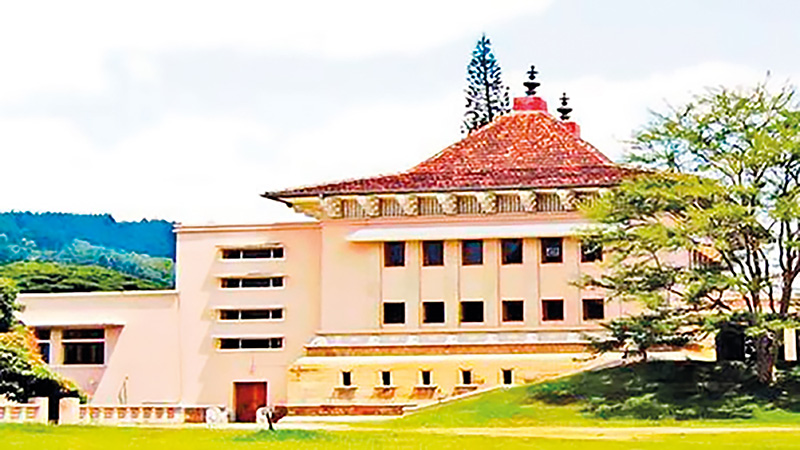
A recent discussion by former Environment Minister, Eng. Patali Champika Ranawaka on the Derana 360 programme has reignited an important national conversation on how Sri Lanka plans, builds and rebuilds in the face of recurring disasters.
His observations, delivered with characteristic clarity and logic, went beyond the immediate causes of recent calamities and focused sharply on long-term solutions—particularly the urgent need for smarter land use and vertical housing development.
Ranawaka’s proposal to introduce multistoried housing schemes in the Gannoruwa area, as a way of reducing pressure on environmentally sensitive and disaster-prone zones, resonated strongly with urban planners and environmentalists alike.
It also echoed ideas that have been quietly discussed within academic and conservation circles for years but rarely translated into policy.
One such voice is that of Professor Siril Wijesundara, Research Professor at the National Institute of Fundamental Studies (NIFS) and former Director General of the Royal Botanic Gardens, Peradeniya, who believes that disasters are often “less acts of nature and more outcomes of poor planning.”

Professor Siril Wijesundara
“What we repeatedly see in Sri Lanka is not merely natural disasters, but planning failures,” Professor Wijesundara told The Island.
“Floods, landslides and environmental degradation are intensified because we continue to build horizontally, encroaching on wetlands, forest margins and river reservations, instead of thinking vertically and strategically.”
The former Director General notes that the University of Peradeniya itself offers a compelling case study of both the problem and the solution. The main campus, already densely built and ecologically sensitive, continues to absorb new faculties, hostels and administrative buildings, placing immense pressure on green spaces and drainage systems.
“The Peradeniya campus was designed with landscape harmony in mind,” he said. “But over time, ad-hoc construction has compromised that vision. If development continues in the same manner, the campus will lose not only its aesthetic value but also its ecological resilience.”
Professor Wijesundara supports the idea of reorganising the Rajawatte area—located away from the congested core of the university—as a future development zone. Rather than expanding inward and fragmenting remaining open spaces, he argues that Rajawatte can be planned as a well-designed extension, integrating academic, residential and service infrastructure in a controlled manner.
Crucially, he stresses that such reorganisation must go hand in hand with social responsibility, particularly towards minor staff currently living in the Rajawatte area.
“These workers are the backbone of the university. Any development plan must ensure their dignity and wellbeing,” he said. “Providing them with modern, safe and affordable multistoried housing—especially near the railway line close to the old USO premises—would be both humane and practical.”
According to Professor Wijesundara, housing complexes built near existing transport corridors would reduce daily commuting stress, minimise traffic within the campus, and free up valuable land for planned academic use.
More importantly, vertical housing would significantly reduce the university’s physical footprint.
Drawing parallels with Ranawaka’s Gannoruwa proposal, he emphasised that vertical development is no longer optional for Sri Lanka.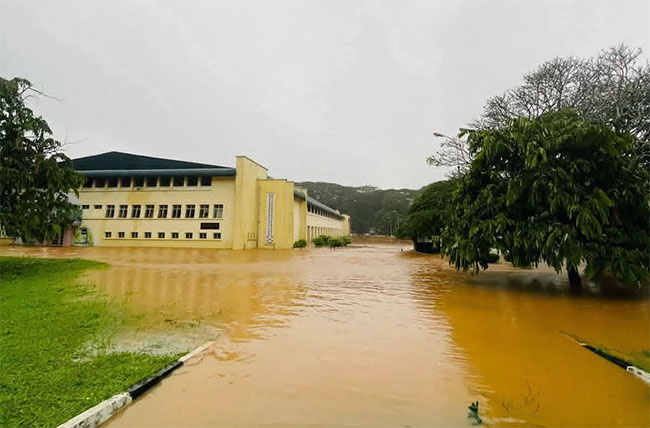
“We are a small island with a growing population and shrinking safe land,” he warned.
“If we continue to spread out instead of building up, disasters will become more frequent and more deadly. Vertical housing, when done properly, is environmentally sound, economically efficient and socially just.”

Peradeniya University flooded
The veteran botanist also highlighted the often-ignored link between disaster vulnerability and the destruction of green buffers.
“Every time we clear a lowland, a wetland or a forest patch for construction, we remove nature’s shock absorbers,” he said.
“The Royal Botanic Gardens has survived floods for over a century precisely because surrounding landscapes once absorbed excess water. Urban planning must learn from such ecological wisdom.”
Professor Wijesundara believes that universities, as centres of knowledge, should lead by example.
“If an institution like Peradeniya cannot demonstrate sustainable planning, how can we expect cities to do so?” he asked. “This is an opportunity to show that development and conservation are not enemies, but partners.”
As climate-induced disasters intensify across the country, voices like his—and proposals such as those articulated by Patali Champika Ranawaka—underscore a simple but urgent truth: Sri Lanka’s future safety depends not only on disaster response, but on how and where we build today.
The challenge now lies with policymakers and planners to move beyond television studio discussions and academic warnings, and translate these ideas into concrete, people-centred action.
By Ifham Nizam ✍️

At the initial stage of my six-year involvement in uplifting society through skill-based initiatives, particularly by promoting handicraft work and teaching students to think creatively and independently, my efforts were partially jeopardized by deep-rooted superstition and resistance to rational learning.
Superstitions exerted a deeply adverse impact by encouraging unquestioned belief, fear, and blind conformity instead of reasoning and evidence-based understanding. In society, superstition often sustains harmful practices, social discrimination, exploitation by self-styled godmen, and resistance to scientific or social reforms, thereby weakening rational decision-making and slowing progress. When such beliefs penetrate the educational environment, students gradually lose the habit of asking “why” and “how,” accepting explanations based on fate, omens, or divine intervention rather than observation and logic.
Initially, learners became hesitant to challenge me despite my wrong interpretation of any law, less capable of evaluating information critically, and more vulnerable to misinformation and pseudoscience. As a result, genuine efforts towards social upliftment were obstructed, and the transformative power of education, which could empower individuals economically and intellectually, was weakened by fear-driven beliefs that stood in direct opposition to progress and rational thought. In many communities, illnesses are still attributed to evil spirits or curses rather than treated as medical conditions. I have witnessed educated people postponing important decisions, marriages, journeys, even hospital admissions, because an astrologer predicted an “inauspicious” time, showing how fear governs rational minds.
While teaching students science and mathematics, I have clearly observed how superstition acts as a hidden barrier to learning, critical thinking, and intellectual confidence. Many students come to the classroom already conditioned to believe that success or failure depends on luck, planetary positions, or divine favour rather than effort, practice, and understanding, which directly contradicts the scientific spirit. I have seen students hesitate to perform experiments or solve numerical problems on certain “inauspicious” days.
In mathematics, some students label themselves as “weak by birth”, which creates fear and anxiety even before attempting a problem, turning a subject of logic into a source of emotional stress. In science classes, explanations based on natural laws sometimes clash with supernatural beliefs, and students struggle to accept evidence because it challenges what they were taught at home or in society. This conflict confuses young minds and prevents them from fully trusting experimentation, data, and proof.
Worse still, superstition nurtures dependency; students wait for miracles instead of practising problem-solving, revision, and conceptual clarity. Over time, this mindset damages curiosity, reduces confidence, and limits innovation, making science and mathematics appear difficult, frightening, or irrelevant. Many science teachers themselves do not sufficiently emphasise the need to question or ignore such irrational beliefs and often remain limited to textbook facts and exam-oriented learning, leaving little space to challenge superstition directly. When teachers avoid discussing superstition, they unintentionally reinforce the idea that scientific reasoning and superstitious beliefs can coexist.
To overcome superstition and effectively impose critical thinking among students, I have inculcated the process to create a classroom culture where questioning was encouraged and fear of being “wrong” was removed. Students were taught how to think, not what to think, by consistently using the scientific method—observation, hypothesis, experimentation, evidence, and conclusion—in both science and mathematics lessons. I have deliberately challenged superstitious beliefs through simple demonstrations and hands-on experiments that allow students to see cause-and-effect relationships for themselves, helping them replace belief with proof.
Many so-called “tantrik shows” that appear supernatural can be clearly explained and exposed through basic scientific principles, making them powerful tools to fight superstition among students. For example, acts where a tantrik places a hand or tongue briefly in fire without injury rely on short contact time, moisture on the skin, or low heat transfer from alcohol-based flames rather than divine power.
“Miracles” like ash or oil repeatedly appearing from hands or idols involve concealment or simple physical and chemical tricks. When these tricks are demonstrated openly in classrooms or science programmes and followed by clear scientific explanations, students quickly realise how easily perception can be deceived and why evidence, experimentation, and critical questioning are far more reliable than blind belief.
Linking concepts to daily life, such as explaining probability to counter ideas of luck, or biology to explain illness instead of supernatural causes, makes rational explanations relatable and convincing.
Another unique example that I faced in my life is presented here. About 10 years ago, when I entered my new house but did not organise traditional rituals that many consider essential for peace and prosperity as my relatives believed that without them prosperity would be blocked. Later on, I could not utilise the entire space of my newly purchased house for earning money, largely because I chose not to perform certain rituals.
While this decision may have limited my financial gains to some extent, I do not consider it a failure in the true sense. I feel deeply satisfied that my son and daughter have received proper education and are now well settled in their employment, which, to me, is a far greater achievement than any ritual-driven expectation of wealth. My belief has always been that a house should not merely be a source of income or superstition-bound anxiety, but a space with social purpose.
Instead of rituals, I strongly feel that the unused portion of my house should be devoted to running tutorials for poor and underprivileged students, where knowledge, critical thinking, and self-reliance can be nurtured. This conviction gives me inner peace and reinforces my faith that education and service to society are more meaningful measures of success than material profit alone.
Though I have succeeded to some extent, this success has not been complete due to the persistent influence of superstition.
by Dr Debapriya Mukherjee
Former Senior Scientist
Central Pollution Control Board, India ✍️


 Australian Prime Minister Anthony Albanese has done very well to speak-up against and outlaw race hate in the immediate aftermath of the recent cold-blooded gunning down of several civilians on Australia’s Bondi Beach. The perpetrators of the violence are believed to be ardent practitioners of religious and race hate and it is commendable that the Australian authorities have lost no time in clearly and unambiguously stating their opposition to the dastardly crimes in question.
The Australian Prime Minister is on record as stating in this connection: ‘ New laws will target those who spread hate, division and radicalization. The Home Affairs Minister will also be given new powers to cancel or refuse visas for those who spread hate and a new taskforce will be set up to ensure the education system prevents, tackles and properly responds to antisemitism.’
It is this promptness and single-mindedness to defeat race hate and other forms of identity-based animosities that are expected of democratic governments in particular world wide. For example, is Sri Lanka’s NPP government willing to follow the Australian example? To put the record straight, no past governments of Sri Lanka initiated concrete measures to stamp out the evil of race hate as well but the present Sri Lankan government which has pledged to end ethnic animosities needs to think and act vastly differently. Democratic and progressive opinion in Sri Lanka is waiting expectantly for the NPP government’ s positive response; ideally based on the Australian precedent to end race hate.
Meanwhile, it is apt to remember that inasmuch as those forces of terrorism that target white communities world wide need to be put down their counterpart forces among extremist whites need to be defeated as well. There could be no double standards on this divisive question of quashing race and religious hate, among democratic governments.
The question is invariably bound up with the matter of expeditiously and swiftly advancing democratic development in divided societies. To the extent to which a body politic is genuinely democratized, to the same degree would identity based animosities be effectively managed and even resolved once and for all. To the extent to which a society is deprived of democratic governance, correctly understood, to the same extent would it experience unmanageable identity-bred violence.
This has been Sri Lanka’s situation and generally it could be stated that it is to the degree to which Sri Lankan citizens are genuinely constitutionally empowered that the issue of race hate in their midst would prove manageable. Accordingly, democratic development is the pressing need.
While the dramatic blood-letting on Bondi Beach ought to have driven home to observers and commentators of world politics that the international community is yet to make any concrete progress in the direction of laying the basis for an end to identity-based extremism, the event should also impress on all concerned quarters that continued failure to address the matters at hand could prove fatal. The fact of the matter is that identity-based extremism is very much alive and well and that it could strike devastatingly at a time and place of its choosing.
It is yet premature for the commentator to agree with US political scientist Samuel P. Huntingdon that a ‘Clash of Civilizations’ is upon the world but events such as the Bondi Beach terror and the continuing abduction of scores of school girls by IS-related outfits, for instance, in Northern Africa are concrete evidence of the continuing pervasive presence of identity-based extremism in the global South.
As a matter of great interest it needs mentioning that the crumbling of the Cold War in the West in the early nineties of the last century and the explosive emergence of identity-based violence world wide around that time essentially impelled Huntingdon to propound the hypothesis that the world was seeing the emergence of a ‘Clash of Civilizations’. Basically, the latter phrase implied that the Cold War was replaced by a West versus militant religious fundamentalism division or polarity world wide. Instead of the USSR and its satellites, the West, led by the US, had to now do battle with religion and race-based militant extremism, particularly ‘Islamic fundamentalist violence’ .
Things, of course, came to a head in this regard when the 9/11 calamity centred in New York occurred. The event seemed to be startling proof that the world was indeed faced with a ‘Clash of Civilizations’ that was not easily resolvable. It was a case of ‘Islamic militant fundamentalism’ facing the great bulwark, so to speak, of ‘ Western Civilization’ epitomized by the US and leaving it almost helpless.
However, it was too early to write off the US’ capability to respond, although it did not do so by the best means. Instead, it replied with military interventions, for example, in Iraq and Afghanistan, which moves have only earned for the religious fundamentalists more and more recruits.
Yet, it is too early to speak in terms of a ‘Clash of Civilizations’. Such a phenomenon could be spoken of if only the entirety of the Islamic world took up arms against the West. Clearly, this is not so because the majority of the adherents of Islam are peaceably inclined and want to coexist harmoniously with the rest of the world.
However, it is not too late for the US to stop religious fundamentalism in its tracks. It, for instance, could implement concrete measures to end the blood-letting in the Middle East. Of the first importance is to end the suffering of the Palestinians by keeping a tight leash on the Israeli Right and by making good its boast of rebuilding the Gaza swiftly.
Besides, the US needs to make it a priority aim to foster democratic development worldwide in collaboration with the rest of the West. Military expenditure and the arms race should be considered of secondary importance and the process of distributing development assistance in the South brought to the forefront of its global development agenda, if there is one.
If the fire-breathing religious demagogue’s influence is to be blunted worldwide, then, it is development, understood to mean equitable growth, that needs to be fostered and consolidated by the democratic world. In other words, the priority ought to be the empowerment of individuals and communities. Nothing short of the latter measures would help in ushering a more peaceful world.

Australia seize handy lead after Josh Tongue five-for on 20-wicket day

Showers may occur in the Northern, Eastern and Uva provinces and in Polonnaruwa, Matale and Nuwara-Eliya districts

Lankan aircrew fly daring UN Medevac in hostile conditions in Africa

Lanka to observe National Safety Day today

Street vendors banned from Kandy City

Police fully armed with breathalyser test kits during season of cheer

‘Dates have the highest sugar content to fight Coronavirus’

Sunday Island 27 December – Headlines

#SundayIsland 17th December – Headlines

Sunday Island – 28th March

Sunday Island Headlines – 21 March

Sunday Island – 21st February – Headlines
-

 News3 days ago
Members of Lankan Community in Washington D.C. donates to ‘Rebuilding Sri Lanka’ Flood Relief Fund
-

 Latest News6 days ago
Landslide early warnings issued to the districts of Badulla, Kandy, Kurunegala, Matale and Nuwara-Eliya extended till 8AM on Sunday (21)
-

 News4 days ago
Air quality deteriorating in Sri Lanka
-

 Business5 days ago
Browns Investments sells luxury Maldivian resort for USD 57.5 mn.
-

 Editorial6 days ago
Cops as whipping boys?
-

 News4 days ago
Cardinal urges govt. not to weaken key socio-cultural institutions
-
 Features5 days ago
Another Christmas, Another Disaster, Another Recovery Mountain to Climb
-
 Features5 days ago
Hatton Plantations and WNPS PLANT Launch 24 km Riparian Forest Corridor