
Latest News
Mushfiqur 191 hands Bangladesh 117-run lead, and clear advantage ahead of final day

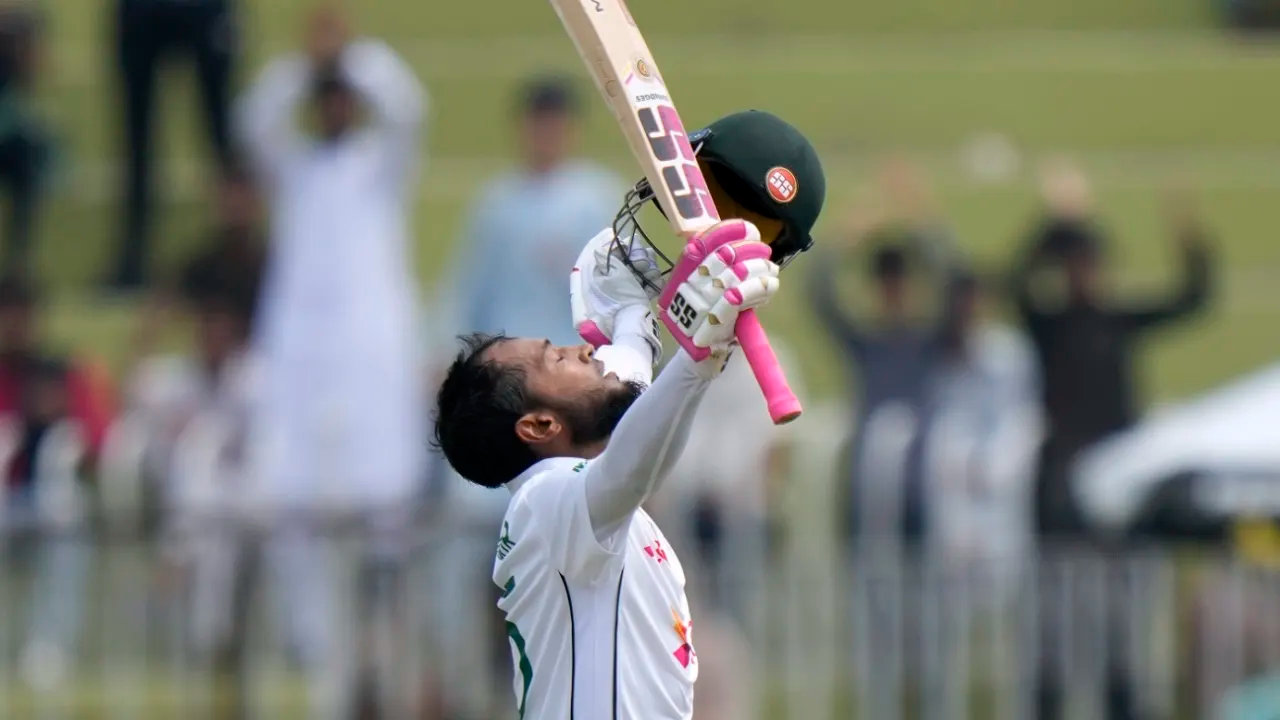
Mushfiqur Rahim turned the tables on Pakistan on a hot and humid fourth day in Rawalpindi with an innings of 191 by being a figure of patience, and exhibiting controlled aggression and compact technique. His 11th Test hundred was also his first against Pakistan in the format.
Mushfiqur’s two century partnerships poured water on any hopes the hosts had of taking a first-innings lead at the start of the day. Riding on his knock, Bangladesh first took a sizeable lead of 117 runs by putting up 565, and then adding to Pakistan’s jitters by dismissing Saim Ayub late in the day, with the hosts still trailing by 94 runs with three sessions left in the game.
Bangladesh’s opening bowlers Shoriful Islam and Hasan Mahmud swung the ball beautifully in the ten overs Pakistan had to see through. They drew multiple edges out of which only one carried, beat the edges of the bat consistently, and bowled stifling lines to create several tense moments for Pakistan to concede only 23 runs.
Mushfiqur’s century partnership with Litton Das didn’t last long on Saturday, and when he added another hundred with No. 8 Mehidy Hasan Miraz, it made Bangladesh only the second team with two century partnerships after the fall of the fifth wicket in a Test innings against Pakistan. Mehidy gave Mushfiqur company in a massive stand of 196 runs for the seventh wicket with his seventh Test half-century – and only his second outside Bangladesh – which first loosened Pakistan’s grip on the game, and then strengthened their own by taking a lead after lunch.
Bangladesh were 316 for 5 and trailing by 132 at the start of the day, which will make Pakistan rue the chances they put down to allow a wicketless second session. Seeing that there was nothing in the pitch for the bowlers, and that Pakistan were without any frontline spinner, the visitors changed gears after a slow first hour.
The only time Mushfiqur came close to getting dismissed in the first session was when Mohammad Ali trapped him in front, on 59, but a review overturned the on-field decision. Ali jagged one sharply into Mushfiqur with the help of movement off the pitch to hit him in front of leg stump. Mushfiqur, however, reviewed with success, with ball-tracking showing the ball missing leg stump. Bangladesh had started the day with all three reviews intact while Pakistan had none left in the bank.
Once Litton edged one behind off Naseem Shah’s short delivery outside off which he failed to get on top of, Mushfiqur hit the pedal – especially against the spinners. Soon after Mehidy, whose technique wasn’t as compact as Mushfiqur’s in the first session, collected fours in consecutive overs off Khurram Shahzad, Mushfiqur raced from 73 to 100 in just 20 balls. He punished Shahzad for two more fours in an over – a deft steer through gully, and a punch through the covers – before also driving Shaheen Shah Afridi straight for four in the next over, to reach 88.
With Bangladesh chipping away at the deficit and Pakistan desperate for wickets, Masood brought on spin from both ends with 12 minutes left for lunch, and Mushfiqur cashed in. He smote Ayub for back-to-back fours, first against the turn over midwicket and then to the long-on boundary to reach 96, and in the next over nudged one to the leg side for two to spark off animated celebrations for his hundred.
In the second session, the temperature had crossed 35 degrees Celsius, Pakistan had bowled over 100 overs already, and it was going to take something extraordinary to take the remaining four wickets quickly. Mehidy looked a lot more assured after lunch, while Mushfiqur continued to play the ball late and right under his eyes to collect runs. Ali soon resorted to a short-ball plan for Mehidy by placing six fielders on the leg side, but his wayward lines failed to create opportunities, and Pakistan moved away from that tactic a bit too soon.
The scant Pakistan crowd at the ground thought Mushfiqur, on 126, was finally gone when he nudged a ball from Agha Salman to square leg, but the ball actually fell just short of Saud Shakeel. Mushfiqur wasn’t deterred though; he then lofted Salman over Shakeel two balls later to bring up the century stand as Bangladesh soon took the lead, and when he reached 140, Mushfiqur had overtaken Tamim Iqbal as Bangladesh’s top scorer in away Tests.
The real chance of dismissing Mushfiqur came after he reached 150, when he tickled the ball down leg where Babar Azam put down a catch at leg slip to his left. Mehidy, meanwhile, moved along to his half-century, and in the last over before tea, Mushfiqur smacked Salman for four over extra cover and then almost for a six to the long-on boundary to further stamp Bangladesh’s authority on the day.
Once Mushfiqur fell in the last session by edging Ali behind just before the third new ball was taken, Shoriful gave his side the kind of attacking and late lift Afridi had given Pakistan, with 22 runs off 14 balls, while Afridi took two of the last three wickets with the new ball to help Pakistan take 4 for 37 and wrap Bangladesh’s lower order up.
Among the Pakistan bowlers, Salman toiled the most by bowling a spell of 24 overs, split by the tea break, which saw 16 overs on the trot in the second session.
Brief scores:
Pakistan 448 for 6 dec and 23 for 1 in 10 overs (Abdullah Shafique 12*, Shan Masood 9*, Shoriful Islam 1-13) trail Bangladesh 565 in 167.3 overs (Mushfiqur Rahim 191, Mehidy Hasan Miraz 77, Litton Das 56; Naseem Shah 3-93) by 94 runs
[Cricinfo]
[Cricinfo]

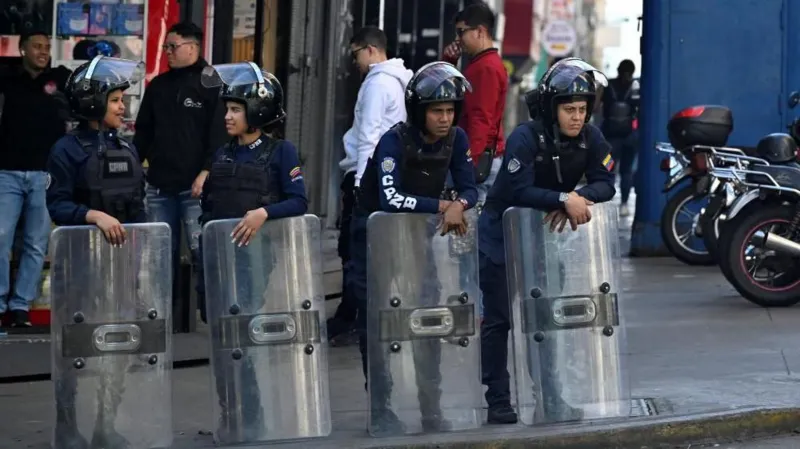
At least 14 members of the press were detained in Venezuela on Monday as they were covering the aftermath of the seizure of Venezuelan leader Nicolás Maduro by US forces.
The union representing media workers in Venezuela said all but one of those detained were employed by foreign news organisations and were released later on Monday, with one reporter deported.
Foreign news media have long faced restrictions in Venezuela, with very few being granted visas to work in the country.
Their detention came as Delcy Rodríguez was sworn in as the interim president and shortly after she said that she was willing to co-operate with the Trump administration, which has said it would “run” Venezuela.
The union said the media workers were detained by Venezuelan security forces at the National Assembly and its environs, and in the neighbourhood of Altamira – all in the capital, Caracas.
At least two of them were seized by agents working for Venezuela’s military counterintelligence agency, while others were detained by Venezuela’s intelligence service.
They said they had their equipment searched, their phones checked and their social media posts and messages read, the union statement added.
A Colombian and a Spanish reporter were also detained at Venezuela’s border with Colombia near Cúcuta.
The two reporters were held for hours incommunicado before being released back into Colombia, the statement said.
The union called the incidents “alarming” and called for the release of 23 media workers who remain in detention in the country.
(BBC)

South Korea’s President Lee Jae Myung has called for a “new phase” in ties with China as he met its leader Xi Jinping in Beijing on Monday.
Regional security and lifting Beijing’s unofficial ban on Korean pop culture is high on Lee’s agenda, as he continues his four-day trip in China. He is set to meet China’s Premier Li Qiang and the chairman of parliament, Zhao Leji on Tuesday.
It marks the first visit by a South Korean leader since 2019. Bilateral ties had soured under Lee’s predecessor, impeached ex-president Yoon Suk Yeol, who was very critical of China.
Xi, meanwhile, has appeared keen to shore up ties with South Korea amid a diplomatic row between China and Japan.
South Korea is a US security ally – like Japan – but also relies on China for trade. Experts say Lee is expected to keep walking a diplomatic tightrope between Beijing and Tokyo.
The visit marks the second time the two leaders have met since November when Xi visited South Korea for a regional economic summit.
On Monday Lee stated that the visit was “a crucial opportunity” for the “full-scale restoration of South Korea-China relations”, reported South Korean newspaper Chosun. “We want to usher in a new phase in the development of South Korea-China relations.”
Government officials and companies from both countries signed a series of cooperation agreements on technology, trade and environment.
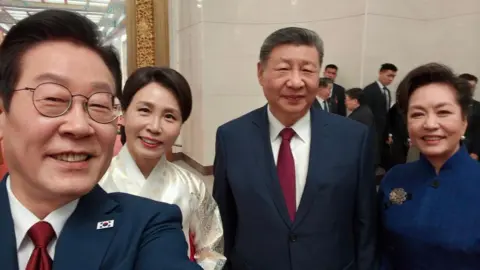
Lee also took selfies with Xi, using a Xiaomi phone that the Chinese president had gifted him last year.
“The image quality is certainly good, right?” Lee posted on X along with the photos.
Xi noted that the “international situation is becoming more turbulent and complex”.
The meeting followed the US’s capture of Venezuelan president Nicolas Maduro over the weekend.
Xi urged Lee to “firmly stand on the right side of history and make correct strategic choices”, China’s official Xinhua news agency reported.
He also brought up the two countries’ shared history of resisting Japan militarism, saying that China and South Korea should now “work hand in hand to safeguard the outcomes of the victory of World War Two and uphold peace and stability in Northeast Asia”.
Xi’s eagerness to meet Lee signals the pressure he faces in finding a regional ally, Park Seung-chan, professor of China studies at Yongin University told the BBC.
“China may beat around the bush but its demand is clear: side with China and denounce Japan.”
During his four-day trip to China, Lee is expected to hold a memorial service in Shanghai for activists who fought for Korea’s independence from Japan.
But while South Korea is “still showing all its deference towards China”, it wants to “strengthen its relationships with both Japan and China”, Mr Park said.
Lee is reportedly planning to visit Japan later this month to meet Prime Minister Sanae Takaichi.
Security on the Korean Peninsula has also been part of the discussions. Lee has sought to engage North Korea diplomatically, but there has been little progress so far. He needs Chinese cooperation in pressuring the North’s Kim Jong Un to give up his nuclear weapons. Beijing is one of Pyongyang’s biggest supporters, economically and diplomatically.
Lee vowed on Monday to work with China on “viable alternatives for peace on the Korean Peninsula”.
On Sunday Seoul’s military said Pyongyang fired ballistic missiles off its east coast. And on Monday the North’s state news agency said the country test-fired hypersonic missiles to assess deterrence capabilities following recent developments, in an apparent reference to the US’s seizure of Maduro.
It remains unclear how much Lee will be able to push China on North Korea. In September, Xi had pledged to strengthen Beijing’s “traditional friendship” with Pyongyang.
And Seoul and Beijing are not natural allies.
US troops have been stationed in South Korea for decades in case of an attack from the North, and last year the two sides agreed to cooperate on building nuclear-powered submarines. The announcement drew warnings from China.
Lee has also sought to put a stop to China’s build-up of maritime structures in waters between the two countries. Beijing says the structures are fish-farming equipment, but they have sparked security concerns in Seoul.
The two leaders agreed on Monday to continue “constructive” dialogue on the matter, South Korea’s presidential spokesperson said.
Another item high on Lee’s agenda is China’s unofficial restrictions on South Korean music and dramas that have been in place for a decade. K-pop and K-dramas are either unavailable or difficult to access on Chinese media platforms.
While China has never acknowledged a ban on Korean artists, it’s believed to be a protest against South Korea’s decision to deploy a US anti-missile system in 2016, which China sees as a threat to its military operations in the region.
China is a massive market for Korean entertainment, which is already a huge global success.
At a Korea-China business forum on Sunday, Lee encouraged deeper bilateral collaboration in beauty products, food and cultural content including movies and music.
A South Korean presidential spokesperson said on Monday that the two leaders agreed to discuss the gradual expansion of cultural exchanges – without specifying concrete commitments on K-dramas or K-pop.
A Chinese foreign ministry spokesperson similarly told reporters on Tuesday that both sides have agreed to “carry out orderly, healthy, and beneficial cultural exchanges”.
Speaking before Korean residents in Beijing on Sunday, Lee said his visit would “serve as a new starting point to fill in the gaps in Korea-China relations, restore them to normal and upgrade them to a new level”.

The Cabinet of Ministers granted approval to the proposal forwarded by the Minister of Agriculture, Livestock, Lands and Irrigation to appoint Mrs. P. K. L. S. Panduwawala, the officer
in the special grade of Sri Lanka Surveyors’ Service currently serving as the Additional Surveyor General (Central) to the post of Surveyor General with effect from 02.02.2026.

Venezuelan security forces detain journalists as armed police patrol streets

Selfies and smiles: South Korea seeks ‘new phase’ in ties with China

M/s South Asian Technologies awarded contract to supply vehicle number plates

A new act for National Lotteries Board to be introduced
Motor Vehicles (Driving License Levy) Regulations No. 3 of 2022 to be amended
Mrs. P. K. L. S. Panduwawala appointed to the post of Surveyor General

‘Dates have the highest sugar content to fight Coronavirus’

Sunday Island 27 December – Headlines

#SundayIsland 17th December – Headlines

Sunday Island – 28th March

Sunday Island Headlines – 21 March

Sunday Island – 21st February – Headlines
-
 News20 hours ago
Broad support emerges for Faiszer’s sweeping proposals on long- delayed divorce and personal law reforms
-

 News2 days ago
Private airline crew member nabbed with contraband gold
-

 News4 days ago
Health Minister sends letter of demand for one billion rupees in damages
-

 News20 hours ago
Interception of SL fishing craft by Seychelles: Trawler owners demand international investigation
-

 Opinion6 days ago
Remembering Douglas Devananda on New Year’s Day 2026
-
 News7 days ago
Leading the Nation’s Connectivity Recovery Amid Unprecedented Challenges
-

 Features2 days ago
Pharmaceuticals, deaths, and work ethics
-

 Latest News2 days ago
Curran, bowlers lead Desert Vipers to maiden ILT20 title