
News
MODERNISING SRI LANKA’S ARMED FORCES: PREPARING FOR FUTURE SECURITY CHALLENGES

PATHFINDER NATIONAL SECURITY BRIEF -02
A nuanced synthesis of threat perception, demographic trends, geophysical constraints, strategic doctrine, and external alignments invariably shapes the architecture of any credible military force. As we face, rapid technological advancements, evolving geopolitical landscapes, and multifaceted array of conventional and asymmetric threats, the Pathfinder Foundation suggests that a clear and proactive military strategy is essential for addressing future security challenges. Such a strategy not only augments operational readiness but also enhances the flexibility of the armed forces to mitigate unforeseen contingencies that may compromise sovereignty or destabilise national cohesion. It also cultivates necessary linkage between civilian decision-makers and military leadership, helping to meet state security objectives and reinforce long-term resilience.
Threat Perception
Sri Lanka’s threat perception is complex and multifaceted, encompassing both traditional and non-traditional security challenges. While the country has made significant strides in counter-terrorism since the end of the conflict in 2009 and the Easter Sunday attacks in 2019, Covid pandemic in 2020, new and evolving threats continue to shape its security landscape. The contours of future conflict are increasingly shaped by threats that challenge traditional military classifications. Terrorism, proliferation of cyber-attacks, irregular warfare, transnational criminal activities, natural disasters and rising maritime disputes all require a fundamental change in military strategy. Additionally, cross-border terrorism, piracy, illicit maritime trafficking, illegal fishing, and strategic rivalries across key sea lanes all need an adapted security framework. Moreover, geopolitical rivalries in the Indian Ocean further complicate its security landscape.
Spending and Reforms
Since the end of the separatist conflict in 2009, the need to “right-size” and modernizing the armed forces have emerged in policy debates. However, its realisation has been deterred by institutional inertia, competing fiscal priorities, and political pragmatism, leading to defence allocations remaining dominant within the national budget over the past decade and a half. In analyzing the Sri Lanka’s defence expenditure and reform trajectory from 2010 to 2025, it demonstrates a pattern of strategic uncertainty mixed with occasional efforts at structural adjustment.
Sri Lanka’s defence spending reached its highest point in 2015. While it then decreased gradually from 2017, hitting a low in 2022 due to severe economic problems, spending has been rising again since 2023. The allocation for 2025, now around US$1.5 billion, shows a significant increase despite ongoing economic challenges. This recent rise, surpassing previous fiscal oddities, indicates a new strategic focus on technology and maritime security. This approach, though seemingly unusual, aims to create a smaller, more effective military that prioritizes quality over quantity, signalling a deliberate re-emphasis on strategic goals amidst national adversity.
A granular analysis of the 2025 budgetary composition also discloses that, a dominant proportion directed towards recurrent liabilities, remunerations, pensions, and logistical maintenance, while capital expenditure remains noticeably modest. This structural disproportionateness principally constrains transformative procurement and hinders the adoption of cutting-edge military technologies. Interestingly, the anticipated fiscal dividends from troop rationalisation efforts since 2010 have not materialised in proportion, suggesting entrenched structural commitments and administrative inflexibility within the defence establishment.

Source: Stockholm International Peace Research Institute (SIPRI). SIPRI Military Expenditure Database. www.sipri.org/databases/milex
Comparative Defence Spending in South Asia
When compared with the regional counterparts, Sri Lanka’s defence financing appears modest and strategically limited. Between 2010 and 2025, Sri Lanka’s annual budget allocations foe defence, ranged from US$1.0 to US$2.0 billion, a figure small in comparison to the substantial military budgets of neighbouring states.
India, as South Asia’s dominant strategic actor, consistently allocates over US$60–85 billion annually to its defence forces. This reflects a complex mix of security needs, global ambitions, prolonged territorial disputes with both China and Pakistan, and extensive maritime duties across the Indian Ocean littoral. Pakistan, facing both internal insurgencies and geopolitical rivalry with India, maintains a defence budget between US$8 and US$12 billion, a necessary expenditure to sustain deterrence and strategic parity. Bangladesh has gradually increased its defence spending, surpassing US$4 billion by 2024 under the “Forces Goal 2030,” a modernisation plan prioritising naval and aerial capabilities, especially in safeguarding maritime sovereignty and boosting contributions to multilateral peacekeeping missions. The Maldives, by contrast, maintains a modest defence budget of less than US$200 million, with its strategic priorities limited by its size and chiefly focused on coastal surveillance, internal security, and cooperative security arrangements.
Compared to its regional neighbours, Sri Lanka’s military capabilities are significantly overshadowed by the immense power of India and Pakistan. This notable imbalance demands careful consideration in its foreign policy, procurement strategy, and alliance formation. Given the strategic interests of both New Delhi and Beijing in the Indian Ocean, Sri Lanka’s procurement decisions and doctrinal directions are increasingly influenced by the region’s great power dynamics.
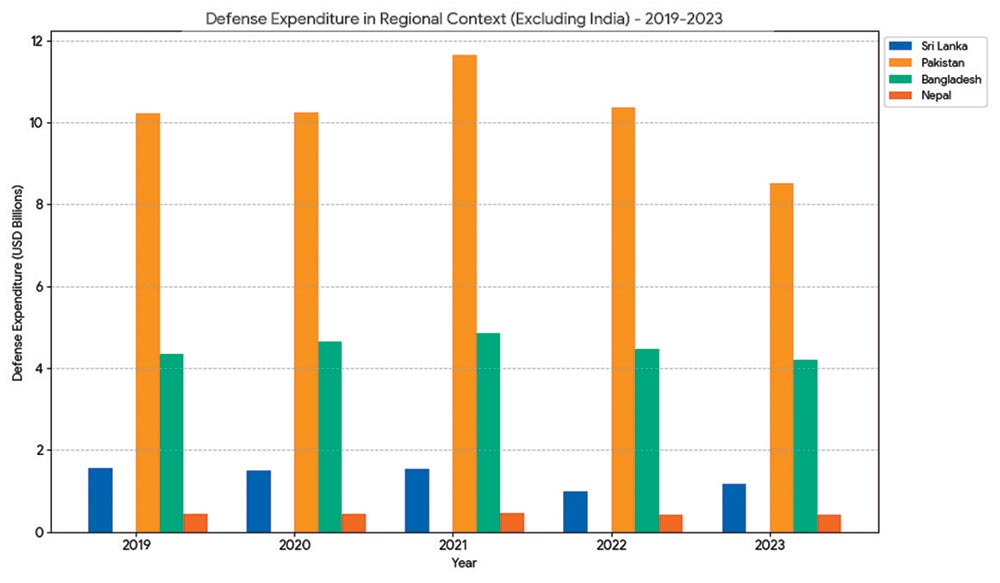
Source: Stockholm International Peace Research Institute (SIPRI). SIPRI Military Expenditure Database. www.sipri.org/databases/milex
Pathfinder View on Strategic Approach
The imperative to develop a technologically proficient and demographically efficient military force is emphasised by a crucial reassessment of both current and emerging threat trajectories. Shifting from a mass mobilisation approach to a network-centric, precision-focused force structure is essential for fostering a security environment that supports sustainable development. Cost savings achieved through force reduction must be strategically reinvested into advanced technologies, doctrinal training, and cyber readiness. However, such a transformation is complex and it requires a careful balance between reducing costs and the substantial capital investment needed to equip personnel with modern capabilities. Through careful reorganisation and technological foresight, Sri Lanka could develop a lean yet strong defence force capable of deterring opponents and deploying limited force when needed. The successful implementation of the “right-sizing” strategy must align with the current regional situation, geopolitical needs, evolving threat factor and financial limitations. The country’s future defence approach should go beyond traditional models based on manpower numbers and instead adopt a flexible, high-tech structure suited to meet multifaceted threats, including ecological, security and non-state adversaries.
Rationalisation of the force structure emerges as a pivotal component of military reform, streamlining operational units, reallocating fiscal resources, and enhancing inter-service interoperability. The current administration has reaffirmed its commitment to recalibrate the military’s human capital in line with the previously published strategic blueprints. Among these, the “Defence Review 2030”, a comprehensive policy document submitted in August 2024 to the former administration, outlining a forward-looking vision that incorporates evolving threat trajectories, regional dynamics, and transformative defence postures. The President Anura Kumara Dissanayake has announced plans to reduce numbers of persons in the armed forces and transform the armed forces into a “professional institution”. Accordingly, the Army, Navy, and Air Force are expected to be curtailed to personnel strengths of 100,000, 40,000, and 18,000 respectively by 2030, while simultaneously reinforcing its technological and strategic capabilities. These measures facilitate institutional agility and operational efficacy of armed forces across multifarious threat theatres.
The expansion of the Intelligence domain through the integration of artificial intelligence, unmanned aerial systems, cyber defence infrastructure, and enhanced signal intelligence capacities must be prioritised to bolster intelligence collection, situational awareness, and response effectiveness. Strategic investments in long-range surveillance systems, reconnaissance drones, and sophisticated cyber shields can substantially increase the operational impact of a downsized, yet professionalised military force. This transformation not only strengthens internal deterrence but also establishes Sri Lanka as a dependable partner in regional security coalitions and information-sharing initiatives across the Indian Ocean. Focusing on capability rather than capacity, and foresight rather than inertia, remains essential. Strategic alliances, especially those involving defence technology transfers and maritime interoperability, can further boost national preparedness and uphold diplomatic stability amidst rising geostrategic competition.
The integration of next-generation technologies must align with the state’s broader policy objectives, ensuring military transformation supports national security imperatives. The defence sector’s transformation into a lean, technologically advanced institution will not only guarantee national resilience but also raise Sri Lanka’s profile within the wider Indo-Pacific security framework. The challenge ahead is not just reform, it’s a strategic rethink; prudent in its foundation, innovative in its approach, and precise in its execution. (This is the ‘PATHFINDER NATIONAL SECURITY BRIEF -02, issued by the Pathfinder Foundation. NATIONAL SECURITY BRIEF-01 can be read https://pathfinderfoundation.org, and Readers’ comments via email to pm@pathfinderfoundation.org are welcome.)



It was decided at the committee appointed to oversee the distribution of essential goods to appoint five officials from the Ceylon Petroleum Corporation to cover all ministries in order to examine fuel-related issues and undertake the necessary interventions.
It was further discussed that the responsibility of these officials would be to examine fuel-related issues arising in institutions under each ministry and to intervene in providing solutions by maintaining coordination with the Corporation.
These matters were discussed at a meeting of the committee appointed to oversee the distribution of essential goods, chaired by Minister of Transport, Highways and Urban Development Bimal Rathnayake held on Friday (27) at the Presidential Secretariat.
It was also noted, with particular attention, that requests have been made by industrialists indicating that the current fuel quota allocated to vehicles for the distribution of their products across the country is insufficient. It was further discussed that, if these concerns are not addressed, there is a likelihood of an increase in the prices of goods, which could in turn cause significant hardship to the public during the festive season.
The committee also discussed the issuance of fuel for the distribution of essential food items by state and private institutions, including supermarkets such as Sathosa, wholesale importers, tourism-related service providers, hotels and other service-providing organisations.
Accordingly, it was discussed that requests for fuel quotas submitted by these institutions should be carefully considered and prompt action taken as necessary and that such requests should be forwarded to the Ministry of Energy through the relevant ministries.
Attention was also drawn to the need for the swift implementation of a QR code system for the issuance of fuel to other sectors, including agriculture and the fisheries industry, based on letters issued on the recommendations of the relevant government officials, including agricultural research officers, instead of the previous method of direct fuel allocation.
Minister Bimal Rathnayake emphasised the need to ensure a continuous and properly managed fuel supply, with particular focus on providing goods to the public without shortages and preventing excessive price increases during the forthcoming Sinhala and Hindu New Year season.
The discussion was attended by a group of government officials, including Minister of Trade, Commerce, Food Security and Cooperative Development Wasantha Samarasinghe, Deputy Minister of Power Arkam Ilyas, Senior Additional Secretary to the President, Kapila Janaka Bandara and Chairman of the Ceylon Petroleum Corporation, D. J. Rajakaruna.

Parliament:
… sexual harassment claims dismissed
Recommendations made by retired High Court Judge Ms. Sujatha Alahapperuma, following an inquiry into claims by a female employee of the Department of Information Systems and Management of Parliament, regarding sexual harassment, denial of due salary increments and other forms of harassment, were yet to be implemented, sources familiar with the investigation said.
The retired HC Judge handed over the report to Speaker Dr. Jagath Wickramaratne on 24 November, 2025. Secretary General of Parliament Kushani Rohanadeera was also present on that occasion.
The retired judge has recommended that administrative decisions be taken expeditiously to grant her salary increments due for 2024 and 2025, reevaluation of all employees attached to the Department of Information Systems and Management and keep them under close scrutiny and strengthening of the ‘Helpdesk’ to meet the requirements.
Sources said that none of the recommendations have been implemented and the concerned employee in spite of still being the Senior Helpdesk coordinator remained attached to the Supplies and Services Office. She had been ordered to report to the Supplies and Services Office in January 2025 following a continuing dispute with the top management of the Department of Information Systems and Management.
Parliamentary Staff Advisory Committee on 25.07.2025 decided to conduct an external investigation into the issue after the employee refused to accept the outcome of the internal inquiry conducted in the wake of SJB lawmaker Mujibur Rahman raising the issue in Parliament.
The retired judge has emphasised the urgent need to take tangible measures to address administrative issues with a view to enhance discipline and human resources management among other issues.
However, the retired judge has declared that the complainant or any other female employee attached to the of Department of Information Systems and Management hadn’t been subjected to any form of sexual harassment as alleged.
The retired judge further asserted that the complainant had been prejudicially treated by two interview boards when she appeared before them seeking posts of Database Administrator and Parliament Officer.
The retired judge has also asserted that the Supplies and Services Office where the complaint continued to serve even now was not suitable and not in line with her qualifications. Some of those who had appeared before the retired judge during the inquiry claimed that was a temporary transfer. However, the report dismissed that claim declaring that transfer appeared to have been done outside acceptable procedure and her increments stopped without giving any justifiable reason.
The retired judge has stated that for want of proper procedures and systems, the administration seems to be in turmoil.
By Shamindra Ferdinando
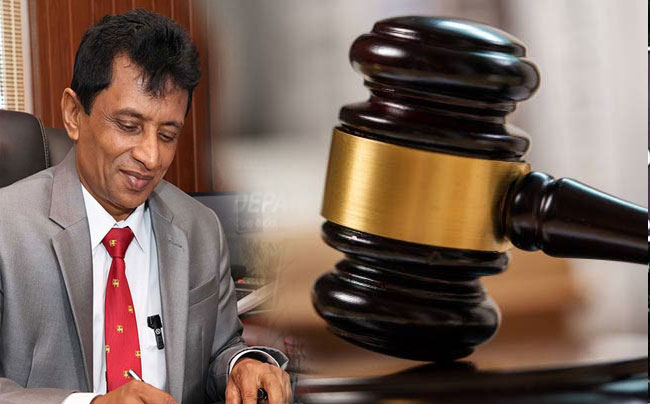
Motor Traffic Commissioner General Kamal Amarasinghe, taken into custody by the CID, was remanded until today (30) following his production before the Kurunegala Magistrate’s Court.
The investigation was launched after the Central Anti-Corruption Task Force received information regarding an illegally assembled taxi, which was later handed over to the CID for further inquiries.
Preliminary findings revealed that the vehicle’s registered chassis number had been altered and documents submitted to obtain a “weight certificate.” These documents were then used to assign a registration number to the taxi, while the chassis modification files were concealed. False declarations were allegedly made to facilitate the fraudulent assembly, with Commissioner General Amarasinghe accused of aiding and abetting the operation.
The suspect was taken into custody on the afternoon of Friday (27) by a CID team at the Hector Kobbekaduwa Road, Colombo 7.
In parallel, the Bribery and Corruption Commission has launched a separate probe into the matter.
The initial investigation was conducted under the direction of SSP Indika Weerasinghe, Head of the Central Anti-Corruption Task Force, along with DIG Rohan Olugala and Senior DIG of CID Kamal Ariyawansa.
BY Norman Palihawadane

A QR code system to be introduced for agricultural lands and other sectors requiring fuel

Rickelton, Rohit, Shardul break Mumbai’s first-game jinx

Oil tops $116 a barrel as Iran accuses US of preparing invasion

Iranian attack damages Kuwait power and desalination plant, kills worker

Warm weather conditions prevailing over the island are expected to continue

Inquiry into female employee’s complaint: Retired HC Judge’s recommendations ignored

‘Dates have the highest sugar content to fight Coronavirus’

Sunday Island 27 December – Headlines

#SundayIsland 17th December – Headlines

Sunday Island – 28th March

Sunday Island Headlines – 21 March

Sunday Island – 21st February – Headlines
-

 News5 days ago
Senior citizens above 70 years to receive March allowances on Thursday (26)
-

 Features3 days ago
A World Order in Crisis: War, Power, and Resistance
-

 News3 days ago
Energy Minister indicted on corruption charges ahead of no-faith motion against him
-

 News4 days ago
US dodges question on AKD’s claim SL denied permission for military aircraft to land
-

 Business5 days ago
Dialog Unveils Dialog Play Mini with Netflix and Apple TV
-

 Sports4 days ago
SLC to hold EGM in April
-

 News5 days ago
CEB Engineers warn public to be prepared for power cuts after New Year
-
 Business7 days ago
Postponement of Sri Lanka Investment Forum 2026