
News
Missing persons issue won’t go away; serious effort required to address concerns – HRCSL


“Prez wants to fast-track the process. Ready to meet protesting mothers’
By Shamindra Ferdinando
Genuine post-war national reconciliation will not be possible unless grievances of those who had suffered during the war and after were addressed, Harsha Kumara Navaratne, a member of the Human Rights Commission of Sri Lanka (HRCSL) says.
Emphasizing the responsibility on the part of the government as regards concerns of all communities, Navaratne asserted that the alleged disappearances of persons who had been handed over to the military by their families soon after the war was brought to a conclusion remained a contentious issue.
Prominent civil society activist Navaratne said so during a brief discussion with The Island on Tuesday (6) at the HRCSL, R.A. de Mel Mawatha, Colombo 4. Except the Chairman of the HRCSL Dr. Jagath Balasuriya, a former lawmaker, other members of the five-member outfit namely Dr. M.H. Nimal Karunasiri, Dr. Vijitha Nanayakkara and Ms. Anusuya Shanmuganathan, joined the discussion.
Nihal Chandrasiri, Director – Research & Monitoring (Actg.), HRCSL was also present.
Referring to accountability issues as well as confidence building measures, Navaratne said the HRCSL was told during a meeting with President Gotabaya Rajapaksa to fast-track the process.
President Gotabaya Rajapaksa named the new HRCSL team on Dec 10, 2020 in terms of the 20th Amendment to the Constitution.
Navaratne said that the HRCSL discussed the issue at hand with those who had visited the Geneva-based United Nations Human Rights Council on several occasions since the end of the war in 2009 to explore ways and means of reaching a consensus on disappearances/missing persons issue.
The HRCSL has been established in terms of HRC Act No 21 of 1996 with the first commission named in 1997 during Chandrika Bandaranaike Kumaratunga’s tenure as the President. The incumbent commission is the seventh.
Responding to another query, Navaratne said that an organization consisting of women who continue to insist on the disappearance of their loved ones was adamant the government addressed the issue without further delay. “They are quite angry over the failure on the part of the authorities to inquire into cases raised by them. They say the previous government didn’t take tangible action regarding six files handed over to the Office of Missing Persons,” Navaratne said.
According to the one-time head of civil society organization Sewa Lanka, the same set of files had been made available to the UNHRC, inquiring into alleged wartime atrocities. Asked whether some sort of understanding with the women’s grouping working closely with a section of the international community pursuing war crimes inquiry, was possible, Navaratne explained how they pushed for international intervention in that regard.
Navaratne said he advised the women that their push for ICC (International Criminal Court) intervention was not realistic therefore whatever the shortcomings that affected the community, they should work closely with the government on the matter.
Navaratne is likely to leave the HRCSL later this year to take up duties as the Sri Lankan High Commissioner in Ottawa. The government recently named Navaratne to the top post in our Embassy in Canada.
Navaratne claimed that Western governments didn’t really appreciate Sri Lanka’s response to human rights accusations. The outgoing HRCSL member said so when The Island sought his explanation why the Western powers refused to assist Sri Lanka to identify the missing persons by sharing available information. The Island pointed out that quite a number of persons who had been reported killed and missing during the conflict and after were actually living abroad under assumed names. Navaratne acknowledged that Sri Lanka hadn’t been successful in convincing Western governments to share information as regards those who received their foreign nationality or living within their borders under different status.
Commenting on various figures quoted by different parties regarding the dead, wounded and missing, Navaratne said that a thorough inquiry could establish the truth.
A UN fact finding mission in a report released in March 2011 alleged 40,000 civilians perished in the final phase of the Vanni offensive. However, the UN claim has been disputed by Lord Naseby on the basis of confidential wartime dispatches from the UK High Commission in Colombo to the Foreign and Commonwealth Office. Naseby made the revelation in Oct 2017 in the House of Lords.
The HRCSL hasn’t taken up this issue with the UK though it engages in consultations with the British High Commission in Colombo. The current HRCSL held a zoom conference with British High Commissioner in Colombo Sarah Hulton early last month.
Navaratne said that the Bishop of Jaffna recently advised him to arrange a meeting between representatives of the affected community and the President without the presence of politicians to discuss the issue at hand.
Dr. Nimal Karunasiri said that the government’s response to the raging Covid-19 epidemic hadn’t taken into consideration the right of the people to obtain a treatment they were comfortable with. Dr. Karunasiri explained how the failure on the part of those responsible to take Ayurveda and Homeopathy into consideration in the government’s overall response violated the basic rights of the people. The HRCSL member said that in the absence of desired constitutional changes to make the 1972 Republican Constitution meaningful, archaic laws were still operative. Dr. Karunasiri explained how the entire Covid-19 management process came under the control of the Director General of Health Services (DGHS) due to archaic laws. According to him, in addition to the health sector, various other spheres had been affected and undermined for want of modification to suit post-independence Sri Lanka.
The DHGS hasn’t responded to HRCSL’s request for vaccination map to be submitted by or before June 15. The HRCSL Chairman Dr. Balasuriya has made the request on May 28.The HRCSL called for vaccination map amidst allegations of serious shortcomings in the ongoing inoculation drive.
The HRCSL said that the DGHS hadn’t responded though approval was granted for a separate request for meetings with small groups of people representing the civil society.
The HRCSL emphasized the responsibility of the government and institutions given specific tasks such as the HRCSL and OMP to meet the challenging objectives.
The previous government set up OMP in terms of an understanding reached in Geneva. Navaratne said that the six files handed over by the affected women to the OMP remained with the outfit.
Since the last general election in Aug 2010, new members have been appointed to the OMP.
The Tamil National Alliance (TNA) is upset with the composition of the OMP. Tamil sources questioned the appointment of retired IGP Jayantha Wickremaratne as the OMP Chairman.


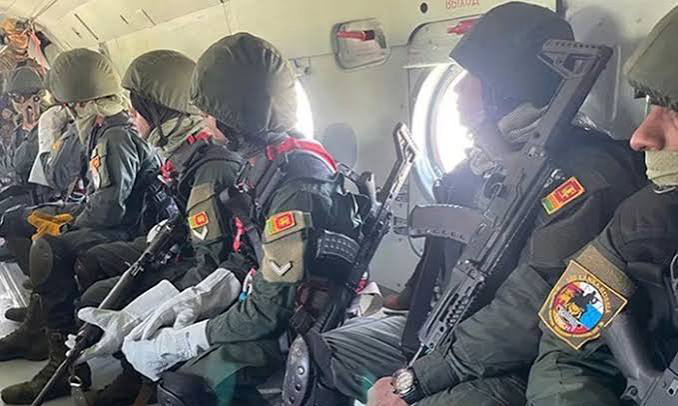
The Defence Ministry said yesterday that Sri Lankan troops had participated in counter-terrorism exercise with Russian counterparts in Russia. The announcement was made after the conclusion of the exercise and the return of 75 personnel, including 20 officers, to Sri Lanka. The exercise included training in heli-rappelling, close-quarters battle, sniper fire, ambush operations and drone operations in the far east of Russia.
The contingent of 20 officers and 55 other ranks took part in Exercise Wolverine Path II, held at Vladivostok, from 18 to 25 September. The troops returned, through Mattala Rajapaksa International Airport, on 28 September.
The Defence Ministry listed the training as counter-insurgency operations, tactical shooting, offensive and defensive manoeuvres, tactical medical training and the deployment of unmanned aerial systems.
“The training programme provided an opportunity for the participating troops to exchange operational experiences and training methodologies while developing their ability to operate together in diverse tactical scenarios,” the Ministry said.
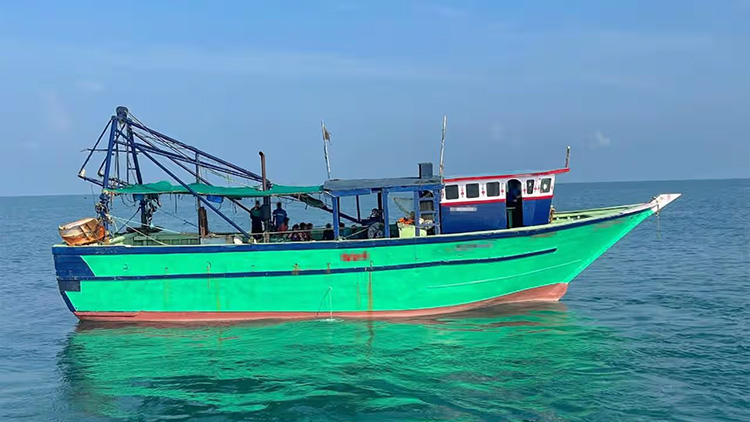
Nine Indian fishermen and their fishing boat taken into custody by the Navy on 3 October for engaging in illegal fishing south of Delft Island, Jaffna, were brought to Kankesanthurai harbour yesterday (04) morning.
The Navy took the boat into custody after it crossed the International Maritime Boundary. The fishing boat and the nine fishermen have been handed over to the Jaffna District Fisheries and Aquatic Resources Department for legal action.
The National Peace Council (NPC) said that the death sentence imposed on Sri Lankan citizen Sivarasa Anojan in Saudi Arabia and the removal of the Thileepan statue in Jaffna are very different events that carry the risk of turning into grievances that affect entire communities. The NPC urged the government as well as political parties, civil society and religious leaders to ensure that this does not happen.
The text of the statement: “NPC welcomes the government’s efforts in the Anojan case and the appeals for clemency made by political and religious leaders, including Muslim leaders. We encourage Muslim, Buddhist, Hindu and Christian leaders to express solidarity together. This would demonstrate that the life of a Sri Lankan citizen is a concern of all Sri Lankans, and that seeking mercy for him is not against any one religion. In particular, political, civil and religious leaders should reject attempts to turn the case into a source of anti-Muslim sentiment or collective blame. It is in this spirit that NPC joins the appeal for clemency for Anojan.
The Thileepan statue raises a different but related peacebuilding concern. Many Tamils attach deep significance to Thileepan, who died on 26 September 1987 after a twelve-day fast to protest the terms of the Indo-Lanka Peace Accord. The statue erected during this year’s commemoration was removed by police on 27 September. The government has raised legal concerns relating to the commemoration of a person associated with the LTTE, which remains a proscribed organisation. But the depth of Tamil anguish cannot be disregarded. For many Tamils, remembrance of Thileepan is connected to grief, loss and historical memory.
NPC notes that the Office for Reparations Act, No. 34 of 2018 provides for policies on memorialisation within its broader reparations framework. The government needs to engage the Office for Reparations and examine whether an appropriate form of memorialisation can be accommodated within the law. The JVP that now leads the NPP Government was itself once proscribed, later entered democratic politics, and now for many years has publicly commemorated its own fallen. The opportunity to remember those who died, while remaining within the law, should not belong to one community alone.
The cases involving Anojan and Thileepan give Sri Lanka an opportunity to demonstrate that it has learned from its past. Peacebuilding is the capacity to address today’s difficult issues in ways that prevent them from becoming tomorrow’s communal divisions. That is the real test of Sri Lanka’s continuing peace.”

Sri Lankan troops in joint anti-terrorist exercise in Russia

Nine Indian poachers brought to KKS with their boat

Quo Vadis? Private sector medicine in Sri Lanka

Sri Lanka must rethink plastics before waste crisis deepens, says OUSL Vice Chancellor

Dons’ frustration and rulers’ nonchalance

The internationally acclaimed play ‘Every Brilliant Thing’ comes to Sri Lanka

‘Dates have the highest sugar content to fight Coronavirus’

Sunday Island 27 December – Headlines

#SundayIsland 17th December – Headlines

Sunday Island – 28th March

Sunday Island Headlines – 21 March

Sunday Island – 21st February – Headlines
-

 News7 days ago
Police remove Thileepan statue in Jaffna
-

 Latest News5 days ago
Gold winner Tharanga gets brand-new Honda Vezel from SLAAJ
-

 News7 days ago
Sajith rejects Jt. Opp. protest sabotage claim; SJB TU chief demands remedial action
-

 Features5 days ago
Why Sri Lanka needs an Inclusive Civic Nationalism – urgently
-

 News4 days ago
US-assisted ‘Ice’ detection: NPC to examine IGP’s move to transfer drug-busting team
-

 Features6 days ago
Thailand’s biggest new global star …
-

 News6 days ago
First cases taken up by SC after enactment of 22A dismissed
-

 News5 days ago
Civil society activist accuses govt. of favouring Ven. Gnanasara