
News
Million trees to reduce pollution on highways

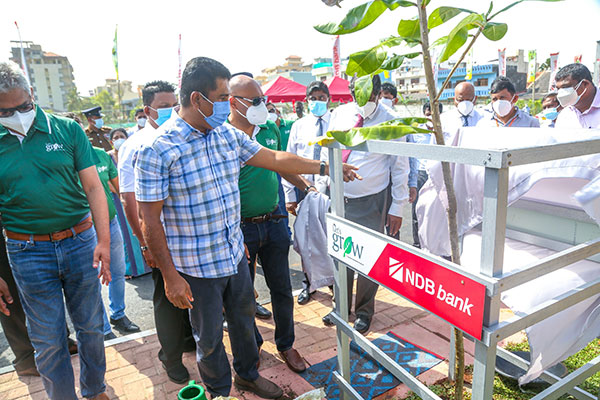
One million moodilla saplings would be planted on either side of roads to minimize carbon footprint and to manage emissions, Chief Government Whip and Highways Minister Johnston Fernando said last Friday.
Speaking to journalists after launching the sapling planting project along the Marine Drive from Wellawatte to the Dehiwela section under the one million trees green project of the Vistas of Prosperity and Splendour programme, the Minister said that the tree planting project in addition to helping minimise the carbon footprint, would provide shade and shelter to pedestrians. “Out target is to plant one million saplings along the roadside. Around 300,000 saplings are already ready in nurseries belonging to the Road Development Authority. Our development projects have been designed to ensure the protection of the environment so that they would be in line with the visions of sustainable development goals. The Opposition has been clamouring during recent times accusing our government of engaging in a countrywide tree felling spree. We are not worried about their false propaganda. We continue with our development process so that within a couple more months people will see the results. Within 24 hours of the President assuming duties of office after his winning of the election, he commenced a project of cleaning the environs and he set up an environmental police unit. Within a couple of days of the victory at the presidential election, all waste and garbage that had not been cleared were cleaned up. People may recall how the Yahapalana regime could not even clean the garbage and waste during the last half of their government. Now it is they who come and give us instructions on how to run the economy,” the Minister said.
Minister Fernando said that the project to plant one million saplings along the roads was being carried out with the assistance of private sector institutions. The sapling planting project along Marine Drive is assisted by the NDB Bank.
Responding to a query by journalists on the speculations related to Basil Rajapaksa being sworn in as an MP soon, the Minister said: “The story of Basil Rajapaksa becoming an MP started from the day the last general election was won by the SLPP. Yet he did not come to Parliament. That is why this question is being raised repeatedly. Everybody is waiting to see if he becomes an MP.”
Asked to comment on the presidential pardon given to Duminda Silva, the Minister said: “It is my personal opinion that justice has been done. We all know that not only Duminda Silva but many other persons had been incarcerated during the Yahapalana misrule just because they were from our party. We all have heard the leaked audio tapes on how Shani Abeyesekera and others had manufactured evidence and manipulated the court process to put Duminda Silva behind bars. In addition, there was a Presidential Commission of Inquiry on political victimization where evidence came out on how selective justice had been dispensed against our party members and supporters. Justice had been suppressed by the political powers during the time of the former government. President Gotabaya Rajapaksa has rectified an injustice. There are many more still languishing behind bars. Public sector officials, members of the Maha Sangha, members of tri-forces and police intelligence units, artistes, etc., had been victimized politically during the times of the last government. We hope that justice would be done to them too. It is because of that conduct of the Yahapalana government that the people of this country voted us in and gave us two-thirds of the power. The President did the right thing and we stand by with him.”
Responding to a question on fuel price hikes, the Minister said: There are various statements by various parties. Let’s see what will happen in the coming days. Anyone is free to express his or her opinions. Even parties within our government are making different statements. But you have to remember that we are moving to a specific target. The government has not yet made a statement saying that the fuel prices will go down. A government cannot make such statements in advance because it would result in unfavourable consequences in the market. The businessmen may hoard supplies or fleece the consumers.”
Among those present were Secretary to the Ministry of Highways Ranjith Pemasiri, Secretary to the Ministry of Rural Roads and Other Infrastructure Ranjith Dissanayake, Director and Group Executive Officer of the NDB, Dimantha Senaratne, Director Assets Management and Revenue Rasangani Paranagama and other officials.


Approval of the Cabinet of Ministers was granted to the preparation of the Appropriation Bill for the financial year of 2027 at their meeting held on 30.06.2026.
Accordingly, clearance of the Attorney General has been given to the Appropriation Bill prepared by the Legal Draftsman.
Therefore, the Cabinet of Ministers approved the resolution furnished by the President in his capacity as the Minister of Finance, Planning and Economic Development to publish the aforementioned draft bill in the government gazette notification and thereby submit the same to the Parliament for its concurrence.
Latest News
Cabinet approves aditional Rs. 2,500 million to the Paddy Marketing Board to purchase 2026 Yala harvest

The Cabinet of Ministers has approved the resolution furnished by the Minister of Agriculture, Livestock, Land and Irrigation to provide an additional Rs. 2,500 million to the Paddy Marketing Board on a reimbursable basis from the Rs. 7,500 million additional allocations granted to the Ministry to implement
the expedited paddy purchasing program for the 2026 Yala harvest.
Latest News
Cabinet nod to host the 8th Asian Regional Conference of the Commonwealth Parliamentary Association and the 3rd Joint Asian and South-East Asian Regional Conference of the Commonwealth Parliamentary Association
The 8th Asian Regional Conference of the Commonwealth Parliamentary Association (CPA) and the 3rd Joint Asian and South-East Asian Regional Conference of the CPA are planned to be held over three days in Colombo during April/May 2027.
Approximately 90 delegates including speakers, Deputy Speakers, Member of Parliamentarians, and Parliamentary officers representing member countries of the Commonwealth Parliamentary Association, in the Asian and South-East Asian regions, are expected to participate in these conferences.
The Cabinet of Ministers has approved the resolution furnished by the Prime Minister of the Parliament of Sri Lanka to host the said conferences considering the opportunities to strengthen parliamentary diplomacy and regional cooperation, as well as to enhance international recognition of the Parliament of Sri Lanka within the Commonwealth Parliamentary Association.

Draft of the Appropriation Bill for the Financial Year 2027 su mitted to the Parliament
Cabinet approves aditional Rs. 2,500 million to the Paddy Marketing Board to purchase 2026 Yala harvest
Cabinet nod to host the 8th Asian Regional Conference of the Commonwealth Parliamentary Association and the 3rd Joint Asian and South-East Asian Regional Conference of the Commonwealth Parliamentary Association

SAARC Training Workshop on Financial Modeling for Renewable Energy Projects from 5th to 7th October in Colombo
National Children’s Week from 25th September to 01st October

Nairobi and Munich to host 2029 and 2031 World Athletics Championships

‘Dates have the highest sugar content to fight Coronavirus’

Sunday Island 27 December – Headlines

#SundayIsland 17th December – Headlines

Sunday Island – 28th March

Sunday Island Headlines – 21 March

Sunday Island – 21st February – Headlines
-

 Sports5 days ago
DDS set to lose Test captaincy
-

 News5 days ago
Sri Lanka faces new grid challenge as rooftop solar surges: former CEB GM
-

 Latest News5 days ago
Shafali, Deepti power India into sixth T20 Asia Cup final
-

 Opinion7 days ago
Navigating Sri Lanka’s Israeli Dilemma
-

 Latest News4 days ago
Sri Lanka thwart Fatima Sana challenge to secure Asia Cup final spot
-
 Features6 days ago
Lost for 90 years: Rare Goby resurfaces in Jaffna
-

 News3 days ago
Gnanasara Thero absconding after SC ruling
-

 News4 days ago
Ammunition cache found in old Kandy bungalow