
News
Mahara prison riot: How pills meant for mental patients triggered violence


* Over 2,400 inmates on their own within complex
* Death toll reachers 11, could rise further
* Clashes among prisoners injure 80
* Doctor under investigation
* Rioters popped more than 21,000 pills
By Shamindra Ferdinando
A high-level investigation into the Mahara Prison riot took an unexpected turn yesterday (1) following the revelation that the prison dispensary had stored over 21,000 tablets prescribed for mental disorders and sleeping pills.
Police spokesperson DIG Ajith Rohana told a joint media briefing called by the Police Headquarters and the Prisons Department, in Colombo, that they were quite surprised that such a large stock of tablets was maintained. He said it had to be found out who had ordered the stock, how inmates got addicted to such substances, and whether a doctor attached to the Mahara Prison hospital had instigated prisoners to demand PCR tests.
DIG Rohana said that on the directions of the IGP C.D. Wickremaratne as per the instructions received from Defence Secretary Maj. Gen. Kamal Gunaratne, a 12 -member team from the Criminal Investigation Department (CID) was inquiring into the riot.
DIG Rohana said those who had been addicted to heroin and cocaine were believed to have used tablets prescribed to mental patients.
Prisons Commissioner Chandana Ekanayake (Administration) said that those who popped the tablets had turned on each other. Quoting officers who had been at the scene last Sunday (29) Ekanayake said they had never witnessed such scenes of violent behaviour among prisoners before.
Responding to a media query, Ekanayake emphasised that the Mahara Prison riot had erupted suddenly whereas they received intelligence warning of possible trouble at some other prisons.
National Freedom Front (NFF) leader Wimal Weerawansa told Parliament, on Monday, that the prison riot was part of a sinister plan to bring President Gotabaya Rajapaksa’s government into disrepute.
The media was told that at the time of the riot there had been 2,782 inmates at the Mahara Prisons complex. 585 were convicts and others suspects, DIG Rohana said, alleging that they had initiated Sunday’s violence. What initially started as common demand for all of them to be subjected to RT-PCR tests quickly had led to a riot, the DIG said.
DIG Rohana, who is also the head of the Police Legal Division, said that a section of those rioters had made repeated attempts to escape. Having failed, they had set fire to buildings within the complex. Among those destroyed were the Registry and the offices of top officials in charge of the prison.
The media was told one more inmate admitted to the Ragama Teaching Hospital had succumbed to his injuries yesterday. With that the total number of dead increased to nine, while 105 continued to receive treatment.
Besides, two Prison officers taken hostage and badly assaulted by the rioters were receiving treatment at the same hospital. Several hours after the conclusion of the media briefing Police headquarters said that two more persons had succumbed to their injuries.
At the beginning of the briefing Ekanayake said that of over 2,700 prisoners, approximately 1,600 had gone on the rampage. “Trouble erupted while they were being served food in line with health guidelines. They broke out from where they were held and swiftly gathered close to the main gate. They demanded immediate PCR tests on them.”
Ekanayake said 187 inmates had tested positive by then.
The rioters had attacked the main gate, Ekanayake said. “Officers opened fire having failed to bring the situation under control by shooting rubber bullets.” He said the situation had taken a turn for the worse after inmates took tablets meant for mental patients.
DIG Rohana said that of the 106 who had received injuries, 80 suffered as a result of violence among the prison community. Of the injured, only 26 were believed to have received gunshot injuries, DIG Rohana said.
Commissioner Ekanayake alleged that both the dead and the wounded were those in custody on narcotic charges.
Seventy eight coronavirus positive inmates had since been moved to a quarantine facility at Adalachchenai in the Akkaraipattu police area, DIG Rohana said.
DIG Rohana said those who had been granted bail couldn’t be immediately released as the Director General of Health Services (DGHS) had issued specific instructions on subjecting inmates to two weeks quarantine before release.
DIG Rohana said that following the removal of the injured and the dead to the Ragama hospital, those granted bail and infected inmates had been moved to a special section within the Welikada Prison complex and about 2,400 remained in the Mahara Prison.
Rohana said that among them were a large number of inmates who hadn’t been involved in violence. Acknowledging that the prisons complex wasn’t yet under the control of the jailers, the DIG said that the Police, including the Special Task Force (STF) and the Prison security were making plans to carry out an operation to restore normalcy. He said they would implement a special plan while the police backed by the STF maintained its presence outside the prison.
The police deployment consisted of 400 police and 200 STF personnel.
Both Police and Prisons officers couldn’t confirm whether at least some inmates had managed to escape though they believed such attempts were thwarted.
DIG Rohana said that the rioting inmates had been prevented from seizing the armoury.
The Parliamentary Consultative Committee on Defence, too, discussed the availability of three varieties of pills totalling 21,000 meant for mental patients at the Prison. Defence Secretary Maj. Gen. Gunaratne briefed the CC on the matter and steps taken by authorities to bring the situation under control.
DIG. Rohana told the media that he had requested Justice Minister Ali Sabry, PC, to leave him out of a special committee headed by retired HC judge Kusala Sarojini Weerawardena tasked with inquiring into the riot due to conflict of interests as his duties and responsibilities as the Police Spokesperson clashed with the probe undertaken by the committee.




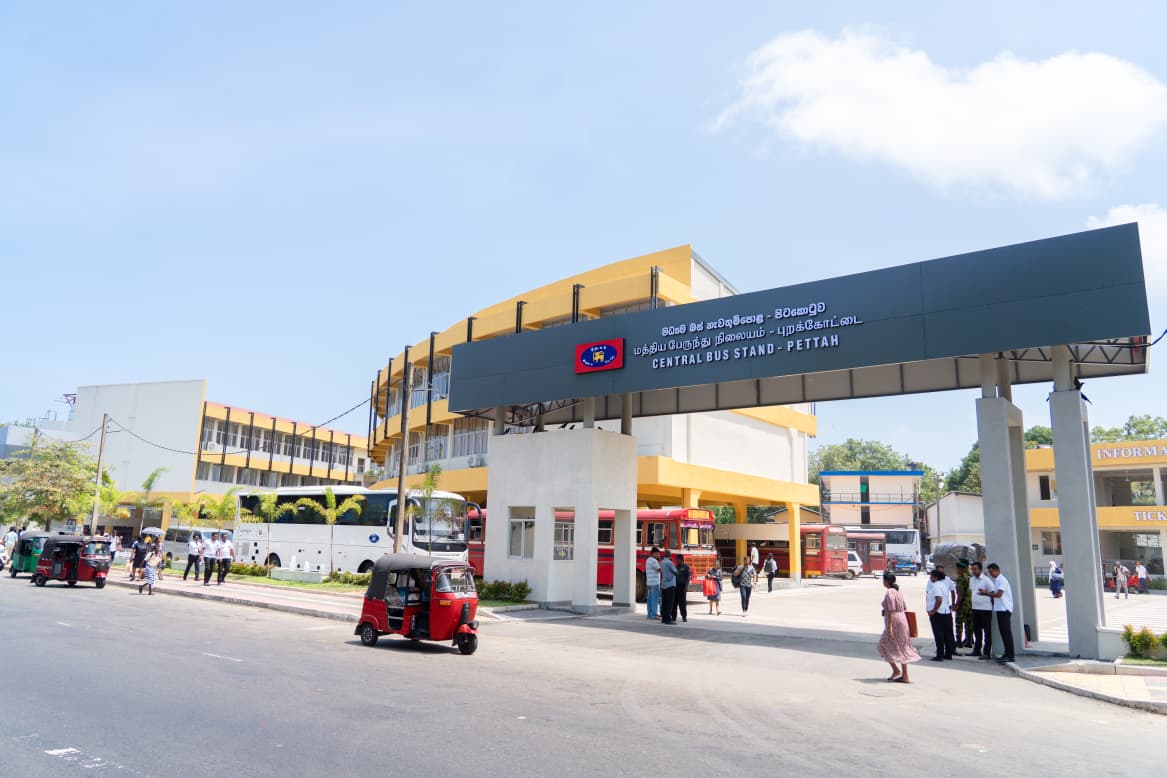
The Colombo Central Bus Stand, which has a history of over six decades and had remained without a proper maintenance for many years, has now been renovated under the current government’s development programme and vested to the public. Following that, the Prime Minister undertook an inspection tour of the newly renovated Colombo Central Bus Stand.
Originally constructed in 1964, the bus stand was refurbished with modern facilities to meet current needs and was officially reopened to the public on April 8. The primary objective of this initiative is to provide passengers with a higher-quality and more comfortable transportation service.
During the renovation process, special attention has been given to the comfort and safety of women, which was commended by the Prime Minister. In particular, a modern rest area designed to ensure privacy for nursing mothers travelling from distant areas received special praise.
The Prime Minister also reviewed the newly introduced passenger seat reservation system and information services established to assist commuters. In addition, the modern surveillance unit and other security measures installed within the premises to ensure passenger safety were also inspected.
During the visit, the Prime Minister engaged in conversations with passengers at the bus stand and inquired about their views on the newly renovated facilities and the quality of transport services.
It was emphasized that the government’s objective is to transform public transportation into a safe, technologically advanced service that can be used with convenience by all citizens.

(Prime Minister’s Media Division)
Latest News
Sun directly overhead Nagawilluwa, Galgamuwa, Sigiriya, Palugasdamana and Mankerni about 12:11 noon today (10)


On the apparent northward relative motion of the sun, it is going to be directly over the latitudes of Sri Lanka from the 05th to 15th of April in this year.
The nearest areas of Sri Lanka over which the sun is overhead today (10th) are Nagawilluwa, Galgamuwa, Sigiriya, Palugasdamana and Mankerni about 12:11 noon.

No-faith motion to be taken up today
Former Foreign Minister Prof. G. L. Peiris yesterday (9) said that President Anura Kumara Dissanayake should remove Energy Minister Kumara Jayakody unless the minister stepped down on his own.Prof. Peiris, addressing a press conference called by the Opposition, said that Jayakody couldn’t under any circumstance continue to serve as a minister after the Commission to Investigate Allegations of Bribery or Corruption (CIABOC) moved the Colombo High Court against the government member over a previous financial scandal.
Pointing out that Minister Jayakody had been indicted of a corrupt deal struck during the yahapalana regime, Prof. Peiris said it was wrong for the NPP to retain him as a minister, claiming that the offence was not committed during his tenure as a Cabinet minister in the current government.
Prof. Peiris and several other Opposition members dealt with the No-Confidence Motion (NCM) against Jayakody that would be taken up today (10) with the academic calling the vote an acid test for the NPP. Having campaigned on an anti-corruption platform at presidential and parliamentary polls, the NPP couldn’t protect Jayakody though he was widely believed to be close to President Dissanayake.
As the Manager of the Procurement and Import Division of the Ceylon Fertilizer Company, Jayakody is alleged to have committed the offence of corruption, according to CIABOC.
Jayakody has been accused of causing a loss of Rs. 8,859,708 to the State by influencing and exploiting the procurement process.
Following the serving of indictments on 27 March, the judge ordered Jayakody’s release on two personal bail bonds of Rs. 1 million each. The court directed that the defendant’s fingerprints be obtained and a formal report be submitted. The case has been scheduled for a pre-trial conference on 6 May.
Prof. Peiris stressed that the CIABOC action against Jayakody is central to the NCM primarily moved over the irregularities ridden coal procurement process launched in 2025 that caused severe disruption to the power generation. Responding to The Island query after the media briefing, Prof Peiris expressed surprise that the JVP/NPP accommodated a person under investigation by the CIABOC. Having taken an utterly irresponsible decision, the JVP/NPP were now playing down the developing issue, prof. Peiris said.
The entire government parliamentary group faced the prospect of having its image tarnished by defending Jayakody, the former lawmaker said.
Prof. Peiris said that they intended to build a campaign around the issues involving the energy minister to expose the government. With yet another electricity tariff hike in the offing due to the growing demand for thermal generation as a result of coal-fired Lakvijaya power plant’s failure to meet the requirement[RA1] , the energy minister and ministry’s performances have to be examined, Prof. Peiris said.The timely release of the Auditor General’s report on controversial coal procurement should compel the government to decide on the energy minister’s fate or be prepared to face the fallout.
By Shamindra Ferdinando

Brazil bowler Laura Cardoso takes 9 Lesotho wickets in record-breaking T20 win

Zimbabwe Women set for maiden tour of Pakistan

Bangladesh advance match timings to save energy

PM on inspection tour of newly renovated Colombo Central Bus Stand

Israel to hold direct talks with Lebanon but no ceasefire, Netanyahu says

Sun directly overhead Nagawilluwa, Galgamuwa, Sigiriya, Palugasdamana and Mankerni about 12:11 noon today (10)

‘Dates have the highest sugar content to fight Coronavirus’

Sunday Island 27 December – Headlines

#SundayIsland 17th December – Headlines

Sunday Island – 28th March

Sunday Island Headlines – 21 March

Sunday Island – 21st February – Headlines
-

 Features6 days ago
Ranjith Siyambalapitiya turns custodian of a rare living collection
-

 News6 days ago
Global ‘Walk for Peace’ to be held in Lanka
-

 News4 days ago
Lankan-origin actress Subashini found dead in India
-

 Features6 days ago
Beyond the Blue Skies: A Tribute to Captain Elmo Jayawardena
-

 News2 days ago
AG: Coal procurement full of irregularities
-

 Features6 days ago
Aspects of Ceylon/Sri Lanka Foreign Relations – 1948 to 1976
-

 Business2 days ago
Hayleys Mobility introduces Premium OMODA C9 PHEV
-

 Sports2 days ago
DS to face St. Anthony’s in ‘Bridges of Brotherhood’ cricket encounter