
Foreign News
Living in Delhi smog is like watching a dystopian film again and again

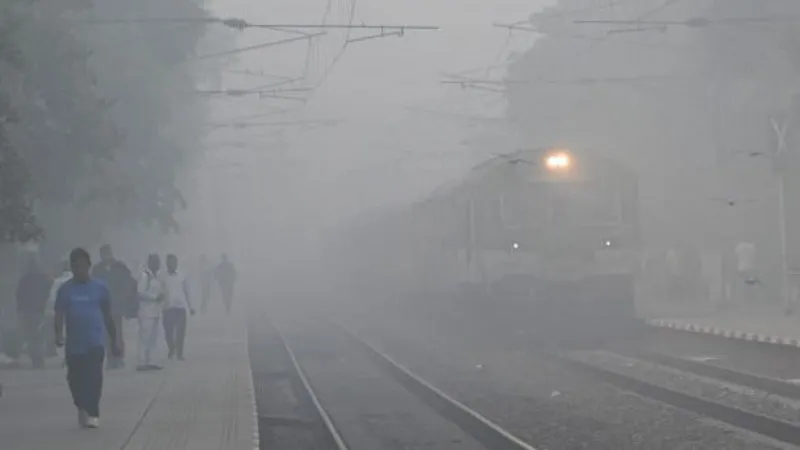
Winter has come to Delhi and with it, a familiar sense of gloom. The sky here is grey and there is a thick, visible blanket of smog.
If you stay outdoors for more than a few minutes, you can almost taste ash. You will feel breathless within minutes if you try to run or even walk at a brisk pace in the smog.
Newspapers are back to using words like toxic, deadly and poisonous in their main headlines.
Most schools have been shut and people have been advised to stay indoors – though those whose livelihoods depend on working outdoors can’t afford to do so.
Delhi’s air quality score was somewhere between 1,200 and 1,500 on Monday and Tuesday, according to different monitoring agencies. The acceptable limit is less than 100.
These scores measure the levels of particulate matter – called PM 2.5 and PM10 – in the air. These tiny particles can enter the lungs and cause a host of diseases.
On social media, people have been expressing shock, disappointment and anguish that it’s all happening again.
Along with the gloom, there is a strong sense of déjà vu – like we have seen this all many times before in the past 15 years.
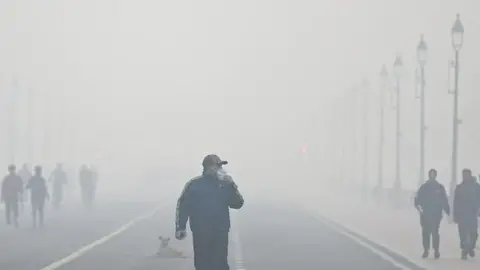
Covering this story feels like watching (and being in) the same dystopian film every year – following the same characters, plot and script. The outcome is always the same – nothing changes.
The parks are empty again – people, particularly children and the elderly, have been told to stay indoors.
Those who must work – daily-wage labourers, rickshaw pullers, delivery riders – are coughing but still going out.
Hospitals are seeing an increasing number of people coming in with respiratory problems.
And amid all this, we are back to the same question again – why does nothing change?
The simple answer is that solving Delhi’s air problem requires monumental efforts and coordination.
The sources of the problem are many. One of them is the practice of farmers burning crop remains to clear their fields quickly to sow seeds for the next yield.
This mostly happens in the neighbouring states of Punjab, Haryana and Uttar Pradesh. The smoke from the farm fires engulfs Delhi every winter and hangs low in the atmosphere as wind speeds reduce during winter months.
But farmers can’t be entirely blamed for this because this is the cheapest way of clearing fields.
Different governments have talked about providing machines and financial incentives to stop crop burning, but very little has happened on the ground.
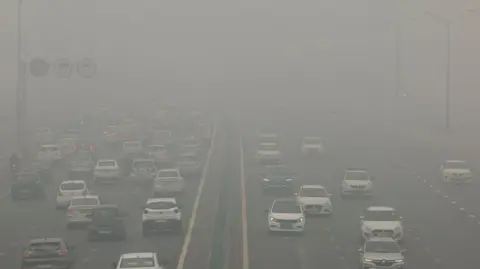
Delhi itself produces a huge chunk of the pollution – emission from vehicles, construction and factories.
Every year, in the winter months, people get angry, journalists write and produce reports, politicians blame each other and courts fume – until we do it all over again the next year.
A public health emergency like this would spark mass protests in most democracies. But the anger in Delhi is mostly limited to social media.
Activists say the reason is that pollution doesn’t cause immediate problems for most people. Ingesting high levels of PM2.5 deteriorates health slowly. A Lancet study found that pollution led to more than 2.3 million premature deaths in India in 2019.
And then there is the class divide. People who can afford to temporarily leave the city do that, those who can buy air purifiers do that, and those who can vent on social media do that.
The rest, who don’t have these options, just go about their lives.
The collective angst has so far not resulted in a massive protest and, as the Supreme Court once observed, politicians just “pass the buck” and wait for the season to get over.
Experts say governments at the federal level and in different states need to leave their party politics behind and work together to solve this problem. They need to focus on long-term solutions.
And citizens need to hold politicians accountable and courts have to pass decisive orders months before the pollution worsens.
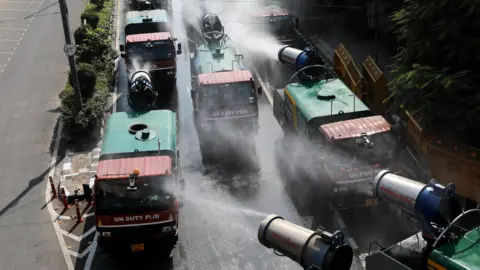
This year, we are again in the thick of the season and temporary measures have been announced, like banning construction work.
But can these bring Delhi’s elusive blue skies back? The evidence from the past few years doesn’t give much hope.
[BBC]

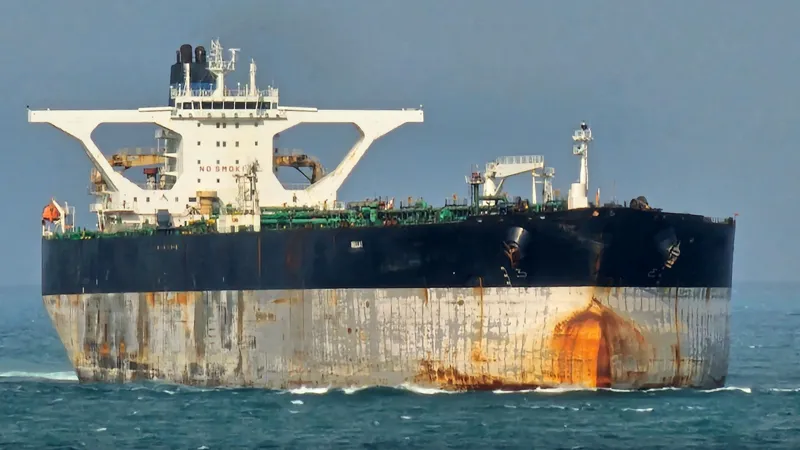
Russia has reportedly deployed a submarine and other vessels to escort an oil tanker – which is also being pursued by US forces – across the Atlantic.
The ship, currently between Iceland and the British Isles, has been accused of breaking US sanctions and shipping Iranian oil. It has historically transported Venezuelan crude oil but is reporting to be empty at the moment.
Previously named Bella 1, its name has been changed to Marinera and it has also reportedly been reflagged from a Guyanese to a Russian vessel.
President Donald Trump said last month that he was ordering a ‘blockade’ of sanctioned oil tankers entering and leaving Venezuela, a move the government there described as “theft”
Two US officials have confirmed to CBS News, the BBC’s US media partner, that Russia has sent a submarine and other navy vessels to escort the tanker.
The US Coast Guard tried to board it last month in the Caribbean when it was believed to be heading towards Venezuela. The Coast Guard had a warrant to seize the ship over its alleged breaking of sanctions.
The vessel has since dramatically changed course and its approach to Europe has coincided with the arrival of around 10 US military transport aircraft as well as helicopters.
Russia says it is “monitoring with concern” the situation around the ship.
“At present, our vessel is sailing in the international waters of the North Atlantic under the state flag of the Russian Federation and in full compliance with the norms of international maritime law,” its foreign ministry said.
“For reasons unclear to us, the Russian ship is being given increased and clearly disproportionate attention by the US and Nato military, despite its peaceful status,” it said.
Two US officials told CBS News earlier on Tuesday that American forces were planning to board the ship, and that Washington preferred to seize it rather than sink it.
BBC Verify has been looking at footage released by Russia Today, reportedly taken onboard an oil tanker, which shows a ship in the distance matching the profile of a US Coast Guard Legend-class cutter.
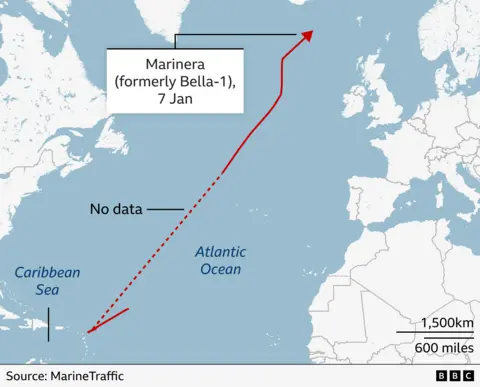
It has also been monitoring the latest reported location of the Marinera. According to AIS location data from ship-tracking platform Marine Traffic, its location as of Tuesday morning was in the North Atlantic Ocean, about 300km (186 miles) south of Iceland’s shoreline.
Previous AIS tracking data suggests it travelled north, past the western coast of the UK over the past two days.
On Tuesday, the US military’s Southern Command posted on social media that it “remains ready to support our US government agency partners in standing against sanctioned vessels and actors transiting through this region.
“Our sea services are vigilant, agile, and postured to track vessels of interest. When the call comes, we will be there.”
Before any US military operation was launched from the UK, Washington would be expected to inform its ally.
For now, the UK Ministry of Defence says it will not comment on other nations’ military activities.
The US officials quoted by CBS suggested that America could mount an operation like one conducted last month when US forces seized the Skipper, a large crude oil tanker, flagged to Guyana, that had just left port in Venezuela.
Under international law, vessels flying a country’s flag are under the protection of that nation. However, simply changing a ship’s name and flag doesn’t necessarily change much, Dimitris Ampatzidis, senior risk and compliance analyst at maritime intelligence firm Kpler, told BBC Verify.
“US action is driven by the vessel’s underlying identity [IMO number], ownership/control networks, and sanctions history, not by its painted markings or flag claim,” he said.
Michelle Bockmann, a maritime intelligence analyst at Windward, said changing to a Russian registry could “complicate US enforcement efforts”.
“Under the UN Convention of the Law of the Sea, there’s a provision that allows a stateless vessel to be boarded by authorities. By reflagging to Russia, the vessel is no longer able to be boarded under this provision,” she explained.
Bockmann adds that she has previously observed vessels changing their flag mid-voyage, but “it’s highly unusual and only seen with dark fleet tankers”.
The potential stand-off over the oil tanker comes days after the US shocked the world with the arrest of Venezuela’s Nicolás Maduro in Caracas. It bombarded targets in the city during the operation to extricate him and his wife on suspicion of weapon and drug offences.
Since he was seized, BBC Verify has identified three US-sanctioned tankers that have switched to a Russian registry, including the Marinera.
This follows a broader trend.
Since the seizure of the Skipper, BBC Verify has identified 19 US-sanctioned oil tankers that have switched to a Russian registry, with many of them having previously sailed under a false flag.
[BBC]

The survivor of a gang rape in the northern Indian state of Haryana has been discharged from hospital a week after her horrific assault, a police official told the BBC.
The 26-year-old mother-of-two was taken to hospital in Faridabad city on the morning of 30 December with serious head and facial injuries and several fractures.
Her sister said she was out visiting a friend and was waiting for transport just after midnight when two men in an ambulance offered her a lift. They drove her to a deserted place where they raped her and then threw her out of the speeding vehicle.
A police spokesman said they had acted swiftly and arrested the two men and seized the vehicle.
The woman was discharged by the hospital on Monday night following treatment and surgeries.
Senior police official Mukesh Kumar told the BBC that they have approached the court to allow her to visit the prison for an “identification parade”.
Once the court order comes, she would be asked to pick out the two suspects from a crowd of men.
The police said the crime took place on the intervening night of 29th and 30th December.
“The incident took place between 12.30 and 02:00. One stood outside the van and kept an eye on the surroundings while the other raped the woman inside the van,” Yashpal Yadav, public relations officer of Faridabad police, said.
Police had questioned the suspects, who were later produced in court and sent to prison, he added.
A doctor at the hospital where the survivor was treated had said that the woman was brought in “at around 05:30 on 30 December… she had a lot of injuries”.
Shalini Chopra, a social worker and an opposition politician, who spoke to the survivor after she was discharged from the hospital told the BBC that the woman was “better but still in pain”.
The case has provoked anger and outrage in India and drawn comparisons with the horrific gang-rape of a 23-year-old woman on a bus in Delhi in December 2012.
That crime had made global headlines, led to huge protests in Delhi and several other cities and forced the government to introduce tough new anti-rape laws that included the death penalty for the most gruesome attacks.
Four men convicted of the gang-rape and murder were hanged in 2020. One of the rapists died in prison while a juvenile was freed after spending time in a reform centre.
But despite the heightened scrutiny of sexual crimes since then, tens of thousands of rapes and sexual assaults continue to be reported every year.
According to latest police records, 29,670 rapes and 2,796 attempted rapes were reported in 2023. In addition, police also recorded 849 cases of child rapes and 94 cases of attempted rapes of children.
[BBC]

South Korea’s President Lee Jae Myung has called for a “new phase” in ties with China as he met its leader Xi Jinping in Beijing on Monday.
Regional security and lifting Beijing’s unofficial ban on Korean pop culture is high on Lee’s agenda, as he continues his four-day trip in China. He is set to meet China’s Premier Li Qiang and the chairman of parliament, Zhao Leji on Tuesday.
It marks the first visit by a South Korean leader since 2019. Bilateral ties had soured under Lee’s predecessor, impeached ex-president Yoon Suk Yeol, who was very critical of China.
Xi, meanwhile, has appeared keen to shore up ties with South Korea amid a diplomatic row between China and Japan.
South Korea is a US security ally – like Japan – but also relies on China for trade. Experts say Lee is expected to keep walking a diplomatic tightrope between Beijing and Tokyo.
The visit marks the second time the two leaders have met since November when Xi visited South Korea for a regional economic summit.
On Monday Lee stated that the visit was “a crucial opportunity” for the “full-scale restoration of South Korea-China relations”, reported South Korean newspaper Chosun. “We want to usher in a new phase in the development of South Korea-China relations.”
Government officials and companies from both countries signed a series of cooperation agreements on technology, trade and environment.
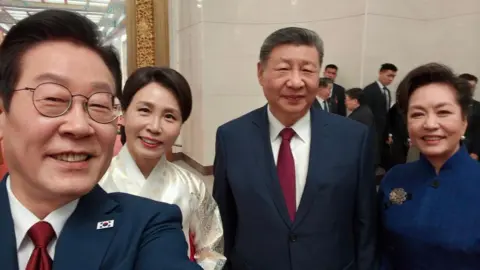
Lee also took selfies with Xi, using a Xiaomi phone that the Chinese president had gifted him last year.
“The image quality is certainly good, right?” Lee posted on X along with the photos.
Xi noted that the “international situation is becoming more turbulent and complex”.
The meeting followed the US’s capture of Venezuelan president Nicolas Maduro over the weekend.
Xi urged Lee to “firmly stand on the right side of history and make correct strategic choices”, China’s official Xinhua news agency reported.
He also brought up the two countries’ shared history of resisting Japan militarism, saying that China and South Korea should now “work hand in hand to safeguard the outcomes of the victory of World War Two and uphold peace and stability in Northeast Asia”.
Xi’s eagerness to meet Lee signals the pressure he faces in finding a regional ally, Park Seung-chan, professor of China studies at Yongin University told the BBC.
“China may beat around the bush but its demand is clear: side with China and denounce Japan.”
During his four-day trip to China, Lee is expected to hold a memorial service in Shanghai for activists who fought for Korea’s independence from Japan.
But while South Korea is “still showing all its deference towards China”, it wants to “strengthen its relationships with both Japan and China”, Mr Park said.
Lee is reportedly planning to visit Japan later this month to meet Prime Minister Sanae Takaichi.
Security on the Korean Peninsula has also been part of the discussions. Lee has sought to engage North Korea diplomatically, but there has been little progress so far. He needs Chinese cooperation in pressuring the North’s Kim Jong Un to give up his nuclear weapons. Beijing is one of Pyongyang’s biggest supporters, economically and diplomatically.
Lee vowed on Monday to work with China on “viable alternatives for peace on the Korean Peninsula”.
On Sunday Seoul’s military said Pyongyang fired ballistic missiles off its east coast. And on Monday the North’s state news agency said the country test-fired hypersonic missiles to assess deterrence capabilities following recent developments, in an apparent reference to the US’s seizure of Maduro.
It remains unclear how much Lee will be able to push China on North Korea. In September, Xi had pledged to strengthen Beijing’s “traditional friendship” with Pyongyang.
And Seoul and Beijing are not natural allies.
US troops have been stationed in South Korea for decades in case of an attack from the North, and last year the two sides agreed to cooperate on building nuclear-powered submarines. The announcement drew warnings from China.
Lee has also sought to put a stop to China’s build-up of maritime structures in waters between the two countries. Beijing says the structures are fish-farming equipment, but they have sparked security concerns in Seoul.
The two leaders agreed on Monday to continue “constructive” dialogue on the matter, South Korea’s presidential spokesperson said.
Another item high on Lee’s agenda is China’s unofficial restrictions on South Korean music and dramas that have been in place for a decade. K-pop and K-dramas are either unavailable or difficult to access on Chinese media platforms.
While China has never acknowledged a ban on Korean artists, it’s believed to be a protest against South Korea’s decision to deploy a US anti-missile system in 2016, which China sees as a threat to its military operations in the region.
China is a massive market for Korean entertainment, which is already a huge global success.
At a Korea-China business forum on Sunday, Lee encouraged deeper bilateral collaboration in beauty products, food and cultural content including movies and music.
A South Korean presidential spokesperson said on Monday that the two leaders agreed to discuss the gradual expansion of cultural exchanges – without specifying concrete commitments on K-dramas or K-pop.
A Chinese foreign ministry spokesperson similarly told reporters on Tuesday that both sides have agreed to “carry out orderly, healthy, and beneficial cultural exchanges”.
Speaking before Korean residents in Beijing on Sunday, Lee said his visit would “serve as a new starting point to fill in the gaps in Korea-China relations, restore them to normal and upgrade them to a new level”.

Shadab, Mirza, Abrar set up Pakistan’s easy win in first T20I

Shadab, Dhananjaya back as Pakistan chase in first T20I

Russia sends navy to guard oil tanker being pursued by US forces

Landslide Early Warnings issued to the Districts of Badulla, Kandy, Matale, Monaragala and Nuwara Eliya

Indian gang rape survivor back home after a week in hospital

Brilliant Bethell hundred pushes SCG Test to fifth day but Australia on target for 4-1

‘Dates have the highest sugar content to fight Coronavirus’

Sunday Island 27 December – Headlines

#SundayIsland 17th December – Headlines

Sunday Island – 28th March

Sunday Island Headlines – 21 March

Sunday Island – 21st February – Headlines
-
 News2 days ago
Broad support emerges for Faiszer’s sweeping proposals on long- delayed divorce and personal law reforms
-

 News2 days ago
Interception of SL fishing craft by Seychelles: Trawler owners demand international investigation
-

 News3 days ago
Private airline crew member nabbed with contraband gold
-

 News5 days ago
Health Minister sends letter of demand for one billion rupees in damages
-

 News21 hours ago
Govt. exploring possibility of converting EPF benefits into private sector pensions
-

 News21 hours ago
Prez seeks Harsha’s help to address CC’s concerns over appointment of AG
-

 Opinion7 days ago
Remembering Douglas Devananda on New Year’s Day 2026
-

 Features2 days ago
Educational reforms under the NPP government