
News
Let’s cut the cackle and get on with it : The fertilizer issue


by Dr. U. Pethiyagoda
It seems that the “Going Organic” tale has lost its novelty and glamour and the matter has been “done and dusted”. Clumsy and ineffective “face-saving” efforts are grossly insufficient.
Obviously, the President cannot be expected to know the background to guide a correct decision on most of the matters that come within his purview. There are too many instances where genuine error or ill-advised steps have to be quickly reversed. Square pegs in square holes cannot move! It is a pity that Our President declared our intent to go totally organic. Apart from the embarrassment, the so called “Chemical Mafia” may react in ways that could be unpleasant. One hopes not.
But, the President, under whose watch, this extraordinarily short-sided operation was launched, has to expect that he has to take the brunt of any criticism. This coterie, (Viyath Maga) which it is said, surrounds and influences him must be made to pay (financially as well) for their sins, folly, (or crimes). I believe that prudence should guide the President to review his trust in such support. I leave it to the competence of drafters of a “New Constitution” to examine ways to prevent a recurrence of this type of colossal tragedy.
“Asewanatcha balanan……..” is the first injunction in the Mahamangala Sutra. In the case of the recent disastrous happenings in the fertilizer matter, I think it is a fair conclusion that opinion (including of those who know the subject), is that increasing the “organic content” of fertilizers is desirable. Though the nutrient content is low in comparison to “artificial or mineral”, the benign effects on soil physical properties and soil biota are significant. But here too, there are unresolved problems, such as unwitting introduction of toxic elements.
As an aside, I was involved long ago, in a study to examine the value of a two-year rejuvenation of tea fields earmarked for replanting, by planting Guatemala or Mana grass. ( the duration varied in different situations), after which the new tea plants are introduced. It seemed that this rotation, produced only a marginal increase of soil Carbon and this too was only transient. It would have been magical if a hundred years of fertility abuse under tea, could be offset by a mere two years under grass. My guess is that the ideal would be alternate 25 year cycles. In that sense the wise farmer would relocate his chena plot.
In summary, abandon the simplistic view of the “Vasa Visa” brigade for a dramatic and radical move to “traditional, organic” farming, as impossible, mythical and misdirected enthusiasm. Although the cry of 100% organic may make good press, it is bad science.
Can the system sustain a possible feared loss of a quarter or so drop in paddy production, with frustrated farmers vowing that they would not cultivate next season’s paddy, unless there is a reversal of this deadly and ill-advised overnight change to organic? The claimed ready availability of suitable “compost” both nationally and internationally, is more rubbishy than a compost heap.
There is a much more serious implication that seems to have escaped notice. The Department of Agriculture is around a century old. As also The CRI, RRI and TRI and more recently, Minor Export Crops. Naturally, much of the experimentation aimed at evolving best practices for maximum productivity. The major means were by evolving appropriate technologies and ensuring reliable supplies of the necessary inputs. Are we really serious about jettisoning the vast effort, devotion and many thousand man hours and millions of rupees expended on trials to evolve the most rewarding use of agrochemicals – fertilizers, pesticides and weed-killers. Who is to foot the bill for what now becomes an astonishing act of idiocy?
The solutions suggested to meet the acute lack of sufficient compost, and tried (at hellish cost), are at the least asinine. One is appalled at the abysmal ignorance of some in authority – (but not in service). Palliatives like “Cabinet reshuffles” will serve no purpose – it will merely provide a chance for the failed, to wreck some other place! In this game, any amount of re-dealing of the same pack will not eliminate “Jokers”.
It seems that a largely ignorant authority does not know that centuries old farming wisdom and experience that paddy needs fertilizer at specific stages of growth, each being of different composition. “Mada pohora” before planting, another to encourage tillering and “Bundi pohora” at heading and grain filling etc. After much fumbling indecision, farmers are finally given the nitrogen rich urea four weeks or so too late! This also at an incredible cost! Will we ever again have ministers, who if they don’t know, are guided by those professionals who do know?
The astonishing methods suggested, for this self-created mess are laughable, if they were not so serious. The hasty import of compost from China has led to unforeseen consequences including diplomatic ones. Anybody who does not realize the limitations of drawing a minute sample from a bulk of some several thousands of tons, cannot be serious. A single case of detection of anything deleterious is cause for rejection. A needle stuck in a haystack has a better chance of being detected. This is a case where a single positive among many negatives is reason for rejecting the whole.
We are told that several million dollars may be claimed by the supplier, whether the cargo is accepted or not. In true “Kekille Style” some genius may decide to save dollars by accepting this stuff, and thus unleashing a public and human health disaster and agricultural risk of introducing new pathogens, causing damage of catastrophic dimension. The circumstance of a Chinese Government involvement in the supplier concerned, presents a further concern.
Then, we go to importing a huge consignment of “liquid nitrogenous” (!) fertilizer (as far as I am aware, a material unknown to Science) from India, at undisclosed and probably huge cost. Many farmers have rejected this foul-smelling material as containing human sewage! As a friend jocularly recalled, PM Narendra Modi promised to have constructed a massive number of latrines to meet a grave shortage. Perhaps India has solved a harrowing problem – finding a customer to receive the stuff and pay for it! Then there was an equally bizarre promise to compensate farmers who have lost income through going organic. How precisely can this be done? Are we totally daft?
All of these problems created through machinations of the evil “Multinationals”,(the British Colonials having lost their currency!).
Incidentally, anyone displaying doubts about such painful inanities, is either a believer of “Pattapal Boru Western Science” or in the pay of evil Multinationals. I am a little peeved. After over five decades of service to the agricultural sector (one way or another), nobody not even those dreadful Multinationals, has shown any inclination to offer me a single dollar or rupee. Have I been short-changed? But then all colleagues I know, are singularly uncorrupt and incorruptible persons of impeccable integrity. So these accusations of bribery are without basis and most unfair.
This whole episode has become a face-saving exercise with several faces needing to be rescued. This is OK if it is free of potential harm. It is a matter of grave regret that The President (possibly misinformed), declared at the UN General Assembly, (no less) that we aim to be the first in the World (or more cynically, the last) country to go one hundred percent organic. Had such a statement been made by a more prominent State Leader, he may never be free of ridicule. We should be thankful that we are only a small country whose Leader’s gaffe goes (hopefully) unnoticed.
It is time for the scientists to consider how best a sensible strategy be developed, to obtain a better integration of the traditional and advanced scientific concepts. This would involve fresh thinking on crop rotation, biological control of pests and diseases, soil and water control, erosion and other undesirable but unavoidable negative environmental consequences, harmonizing responsibilities between the Departments of Agriculture and Veterinary Departments and the CRI, RRI and TRI. There is much that could and must be done. There is no point in making donkeys to bark and dogs to bray. For the immediate future of paddy cultivation, crop rotations, reserves for production of good green manure crops (like “Wal Surya Kantha – Tithonia diversifolia, Glyricidia, Ipil-Ipil and Crotolaria come to mind, The Niyaras could be more systematically used to provide vegetables, yams, and “greens”.
Perhaps we can salvage ourselves from disaster, if it catalyzes a re-visit to the virtues of crop-rotation, fallowing, integration with animal sciences (pasture/fodder) and fish culture. One nostalgically recalls, how during World War Two, paddy lands were able to provide a cornucopia of fresh and palatable vegetables.
Let us grasp this unexpected opportunity.


Allegation of doing business with state:
Civil society activist Oshala Herath has said that regardless of the political party one represents, all members of Parliament should abide by the law of the land. Herath said so when The Island sought his response to a report that he was planning to move court against Deputy Minister Eranga Weeraratne, Deputy Minister of Digital Economy, accused of holding the top positions at Omobio (Pvt.) and Eimsky Business Solutions (Pvt.) Ltd., at the time of the nominations, and took oaths as a National List MP of the NPP government.
President Anura Kumara Dissanayake is the Minister of Digital Economy, in addition to being Minister of Defence and Finance.
Herath is the Chairman of Abhinawa Niwahal Peramuna. Herath, whose legal challenge to SJB MP Diana Gamage over her citizenship issue, led to her removal from Parliament by the Supreme Court on 08 May, last year. He said the latest case underscored the responsibility on the part of political parties to ensure transparency in the nomination process as well as in the finalisation of National List.
Herath pointed out that the court rulings on petitions filed by him against two serving MPs were pending. He moved court against Jaffna District Independent MP Ramanathan Archchuna for handing over nominations to contest the 2024 November parliamentary elections without resigning from his post as a government medical officer. He also moved court against Minister of Rural Development, Social Security and Community Empowerment, Dr. Upali Pannilage, alleging that he had been an employee of the University of Ruhuna at the time he was declared an MP and subsequently appointed as a Cabinet Minister.
Our efforts to contact Deputy Minister Weeraratne were in vain. Our calls went unanswered.
Pointing out that there were many attorneys-at-law in the current Parliament, Herath emphasised the responsibility on their part to take up the issue. The Speaker should, on his own, inquire into such allegations in addition to the Parliamentary Privileges Committee stepping in, Herath said. Responding to another query, Herath said that such violations as well as cases of conflict of interests were far more serious than the recent controversy over NPP National List MP Asoka Ranwala’s educational qualifications.
SJB MP Ajith P. Perera told The Island that the Deputy Minister concerned admitted in Parliament that he had held top posts in the companies mentioned at the time he took oaths as an MP. Therefore, there couldn’t be any ambiguity with regard to his fault. Perera said that the conflict of interest issue involving NPPer was far more serious.
Referring to the issue at hand that had been first raised by SJB lawmaker Amila Prasad Siriwardena in Parliament during committee stage of the debate on the 2026 Budget, Attorney-at-Law Perera said that Weeraratne’s companies were engaged in mega business deals with the government. Declaring that they had secured contracts for government projects since 2019, Perera said that one of the companies Weeraratne was involved in had recently won a major contract from the incumbent government regarding the electronic ticketing system.
Kalutara District MP called for a comprehensive inquiry into the issue as the NPP had come to power, accusing all other political parties of waste, corruption, irregularities and mismanagement of state funds. MP Perera queried whether the current dispensation followed proper procedures in selecting Weeraratne’s company for the ticketing project
Both Herath and Perera urged the JVP and NPP to look into what they called the Weeraratne affair.
Over the years, several MPs had been disqualified to hold parliamentary seats. Dr. Rajitha Senaratne is one of them. When the Court of Appeal dismissed Dr. Senaratne from Parliament for being a supplier to the government, Ranil Wickremesinghe brought him back to Parliament, through the National List.
MP Perera said that since the last parliamentary election, the NPP had been embroiled in many controversies, including the release of 323 containers from the Colombo Port, in January this year, followed by signing of seven Memorandums of Understanding (MoUs)/agreements with India in April.
By Shamindra Ferdinando
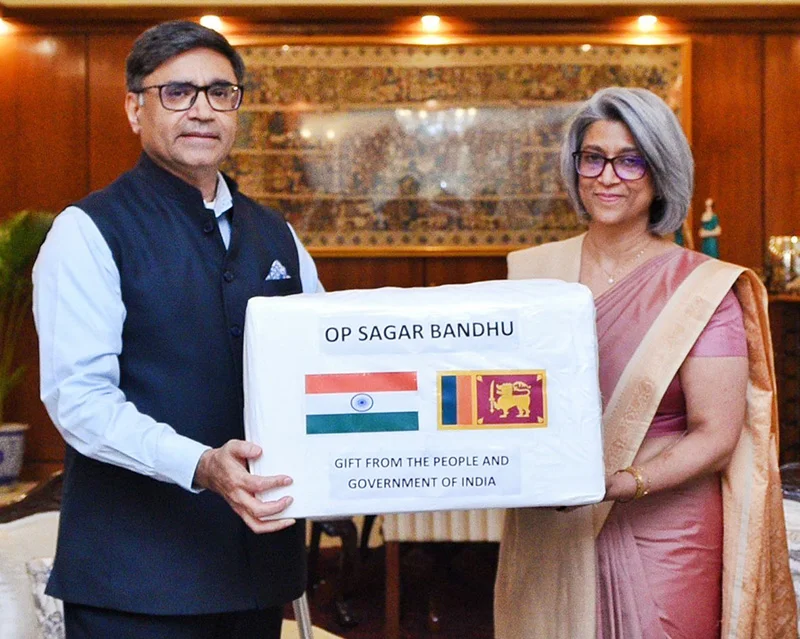
The government has appealed to India for immediate help to overcome the serious shortage of life-saving drugs and injections.
The Sri Lankan High Commission in New Delhi confirmed the appeal made by the government. The following is the text of statement issued by the Sri Lankan mission in New Delhi: “The Foreign Secretary of India, Vikram Misri, over the weekend handed over a consignment of urgently required essential medicines to Sri Lanka’s High Commissioner to India, Mahishini Colonne, in New Delhi. The assistance, extended in response to a request from the Government of Sri Lanka, forms part of Operation Sagar Bandhu, India’s humanitarian mission supporting Sri Lanka’s relief, recovery, and reconstruction efforts following the devastating Cyclone Ditwah.
The consignment consists of over 400 boxes of life-saving medicines and injections, which will be airlifted to Colombo by an Indian Air Force C-17 aircraft, alongside further additional relief assistance from India.
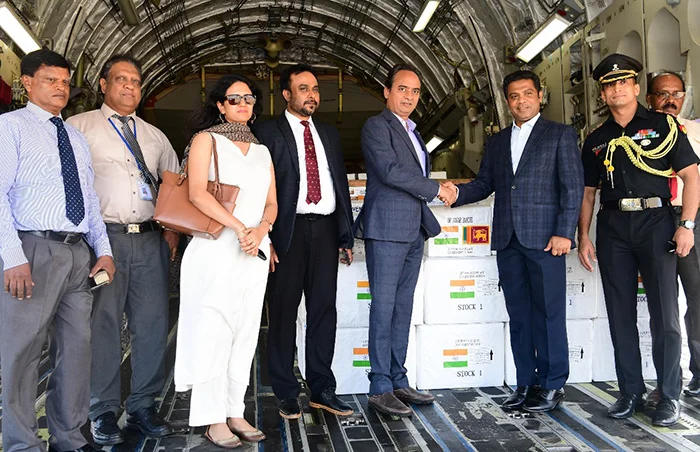
Deputy Indian High Commissioner Pandey shaking hands with Health Minister Dr. Nalinda Jayathissa
Foreign Secretary Misri reiterated the condolences of the Government and people of India for the tragic loss of lives and the extensive damage to infrastructure caused by the Cyclone. He reaffirmed India’s steadfast commitment to supporting Sri Lanka’s immediate humanitarian needs as well as rebuilding and reconstruction efforts. He also highlighted India’s readiness to work with Sri Lanka on a mix of initiatives tailored to the needs of affected communities.
High Commissioner Colonne conveyed the sincere appreciation of the President, Government, and people of Sri Lanka for India’s timely, continuous, and sustained support, and handed over to the Foreign Secretary, a letter of gratitude from the President of Sri Lanka to the Prime Minister of India.
Describing the extensive nature of the damage, the High Commissioner appreciated the ongoing and consistent engagement of the Indian High Commission in Colombo, in collaboration with government officials and local authorities in coordinating relief, rescue, and recovery efforts.
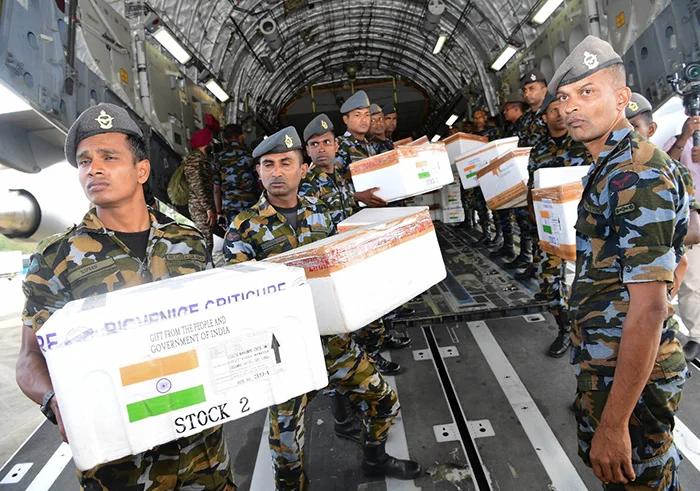
SLAF personnel unloading medicine from IAF transport plane
The High Commissioner also requested India’s support in sharing its expertise and leadership in enhancing disaster-response capabilities and disaster-resilience frameworks, especially lessons from Odisha and Andhra Pradesh, both globally recognized for their advanced disaster resilience frameworks. Apart from this support that is under discussion, the New Delhi-based Coalition for Disaster Resilient Infrastructure (CDRI) has also been requested to undertake a visit to Sri Lanka to explore avenues for strengthening Sri Lanka’s disaster resilient infrastructure capacities. Noting the importance of having an effective and real-time warning system, efforts are being made to deploy a team to explore the establishment of an early warning system that would provide real-time geo-targeted alerts to citizens.
The High Commissioner reiterated Sri Lanka’s gratitude to the Government and people of India for their continued solidarity under Operational Sagar Bandhu, reaffirming the strength of the longstanding partnership between the two nations.”
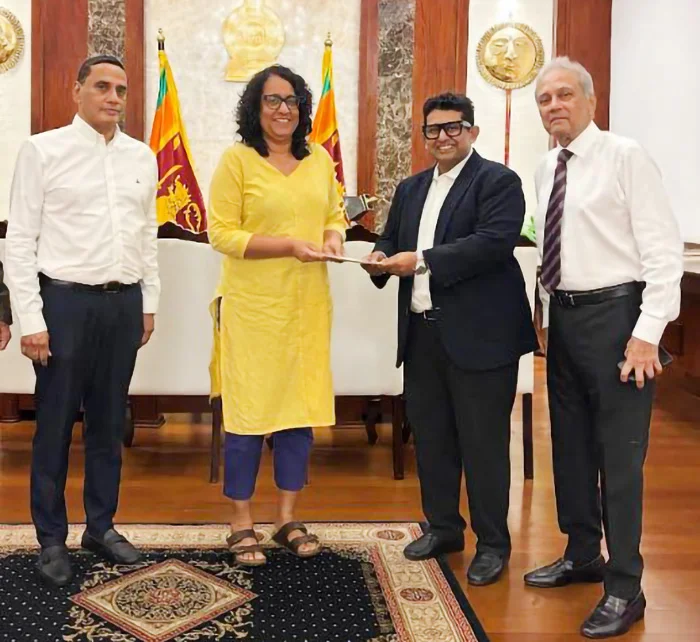
The George Keyt Foundation (GKF) has extended meaningful support to the Government of Sri Lanka’s disaster relief efforts following the severe devastation caused by Cyclone Ditwah.
The text of the press release issued by the GKF: “In 2023, the Foundation undertook its first major fundraiser in recent years by issuing 30 numbered limited edition prints of Kangodi Rangi, a painting by George Keyt entrusted to the Foundation. Twenty-eight prints were acquired by donors to support charitable causes, while another was gifted to the President’s collection. Print Number 1 of 30 was retained to support the Foundation’s long-term priorities.
In light of the unprecedented impact of Cyclone Ditwah and the urgent national need for disaster assistance, the trustees unanimously resolved to seek a donor for Print Number 1 of 30, with clear disclosure that the proceeds would be channeled directly to the Government’s disaster relief programme. This appeal received an immediate response, resulting in a private donation of Rs. 3 million.
The contribution was formally handed over to Prime Minister Harini Amarasuriya for utilisation in the Government’s ongoing relief and recovery efforts.
The George Keyt Foundation is honoured to support the people of Sri Lanka at this critical moment and reaffirms its commitment to serving national needs while preserving and promoting the artistic legacy of George Keyt.

Several spells of showers will occur in the Northern, North-Central, Eastern, Uva and Central provinces

Bondi Beach gunmen who killed 15 after targeting Jewish celebration were father and son, police say

Govt. urged to take action against deputy minister

India sends stock of life-saving medicines

George Keyt Foundation contributes to national disaster relief efforts

New Ambassador to South Korea appreciates job opportunities for Lankans

‘Dates have the highest sugar content to fight Coronavirus’

Sunday Island 27 December – Headlines

#SundayIsland 17th December – Headlines

Sunday Island – 28th March

Sunday Island Headlines – 21 March

Sunday Island – 21st February – Headlines
-

 Features5 days ago
Finally, Mahinda Yapa sets the record straight
-
 News6 days ago
Cyclone Ditwah leaves Sri Lanka’s biodiversity in ruins: Top scientist warns of unseen ecological disaster
-
 Features5 days ago
Handunnetti and Colonial Shackles of English in Sri Lanka
-
 Business4 days ago
Cabinet approves establishment of two 50 MW wind power stations in Mullikulum, Mannar region
-

 News7 days ago
Jetstar to launch Australia’s only low-cost direct flights to Sri Lanka, with fares from just $315^
-
 News4 days ago
Gota ordered to give court evidence of life threats
-

 Features6 days ago
An awakening: Revisiting education policy after Cyclone Ditwah
-

 Features4 days ago
Cliff and Hank recreate golden era of ‘The Young Ones’