
News
Let’s cut the cackle and get on with it : The fertilizer issue


by Dr. U. Pethiyagoda
It seems that the “Going Organic” tale has lost its novelty and glamour and the matter has been “done and dusted”. Clumsy and ineffective “face-saving” efforts are grossly insufficient.
Obviously, the President cannot be expected to know the background to guide a correct decision on most of the matters that come within his purview. There are too many instances where genuine error or ill-advised steps have to be quickly reversed. Square pegs in square holes cannot move! It is a pity that Our President declared our intent to go totally organic. Apart from the embarrassment, the so called “Chemical Mafia” may react in ways that could be unpleasant. One hopes not.
But, the President, under whose watch, this extraordinarily short-sided operation was launched, has to expect that he has to take the brunt of any criticism. This coterie, (Viyath Maga) which it is said, surrounds and influences him must be made to pay (financially as well) for their sins, folly, (or crimes). I believe that prudence should guide the President to review his trust in such support. I leave it to the competence of drafters of a “New Constitution” to examine ways to prevent a recurrence of this type of colossal tragedy.
“Asewanatcha balanan……..” is the first injunction in the Mahamangala Sutra. In the case of the recent disastrous happenings in the fertilizer matter, I think it is a fair conclusion that opinion (including of those who know the subject), is that increasing the “organic content” of fertilizers is desirable. Though the nutrient content is low in comparison to “artificial or mineral”, the benign effects on soil physical properties and soil biota are significant. But here too, there are unresolved problems, such as unwitting introduction of toxic elements.
As an aside, I was involved long ago, in a study to examine the value of a two-year rejuvenation of tea fields earmarked for replanting, by planting Guatemala or Mana grass. ( the duration varied in different situations), after which the new tea plants are introduced. It seemed that this rotation, produced only a marginal increase of soil Carbon and this too was only transient. It would have been magical if a hundred years of fertility abuse under tea, could be offset by a mere two years under grass. My guess is that the ideal would be alternate 25 year cycles. In that sense the wise farmer would relocate his chena plot.
In summary, abandon the simplistic view of the “Vasa Visa” brigade for a dramatic and radical move to “traditional, organic” farming, as impossible, mythical and misdirected enthusiasm. Although the cry of 100% organic may make good press, it is bad science.
Can the system sustain a possible feared loss of a quarter or so drop in paddy production, with frustrated farmers vowing that they would not cultivate next season’s paddy, unless there is a reversal of this deadly and ill-advised overnight change to organic? The claimed ready availability of suitable “compost” both nationally and internationally, is more rubbishy than a compost heap.
There is a much more serious implication that seems to have escaped notice. The Department of Agriculture is around a century old. As also The CRI, RRI and TRI and more recently, Minor Export Crops. Naturally, much of the experimentation aimed at evolving best practices for maximum productivity. The major means were by evolving appropriate technologies and ensuring reliable supplies of the necessary inputs. Are we really serious about jettisoning the vast effort, devotion and many thousand man hours and millions of rupees expended on trials to evolve the most rewarding use of agrochemicals – fertilizers, pesticides and weed-killers. Who is to foot the bill for what now becomes an astonishing act of idiocy?
The solutions suggested to meet the acute lack of sufficient compost, and tried (at hellish cost), are at the least asinine. One is appalled at the abysmal ignorance of some in authority – (but not in service). Palliatives like “Cabinet reshuffles” will serve no purpose – it will merely provide a chance for the failed, to wreck some other place! In this game, any amount of re-dealing of the same pack will not eliminate “Jokers”.
It seems that a largely ignorant authority does not know that centuries old farming wisdom and experience that paddy needs fertilizer at specific stages of growth, each being of different composition. “Mada pohora” before planting, another to encourage tillering and “Bundi pohora” at heading and grain filling etc. After much fumbling indecision, farmers are finally given the nitrogen rich urea four weeks or so too late! This also at an incredible cost! Will we ever again have ministers, who if they don’t know, are guided by those professionals who do know?
The astonishing methods suggested, for this self-created mess are laughable, if they were not so serious. The hasty import of compost from China has led to unforeseen consequences including diplomatic ones. Anybody who does not realize the limitations of drawing a minute sample from a bulk of some several thousands of tons, cannot be serious. A single case of detection of anything deleterious is cause for rejection. A needle stuck in a haystack has a better chance of being detected. This is a case where a single positive among many negatives is reason for rejecting the whole.
We are told that several million dollars may be claimed by the supplier, whether the cargo is accepted or not. In true “Kekille Style” some genius may decide to save dollars by accepting this stuff, and thus unleashing a public and human health disaster and agricultural risk of introducing new pathogens, causing damage of catastrophic dimension. The circumstance of a Chinese Government involvement in the supplier concerned, presents a further concern.
Then, we go to importing a huge consignment of “liquid nitrogenous” (!) fertilizer (as far as I am aware, a material unknown to Science) from India, at undisclosed and probably huge cost. Many farmers have rejected this foul-smelling material as containing human sewage! As a friend jocularly recalled, PM Narendra Modi promised to have constructed a massive number of latrines to meet a grave shortage. Perhaps India has solved a harrowing problem – finding a customer to receive the stuff and pay for it! Then there was an equally bizarre promise to compensate farmers who have lost income through going organic. How precisely can this be done? Are we totally daft?
All of these problems created through machinations of the evil “Multinationals”,(the British Colonials having lost their currency!).
Incidentally, anyone displaying doubts about such painful inanities, is either a believer of “Pattapal Boru Western Science” or in the pay of evil Multinationals. I am a little peeved. After over five decades of service to the agricultural sector (one way or another), nobody not even those dreadful Multinationals, has shown any inclination to offer me a single dollar or rupee. Have I been short-changed? But then all colleagues I know, are singularly uncorrupt and incorruptible persons of impeccable integrity. So these accusations of bribery are without basis and most unfair.
This whole episode has become a face-saving exercise with several faces needing to be rescued. This is OK if it is free of potential harm. It is a matter of grave regret that The President (possibly misinformed), declared at the UN General Assembly, (no less) that we aim to be the first in the World (or more cynically, the last) country to go one hundred percent organic. Had such a statement been made by a more prominent State Leader, he may never be free of ridicule. We should be thankful that we are only a small country whose Leader’s gaffe goes (hopefully) unnoticed.
It is time for the scientists to consider how best a sensible strategy be developed, to obtain a better integration of the traditional and advanced scientific concepts. This would involve fresh thinking on crop rotation, biological control of pests and diseases, soil and water control, erosion and other undesirable but unavoidable negative environmental consequences, harmonizing responsibilities between the Departments of Agriculture and Veterinary Departments and the CRI, RRI and TRI. There is much that could and must be done. There is no point in making donkeys to bark and dogs to bray. For the immediate future of paddy cultivation, crop rotations, reserves for production of good green manure crops (like “Wal Surya Kantha – Tithonia diversifolia, Glyricidia, Ipil-Ipil and Crotolaria come to mind, The Niyaras could be more systematically used to provide vegetables, yams, and “greens”.
Perhaps we can salvage ourselves from disaster, if it catalyzes a re-visit to the virtues of crop-rotation, fallowing, integration with animal sciences (pasture/fodder) and fish culture. One nostalgically recalls, how during World War Two, paddy lands were able to provide a cornucopia of fresh and palatable vegetables.
Let us grasp this unexpected opportunity.


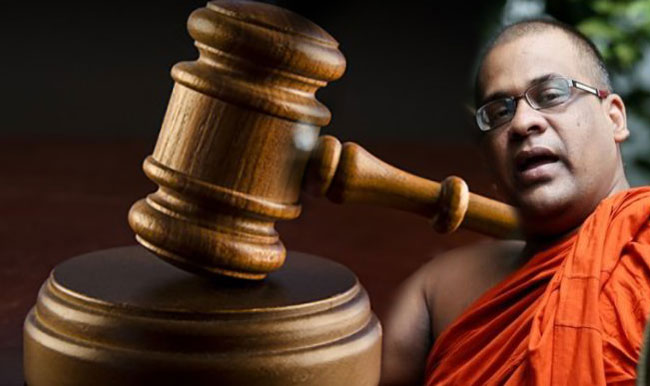
Ven. Galagoda Aththe Gnanasara Thero was not at his temple in Rajagiriya when prison officials visited the premises yesterday to take steps following the Supreme Court ruling that nullified the presidential pardon granted to him, police sources said.
Prison officials who visited the temple on Nawala Road, Rajagiriya, were reportedly informed by those present that the Thero’s whereabouts were unknown. The development comes a day after the Supreme Court declared former President Maithripala Sirisena’s 2019 pardon of Gnanasara Thero null and void.
The three-member Supreme Court bench comprising Justices Janak De Silva, Dr. Sobhitha Rajakaruna and Sampath B. Abayakoon held that the pardon was arbitrary, violated the public trust and principles of natural justice, and was made beyond the proper exercise of the President’s constitutional discretion.
The case arose from Gnanasara Thero’s conduct at the Homagama Magistrate’s Court in January 2016 during proceedings relating to the disappearance of journalist and political cartoonist Prageeth Eknaligoda.
The Court of Appeal convicted him on four counts of contempt of court in 2018 and imposed concurrent prison terms amounting to six years. He had served about nine months when Sirisena granted him a presidential pardon on May 23, 2019.
The Supreme Court found that although Article 34 empowers the President to grant pardons, that power is held in trust for the people and is subject to constitutional limitations and judicial review. The Court concluded that Sirisena had effectively acted on the recommendation of the Additional Secretary (Legal) without demonstrating that he had independently considered the relevant material.
Justice De Silva held that the pardon was “arbitrary”, violated public trust and the rules of natural justice, and was ultra vires the President’s powers. The Court consequently found that the decision violated the fundamental right to equality guaranteed by Article 12(1) of the Constitution.
The ruling effectively restores the legal position under the original conviction, leaving Gnanasara Thero without the benefit of the 2019 pardon. The Supreme Court also clarified that a pardon does not erase a conviction or sentence, but merely relieves an offender from serving the sentence to the extent specified in the pardon.
Gnanasara Thero, the General Secretary of the Bodu Bala Sena, had been convicted over his conduct during proceedings concerning the disappearance of Eknaligoda, who went missing in January 2010 and has not been located.
Sandhya Eknaligoda, Prageeth Eknaligoda’s wife, was among those who challenged the presidential pardon before the Supreme Court, alongside the Centre for Policy Alternatives and its Executive Director Dr. Paikiasothy Saravanamuttu.
The detailed account of the judgment indicates that the Court’s ruling primarily nullified the pardon and restored the legal effect of the original sentence, with the implementation of the sentence falling to the relevant authorities.
Police sources said that the Supreme Court, however, did not permanently close the door on executive clemency. It held that a future President could grant Gnanasara Thero another pardon, provided the power is exercised lawfully and after proper consideration of all relevant material.
The Supreme Court has so far overturned three presidential pardons granted to two former Presidents. In January 2024, the Court declared former President Gotabaya Rajapaksa’s pardon of former MP Duminda Silva unlawful and invalid. In June 2024, it invalidated two pardons granted by former President Maithripala Sirisena to Royal Park murder convict Jude Shramantha Anthony Jayamaha — the first in May 2016, which commuted his death sentence to life imprisonment, and the second in October 2019, which released him from prison. Jayamaha, who was convicted of the murder of 19-year-old Yvonne Johnson, remains at large. Most recently, on September 10, 2026, the Supreme Court declared Sirisena’s 2019 pardon of Ven. Galagoda Aththe Gnanasara Thero null and void, ruling that it was arbitrary and inconsistent with the Constitution.

Parliament is scheduled to debate the Twenty-Second Amendment to the Constitution Bill and the Judicature (Amendment) Bill on September 24 and 25, subject to the Speaker’s announcement following the delivery of the Supreme Court determination on petitions filed against the Bills.
The programme for the Parliamentary Week from September 22 to 25 was decided at a meeting of the Committee on Parliamentary Business held on Thursday (10) under the chairmanship of Speaker Dr. Jagath Wickramaratne.
On each sitting day, Parliamentary Business under Standing Orders 22(1) to 22(6) will be taken up from 9.30 am to 10 am, followed by Questions for Oral Answers from 10 am to 11 am Questions under Standing Order 27(2) will be taken up from 11 am to 11.30 am.
On Tuesday (22), the Orders published in Extraordinary Gazette No. 2497/37 under the Petroleum Resources Act and the Promotion of Export Agriculture (Amendment) Bill will be debated from 11.30 am to 5 pm.
The Tredso Development Foundation (Incorporation) Bill, a Private Member’s Bill, will then be taken up for Second Reading before being referred to the Legislative Standing Committee.
An Opposition motion at the Adjournment Time will follow.
On Wednesday (23), the Chartered Institute of Media Professionals of Sri Lanka Bill will be debated from 11.30 am to 5 pm, followed by Questions at the Adjournment Time.
The Second Reading debate on the 22nd Amendment Bill and the Judicature (Amendment) Bill is scheduled for 11.30 am to 7 pm on Thursday (24) and Friday (25).

Two children aged 11 and 17 were mistakenly killed and their 55-year-old father injured in an early morning hand grenade attack on Sirisangabo Mawatha on Friday. Police investigations later revealed that the attackers targeted the wrong house during an ongoing underworld clash.
Three police teams have been deployed to investigate the attack, which occurred at around 3 am.
According to police, a man who arrived near the house in a three-wheeler knocked on the front door before throwing a grenade into the premises and fleeing.
The victims were identified as 17-year-old Kasun Rashmika and 11-year-old Duminda Gihan. Their 56-year-old father, Nalin Thusantha Perera, was seriously injured and admitted to the Kalubowila Teaching Hospital.
Police said the injured man’s brother was allegedly a close associate of a drug trafficker known as ‘Sando’ and had also been accused of involvement in drug trafficking.
The brother lives in a house adjoining the one targeted in the attack, and police suspect the grenade may have been thrown at the wrong house.
Police are also investigating information that the attack was allegedly carried out at the direction of several overseas-based drug traffickers, identified as Pandithage Shantha Kumara alias ‘Kos Malli’, Samantha Perera alias ‘Chuwa Samantha’, ‘Kudu Avishka’ and ‘I.D.’
Police said the attack was believed to be linked to an ongoing conflict between two underworld factions, which have targeted each other’s associates in shootings and grenade attacks. More than 20 people have reportedly been killed in such attacks.
Security agencies are also investigating alleged links between one faction and overseas-based criminals including Kanjipani Imran, Unakuruwe Shantha, Dubai Gagana and Handaya.
Security agencies have also received information that overseas-based criminals identified as Kanjipani Imran, Unakuruwe Shantha, Dubai Gagana and Handaya are allegedly behind the supply of firearms and drugs to the faction associated with Kos Malli and Chuwa Samantha.

Death toll from Philippines ferry fire rises to 76, with more still missing

Anthropic boss Dario Amodei calls for AI development to slow down

It’s spin vs spin as India and Sri Lanka battle for Asia Cup title

Atmospheric conditions are favorable for afternoon thundershowers in most parts of the Island today [13]

Gnanasara Thero absconding after SC ruling

House to debate 22A, Judicature Bill next week

‘Dates have the highest sugar content to fight Coronavirus’

Sunday Island 27 December – Headlines

#SundayIsland 17th December – Headlines

Sunday Island – 28th March

Sunday Island Headlines – 21 March

Sunday Island – 21st February – Headlines
-

 Sports2 days ago
DDS set to lose Test captaincy
-

 Features6 days ago
After the parade: What a traffic OIC’s walk-out tells us
-

 Editorial6 days ago
Arrests as theatre
-

 News5 days ago
Thailand shuts door on undesirables from Sri Lanka
-

 Latest News6 days ago
Harshitha’s composed knock seals Sri Lanka’s semi-final berth
-

 News2 days ago
Sri Lanka faces new grid challenge as rooftop solar surges: former CEB GM
-
 Business5 days ago
CEB successor company breaks into top three in competitive BESS tender
-

 News6 days ago
‘Choka Malli’ slips out of country before travel ban