
News
Lankan Economic Outlook 2022: Experts call for bold and radical reforms


International and local economic experts and corporate leaders have stressed the need for a concrete, long-term and bold reform agenda for the economy as the country braces for a critical year amidst unprecedented socio-economic challenges.
Speaking at the “Sri Lanka Economic Outlook 2022” forum organised by the Friedrich Naumann Foundation for Freedom and NextGenSL, recently, Prof. Lee. C. Buchheit, an international debt restructuring expert, Prof. H.D. Karunaratne, a prominent economist and the newly-appointed Vice Chancellor of the University of Colombo, Kasturi Chellaraja Wilson, Hemas Group CEO and Economist Deshal de Mel spoke at length about Sri Lanka’s economic trajectory for the year and the options available at present.
“Any fiscal adjustment programme initiated at this stage will be ‘distasteful’ and will involve a degree of pain. Even a home-grown adjustment programme will entail certain political problems due to the nature of reforms. The question here is whether the country’s political leaders will have the political stamina to proceed with them,” Prof. Lee C. Buchheit, an international expert with a 43-year legal career specialising in sovereign debt management, said.
Delivering the keynote speech at the event, Buchheit presented a detailed account of the global debt situation for the year 2022. He has worked on over two dozen sovereign debt restructurings and he led the legal teams advising the sovereign debtors in the two largest sovereign debt workouts in history (Greece in 2012 and Iraq in 2005-08).
“The problem Sri Lanka must ask itself at the moment is whether there is a plausible fiscal adjustment programme that can be implemented within the next two-three years. It is in this context that the option of seeking the support of the International Monetary Fund (IMF) should be assessed and analysed. The country can also proceed with borrowings from bi-lateral partners as long as the Government has a clear policy and the stamina to implement comprehensive reforms,” he added.
“Sri Lanka’s creditors — be they bilateral or commercial — will be interested in one critical question. That would be; who are we going to share the pain with? Every sovereign bond restructuring boils down to one decision — how much of the country’s pain should be borne by its citizens, and how much should be borne by the creditors,” the international expert explained.
“Commercial creditors caught up in this issue often ask themselves whether the proposed debt restructuring is necessary and whether the conditions proposed to them are proportionate to what the country actually needs.”
“This could be a challenging process as both the public and the creditors would say that they are disproportionately carrying the burden.”
“Therefore, the only entity in the world with the technical expertise and the political legitimacy to assuage such concerns and handle this process is the International Monetary Fund (IMF)”, Prof. Buchheit said.
“A number of countries in the world have embarked on debt restructuring without the IMF. But, if you ask whether the involvement of the IMF is useful, the answer would be ‘yes’,” he added.
Commenting on international credit rating agencies downgrading Sri Lanka, Prof. Buchheit said it should not be a major concern for Sri Lanka.
“This will only be a big concern if you are trying to re-access the global capital market in the near future. When the country announces the need for debt restructuring, rating agencies will downgrade the country to ‘selective default’ and this rating will remain until the restructuring is completed. Once this is done, they will upgrade the country to higher rating categories.”
“This will only be a major worry if Sri Lanka intends to issue additional International Sovereign bonds in the near future. I don’t think Sri Lanka is in a position to do so,” he said.
Speaking at the discussion, Prof. H.D. Karunaratne said the crisis in Sri Lanka had been brewing for over 70 years and opined that short-term fixes would not resolve a long-term problem.
“Sri Lanka is a country that harbours a lot of dreams. But, we are not working practically, with a rational approach, to achieve our dreams,” he said.
He added that “the large majority of Sri Lankans assume that bringing in more foreign investments alone will resolve our crisis. But, do we at least have consensus across the political spectrum on the nature of foreign investments Sri Lanka wants? The dynamics investors usually see in other countries do not work in Sri Lanka’s context. How are we going to attract high-value investments without addressing these critical issues?” Prof. Karunaratne asked.
The senior Economist also pointed out that the ever-expanding public sector was also another area of concern for Sri Lanka.
“We have nearly 1.4 million workers in the public sector and each government keeps on adding to this number. In addition, so many loss-making institutions in the public sector are being operated without any plan for restructuring. This irrational approach is one of the key contributing factors to the current situation,” he said.
“Another problem Sri Lanka must pay attention to is policy inconsistencies. For instance, in 2016, the Government announced tax concessions for electricity-based vehicles. In 2017, the Government imposed heavy taxes on the same vehicles. This is just one example as to how policy inconsistencies have contributed to the crisis we find ourselves in today,’ Karunaratne said, adding that Sri Lanka is currently paying the price for its over-reliance on gas.
Commenting on the way forward, Prof. Karunaratne said the country’s top priority should be to keep its house in order. “Whatever we do, we cannot expect satisfactory results unless we decide to keep our house in order. We can go on borrowing money from bilateral partners but what’s the point in doing so without any concrete plan to address these key areas for concern?”
The senior economist proposed to set up a Japanese-style “Economic Planning Agency” to ensure stable and consistent policies related to the country’s economy.
Hemas Group CEO, Kasturi Chellaraja Wilson said Sri Lanka should now focus on its approach to overcome the existing difficulties.
“We have faced immense difficulties ranging from accessing foreign exchange to opening Letters of Credit. But we, Sri Lankans, have faced challenges before and I am sure we will see many more challenges in the future. So, the problem is not the challenges, but the approach we adopt to overcome them,” she said opening her remarks.
“We must first come to the realization that short-term, tactical measures will no longer resolve our crisis at this point. We need long-term, concrete planning.”
“Do we have the political will to do what is right? Our politicians must decide whether they are going to play party politics or do what is right by the country. The Government, the Opposition, the public sector and the private sector must come together to lead the country out of the current crisis. That is what we want to see,” she said.
“There is no doubt about the fact that economic reforms are going to be a bitter pill to swallow. But, there is no other way out. The issue, however, is that we do not seem to have a common agenda as a country to navigate the crisis,” Wilson explained.
Economist Deshal de Mel who described this as an opportunity to come together for a bold and drastic reform agenda expressed the same sentiments.
“Whatever we do — be it debt restructuring or seeking support from bilateral or multilateral donors — we will not be able to avoid reforms. We all know that reforms are not going to be easy but I see this crisis as an opening to come together to initiate bold reforms,” de Mel said.
When asked about suggestions made by the business community and some economists to go for debt restructuring, De Mel said it could be deemed as a prudent approach. “The most important thing right now is to find a sustainable solution to the debt issue,” he added.
“Sri Lanka must find a way to build its reserves and to adjust the country’s fiscal trajectory,” De Mel stated adding that it was important to Sri Lanka to have a concrete plan to regain access to the global capital market.

Latest News
Steps are being taken to abolish the Executive Presidency and establish a Parliamentary System of Government – Prime Minister

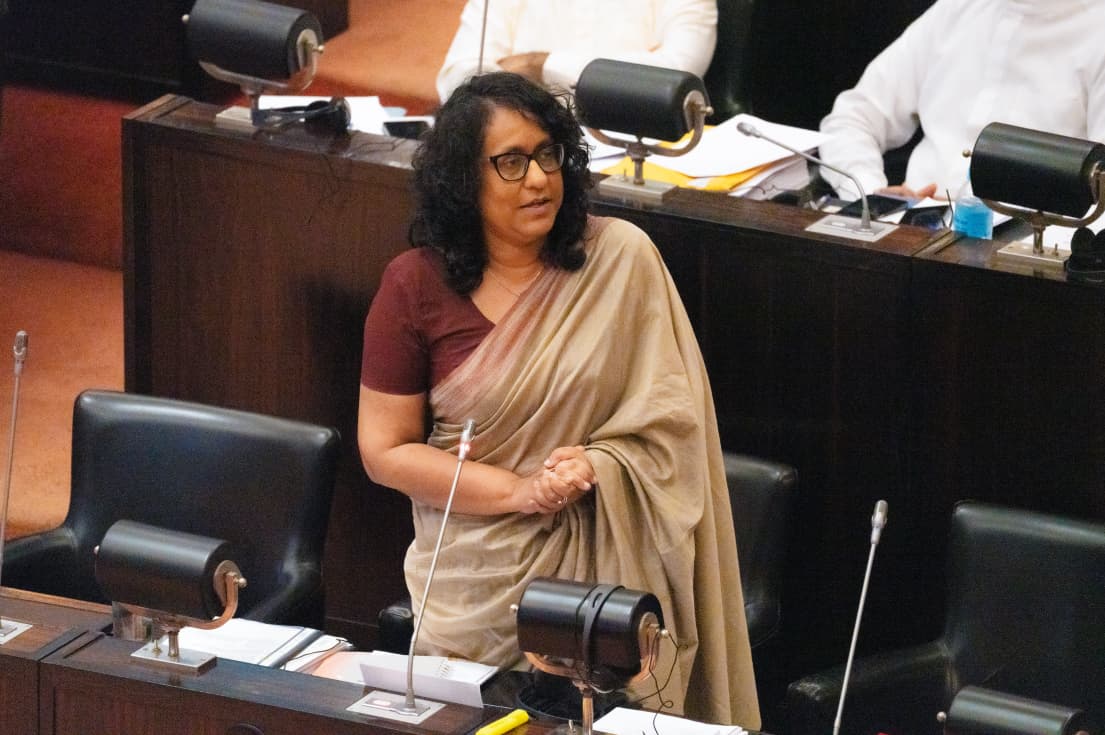
Prime Minister Dr. Harini Amarasuriya stated that steps are being taken to abolish the Executive Presidency and establish a parliamentary system of government, including the appointment of a President without executive powers. The Prime Minister further stated that measures are currently underway to hold the Provincial Council elections, which have been stalled due to provisions in the Provincial Councils Elections (Amendment) Act No. 17 dated 2017.
The Prime Minister made these remarks on Friday the 19th of December at Parliament while responding to a question raised by the Leader of the Opposition, Sajith Premadasa, under Standing Order 27(2).
The Prime Minister further stated,
“As stated on page 194 of the policy statement “A Thriving Nation – A Beautiful Life”, the government intends to draft a new Constitution. This draft will be presented to the public, followed by dialogue and discussion, after which necessary amendments will be made. The Constitution is then expected to be approved through a referendum. At present, reports of committees previously appointed to draft a new Constitution, along with other constitutional reform proposals, are being considered. Thereafter, a basic concept paper will be submitted to the Cabinet of Ministers.
The necessary steps are taken to abolish the Executive Presidency, and establish a parliamentary system of government, and appoint a President without executive powers will be undertaken in the process of drafting the new Constitution. It is not possible to abolish the Executive Presidential system without introducing a new Constitution. A study is currently underway on the abolition of the Executive Presidency and the possible methods of the process. While giving due attention to resolving the country’s pressing issues, focus has also been placed on abolishing the Executive Presidency. Relevant timelines will be announced in due course.
Steps are currently being taken to hold the Provincial Council elections at the earliest possible time. Under Section 3(b) of the Provincial Councils Elections (Amendment) Act No. 17 dated 2017, a Delimitation Commission appointed by the President must submit a report determining the demarcation of electoral divisions and the number of electoral districts. Once this report receives parliamentary approval, it will be possible to hold the Provincial Council elections.
The inability to hold Provincial Council elections thus far is due to the fact that the delimitation process required under the provisions of the Provincial Councils Elections (Amendment) Act No. 17 dated 2017 has not yet been completed. Accordingly, a study is currently being conducted to determine whether the elections should be held after completing the delimitation process, or whether amendments should be introduced to the provisions of Act No. 17 dated 2017 in order to proceed with the elections. A decision on holding the Provincial Council elections will be taken following the completion of this study. Nevertheless, provisions have been allocated in the 2026 Budget to conduct the elections once these processes are concluded.
The Prime Minister further stated that studies are currently underway regarding the introduction of new legislation and necessary legal amendments required to establish a Government Prosecutor’s Office.
(Prime Minister’s Media Division)
Latest News
The full speech delivered by President Anura Kumara Dissanayake in Parliament (2025-12-19)

“Today, we have presented to Parliament the largest supplementary estimate submitted in recent history. On the 5th of this month, following a lengthy debate, this Parliament approved the Budget required for the year 2026. However, within a very short period, we have been compelled to present a supplementary estimate amounting to Rs. 500 billion.
This Parliament acknowledges that such a supplementary estimate is necessary both to restore normal life following the prevailing disaster situation and to revive our economy. However, I am aware that there is a discussion within Parliament and outside it suggesting that, as a result of this Rs. 500 billion, the economy will collapse by April.
I wish to provide some clarification regarding claims that the economy will face a serious threat as a result of presenting such a large sum through a supplementary estimate.
We are a government that has worked with strong fiscal discipline and clear targets. If we consider the year 2025, we have achieved success across a number of important economic indicators this year.
As you know, for a long period the Treasury account operated under a bank overdraft. At times, interest rates of 33% or 36% were paid on these overdrafts.
In 2018, the bank overdraft stood at Rs. 180 billion. In 2019, it increased to Rs. 274 billion; in 2020 to Rs. 575 billion; and in 2021 to Rs. 821 billion. In other words, the government’s bank account was overdrawn by Rs. 821 billion.
However, by November 2025, the balance of the government’s Treasury account had reached Rs. 1,202 billion. That represents an increase of Rs. 2 trillion compared to 2021. This is a very significant development for our country’s economy.
Had such a reserve not existed, we would not have been able to allocate this Rs. 500 billion today. In that case, we would have had to identify several alternative strategies to raise this amount. Secondly, in terms of revenue, Sri Lanka has recorded the highest level of government revenue since 2007 in the year 2025, at 15.9%. Thirdly, the lowest budget deficit since 1977 has been recorded, at 4.5%.
Moreover, this year has become the year in our history in which revenue targets were exceeded. This year, we expected revenue of Rs. 4,960 billion; by 15 December 2025, we had already generated Rs. 5,125 billion in revenue. At the same time, we were able to refrain from increasing the debt ceiling.
When presenting the 2026 Budget, we stated that we expected a debt ceiling of Rs. 3,800 billion. However, through our budget proposals, we reduced this by a further Rs. 60 billion and are maintaining a debt ceiling of Rs. 3,740 billion.
We are utilising this additional Rs. 500 billion without increasing our debt ceiling. This is extremely important. As a result, after a long period, we have been able to remain within the debt limits anticipated in the Budget.
Furthermore, since 1950, a surplus in our primary account has been recorded on only about six occasions. Over a period of 74 years, a positive primary balance has been recorded only six times, and on all six occasions it was below 1%. However, for the first time in history, the primary surplus this year is being reported at 3.8%.
This year, Sri Lanka is receiving the highest level of foreign remittances in its history. Tourism earnings amounted to approximately USD 3.8 billion in 2018, and we expect to surpass that figure. We expect our export earnings from goods and services to reach close to USD 18 billion.
These figures demonstrate that this success has been achieved as a result of strong financial management and disciplined, target-oriented governance.
However, we did not have an economy capable of withstanding major shocks. What we had was an economy in which even a small or misguided decision could result in severe destruction. Therefore, over the past 14 to 15 months, we have acted with extreme caution, avoiding mistakes and carefully examining even the most delicate aspects and have brought the economy to a position of stability.
No one can deny this. However, it is within such a context of economic stability that we have faced this shock. Had we not been in a position of economic stability and strength, we would not have been able to confront this situation.
It is the economic stability we have achieved so far that has created the courage and confidence necessary for us to face this challenge. However, we are also aware that the economy had not yet grown to a level capable of fully absorbing such a shock. This shock was inflicted on our economy at a time when we were rebuilding a collapsed country step by step.
Therefore, the economy must be managed through careful and finely calibrated interventions required to absorb and mitigate this shock. However, an economy is not about hoarding wealth like a miser and accumulating everything in one place. An economy means that if any benefit is derived from it, that benefit must in turn flow back to the people.
Otherwise, there is no benefit to the people merely in having trillions of rupees in surplus in the Treasury. Therefore, if we achieve even a small victory in the economy, that victory must be allowed to flow through to the people.
Accordingly, in this disaster situation, the reserves amounting to Rs. 1.2 trillion that we possess must be utilised to provide relief to the people. We will not refrain from doing so.
Our country has a history in which those in power shared benefits among themselves using large ladles. Was it just that compensation was paid to ministers after houses were set on fire?
There has always been a precedent in this country of those in power allocating themselves a large share, while distributing to the people with small ladles.
We did not form a National People’s Power government in order to distribute benefits to the government using large ladles. Our intention is to provide fair benefits to the people. Therefore, we have intervened to support the people fairly in overcoming this crisis.
Our policy approach is centred on how we intervene to enable people to restart their livelihoods and lead more stable lives once again. It is for this purpose that we are seeking Rs. 500 billion. Accordingly, we have allocated total provisions exceeding Rs. 700 billion for this purpose.
A report containing a preliminary assessment conducted by the World Bank on this matter is scheduled to be provided to us next Monday. The total extent of the damage can be ascertained from that report. However, there are several key matters to which we are paying close attention.
We are taking into account the potential inflationary impact of an additional Rs. 500 billion entering the market. Accordingly, efficiency in the production of goods and services must be enhanced.
A significant portion of the funds we allocate must therefore be spent on achieving growth in the production of goods and services. When approximately Rs. 500 billion is injected into the market, there is a likelihood of a corresponding increase in demand for US dollars. This is a reality we must clearly recognize.
Accordingly, it is essential to generate additional foreign exchange earnings in dollars, over and above the anticipated inflows. Failing to do so would exert pressure on the exchange rate. To mitigate this risk, we are seeking immediate financial assistance of USD 200 million from the International Monetary Fund. The IMF Executive Board is scheduled to meet, and we are confident that a fair and positive decision will be taken. In parallel, we are also expecting support from the World Bank and the Asian Development Bank. Therefore, beyond the dollar inflows projected under the 2026 plan, it is necessary to mobilize at least an additional USD 500 million.
Our focus is to carefully manage inflation and contain any adverse impact on the exchange rate. In this regard, a structured plan has been developed for the allocation of these funds. Accordingly, I will present the full framework of the proposed relief package in due course.
Once the emergency disaster situation has subsided, a payment of Rs. 25,000 is being provided to affected families to support the cleaning and restoration of their homes. This allowance is applicable to all eligible households. I am aware, however, that certain practical challenges arise in the implementation process. The determination of eligibility is carried out by public officials, including Grama Niladhari. Politicians neither distribute these funds nor make eligibility decisions. That said, if any individual has been treated unfairly, or if a deserving beneficiary has not received the payment, the political authority will intervene to review and address the issue.
This is the established and proper procedure. Claims suggesting that signatures from political committees are required are entirely false and misleading. A clear, structured mechanism has been established and is being implemented strictly through the state administrative system. Given the diversity of circumstances on the ground, some delays in the selection and verification process are inevitable and should be understood as natural. This is a reality we all recognize. The allowance is being distributed without discrimination. According to current reports, nearly 65% of eligible beneficiaries have already received the payment, while in some districts, distribution has reached 90% to 100% completion.
In addition, a further Rs. 50,000 allowance will be provided. This payment is intended to support families whose homes have been damaged or whose household furniture has been affected, enabling them to replace essential kitchen items. Every affected household will be eligible for this allowance. No previous government has implemented assistance of this nature in such a manner, this initiative is being carried out strictly based on a clear policy framework and guiding principles. According to the latest reported data, there are 6,228 fully damaged houses, 4,543 partially damaged houses deemed unsafe by the NBRO and 6,877 houses with no visible damage but not approved for occupancy by the NBRO. This brings the total number of affected houses to 17,648.
As a first step, all 17,648 households will receive a monthly allowance of Rs. 50,000 for a period of three months, commencing in January. We are also fully aware of the severe hardships faced by families living in displacement camps. Therefore, our objective is to relocate them from these facilities as quickly as possible and provide a housing rental allowance of Rs. 25,000, in accordance with the three categories previously outlined, to enable them to return to normal living arrangements. This allowance will be provided even if the affected families are temporarily residing with relatives.
In parallel, we have decided to expedite the resumption of agricultural activities. A large number of reservoirs under the Irrigation Department, Provincial Irrigation Departments and the Department of Agrarian Development have sustained damage. Steps are being taken to restore these facilities at the earliest possible time to ensure the availability of water for the upcoming Maha season. To this end, district-level discussions have been conducted across the country and the necessary assistance and concessions required for cultivation have already been extended to the farming community.
Accordingly, it has been decided to provide Rs. 150,000 per hectare to farmers who have cultivated paddy, maize, groundnuts and other cereal crops. Even where the extent of damage is relatively limited, it is essential to support farmers in rebuilding their livelihoods. We understand the deep personal and emotional loss experienced when cultivated land is destroyed. A farmer’s daily routine, walking to the field each morning, observing the crop and taking pride in its growth is closely tied to their sense of purpose. The psychological distress caused by the loss of such a harvest is fully recognised. Arrangements have been made for the Department of Agrarian Development to credit the relevant compensation amounts to the bank accounts of all farmers who received fertiliser subsidies by the course of next week.
In addition, farmers engaged in the cultivation of chillies, onions, papaya and banana will be classified under the vegetable crop category and will receive Rs. 200,000 per hectare as assistance. A number of proposals were received from the export agriculture sector. Accordingly, a decision has been taken to provide compensation for pepper, cardamom and coffee cultivations. All the necessary data required for this purpose have been provided. Based on those data, it has been decided to pay Rs. 250 per pepper plant. The Department of Export Agriculture has also agreed to provide new plants.
The livestock sector was the next major issue we were required to address. For paddy cultivation, the unit of measurement is a hectare. For vegetable cultivation, it is an acre. However, there is no such fixed unit of measurement for livestock farming. How many animals are there? There is a wide variety of animals. Even within the same species, animals vary in size. Therefore, the diversity is considerable.
So the question is how we ensure fairness in the face of this diversity. In addition, livestock farmers must be registered with the veterinary office. We need to consider unregistered livestock farming separately. As a first step, we have prepared plans for registered livestock farms. Accordingly, compensation of Rs. 200,000 will be provided for each hybrid cow lost, up to a maximum of ten cows, amounting to a maximum of Rs. 2 million.
For a non-hybrid indigenous cow, compensation of Rs. 50,000 will be provided per animal, up to a maximum of twenty cows, amounting to Rs. 1 million. The primary responsibility of every livestock farmer must be to register with the veterinary office. At the very least, farmers must report the number of animals they own every six months. If veterinary services are provided to an unregistered farm, a fee will have to be charged.
From this point onwards, services cannot be provided free of charge. Unregistered farmers will not be permitted to transport cattle from one province to another. Therefore, registration is essential. However, if a pig, goat or sheep has been lost, compensation of Rs. 20,000 per animal will be paid, up to a maximum of twenty animals. Accordingly, such plans have been prepared to revive the livestock sector.
Next, in the poultry sector, there are several different categories. For each layer chicken that has died, compensation of Rs. 500 will be provided, up to a maximum of 2,000 birds. Accordingly, if 2,000 birds have been lost, compensation of Rs. 1 million will be received.
For broiler chickens, compensation of Rs. 250 per bird will be paid, up to a maximum of 4,000 birds. There are many backyard poultry farms to which birds were provided to encourage farmers. We have decided to provide them as well with a grant of Rs. 10,000. Chicks can also be obtained free of charge again through the Provincial Council.
There are several issues within the fisheries sector. Those engaged in marine fishing cannot operate without insuring their boats. The Ministry of Fisheries issues fishing licences only if the boats are insured.
Everyone engaged in ocean fishing has insurance. However, although compensation is received through insurance, that amount is insufficient to purchase a new boat. We therefore decided that the insurance compensation should be paid to the Cey-Nor Foundation, which will then provide a new boat. A voucher worth Rs. 100,000 will be provided for fishing nets and gear. Once that voucher is submitted to the Cey-Nor Foundation, fishing nets and equipment can be obtained.
Our objective is to rejuvenate the fisheries industry. In addition, boats that have suffered minor damage will be repaired free of charge by the Cey-Nor Foundation and returned. Similarly, for a canoe used in inland fisheries, Rs. 100,000 will be provided, along with up to five nets through the fisheries society, at Rs. 15,000 per net, totalling Rs. 75,000.
In some tanks, approximately 35% of the fish fingerlings have been washed away. In some tanks, all of them have been washed away. The Ministry of Fisheries will provide fingerlings to damaged reservoirs on two occasions.
Schoolchildren affected by the disaster will receive Rs. 10,000 from the President’s Fund and Rs. 15,000 from the Treasury. We will make every effort to provide this assistance to schoolchildren before the new school term begins.”


BASL condemns Ranjan Jayalal for obstructing lawyer
The Bar Association of Sri Lanka (BASL) yesterday strongly condemned Kaduwela Mayor Ranjan Jayalal, alleging that he had obstructed an Attorney-at-Law representing an Animal Welfare Association during an inquiry conducted by the Mayor.
According to the BASL, the Mayor’s conduct amounted to a serious interference with the professional independence and duties of the lawyer.
The BASL in a media statement has referred to audio recordings in which the Mayor is allegedly heard claiming to be an “Unofficial Magistrate” and implying he was exercising judicial authority.
The BASL has stressed that such claims are entirely erroneous, noting that the Mayor was not acting under the authority of any Magistrate nor exercising judicial powers at the time.
The statement, dated December 19, 2025, has been signed by BASL President Rajeev Amarasuriya and Secretary Chathura Galhena, highlighting the association’s concern over what it described as a serious breach of professional conduct.

Showers will occur in the Eastern, Uva and Central provinces and in Polonnaruwa and Hambantota districts.

Steps are being taken to abolish the Executive Presidency and establish a Parliamentary System of Government – Prime Minister

The full speech delivered by President Anura Kumara Dissanayake in Parliament (2025-12-19)

Lawyers slam NPP Mayor for claiming judicial powers

Electricity consumers oppose going to WB to cover CEB losses from Ditwah, instead of using funds in its kitty

PM rejects Hakeem’s call for involving ex-Presidents for disaster fundraising

‘Dates have the highest sugar content to fight Coronavirus’

Sunday Island 27 December – Headlines

#SundayIsland 17th December – Headlines

Sunday Island – 28th March

Sunday Island Headlines – 21 March

Sunday Island – 21st February – Headlines
-

 Midweek Review4 days ago
How massive Akuregoda defence complex was built with proceeds from sale of Galle Face land to Shangri-La
-

 News3 days ago
Pakistan hands over 200 tonnes of humanitarian aid to Lanka
-

 News3 days ago
Pope fires broadside: ‘The Holy See won’t be a silent bystander to the grave disparities, injustices, and fundamental human rights violations’
-
 News4 days ago
Burnt elephant dies after delayed rescue; activists demand arrests
-

 Editorial4 days ago
Colombo Port facing strategic neglect
-

 News2 days ago
Army engineers set up new Nayaru emergency bridge
-

 Business2 days ago
Unlocking Sri Lanka’s hidden wealth: A $2 billion mineral opportunity awaits
-

 News4 days ago
Sri Lanka, Romania discuss illegal recruitment, etc.