
News
Lankan crisis embedded into political system with leaders playing Sinhalese Buddhist card and catering to majoritarian sentiment

UK-based NGO holds discussions on what lessons South Asian nations can draw from Lankan crisis
London (ANI): A recent Democracy Forum seminar highlighted the dire political and economic problems overwhelming Sri Lanka, and what other South Asian nations might learn from its experience.On July 14th, Sri Lankan President Gotabaya Rajapaksa resigned, as his country faced economic ruin and civil unrest. Protestors demanded that the interim government probe allegations of corruption against Rajapaksa and his family, who have dominated Sri Lankan politics for much of the past two decades.
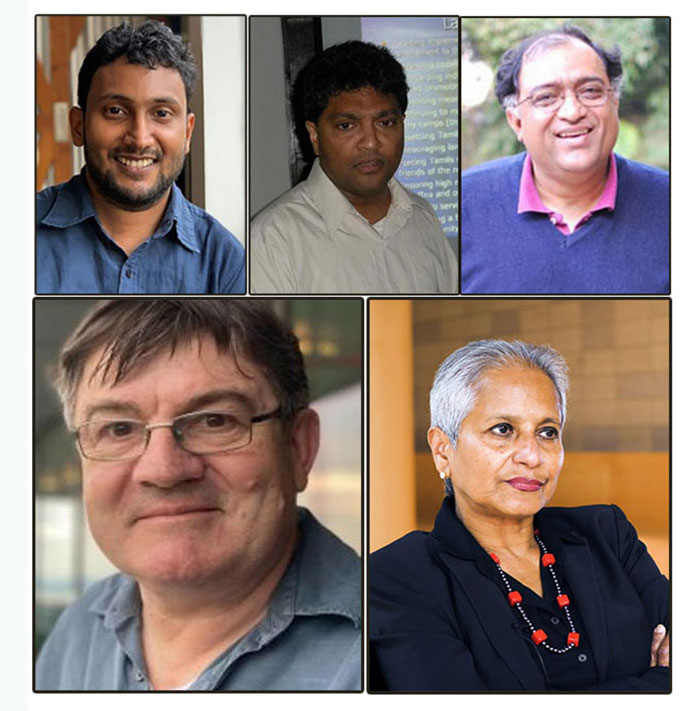
To analyze what lies behind the Rajapaksas’ fall and Sri Lanka’s economic collapse, and discuss what lessons other South Asian nations might learn from the country’s predicament, London-based NGO The Democracy Forum invited a panel of experts to address the central theme: ‘Sri Lanka: Lessons for South Asia’.
In his opening comments, TDF President Lord Bruce spoke of the plight of Sri Lanka, a country traumatized by its political shortcomings, exacerbated by a combined balance of payments and sovereign debt crisis, which betrays many of the systemic problems that continue to beset countries throughout South Asia.The Sri Lankan government’s reckless pursuit of unsustainable foreign borrowing has propelled the country into the midst of a proxy tug-of-war between China and India, he said, and although Beijing has long courted the Rajapaksa family with loans for huge infrastructure projects, it has been slow to respond to Colombo’s evolving crisis.
In contrast, the Indian government earlier this year offered a package of credit, loans, and humanitarian assistance worth USD 3.8bn. The outcome of this hegemonic rivalry is far from clear, but the machinations reflect the shifting sands of allegiance in South Asia, concluded Lord Bruce, with Beijing still wielding the most significant clout in the region.
Focusing on deep-rooted, long-term economic vulnerabilities that led to sovereign default in Sri Lanka – the first time in the country’s history – Umesh Moramudali, a Lecturer at the University of Colombo and Researcher on Public Debt and Development, pondered why Sri Lanka had come to this.
While some observers believe China, the Russian war, and Covid are key external culprits in Sri Lanka’s economic decline, Moramudali pointed to three long-term internal vulnerabilities: Sri Lanka’s declining tax revenue, a much reduced exports-to-GDP ratio, and very low foreign direct investment.On Sri Lanka’s path to becoming a middle-income country, he argued, it had failed to fix the structural weakness of its economy, and core political weaknesses. Heavy borrowing from China for infrastructure projects, as well as increasing domestic and external debt, had also left their mark.
Dr Neil DeVotta, Professor of Politics and International Affairs at Wake Forest University, discussed the proximate causes of the crisis facing Sri Lanka, juxtaposing that with mal-governance over the decades and linking the island’s current problems with its ethnocentric trajectory. The hardship that Sri Lanka continues to face is almost invisible, he said, as the protest movement is now less vigorous, yet malnutrition, poverty, dipping agricultural output and lack of medicines are among growing problems.
DeVotta also drew attention to exogenous causes (Covid, the war in Ukraine), although he believed the long-term explanation was rooted in Sri Lanka’s ethnonationalism and its dynamics, with decades of ethnocentric governance having eroded meritocracy, leading to poor governance, corruption and lack of transparency. This is embedded into the political system, he said, with leaders playing the Sinhalese nationalist Buddhist card and catering to majoritarian sentiment.
The political roots of the crisis were also at the forefront for Jonathan Spencer, Regius Professor of South Asian Language, Culture & Society at the University of Edinburgh, who specifically focused on the gap between the political class and the people. He underscored the essentially non-violent nature of most protests, but also the limitations of what has been achieved by the protestors, who initially focused their ire against Gotabaya and Mahinda Rajapaksa, but are now also directing it at the other 225 current members of parliament.
Spencer called the existing political system ‘sealed’, and asked why there have been no new forces and voices entering it – for example, there are only 12 women MPs in parliament out of 225, in a country that had the first democratically elected female prime minister, and young people and those from poorer communities are also blocked from participation. So there is a long-term structural crisis though a crisis of representation in the current Parliament.
The good news, concluded Spencer, is that the aspirations of the young protestors who want to see post-ethnic, post-corruption politics have not been crushed by the repression of recent months; but the bad news is it is very hard to see how they can find expression in the mainstream political realm.
Broadening the focus to a more regional viewpoint, Dr. Ali Cheema, Associate Professor of Economics, Lahore University of Management Sciences and Research Fellow, IDEAS, looked at Pakistan’s domestic political economy challenges and development, in light of what might be learned from Sri Lanka’s recent experiences.
He drew parallels between Sri Lanka and Pakistan, given their structural weaknesses, and how these have been worsened within the context of the global economic crisis. But Cheema cautioned against being reductive, as each South Asian nation has a different set of fragilities, underpinned by growth models that are themselves fragile.
Dr Deepa Ollapally, Research Professor of International Affairs & Director of the Rising Powers Initiative at the Elliott School of International Affairs, George Washington University, also addressed the regional repercussions of the Sri Lankan crisis, especially what it means for India’s role vis-a-vis Colombo, and in the region.
She spoke of how the region is being redefined, as are regional roles and expectations, with Quad member Japan now a major player, seen as an honest broker able to develop, along with other Quad members, restructuring packages and provide alternatives to the China option, especially the BRI.
Ollapally said that, previously, India had watched helplessly as Sri Lanka fell into Beijing’s arms. But, with the Ukraine war diverting most of the international community’s attention, China then vanished from the scene and India appeared as a first responder with a huge aid package, far outstripping China’s. Sri Lanka, she added, had been overly optimistic in its expectations of China, which is a tough customer when it comes to bailouts, as it is more concerned with its own economic situation.
Many countries are in debt to China (eg Pakistan, African nations), and the upshot is a slowing down of the BRI, which had been speeding up. At the same time, Sri Lanka has underestimated India – despite the island nation begging for global help, only India came good.
India’s expectations of Sri Lanka have also increased, as the crisis has given India the opportunity to push back China. Prime Minister Narendra Modi government has been much quicker than its predecessors to realize that, in order to project itself globally, India needs to take care of its immediate neighborhood – otherwise there are others waiting in the wings, like China, to play that role. So Sri Lanka, concluded Ollapally, is a test case in India’s journey towards being a global power.
Barry Gardiner MP, Chair of the Forum, closed the event by considering some of the elements of a useful rescue package for Sri Lanka. More money would need to be channelled to the bottom of society, and fuel and fertilizer would have to reach farmers for healthy harvests next year. Regarding lessons the region could learn from Sri Lanka’s situation, Gardiner stressed the importance of borrowing to invest, not to consume, and putting funds into the hands of the people, who will help drive growth, tackle corruption, and fostering transparency within the polity.

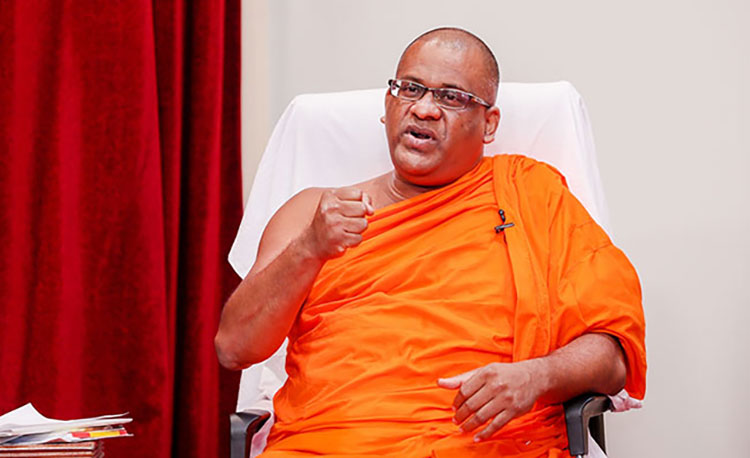
The Mahanayaka Theras of all Nikayas have protested against Bodu Bala Sena (BBS) General Secretary Ven. Galagodaaththe Gnanasara Thera, who is serving a prison sentence for contempt of court, being produced before court in civilian attire.
In a letter to the Commissioner General of Prisons, the Mahanayaka Theras have said they were surprised and concerned by the decision to remove the monk’s robes.
The letter has been signed by Most Ven. Thibbotuwawe Sri Siddhartha Sumangala Thera of the Malwatu Chapter, Most Ven. Warakagoda Sri Gnanarathana Thera of the Asgiri Chapter, Most Ven. Karagoda-Uyangoda Maithri Murthi Thera of the Amarapura Maha Nikaya and Most Ven. Makulawe Sri Wimala Thera of the Ramanna Maha Nikaya.
The Mahanayaka Theras have said they respect the Constitution and the judicial process, but maintained that removing a monk’s robes or ending his status as a member of the Buddhist Order is a matter that should be decided by the Maha Sangha.
They have said the relevant Sangha Council has not determined that Ven. Gnanasara Thera committed a Parajika offence or any other offence warranting his removal from the Buddhist Order.
The Mahanayaka Theras have also referred to Regulation 550 of the Prison Standing Orders, which they say stipulates that convicted prisoners should not be taken to court in prison uniform and should be allowed to wear the type of clothing they normally wore before their conviction. In the case of a Buddhist monk, they have said, this means his monastic robes.
They also referred to the United Nations Standard Minimum Rules for the Treatment of Prisoners, which provide for prisoners taken outside prison to be allowed to wear their own clothing or other unobtrusive clothing.
The Mahanayaka Theras have requested the Commissioner General of Prisons to allow Ven. Gnanasara Thera to wear his robes when appearing in court and to maintain his status as a monk while he remains in prison.
Prisons authorities have said that the clothing decision was made under prison regulations, and the Prisons Department has stated that prisoners serving sentences of more than three years are required to wear prison-issued clothing when produced before court.
The Committee on Public Finance has said that the actual losses suffered by the NDB bank are much more than what was initially reported. When compared with the initial disclosure made by NDB on 6 April 2026, the reported amount of the fraud had increased by Rs. 0.4 billion, from Rs. 13.2 billion to Rs. 13.6 billion, the committee said.
When compared with the amount disclosed by NDB on 26 June 2026, based on the interim report dated 22 June 2026, the additional amount of fraud is Rs. 60 million.
The has committee issued the following statement: The Committee on Public Finance recently summoned officials of the Central Bank of Sri Lanka to Parliament to inquire into the financial irregularities identified at NDB Bank and the final audit report relating to the matter.
The Committee meeting, chaired by Member of Parliament Dr. Harsha de Silva, discussed irregularities identified in NDB Bank’s financial statements, shortcomings in the audit process, and the relevant audit reports.
The meeting was attended by Deputy Ministers Chathuranga Abeysinghe, Dr. Kaushalya Ariyaratne, and Nishantha Jayaweera, as well as Members of Parliament Attorney-at-Law Rauff Hakeem, Ravi Karunanayake, Ajith Agalakada, Nimal Palihena, Wijesiri Basnayake, M.K.M. Aslam, Champika Hettiarachchi, and Attorney-at-Law Lakmali Hemachandra.
The Committee also focused on the findings of the investigation conducted by the Sri Lanka Accounting and Auditing Standards Monitoring Board (SLAAMB), as well as the findings revealed through the investigation conducted by Deloitte Touche Tohmatsu India LLP. In particular, the Committee inquired into the failure of the external auditors to identify irregularities in NDB Bank’s financial statements.
The accountability of senior management with regard to corporate governance and risk management in relation to the financial irregularities was also discussed.
As a significant proportion of NDB Bank’s shares are held by institutions representing public and state funds, the Committee also considered the potential impact of such financial irregularities on public funds and the general public.
The Committee also discussed the progress made by LankaPay in establishing a centralized fraud monitoring system to prevent fraud within the financial system. The need to strengthen fraud monitoring systems at the individual bank level to monitor transactions carried out within each bank was also emphasized.
Accordingly, the following observations are included in the final audit report concerning the financial irregularities at NDB Bank:
1. The audit covers the period from 1 April 2016 to 31 March 2026. The audit report specifically identifies the financial impact arising from fraudulent transactions amounting to Rs. 13,639,664,684 (Rs. 13.6 billion).
2. According to the disclosure made on 29 September 2026, the financial impact arising from the fraudulent transactions is as follows:
· Rs. 1.5 billion for the period prior to 1 January 2025;
· Rs. 9.6 billion during 2025; and
· Rs. 2.5 billion for the quarter ended 31 March 2026.
3. Compared with the initial disclosure made by NDB on 6 April 2026, the reported amount of the fraud has increased by Rs. 0.4 billion, from Rs. 13.2 billion to Rs. 13.6 billion. Compared with the amount disclosed by NDB on 26 June 2026, based on the interim report dated 22 June 2026, the additional amount of fraud is Rs. 60 million.
4. The final audit report has also confirmed the previous disclosures that no customer accounts were affected as a result of the fraud incident.
5. The report has identified several governance failures at NDB relating to the processing of CEFT transactions, user-level activities within the Core Banking System, and the management of user credentials and access information. In addition, shortcomings have been identified in several operational areas, including transaction monitoring, daily account reconciliation, financial compliance, internal audit, branch network management, and operational risk management.
The audit report has made comprehensive recommendations to strengthen the control mechanisms, governance structures, and processes relating to the above-mentioned activities of the bank.
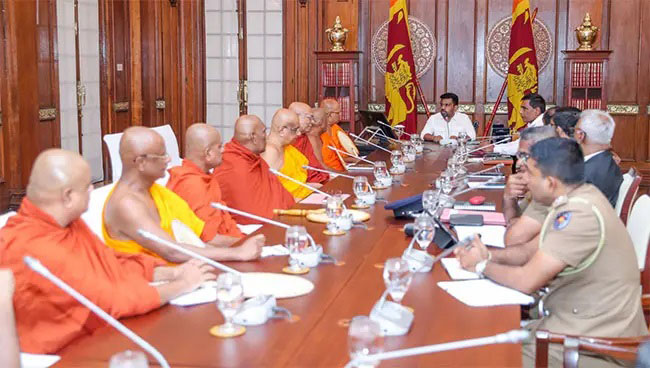
President Anura Kumara Dissanayake has ordered the formation of a committee to review the laws and regulations on how Buddhist monks serving prison sentences are treated, including the procedures that apply when they are taken out of prison.
He revealed this at a special meeting with Maha Sangha representatives held yesterday (8) at the Presidential Secretariat. The meeting was called after concerns were raised over how Ven. Galagoda Aththe Gnanasara Thera was treated when he was taken from prison to court.
The committee will recommend amendments to existing laws and, where needed, new prison standing orders and regulations. Its members will be drawn from the Attorney General’s Department, the Ministries of Justice, Public Administration, and Buddha Sasana, Religious and Cultural Affairs, and the Department of Prisons, including the Commissioner General of Prisons. It has been given two weeks to review the current legal provisions and submit its recommendations. The President added that any changes specific to Buddhist monks would be made in consultation with the Maha Sangha.
Outlining the legal background, the President said prison administration was governed by the Prisons Ordinance of 1877, along with the regulations and standing orders issued under it. That framework mostly addressed prisoners in general, he said, and had few provisions dealing specifically with Buddhist monks.
The meeting was attended by senior Maha Sangha members representing the Siyam, Amarapura and Ramanna Nikayas, along with Minister of Buddhasasana, Religious and Cultural Affairs Hiniduma Sunil Senevi and Minister of Justice Harshana Nanayakkara.

Showers or thundershowers will occur in most part of the island after 1.00 p.m.

Removing monk’s robes matter for Sangha to decide: Mahanayake Theras

NDB fraud Rs 60mn more than reported

President orders review of laws on treatment of imprisoned monks

BHC, Colombo: “LTTE remains a proscribed org. in the UK”

Sri Lanka runs out of essential anti-TB medicines, India comes to rescue

‘Dates have the highest sugar content to fight Coronavirus’

Sunday Island 27 December – Headlines

#SundayIsland 17th December – Headlines

Sunday Island – 28th March

Sunday Island Headlines – 21 March

Sunday Island – 21st February – Headlines
-

 Features5 days ago
The first woman in the foreign service or Ceylon Overseas Service it was then called
-

 News4 days ago
Geneva takes up Sallay’s case and govt. ignores opportunity to answer accusations
-

 Editorial6 days ago
Fuelling discontent and protest
-
 Foreign News6 days ago
Ten injured after car crashes into rugby supporters in Australia
-

 Latest News6 days ago
Tharindu Rathnayake, bowlers secure Asian Games Bronze for Sri Lanka
-
 News5 days ago
Nearly 20 Iranian tankers stranded off Lanka amid US sanctions
-

 Features4 days ago
Sri Lanka Cricket Bill: Governance reform is not yet a cricket strategy
-

 Features3 days ago
Preventing grievances from becoming communal