
News
Lacille poses pertinent questions to Parliament, UNDP


‘Forty MPs skipping DDO vote inexcusable’
By Shamindra Ferdinando
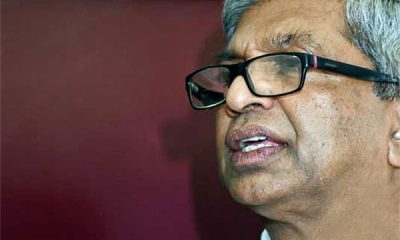
Former Director, Administration of Parliament Lacille de Silva said that both Parliament and the United Nations Development Programme (UNDP) should reveal whether they were satisfied with the progress in the ongoing project funded by the latter to improve the parliamentary system.
De Silva said that parliamentary standards had deteriorated to such an extent over the years that he was amazed by the recent reportage of the UNDP funding a House project to improve the Sectoral Oversight Committee (SOC) system.
Responding to The Island queries, de Silva said that actually members of Parliament, regardless of the party they represented, should have raised the issue. The civil society activist said that he was particularly worried about the failure on the part of the Opposition to seek a clarification from Speaker Mahinda Yapa Abeywardena.
Lacille de Silva served as Director, Administration of Parliament, from 2003 to 2013, during his 37-year career. Having retired in
2013, de Silva, in 2015, received appointment as Secretary to the Special Presidential Commission of Inquiry to Investigate and Inquire into Serious Acts of Fraud, Corruption and Abuse of Power. The then President Maithripala Sirisena however sacked him in early March 2016.
Referring to the UNDP arranging former Canadian MP Kevin Deveaux described as an international expert on parliamentary development to meet Speaker Mahinda Yapa Abeywardena on June 14 at the Parliament premises, de Silva declared that there was no harm working with international partners to improve systems in place. UNDP Resident Representative in Colombo Azusa Kubota accompanied Devaaux. That was followed by Kubota meeting President Ranil Wickremesinghe at the Presidential Secretariat where an assurance was given on the UNDP’s continued assistance, particularly to further improve SOC system. USAID, too, supports some projects implemented by parliament.
A senior House official said that Speaker Abeywardena presides over an advisory board meant to handle all activities assisted by development partners. The former Canadian lawmaker has been here on the invitation of the UNDP to do what the official called the needs assessment in consultation with relevant parties to prepare the parliamentary development action plan in collaboration with all partners. The official added that the current action plan was prepared in consultation with the former Canadian MP during Gotabaya Rajapaksa’s tenure as the president. Declaring that the Speaker is the final authority, the official emphasized that Parliament didn’t follow anyone’s agenda.
Lacille de Silva asked whether political parties represented in parliament needed any external advice to take remedial measures to overcome shortcomings and negligence. Statements issued by parliament on regular proceedings at watchdog committees exposed the pathetic failure on the part of parliament to address issues at hand. The recent revelation at COPA (Committee on Public Accounts) that the total arrears of taxes, penalties and interest due to the Inland Revenue Department by Dec 31, 2022 is Rs. 904 bn underscored the responsibility on the part of Parliament, de Silva said.
“Public finance is the responsibility of Parliament. Therefore, the House cannot absolve itself of the responsibility for allowing accumulation of total arrears to over 904 bn,” de Silva said. “What really worries me is that even after the national economy suffered in early 2020 due to a toxic combination of reasons, those in authority haven’t made a genuine effort to improve revenue collection.”
The debate and vote on the high profile resolution pertaining to the Domestic Debt Optimization (DDO) on July 01 highlighted the crisis in parliament. Referring to accusations directed at Speaker Abeywardena that he arbitrarily conducted the vote at 7.30 pm on Saturday though the original plan was to conduct a two-day debate before the vote, de Silva said that only 184 voted that day.
“Therefore, 41 didn’t vote. If we leave out the Speaker, 40 MPs skipped the vote. This shows, some political parties are in disarray. How come 40 MPs refrained from taking a stand on such a crucial issue,” de Silva said, adding that the bone of contention is whether political parties have no control of its members.
Current Parliament is represented by 15 political parties. Parliament consists of SLPP 145, SJB 54, ITAK 10, JJB 03, EPDP 2, AITC 02 and an MP each represents nine political parties.



News
Establishment of an Institutional Framework to Inagurate Upper Hydro Catchment Areas Management Authority

Policy approval of the Cabinet of Ministers was granted at their meeting held on 08.06.2026 to establish the Upper Hydro Catchment Areas Management Authority for identification and
execution of a formal and long – lasting remedy to secure the central hills including the upper hydro catchment areas enabling them to sustain amidst extreme weather conditions
due to natural calamities and human activities as well as to be used for the sustainable development of the country.
Accordingly, a concept paper has been prepared including
institutional structure, activities, powers, active subject area as well as administrative and coordination mechanism for the proposed authority by an expert technical committee appointed by the Secretary to the President.
Based on the said concept paper, the Cabinet of Ministers granted approval to the resolution furnished by the President to instruct the Legal Draftsman to prepare a draft bill including legal provisions required for the establishment of Upper Hydro Catchment Areas Management Authority.
News
Introduction of Flora and Fauna (Regulation of actions of the Indigenous Community within the nominated areas) Regulations
With the objective of securing the traditional livelihood and the eco system of the indigenous community, it has been recognized the necessity of introducing a formal regulation methodology to secure their engagement in livelihood activities by being more sensitive to the existing laws.
Thereby, the Fauna and Flora (regularizing) regulations under the Fauna and Flora Protection Ordinance (Authority 469) have been prepared so that nominated activities within the prescribed area to a member of the indigenous community
who has been registered for securing the rights acquired from law or custom or usage or traditional stance to execute an act within a certain state land that is fundamental to the survival of the indigenous community permission can be granted
Accordingly, the Cabinet of Ministers granted approval to the resolution furnished by the Minister of Environment to publish the said regulations in the government gazette notification and thereby submit to the Parliament for its concurrence.
Latest News
M. M. D. J. Senarathne, appointed Director General of the Department of National Botanical Gardens
The Cabinet of Ministers approved the resolution furnished by the Minister of Environment to appoint M. M. D. J. Senarathne, who is the senior most officer in Grade I of Sri Lanka Scientific Service se

Establishment of an Institutional Framework to Inagurate Upper Hydro Catchment Areas Management Authority
Introduction of Flora and Fauna (Regulation of actions of the Indigenous Community within the nominated areas) Regulations
M. M. D. J. Senarathne, appointed Director General of the Department of National Botanical Gardens

Harmanpreet Kaur steps down as India captain

Turkiye, Pakistan agree Saudi Arabia military deployment under Mecca pact

Rumesh Tharanga among nominees announced for World Athlete of the Year 2026

‘Dates have the highest sugar content to fight Coronavirus’

Sunday Island 27 December – Headlines

#SundayIsland 17th December – Headlines

Sunday Island – 28th March

Sunday Island Headlines – 21 March

Sunday Island – 21st February – Headlines
-

 Latest News7 days ago
Gold winner Tharanga gets brand-new Honda Vezel from SLAAJ
-

 News6 days ago
US-assisted ‘Ice’ detection: NPC to examine IGP’s move to transfer drug-busting team
-

 Features7 days ago
Why Sri Lanka needs an Inclusive Civic Nationalism – urgently
-

 Editorial5 days ago
Colombo Port drug bust: The plot thickens
-

 News7 days ago
Civil society activist accuses govt. of favouring Ven. Gnanasara
-
 Midweek Review7 days ago
Dappula’s Easter Sunday ‘grand conspiracy’ claim demolished
-

 Editorial7 days ago
When crime bosses rise above law and shrines
-
Editorial6 days ago
Drug busting, transfers and trust deficit