
News
Lacille claims corruption case involving two Ministers could have been dealt with during Yahapalanaya

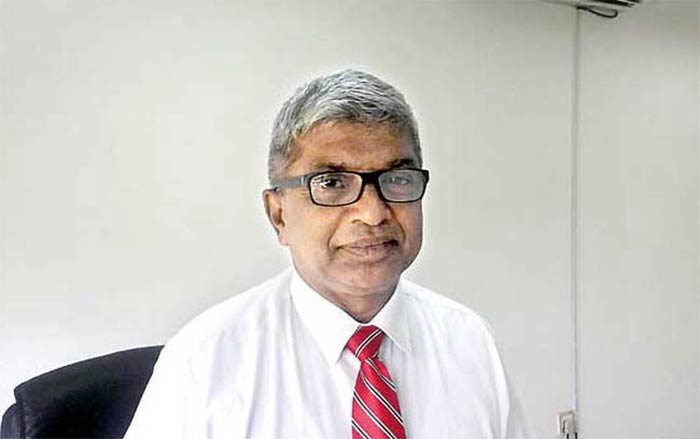
Former Secretary to the Presidential Commission of Inquiry to Investigate and Inquire into Serious Acts of Fraud, Corruption and Abuse of Power, State Resources and Privileges (PRECIFAC), Lacille De Silva, yesterday (02) said that Yahapalana President Maithripala Sirisena owed an explanation as to why the case involving ex-Minister Mahindananda Aluthgamage was not heard during his time.
PRECIFAC consisted of four High Court Judges – Padman Surasena, Amendra Seneviratna, Vikum Kaluarachchi, Gihan Kulatunga – and former Auditor General B.A. Premathilake.
Civil society activist De Silva, who had served as Director of Administration of Parliament for over a decade, said that PRECIFAC recommended action against Aluthgamage and Nalin Fernando, Sathosa Chairman at the time of the scam the state entity suffered a loss of Rs 53 mn. At the time PRECIFAC probed the Sathosa case, Nalin Fernando hadn’t entered parliamentary politics, De Silva pointed out urging the government to find out as to why the investigations couldn’t be brought to a successful conclusion.
Nalin Fernando first entered Parliament on the SLPP ticket at the 2020 parliamentary elections.
The Yahapalana administration lacked the political will to continue with the investigations into cases involving politicians. The Financial Crimes Investigation Division (FCID) arrested Fernando in April 2018 but was later granted bail. In the following year, a travel ban was imposed in October but was lifted in December, De Silva said, alleging poor handling of the anti-corruption drive caused the Yahapalana government a debilitating setback.
Aluthgamage was handed a 20-year term of rigorous imprisonment, while Fernando was given a 25-year term of rigorous imprisonment by a High Court trial-at-bar after being found guilty of causing a Rs 53 million loss to the state.
They were accused of importing carrom boards and checkers boards through Sathosa in the run-up to 2015 presidential elections and distributing them to clubs.
Responding to The Island queries, De Silva said that the government tasked PRECIFAC with inquiring into mishandling, misuse and abuse, misappropriation, corruption and frauds with regard to state funds and resources from 2010 to 2015. On the instructions issued by the then government, police headquarters assigned a team of 30 police officers, under the leadership of ASP Lalith Abeysekara. Chief Inspector Geethika Bodhipaksha had been in charge of the unit, De Silva said, alleging that the Yahapalana leaders wasted their (PRECIFAC) efforts.
Declaring the Commission to Investigate Allegations of Bribery or Corruption (CIABOC) should be commended for bringing the case involving Aluthgamage and Fernando to a successful conclusion, De Silva emphasised that it would be the responsibility of the Commission to ensure that cases weren’t withdrawn on technical grounds. The current CIABOC leadership consists of Justice W.M.N.P. Iddawala (Chairman), K.B.Rajapakse and Chethiya Goonesekera P.C. R.S.A. Dissanayake functions as the Director General of the CIABOC.
De Silva said that PRECIFAC handed over its final report to President Sirisena in early January 2018 and the President brought the investigated lot back into power just nine months later.
Referring to media reports that dealt with CIABOC, De Silva pointed out that the number of cases that had been withdrawn by the CIABOC and Attorney General during Yahapalana as well as during tenures of Gotabaya Rajapaksa and Ranil Wickremesinghe highlighted the pathetic situation.
De Silva said that during the hearing of a recently concluded case involving two Ministers the head of Trial-at-Bar and senior CIABOC representative underscored how corruption contributed to the deterioration of the economy to such an extent the country ended up bankrupt in 2022.
By Shamindra Ferdinando


Bus fares have been increased by 12.19% with effect from midnight today [23rd March 2026].
The minimum fare will be increased from Rs 27 to Rs 30 while the maximum fare of Rs2159/- will be increased to 2422/-
Latest News
Public will not be served as Computer system failure at Department of Registration of Persons

The Acting Commissioner General of Registration of Persons has announced that due to an unexpected failure of the computer system of the Department of Registration of Persons, all services, including the one day service will not be held on Tuesday (24th March) at the Head Office and all Provincial offices.

Latest News
Heat Index at Caution Level in the Western, Sabaragamuwa, Southern and North-western provinces and in Anuradhapura, Mannar and Vavuniya districts
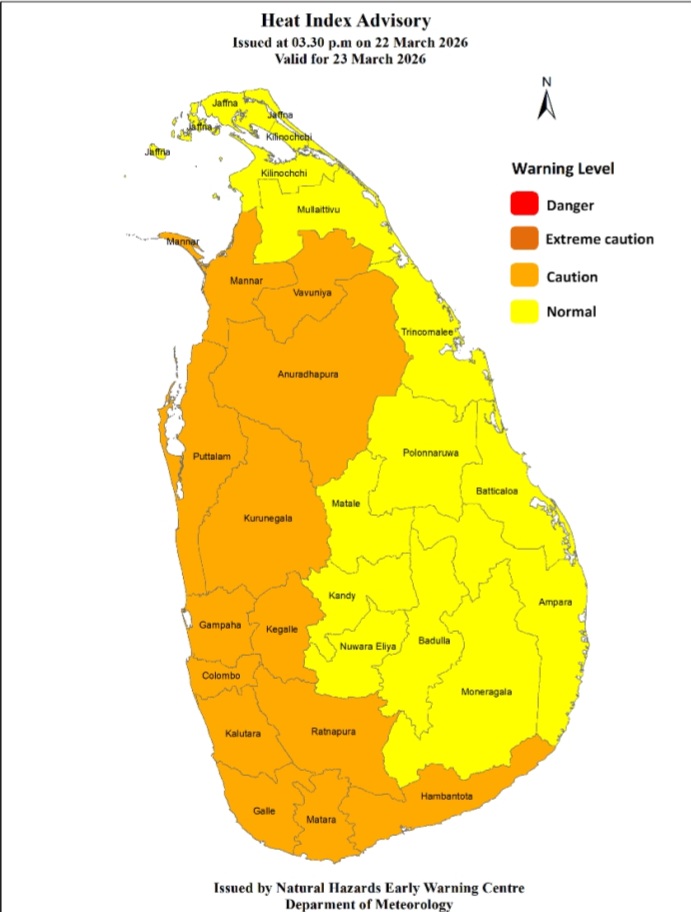
Warm Weather Advisory
Issued by the Natural Hazards Early Warning Centre of the Department of Meteorology
at 3.30 p.m. on 22 March 2026, valid for 23 March 2026.
The Heat index, the temperature felt on human body is likely to increase up to ‘Caution level’ at some places in the Western, Sabaragamuwa, Southern and North-western provinces and in
Anuradhapura, Mannar and Vavuniya districts.
The Heat Index Forecast is calculated by using relative humidity and maximum temperature and this is the condition that is felt on your body. This is not the forecast of maximum temperature. It is generated by the Department of Meteorology for the next day period and prepared by using global numerical weather prediction model data.

Effect of the heat index on human body is mentioned in the above table and it is prepared on the advice of the Ministry of Health and Indigenous Medical Services.
ACTION REQUIRED
Job sites: Stay hydrated and takes breaks in the shade as often as possible.
Indoors: Check up on the elderly and the sick.
Vehicles: Never leave children unattended.
Outdoors: Limit strenuous outdoor activities, find shade and stay hydrated.
Dress: Wear lightweight and white or light-colored clothing.
Note:
In addition, please refer to advisories issued by the Disaster Preparedness & Response Division, Ministry of Health in this regard as well. For further clarifications please contact 011-7446491.

Two killed when Air Canada jet hits fire truck at NYC’s LaGuardia Airport

Bus fares increased by 12.19% from midnight today [23]
Public will not be served as Computer system failure at Department of Registration of Persons

Trump says he is postponing strikes on Iran power plants after ‘productive’ talks on ending war

Asia stocks slide as US and Iran threaten to escalate war

Heat Index at Caution Level in the Western, Sabaragamuwa, Southern and North-western provinces and in Anuradhapura, Mannar and Vavuniya districts

‘Dates have the highest sugar content to fight Coronavirus’

Sunday Island 27 December – Headlines

#SundayIsland 17th December – Headlines

Sunday Island – 28th March

Sunday Island Headlines – 21 March

Sunday Island – 21st February – Headlines
-

 News6 days ago
CIABOC questions Ex-President GR on house for CJ’s maid
-

 News7 days ago
Sri Lankan marine scientist Asha de Vos honoured at UNGA opening
-

 News7 days ago
Australian HC debunks misleading travel risk claims for Sri Lanka
-

 News5 days ago
Bailey Bridge inaugurated at Chilaw
-

 News5 days ago
Pay hike demand: CEB workers climb down from 40 % to 15–20%
-

 News4 days ago
CIABOC tells court Kapila gave Rs 60 mn to MR and Rs. 20 mn to Priyankara
-

 Editorial6 days ago
Couple QR-based quota with odd-even rationing
-

 News3 days ago
Colombo, Oslo steps up efforts to strengthen bilateral cooperation in key environmental priority areas