
Latest News
Kusal Mendis 143 and Avishka Fernando 100 put Sri Lanka 1-0 up


Kusal Mendis and Avishka Fernando made centuries, and put on 206 together to send Sri Lanka to a commanding score. Then, once rain had reduced New Zealand’s chase to 27 overs, Sri Lanka’s spinners reaped five wickets for 22 runs to derail the visitors after their openers had made a strong start.
In the end, New Zealand didn’t get close to the 221 they required off 27 overs. They puttered to 175 for 9, with too little firepower in their lower order to get them up with the required rate, and too much know-how in Sri Lanka’s attack to let them prosper after the collapse.
The primary architects of Sri Lanka’s victory, however, were Kusal and Avishka. Their partnership was the highest ever for the second wicket in men’s ODI’s between these sides. Kusal’s 143 off 128 was also his highest individual score. And their propelling Sri Lanka to their eventual 324 for 5, before rain brought a halt to their innings after 49.2 overs, was a huge step towards victory, because although this surface was not especially spin-friendly, no chasing team had made so much as 290 in Dambulla.
In the end, a long rain delay meant New Zealand had a curtailed chase. But even their openers, who put 88 off 80 balls, weren’t quite keeping up with the required rate. Will Young made 48 off 46 and Tim Robinson 35 off 36. But they needed big fireworks from the likes of Glenn Phillips and Mark Chapman. They never came.
Early on, after Pathum Nissanka was dismissed, Kusal and Avishka gained significant momentum through the first powerplay, in which Sri Lanka scored 57 runs. In the fifth over, bowled by Jacob Duffy, Mendis smoked a straight drive, then crashed a short ball in front of midwicket to hit his first two fours of the innings. In the next over, bowled by debutant Nathan Smith, Avishka lifted a ball down the ground, then swivel-pulled another one over the fine leg boundary for six.
That period did have a hiccup – Mendis was dropped on 11 by Duffy, who could not hold a sharp return catch. But otherwise Sri Lanka’s progress was smooth. There was not as much turn as expected, and Kusal and Avishka settled into a steady rhythm of accumulation, both batters using the sweep to good effect when the New Zealand bowlers delivered consecutive dot balls.
Avishka was also strong over cover, going inside-out repeatedly, while Kusal found runs square of the wicket on the off side. They both milked the bowling of Ish Sodhi and Michael Bracewell, neither of whom were able to build pressure over substantial periods. Kusal got to his fifty off the 64th ball he faced, before Avishka got to his own half-century – his ninth – off his 60th ball.
They raised the tempo slighly after getting to those milestones, but largely batted in the same gear. Avishka was dropped on 77 by Sodhi in the outfield, though the fielder only really got fingertips to the chance. Kusal got to his century first, in the 37th over, off 102 balls. Avishka got there in the 38th. For both batters, this was their fourth ODI ton.
Avishka was out soon after, caught at mid-off, but the partnership had delivered Sri Lanka to the brink of the death overs. At his fall the total was 223 for 2 in the 39th over.
Both Kusal and Charith Asalanka were effective through the last 10, Kusal largely bashing spinners down the ground while Asalanka found runs square of the wicket. The rain returned with Asalanka being caught on the square leg boundary, with four balls remaining. It had rained early in the match too, forcing a roughly 40-minute break in the first over.
Once their opening pair was separated, New Zealand’s downfall was rapid and decisive. Maheesh Theekshana delivered the first two breakthroughs, having Robinson stumped, then Young bowled, in the same over, the 14th of the innings. Henry Nicholls was then bowled off the inside edge by Asalanka, before Theekshana held on to a screamer off the bat of Chapman at short midwicket, also off the bowling of Asalanka. When Glenn Phillips sliced a Jeffrey Vandersay legbreak to point, New Zealand had lost their top five in the space of 28 balls. It was always going to be almost impossible to recover from there.
Of New Zealand’s players, Jacob Duffy came out of this match with perhaps the best performance, having taken 3 for 41 in his 8.2 overs. With the freshly-arrived Adam Milne likely to be fit for the second ODI on Sunday, Duffy has made a strong case that he should be persisted with. Of their three debutants (Nathan Smith, Mitchell Hay, and Robinson), Robinson showed the most promise in this match.
Brief scores:
Sri Lanka 324 for 5 in 49.2 overs (Kusal Mendis 143, Avishka Fernando 100, Charith Asalanka 40; Jacob Duffy 3-41) beat New Zealand 175 for 9 in 27 overs (Will Young 48, Tim Robinson 35, Michaell Bracewell 34*; Dilshan Madushanka 3-39, Maheesh Theekshana 2-32, Charith Asalanka 2-15) by 45 runs (DLS method)
[Cricinfo]





Former President Mahinda Rajapaksa has arrived to appear before the Commission to Investigate Allegations of Bribery or Corruption (CIABOC) this morning (12) to provide a statement regarding the alleged SriLankan Airlines Airbus deal.
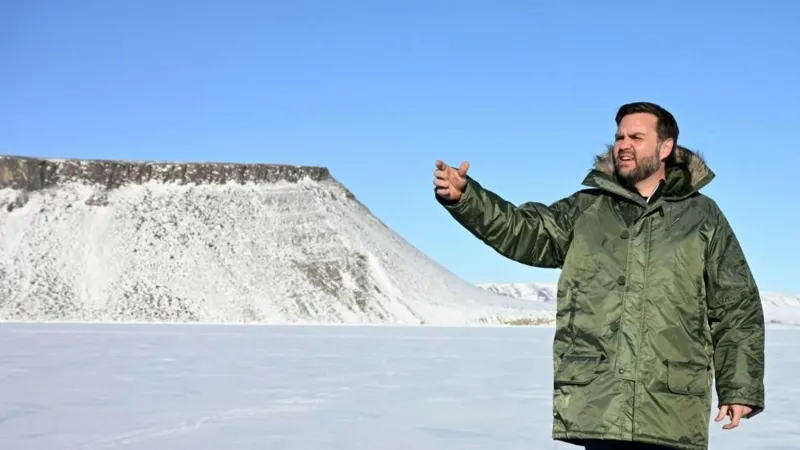
The US has been holding regular negotiations with Denmark to expand its military presence in Greenland, according to multiple officials familiar with the discussions, with talks between both sides progressing in recent months.
US officials are seeking to open three new bases in the south of the territory, a semi-autonomous part of Denmark, as they work to resolve a diplomatic crisis sparked by President Donald Trump when he threatened to seize Greenland by force.
Trump said in January that the US should “own” Greenland to prevent Russia or China from taking it. He said this could happen the “easy way ” or “the hard way”.
The White House confirmed the administration was engaged in high-level talks with Greenland and Denmark, but declined to comment on details of the negotiations. A White House official told the BBC the administration was very optimistic the talks were headed in the right direction.
Denmark has previously expressed a willingness to discuss additional American military bases in Greenland, and its foreign ministry confirmed talks with the US were taking place. “There is an ongoing diplomatic track with the United States. The Ministry of Foreign Affairs will not go into further detail at this time,” a spokesperson said.
US officials have floated an arrangement in which the three new military bases would be formally designated as US sovereign territory, according to one source with knowledge of the negotiations.
The bases would be in southern Greenland and primarily focus on surveillance of potential Russian and Chinese maritime activity in an area of the northern Atlantic between Greenland, Iceland and the United Kingdom known as the GIUK Gap, the officials who spoke to the BBC said.
The two sides have not formally agreed to anything yet and the final number of bases could change, the sources said. One of the new bases would likely be located in Narsarsuaq, on the site of a former US military base that housed a small airport.
Any other new military bases would likely also be located on sites in Greenland that have existing infrastructure such as airfields or ports, which could be upgraded at a lower cost than building new facilities, analysts said.
US officials have not raised the possibility during talks of somehow seizing control of Greenland, something that Denmark and Nato have publicly rejected.
Despite Trump’s threats, the countries have been actively working towards a deal in recent months.
The talks have been confined to a small working group of officials in Washington who have made headway negotiating outside of the spotlight while the administration has been consumed by the war in Iran.
General Gregory Guillot, the head of US Northern Command, gave a broad sense of the negotiations during congressional testimony in March. He said the US was seeking to open new bases, but the sources close to the talks described new details that paint a picture of regular high-level meetings that have progressed in recent months.
The delicate diplomatic effort is being led by Michael Needham, a senior state department official who has been tasked with crafting a deal that satisfies Trump while also respecting Denmark’s redlines around protecting its borders.
“Needham is running point” on Greenland, said a senior diplomat with knowledge of the talks. Behind the scenes, the person said, the administration is “approaching it very professionally”.
The teams have met at least five times since mid-January. Needham is usually accompanied by one or two US officials from the state department or National Security Council, several sources said. His counterparts in the room include Jesper Møller Sørensen, Denmark’s ambassador to the US, and Jacob Isbosethsen, the top Greenlandic diplomat in Washington.
Trump’s special envoy to Greenland, Republican Louisiana Governor Jeff Landry, hasn’t taken part in the negotiations and is largely absent from the diplomatic process, three sources said.
“He was supposed to be more of like a rah-rah cheerleader of the idea that we could just flex our muscles and take over Greenland as a security asset,” said a close Landry ally who asked not to be named. Landry “has never been to any of the actual talks.”
Landry’s office did not respond to a request for comment.
The US currently has one military base in Greenland, down from approximately 17 military facilities during the height of the Cold War. Pituffik Space Base is located in northwestern Greenland – it monitors missiles for NORAD but is not configured to conduct maritime surveillance.
Some current and former officials, as well as Arctic security experts, told the BBC that Washington could have advanced its interests in Greenland without threatening a Nato ally in such strong terms.
“Why threaten an ally with a military operation or invasion when what you want is something that could be negotiated quite easily?” said one former senior US defence official.
Others, however, praised the co-operation between the US and Denmark.
“Wherever the US and our allies leave a vacuum, that vacuum is often filled by China and Russia,” retired General Glen VanHerck, the head of Northern Command and North American Aerospace Defense Command (NORAD) from 2020 to 2024, told the BBC.
Behind closed doors, negotiators have sought to reach a compromise under the framework of an existing decades-old security agreement between the US and Denmark.
The 1951 pact grants the US a wide berth to expand its military operations in Greenland. The Danish government must approve any US military expansions in the territory, but Denmark has historically supported America’s military operations there and has never rejected a US request to expand its presence, Arctic security experts said.
Representatives of the Greenland government in Washington declined to comment. The US state department also declined to comment.
Trump expressed interest in the US gaining greater access to Greenland during his first term as president. But his renewed interest earlier this year set off a diplomatic crisis that highlighted tensions between Nato and the Trump administration.
[BBC]

US President Donald Trump has said the month-long ceasefire between the US and Iran is on “massive life support”.
He told reporters in the Oval Office on Monday that while the ceasefire remained in place, it was “unbelievably weak”.
Following Trump’s comments, Iranian parliamentary speaker Mohammad Ghalibaf wrote on X that Iran’s armed forces were, “ready to respond and to teach a lesson for any aggression.”
Iran laid out its demands to end the war and reopen the Strait of Hormuz in a counter-offer sent to the US on Sunday. Trump rejected the proposal, calling it “totally unacceptable” and a “piece of garbage”.
After Trump’s comments, Esmail Baghaei, a foreign ministry spokesperson for Iran, said Tehran’s proposals were “responsible” and “generous”.
After his comments saying Iran’s armed forces ready to respond, Ghalibaf said in a separate post on X that there was “no alternative but to accept the rights of the Iranian people as laid out in the 14-point proposal”.
“The longer they drag their feet, the more American taxpayers will pay for it,” he said.
Tehran’s offer includes an immediate end to the war on all fronts – a reference to the continued Israeli attacks against Iran-supported Hezbollah in Lebanon – a halt to the US naval blockade of Iranian ports and guarantees of no further attacks on Iran, according to Iran’s semi-official Tasnim news agency.
[BBC]

Former President Mahinda Rajapaksa has arrived at the Bribery Commission

US in closely-guarded talks to open new bases in Greenland

Trump says Iran ceasefire is on ‘massive life support’

Draw on the cards, but Mominul and Shanto extend Bangladesh’s lead

Miller, Axar and Ashutosh keep Delhi Capital’s IPL alive

Showers above 100 mm are likely at some places in the Western, Sabaragamuwa, Southern, North-western and Northern provinces and in Trincomalee district.

‘Dates have the highest sugar content to fight Coronavirus’

Sunday Island 27 December – Headlines

#SundayIsland 17th December – Headlines

Sunday Island – 28th March

Sunday Island Headlines – 21 March

Sunday Island – 21st February – Headlines
-

 News5 days ago
MIT expert warns of catastrophic consequences of USD 2.5 mn Treasury heist
-

 News2 days ago
Lanka Port City officials to meet investors in Dubai
-

 Editorial5 days ago
Clean Sri Lanka and dirty politics
-

 Editorial4 days ago
The Vijay factor
-

 News3 days ago
SLPP expresses concern over death of former SriLankan CEO
-

 News6 days ago
Development Officer bids Rs. 48 mn for CPC’s V8 at auction
-

 News3 days ago
Police inform Fort Magistrate’s Court of finding ex-CEO of SriLankan dead under suspicious circumstances
-
 Opinion6 days ago
Postmortem reports and the pursuit of justice