
Latest News
Kishan, Hardik, spinners hand India record win


Ishan Kisha set things up with a 20-ball half-century, Hardik Pandya made a 27-ball half-century and picked up two wickets. Varun Chakravarthy took three wickets in his first ten balls.
India posted a 200-plus total, and didn’t let Namibia get anywhere near them. Their 93-run win was their biggest in T20 World Cups..
And yet, because of the expectations India have carried into this tournament and the scrutiny that follows them everywhere, this match was also about all the things they didn’t do. When Kishan was taking Namibia’s seamers apart, 300 was a not unrealistic possibility. When Hardik was at the crease, 240 seemed on the cards.
That they only made 209 was down mainly to one man. Namibia captain Gerhard Erasmus, bowling offspin with the widest imaginable range of release points – high-arm and round-arm, sometimes from well behind the bowling crease – made the most of a Delhi pitch with just a bit of grip in it to take 4 for 20 from his four overs. This included two in his final over, the 19th, which also featured a run-out. And that over began a late and only partially explicable collapse from India, who lost 5 for 4 off the last 11 balls of their innings.
For most part, it was normal service for India against an Associate team. But Erasmus and that late collapse briefly brought the contest to life, and perhaps gave India’s future opponents – including Pakistan, who face them on Sunday and have an artful round-arm spinner of their own – a few ideas.
With a stomach bug ruling out Abhishek Sharma, who had been discharged from hospital on the eve of the match, a door reopened for Sanju Samson. He began his World Cup debut with a flurry of effortless hits – three sixes and a crisp drive for four over extra-cover – before falling for 22 off 8, chipping a Ben Shikongo slower ball straight to deep midwicket.
It was brief, exhilarating, and ultimately told us nothing new. Samson plays a high-variance style at the top of the order, and of late his trigger movement – which takes him deep into his crease and leg-side of the ball – has been getting him into early trouble. He adopted the same trigger in this game, whether he was striking the ball sweetly or being dismissed off a shot he didn’t fully commit to.
In Ruben Trumpelmann and JJ Smit, Namibia have a pair of left-arm quicks who can put big teams in trouble on their day. This wasn’t their day; their angle and lengths kept feeding Kishan’s leg-side repertoire, and he took both bowlers apart while rushing to 61 off 24.
India were 86 for 1 after six overs – their biggest powerplay in a T20 World Cup game – and brought up their 100 in 6.5 overs – no team has got to that mark quicker in a T20 World Cup game.
India seemed on course for a monumental total.
Erasmus brought himself on in the eighth over and struck with his first ball, cramping Kishan on the pull to have him caught at deep midwicket.
The wicket transformed the game, as he and left-arm spinner Bernard Scholtz pulled the scoring rate back dramatically. They bowled six overs in tandem from the eighth to the 13th, conceding just 30 runs and picking up two more wickets, with Suryakumar Yadav and Tilak Varma falling in the attempt to hit out.
With the seamers returning, and Hardik and Shivam Dube getting stuck into Scholtz in his final over, India seemed to put their mid-innings lull behind them, scoring 65 from overs 14 to 18. And when Erasmus brought himself back in the 19th, it seemed like he was taking a massive risk, bowling offspin against two set batters with fearsome end-overs records. Hardik pulled the first ball of that over for his fourth six, bringing up his fifty and India’s 200.
The next ball could have gone for six too, only for substitute fielder Dylan Leicher to take a spectacular running, juggling, in-out-in catch on the deep square leg boundary.
Pandemonium ensued. Dube was run out in a mix-up with Rinku Singh. Axar Patel played all around Erasmus’ final delivery, a slow, low-arm grubber. The collapse continued through the final over with Smit – who, along with Trumpelmann, bowled superbly at the death, both nailing their yorkers with a high degree of efficiency – which brought three runs and two wickets.
This was still a daunting total, but imagine the look on Namibia’s face if you’d told them they’d only be chasing 210 when Kishan was blazing away.
Left-right openers Jan Frylinck and Louren Steenkamp looked briefly impressive, both hitting flurries of boundaries off Arshdeep Singh – who went for 36 in three powerplay overs – before falling in the 20s.
They did a good enough job for Namibia to start the eighth over at 67 for 1. Then Varun struck with his first ball, ripping a wrong’un through Steenkamp, bringing a hefty dose of perspective to anyone who might have harboured visions of an upset.
By the time he had bowled ten balls, he had taken three wickets, and the contest was effectively over. Erasmus was still there on the burning deck, having slog-swept Axar for a pair of sixes in ninth over, but the left-arm spinner had his revenge in his next over, and that was pretty much it.
Zane Green and Trumpelmann dragged the game deeper with a seventh-wicket stand of 17 off 27 balls, but once Jasprit Bumrah – playing his first match of the tournament after recovering from illness – ended it with a pinpoint yorker, the end was swift, with Hardik topping off an excellent evening with wickets off successive balls in the 18th over.
Brief scores:
India 209 for 9 in 20 overs (Ishan Kishan 61, Sanju Samson 22, Tilak Varma 25, Suryakumar Yadav 12, Hardik Pandya 52, Shivam Dube 23; Ben Shikongo 1-41, JJ Smit 1-50, Gerhard Erasmus 4-20, Bernard Scholtz 1-41) beat Namibia 116 in 18.2 overs (Louren Steenkamp 29, Jan Frylink 22, Jan Nicol Loftie-Eaton 13, Gerhard Erasmus 18, Zane Green 11; Varun Chakravarthy 3-07, Axar Patel 2-20, Hardik Pandya 2-21, Arshdeeep Singh 1-36, Shivam Dube 1-11, Jasprit Bumrah 1-20) by 93 runs
[Cricinfo]

Latest News
Maldivian President plants a sapling to mark 60 years of Sri Lanka–Maldives Diplomatic Relations
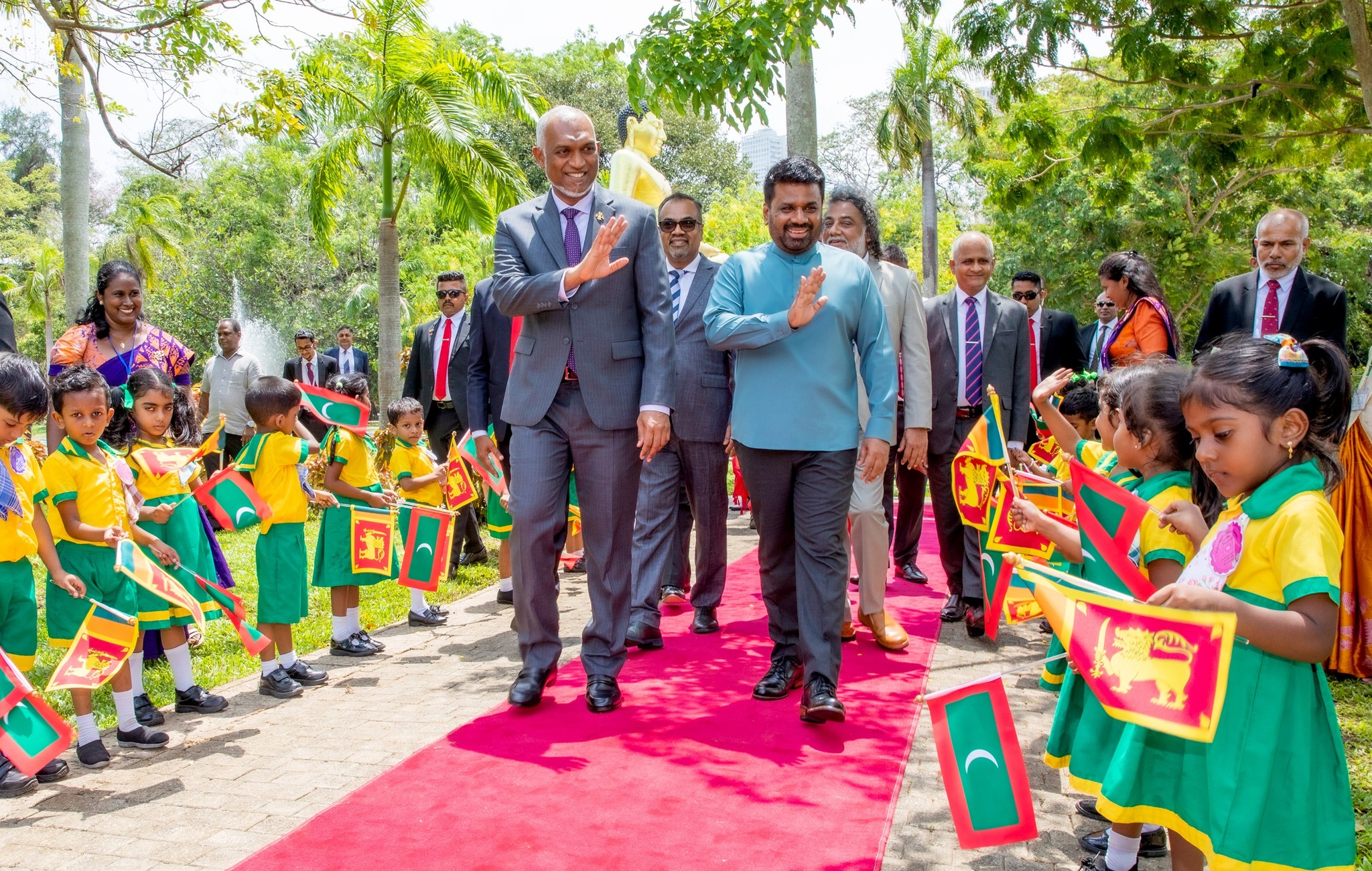
President of the Maldives, Dr Mohamed Muizzu, who is on a State Visit to Sri Lanka at the invitation of President Anura Kumara Dissanayake, planted a sapling this afternoon (04) at Viharamahadevi Park in Colombo to commemorate 60 years of diplomatic relations between Sri Lanka and the Maldives.
Upon arrival at the Viharamahadevi Park in Colombo, President Dr Mohamed Muizzu was warmly received by President Anura Kumara Dissanayake. Children lined both sides of the pathway holding the national flags of the two countries and paid tribute to the visiting Maldivian President.
Among those present at the occasion were Deputy Speaker Rizvi Salih, Minister of Foreign Affairs, Foreign Employment and Tourism, Vijitha Herath and the Mayor of Colombo, Vraie Cally Balthazaar, along with several other dignitaries.
[President’s Media Division (PMD)]

For years, India’s West Bengal state was the great exception to Narendra Modi’s political advance.
His Bharatiya Janata Party (BJP) had swept through India’s Hindi-speaking heartland, expanded into the west and north-east, and overwhelmed once-formidable regional rivals. Yet Bengal – argumentative and steeped in a self-image of cultural exceptionalism – remained stubbornly resistant.
That made this state election unusually consequential. With more than 100 million people, West Bengal’s electorate is larger than Germany’s, turning its election into something closer to a nation choosing a government than a routine Indian state poll.
Monday’s BJP victory there would rank among the most significant breakthroughs of Modi’s 12-year reign. It is not merely the defeat of a three-term incumbent, but the completion of the party’s long march into eastern India.
“Winning Bengal is a big victory for the BJP – a land of promise that has long eluded its grasp,” says author and journalist Nilanjan Mukhopadhyay.
Monday produced an extrodinary political churn across India’s south as well.
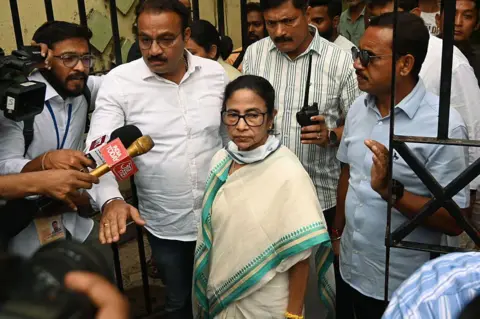
In Tamil Nadu, MK Stalin’s DMK government was swept aside by actor-turned-politician Vijay and his fledgling TVK party, marking the dramatic return of film-star politics to the state.
In Kerala, the Congress-led United Democratic Front (UDF) defeated the Left Democratic Front (LDF) after two consecutive terms, ending the last remaining Communist-led state government in India. Only in Assam did the BJP buck the broader anti-incumbent tide and retain power, while the party and its allies also held on to the federal territory of Puducherry.
Yet nowhere were the results more politically significant than in Bengal.
The state has seen only one change of government in nearly half a century: the Communist Left Front ruled for 34 years before the Trinamool Congress (TMC), led by the firebrand populist Mamata Banerjee, dominated the next 15 years until now. Political scientists have long described Bengal as a system that favours “hegemonic” parties.
Analysts see the outcome not as a sudden upheaval but as the culmination of a decade-long political project. Unlike the BJP’s rapid rise in Tripura or its earlier breakthrough in Assam, Bengal was never a lightning conquest.
“The BJP has been a major force in Bengal for three successive elections, consistently polling around 39% of the popular vote,” says Rahul Verma, who is a fellow at the Centre for Policy Research.
Once it established itself near the 39-40% mark, he argues, “the party really needed only another 5-6% to cross the line”. Voting trends show the BJP mopping up more than 44% of the vote this time.
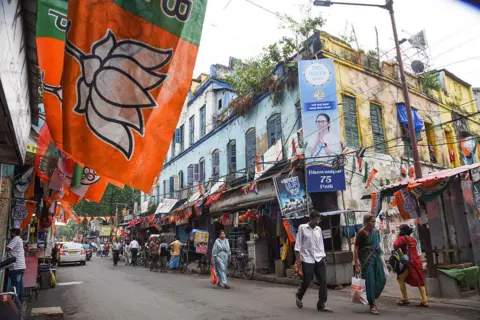
What makes the result particularly striking is that the BJP achieved this despite still lacking the kind of deep organisational machinery that regional parties historically required to win Bengal.
The Trinamool Congress retained a denser grassroots network and the charismatic dominance of Banerjee. Yet the BJP repeatedly sustained a commanding vote share despite allegations of rival political intimidation and the challenge of taking on one of India’s most entrenched regional parties.
“That suggests,” Verma says, “the party’s support now extends beyond the limits of its relatively thin organisational structure.”
So what shifted the election so sharply towards the BJP?
For years, Banerjee’s party forged a formidable social coalition: women, Muslims and large sections of the Hindu vote across both rural and urban Bengal.
Women, in particular, formed the backbone of the party’s welfare-driven politics. The Lokniti-CSDS post-poll survey in 2021 found the TMC’s support among women touching 50% – four percentage points higher than among men – reflecting the impact of years of female-focused welfare schemes and Banerjee’s efforts to expand women’s political representation.
This time, however, the BJP sought to directly challenge that advantage by promising larger cash transfers and expanded welfare benefits of its own.
“Banerjee’s long electoral success rested on a delicate equilibrium between welfare and organisation. But the very organisation that sustained her for 15 years also became her Achilles’ heel,” says political scientist Bhanu Joshi.
“That balance broke down as the party machinery weakened and welfare politics appeared to reach its limits – voters began to see benefits as routine rather than transformative.
“The BJP’s opening was to translate this anti-TMC fatigue into a sharper language of Hindu consolidation. So this is not simply a story of welfare failing; it is a story of welfare and organisation no longer being strong enough to contain polarisation,” says Joshi.
The election also once again highlighted the centrality of Muslim voters to Bengal’s political arithmetic, even if the precise contours of voting patterns remain unclear.
Muslims make up roughly 27% of the population, and nearly a third of the state’s seats have substantial Muslim populations.
In 2021, the TMC swept 84 of 88 Muslim-dominated seats, reflecting a broad consolidation behind Banerjee. While early indications suggest the party retained significant Muslim support this time too, the BJP has increasingly sought to offset that advantage through wider Hindu consolidation and competing welfare promises.
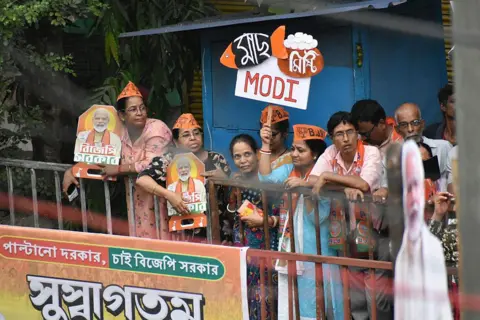
“The BJP combined an aggressive welfare pitch with sharper polarisation. It promised to double cash benefits, while visible communalisation consolidated sections of the Bengali Hindu vote behind the party,” says Maidul Islam, a political scientist at Kolkata’s Centre for Studies in Social Sciences.
BJP leaders, however, framed the result less as ideological consolidation than as a rejection of the Trinamool Congress itself.
The TMC created a “crisis of leadership for itself,” BJP leader Dharmendra Pradhan told one news network. He accused the party of “arrogance” and claimed that “voters, particularly women angered by atrocities and law-and-order failures, had decisively rejected the Trinamool Congress”.
The other elephant in the room was the fiercely contested revision of Bengal’s electoral rolls.
The Election Commission said the exercise, known as the special intensive revision, was intended to clean up voter lists by removing duplicate or ineligible names.
But with nearly three million voters still awaiting tribunal decisions before polling, Banerjee along with activists and civil society groups alleged that Bengal had effectively gone into the election after a “mass disenfranchisement exercise”. This, they said, had disproportionately affecting poor and minority voters, especially Muslims and migrant communities in border districts.
Analysts say the exercise is now likely to come under even sharper scrutiny in closely fought seats where victory margins are much narrower than the number of deleted voters. “The revision of polls will come into play [once the results are in],” politician and activist Yogendra Yadav told NDTV news network.
But the electoral-roll controversy alone cannot explain the scale of the BJP’s surge, many believe.
What also worked in the party’s favour was a tightly focused campaign centred on alleged corruption and governance failures within the Trinamool Congress, hammering scandals such as a trachers’ recruitment scam rather than relying primarily on personal attacks against Banerjee.
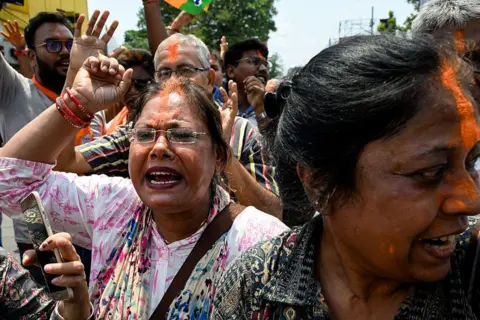
With the BJP firmly on course for victory, the implications will extend far beyond Bengal.
Unlike in neighbouring Bihar, where the party governs through alliances, or even Odisha, where its 2024 breakthrough came against a weakened regional incumbent, a victory in Bengal would represent a standalone conquest of one of India’s most politically formidable states.
“It would strengthen Modi enormously,” says Mukhopadhyay.
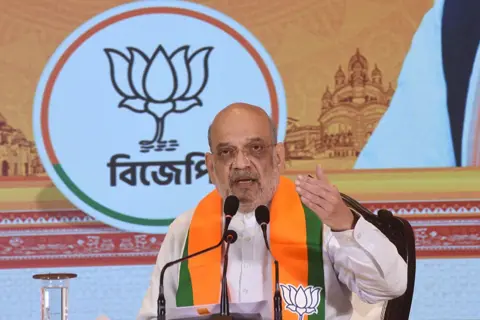
“More than Odisha, this would be seen as a personal political victory not only for Narendra Modi, but also for Home Minister Amit Shah, who effectively ran the campaign.”
Within the BJP, Shah would almost certainly emerge as the informal ‘man of the match’ – echoing the way Modi elevated him after the party’s landmark victory in Uttar Pradesh in 2014.
A Bengal breakthrough could also reshape the BJP’s succession politics, says Mukhopadhyay.
It would reinforce Shah’s standing as Modi’s most likely heir, potentially placing him ahead of rivals such as Yogi Adityanath, Nitin Gadkari and Rajnath Singh in the party’s next-generation power hierarchy.
That would make Bengal’s verdict consequential far beyond the state itself.
For decades, Bengal prided itself on resisting the political currents reshaping the rest of India.
Now that the BJP has finally breached one of India’s most enduring regional strongholds, it may mark not just the end of an era in Bengal, but the beginning of a new phase in the Modi project itself.
[BBC]
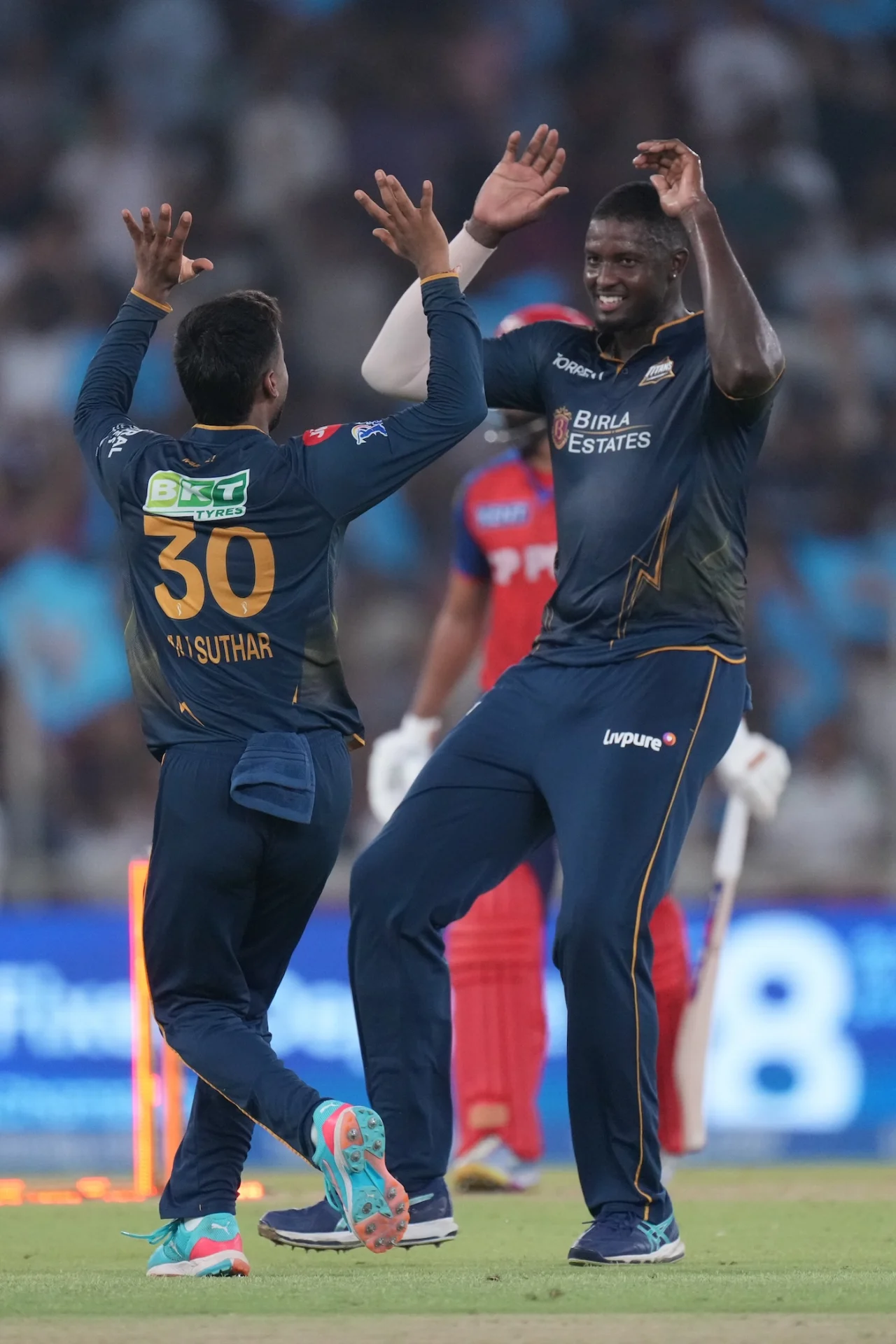
The top half of the IPL 2026 points table is an utter logjam.Punjab Kings (PBKS), unbeaten through their first seven games, have now lost two in a row. And the team that beat them on Sunday night, Gujarat Titans (GT) have won three in a row. All around the IPL, teams that had led secure lives in the top four have endured setbacks over the last few days.
And so the big squeeze. PBKS remain at No. 1, but they’re only one point above GT at No. 5.
GT, however, are the only team in the top five with a negative net run rate (NRR). This may have something to do with their style of play: they rely on their bowlers to ensure their batters don’t have to score at the frenetic rates of some other teams, but that means their margins of victory tend to be less emphatic.
On Sunday, their margin was wafer-thin – one ball remaining – despite the fact that they dominated virtually from start to finish. Their Test-match pace trio of Mohammed Siraj, Kagiso Rabada amd Jason Holder bowled hard lengths on a pitch that offered steep bounce and plentiful seam movement from those lengths, and reduced PBKS to 47 for 5. Suryansh Shedge and Marcus Stoinis ensured that PBKS recovered to post 163 for 9, but this was still very much a GT kind of target, perfect for their style of top-order play.
A measured half-century from B Sai Sudarsan laid the perfect platform, but GT’s scoring rate remained somewhere in the region of their original required rate right through their chase. And suddenly, they ended up needing 11 off the final over. Washington Sundar sealed victory with a penultimate-ball six, but on another day, this could have so easily been the story of GT sleepwalking to defeat.
But the major story was this: for the third match in a row, GT pulled off the trademark GT victory. Straightjacketing their oppositions with the ball, and chasing down sub-170 targets with significant contributions from one or two of their top three.
This was a black-soil pitch with a healthy covering of grass, and it was evident from ball one that it would reward bowlers who hammered away on hard lengths. Ball one from Siraj almost produced a chance, with extra bounce leading to a miscued pull from Priyansh Arya that fell just out of reach of Jos Buttler, who had chased from his spot behind the stumps to the edge of the 30-yard circle at backward square leg. Ball two produced the first wicket: a bit of width for Arya to free his arms, but extra bounce once more to take away his control and bring about a slice to deep third.
Siraj struck again with his next ball, going slightly fuller, getting a bit of swing into the left-handed Cooper Connolly to produce an inside-edge to the wicketkeeper.
Rabada matched Siraj’s excellence from the other end, as the two bowled three overs each in the powerplay, beating the bat multiple times as Prabhsimran Singh and Shreyas Iyer struggled to match their usual rates of scoring. Then, Rabada bowled an outstanding sixth over, which included the wicket of Prabhsimran with a 152kph length ball that cramped him for room on the on-the-up punch, and four straight dots to Nehal Wadhera, including one that zipped past the edge and a bouncer that zipped past the helmet. A wicket maiden completed PBKS’ least productive powerplay since the start of IPL 2025: 35 for 3.
There’s no better resource on a trampoline pitch than a towering fast bowler. Holder is four inches taller than the 6’3″ Rabada, and he immediately got in the act in the seventh over, finding Wadhera’s edge with a hard-length ball slanted across him. And when he nipped a back-of-a-length ball back into Shreyas and bowled him off the inside edge in the ninth over, PBKS were five down and in all kinds of strife.
In GT’s previous game against Royal Challengers Bengaluru (RCB), the left-arm spinner Manav Suthar didn’t bowl a ball. Given the help the quicks were getting on Sunday, GT may have felt inclined to repeat this, but a wayward 13th over from the left-arm seamer Arshad Khan, which went for 16, may have prompted them to bring on Suthar for the 14th.
And Suthar bowled one of the more forgettable overs of the season. Bowlers often get taken to the cleaners in the IPL even when they bowl reasonably good balls, but this was just an old-fashioned bad over: after starting with a single, he sent down two slot balls, a wide full-toss, a wide long-hop, and another full-toss. Shedge took ruthless toll, going 6, 6, 4, 4, 6. Twenty-seven off that over, and PBKS were suddenly looking at a decent total.
That over was the centrepiece of a 79-run partnership between Shedge and Stoinis. Shedge, who was at one stage batting on 13 off 14 balls, rushed to a 24-ball half-century. He then flicked Rabada for a nonchalant six in the 16th over before falling to Rabada’s extra bounce, caught behind for 57 off 29.
Stoinis held the key to a big finish for PBKS, but Holder forced a miscue out of him with an into-the-pitch cutter from around the wicket in the 18th over. When he followed up with an inducker to bowl Xavier Bartlett comprehensively, PBKS were eight down with 13 balls remaining.
Marco Jansen hit Rashid Khan for a six and four in the final over to haul PBKS past 160, but it wasn’t quite the magnitude of finish they may have hoped for. Only 45 came off their last five overs.
This was an innings of many delectable shots: the high-elbow drive through the covers off Bartlett in the first over, the hooked six over fine leg off Jansen in the sixth, and expert riding of the bounce to cut and carve the ball behind point. But there wasn’t a whole lot of intent to force the pace off balls that weren’t in his hitting zones.
And all of GT’s batters played pretty much this way, with the caveat that this was still an awkward pitch to bat on. Jos Buttler picked off a trademark scooped six over short fine leg, but his 26 consumed 22 balls. Nishant Sindhu, making his IPL debut, fell for 15 off 11. Washington scored 16 off his first 14 balls.
And so, it came to a situation where, after Sai Sudharsan and Impact Player Rahul Tewatia fell in the 15th and 17th overs, GT suddenly came under a bit of pressure.
But with 11 to get off the final over, they found a way to push through. Arshad flicked an almost-perfect Stoinis yorker for four, and then, with three to get off two balls, Washington coolly stepped across his stumps and scooped a full-toss over the fine leg boundary to take GT over the line.
Brief scores:
Gujarat Titans 167 for 6 in 19.5 overs (Sai Sudharsan 57, Jos Buttler 26, Nishant Sindhu 15, Washington Sundar 40*; Arshdeep Singh 2-24, Marco Jansen 1-33, Vyjayakumar Vyshak 2-31, Marcus Stoinis 1-26) beat Punjab Kings 163 for 9 in 20 overs (Prabhsimran Singh 15, Shreyas Iyer 19, Suryansh Shedge 57, Marcus Stoinis 40, Marco Jansen 20; Mohammed Siraj 2-28, Kagiso Rabada 2-22, Jason Holder 4-24, Rashid Khan 1-32) by four wickets
[Cricinfo]

Maldivian President plants a sapling to mark 60 years of Sri Lanka–Maldives Diplomatic Relations

Sri Lanka and Maldives strengthen ties with productive bilateral talks

Maldives and Sri Lanka exchange seven MOUs

Warm Welcome Accorded to the President of the Maldives at the Presidential Secretariat

Modi’s BJP conquers Bengal, one of India’s toughest political frontiers

PM participated in ’Swarnabhivandana 2026,’ Sacred Relic Veneration Ceremony

‘Dates have the highest sugar content to fight Coronavirus’

Sunday Island 27 December – Headlines

#SundayIsland 17th December – Headlines

Sunday Island – 28th March

Sunday Island Headlines – 21 March

Sunday Island – 21st February – Headlines
-

 News6 days ago
Treasury chief’s citizenship details sought from Australia
-

 News5 days ago
Rooftop Solar at Crossroads as Sri Lanka Shifts to Distributed Energy Future
-
 News4 days ago
“Three-in-one blood pressure pill can significantly reduce risk of recurrent strokes”
-
 News7 days ago
Govt. assures UN of readiness to introduce ‘vetting process’ for troops on overseas missions
-

 Business7 days ago
ADB-backed grid upgrade tender signals next phase of Sri Lanka’s energy transition
-

 News6 days ago
Central Province one before last in AL results
-

 Sports6 days ago
Well done AKD!
-

 Business7 days ago
Update on independent forensic review